The Biggest Failure of Modern Poker Theory


Overview
What follows is a controversial claim about modern poker theory and GTO, but I believe it is true:
People talk about solver outputs as if GTO / Nash equilibrium were a singular strategy, a perfect recipe for how every hand should mix in every spot. As if somewhere inside the machine there exists one sacred answer: bet this combo 43%, check it 57%.
But equilibrium doesn’t care about that.
A solver is not trying to discover the “one true way” to play a hand. It is trying to minimize exploitability. And once you understand that, a deeper reality comes into view: the space of nearly unexploitable strategies is enormous.
Give three different solvers identical parameters, and they will produce three completely different (equally good) strategies. As it turns out, even superhuman exploitability (0.3% Nash distance) is enough wiggle room to produce vastly different outputs.
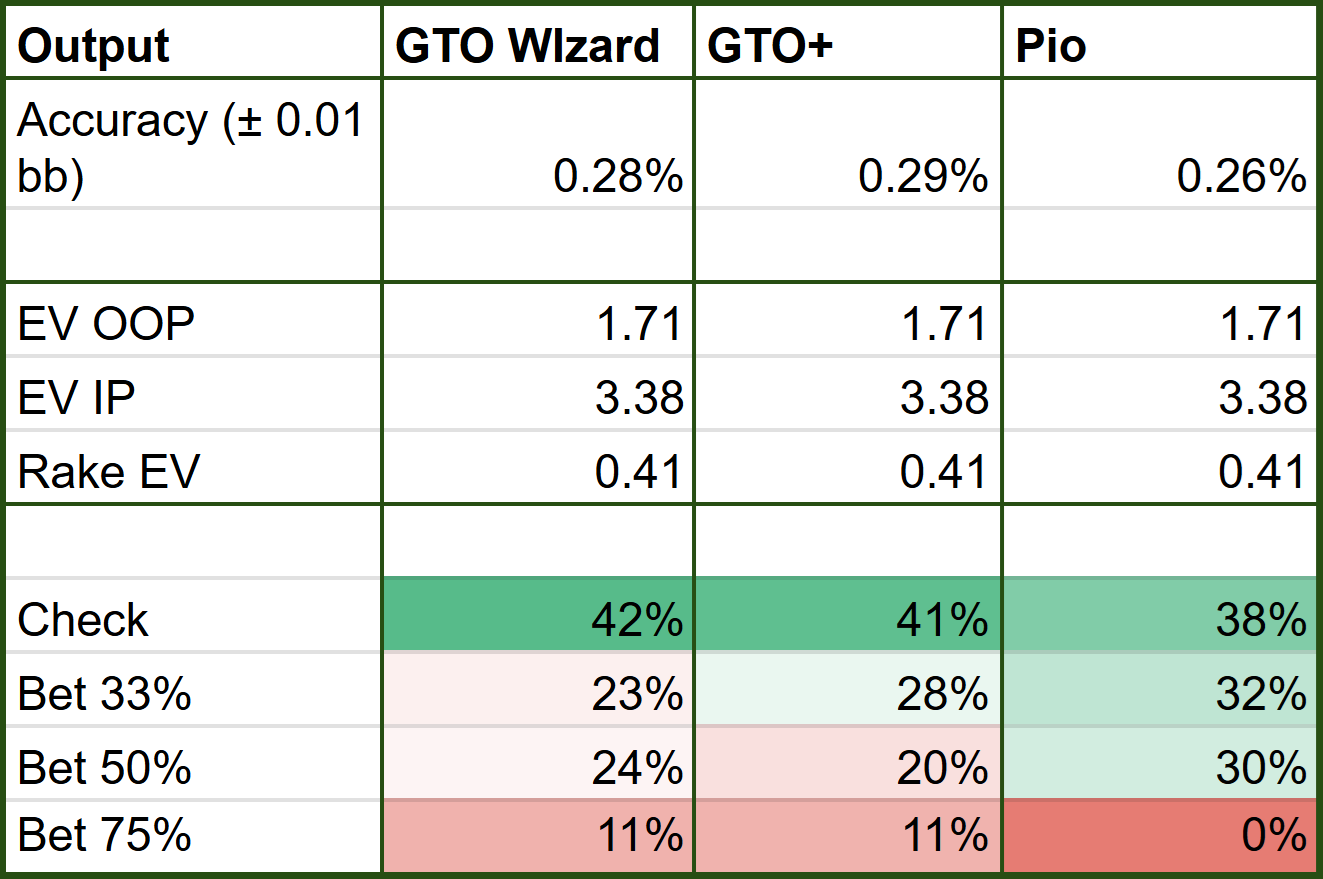
At this point, pedants might argue that I just did not solve accurately enough. Perhaps if I pushed the tolerance lower. Maybe 0.1%. Maybe 0.01%. Maybe then the outputs would start to look the same…But that just proves my point. If absurd precision is required before combo frequencies start to agree, then combo frequencies probably are not the deepest thing that matters. Who cares about capturing the last 0.1% if we haven’t learnt what drives the first 99.9%?
And this underlines the core issue of modern poker theory: We put absurd amounts of focus into the microscopic factors that matter the least, while neglecting that macroscopic factors that matter the most.
The Macros
At this point, the obvious question is: if exact combo frequencies are not the core of strategic quality, then what is?
The answer is that exploitability is not really a property of one hand in one node. It is an emergent property of the entire strategy across full betting lines. I call these deeper properties the macro factors.
Things like:
- Expected chip contribution to each line (betting volume)
- How equity is distributed across those lines
- How much gets invested now and surrendered later, (relative to betting pressure)
- Bluff-to-value ratios, (relative to sizing and leverage)
This list is not exhaustive, but these are major drivers of exploitability. If any one of them is out of line, the strategy becomes exploitable in broad, obvious ways. Generally, macro imbalances bias large swaths of the game tree.
If your opponent puts more money into the pot when you bet than when you check, then all of your strong hands prefer betting. You don’t need to be a solver sicko to figure out that strong hands want bigger pots. But consider what that means: This implies whenever a solver mixes checks/bets with strong hands, the opposing player must be balancing their betting volume across all lines.
For example, take this CO vs BB spot where CO has flopped a Royal Flush. Now let’s say that CO randomizes between all actions that KhQh would take in this node, and on future nodes. Since all mixed actions are indifferent, they make the same EV. And since our Royal is unbeatable, our EV is perfectly correlated with how much money Villain puts into the pot overall.
That implies BB contributes precisely the same amount to the pot on average, regardless of whether CO bets or checks the flop!
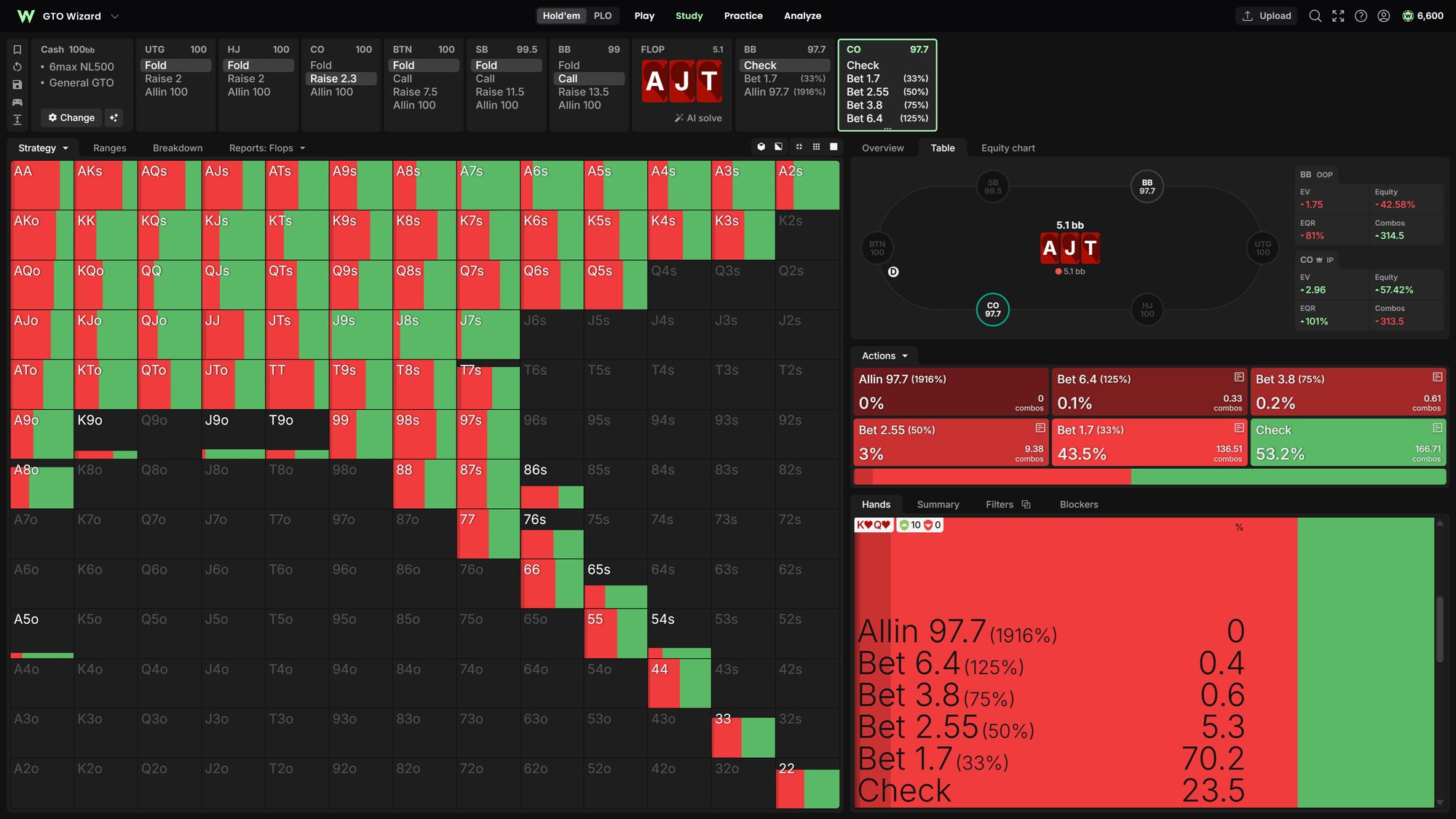
BB’s expected contribution to the pot accounts for every possible turn and river card, every check-raise, every barrel, every fold, every call, every shove. All of that complexity collapses into this one macroscopic constraint of ‘balanced betting volume’. If BB were even slightly imbalanced in this regard, the solver would immediately capitalize by funneling all of CO’s strongest hands into one line that maximizes EV. The fact that strong hands are mixing at all is a testament to BB’s incredible balancing act.
This is the true essence of GTO: structural constraints that apply across the entire game tree, not just surface-level mixing frequencies.
If you’ve ever manually solved a spot, you’ve experienced this curve: Exploitability falls rapidly, then the solver spends hours grinding out the final few fractions of a percent. My belief is that the violent early drop is mostly the big macro leaks being patched first. The solver quickly patches these macro leaks because they are huge, obvious, and resolve quickly, even with very clumsy back and forth exploits.
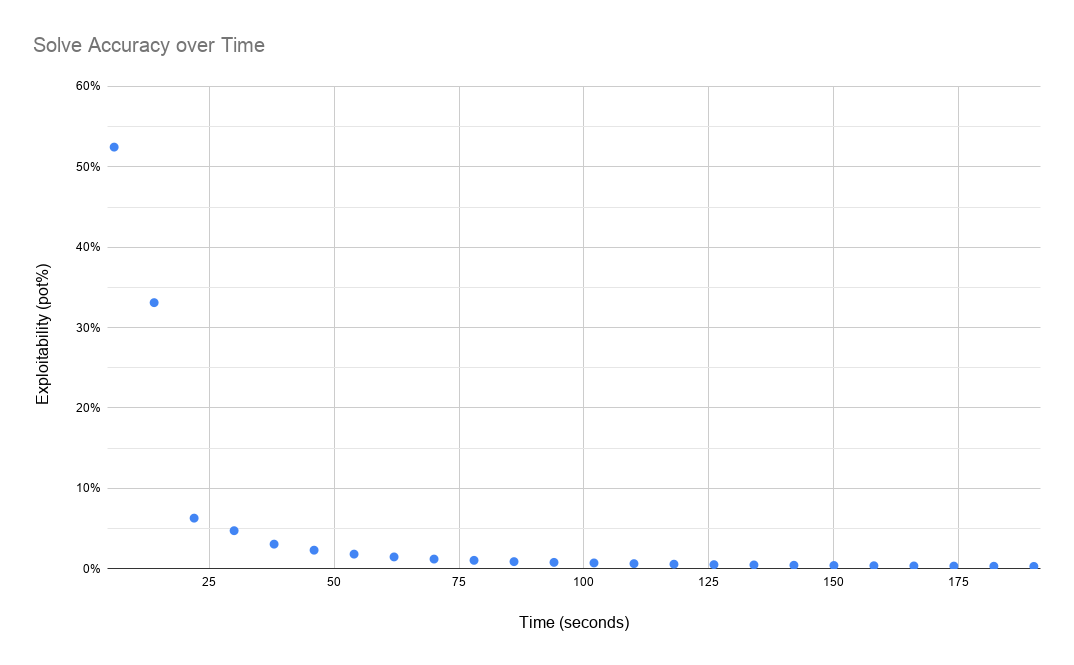
The thing is, there are many different mixtures that can satisfy the same macro constraints. The (near) GTO solution is fundamentally undetermined. Once the big macro exploits are patched, there are still many viable ways to mix hands while obeying those larger constraints. That is where the micro factors come in.
The Micros
The micros are the subtle effects: card removal, backdoors, board coverage, suit effects, and the distribution of hand classes across future runouts. These factors often determine the last few percent. They refine the mixture after the macro structure is already sound.
The problem is that micro factors tend to have an outsized effect on solver outputs precisely because they are what force the final convergence. They act as tie-breakers within a strategy that is already mostly balanced.
A solver may choose one combo over another because it has slightly better blocker properties, or because it helps represent nutted hands on vulnerable runouts. Maybe your bluffs tend to contain too much 6x and create a blocker imbalance. Perhaps too many combos of one hand class land in the same future branches, so the solver wants to spread them out more. These are legitimate strategic factors, but they are downstream of the more important macro constraints.
More importantly: Just because something acts as the tie-breaker does not mean it is the main thing holding the strategy together.
And here lies the problem.
Modern poker theory is obsessed with the tie-breakers. Modern poker theory spends too much energy optimizing microscopic factors that shape the final few percent of exploitability, while neglecting the macro constraints that do most of the real strategic work.
The deeper issue is methodological. Poker coaches try to explain chaotic solver outputs one node at a time, without ever stepping back to examine the line-level structures that govern them. And if your entire routine is explaining why one combo checks while another nearly combo bets, then of course you end up fixating on minutiae. Of course you miss the forest for the trees. But modern poker tools are built to study one node at a time, so nobody studies the game at the macro level.
Beyond GTO
This is not just about playing balanced poker. GTO aims to minimize your own exploitability, while exploitative poker aims to capitalize on the exploitability of others. But in both cases, the real question is the same: what actually makes a strategy exploitable?
If you’re trying to punish population leaks, exploit inelastic opponents, or learn from MDA, the real drivers of EV are line-level macro factors, not node-level micro factors.
Mass data analysis is almost entirely node-level. Does the population c-bet too much here? Overfold there? Under-bluff this river? That can be useful, but EV does not exist in isolation. By definition, it includes all future streets.
For example, imagine the population overfolds to a certain river betting line. Does that mean you should automatically funnel more bluffs toward that node? Not necessarily. If they over-defend earlier streets, then the overall bluffing line may still be -EV. Once again, what matters is not how they play one node, but the economics of the full line.
That is the gap in modern poker theory. We have become very good at analyzing local decisions, and very bad at measuring the larger line-level structural forces that govern them.
One day, the tools may catch up. Until then, the game remains far more exploitable than most people realize.