Attacking Limpers From the Blinds


Overview
Limping is common in low-stakes no-limit hold ‘em, especially live cash games. However, because it is not generally a feature of equilibrium solver solutions, insight into how to exploit limpers has not proliferated throughout the poker world as well as other theoretical concepts have.
For example, suppose you suspect an opponent folds too often, so you bluff the flop with a hand you ordinarily would not. But this time, your opponent doesn’t fold; they call instead. Should you keep bluffing the turn or give up?
Through trial and error, experienced players have converged on an effective strategy for exploiting limpers when they (the experienced players) are in position: they simply raise a bit larger than they would if they were open raising, with a somewhat tighter range. The limpers can generally be relied upon to call the raise with a weak, capped range and then to check-fold the flop too often and just generally play poorly on later streets.
These players get into trouble when they attempt to apply this same strategy from the blinds. Simply by dint of their position, the limpers’ loose calls will be much closer to correct, and they will make fewer mistakes postflop. This article will use the new multiway preflop solver to investigate the game theory behind raising limpers from the blinds and derive some more useful heuristics.
Our examples all come from a three-handed game with 100bb stacks, a 10% rake with a 1bb cap, and a no flop, no drop structure where players do not pay rake if the action ends before the flop. This means the limper in the experiment will always be on the BTN, but the principles derived from this example will apply to other cases as well (limpers in other positions, multiple limpers, etc).
Where Are You Now?
Before we start asking questions of the solver, ask some questions of yourself. How do you currently respond to limpers when you are in the blinds? How do you decide which hands to raise? How do you decide how large to raise? When is your raising range more or less polarized? How does your strategy differ depending on whether you are BB or SB? How does it differ depending on what you know about the player(s) who limped?
Committing to firm answers to these questions now, even if you are not sure they are correct, will improve your retention of the information to come. So, take a moment to write out your answers, in as much detail as you can.
The Baseline
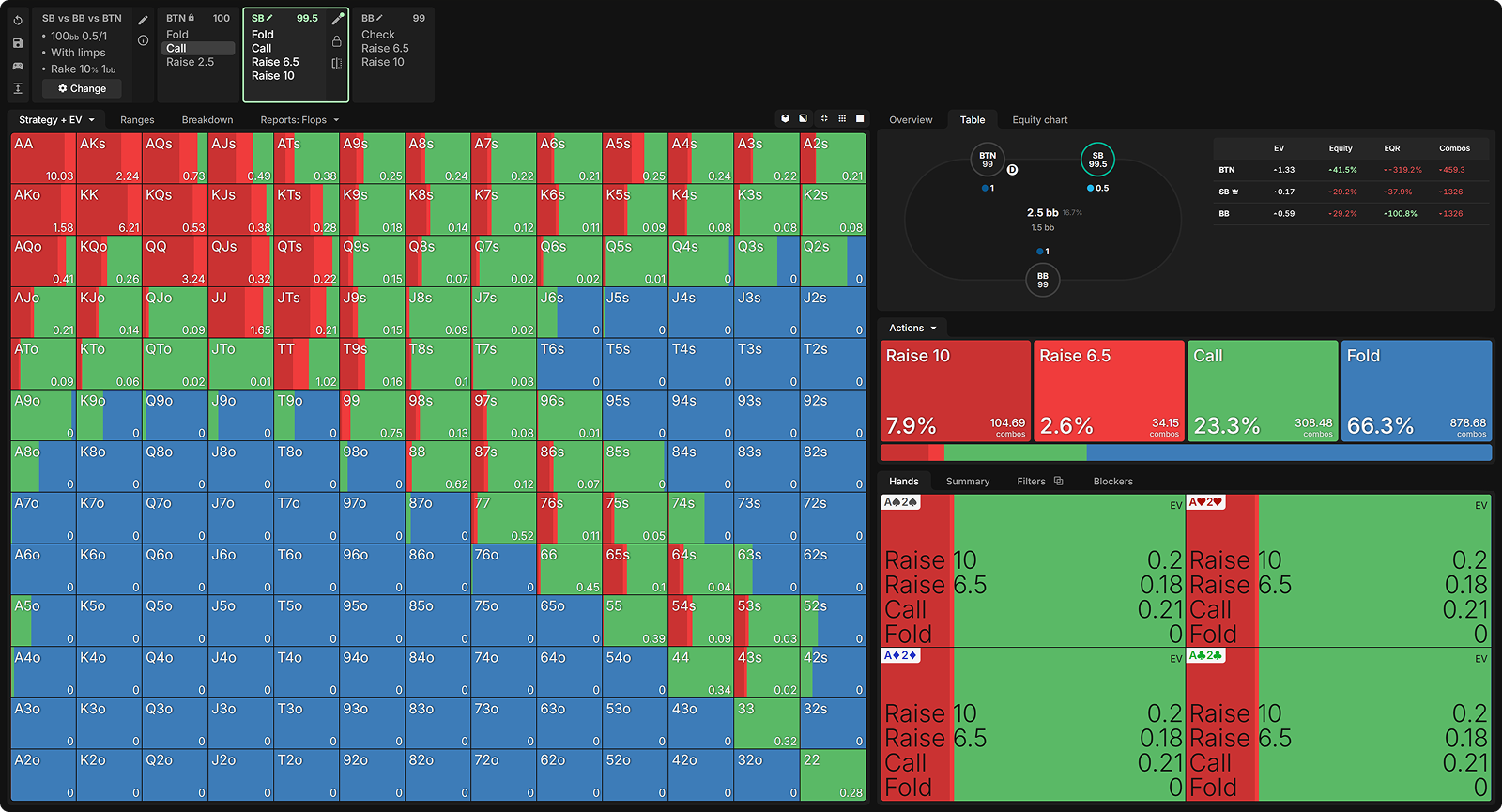
We’ll begin by establishing a baseline with an unlocked sim where BTN is allowed to limp. Facing a BTN limp, the blinds may raise to either 6.5bb (the solver’s default) or 10bb.
As you might expect, the solver never open limps the BTN. However, it can still be illuminating to look at how the solver would respond to a BTN limp from an unknown opponent. After all, if its strategy for raising a limp were exploitable, then BTN would have incentive to limp.
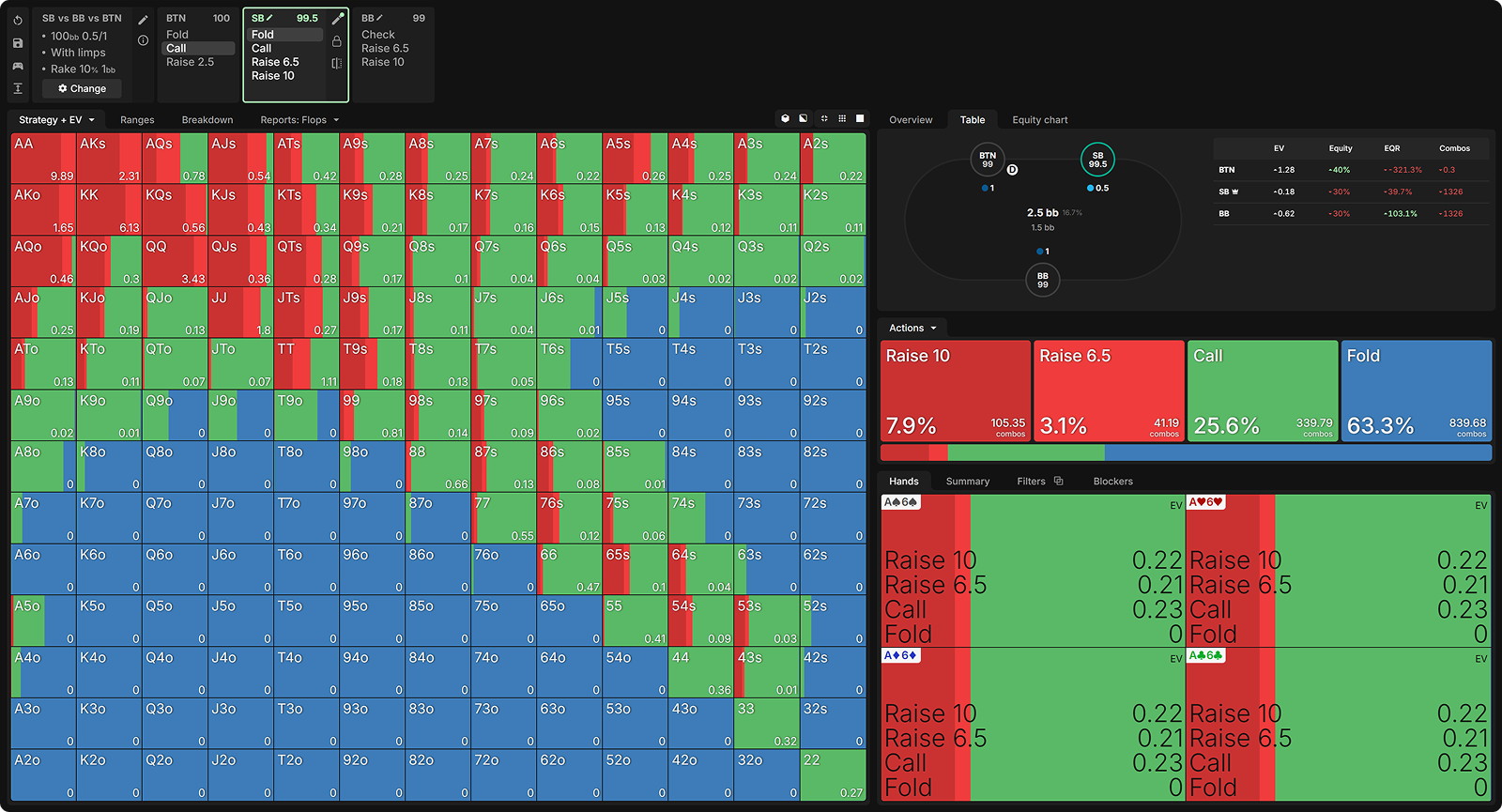
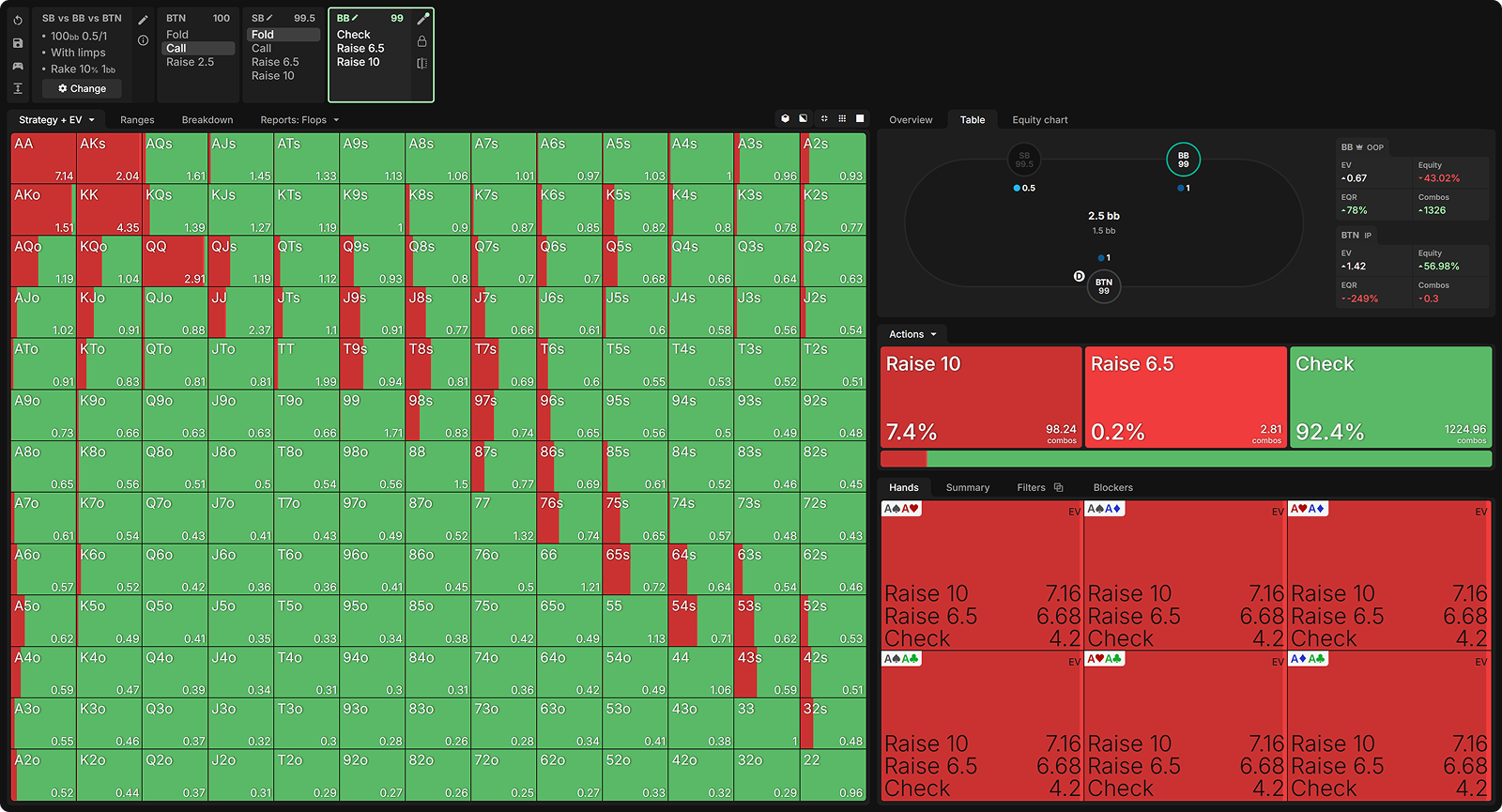
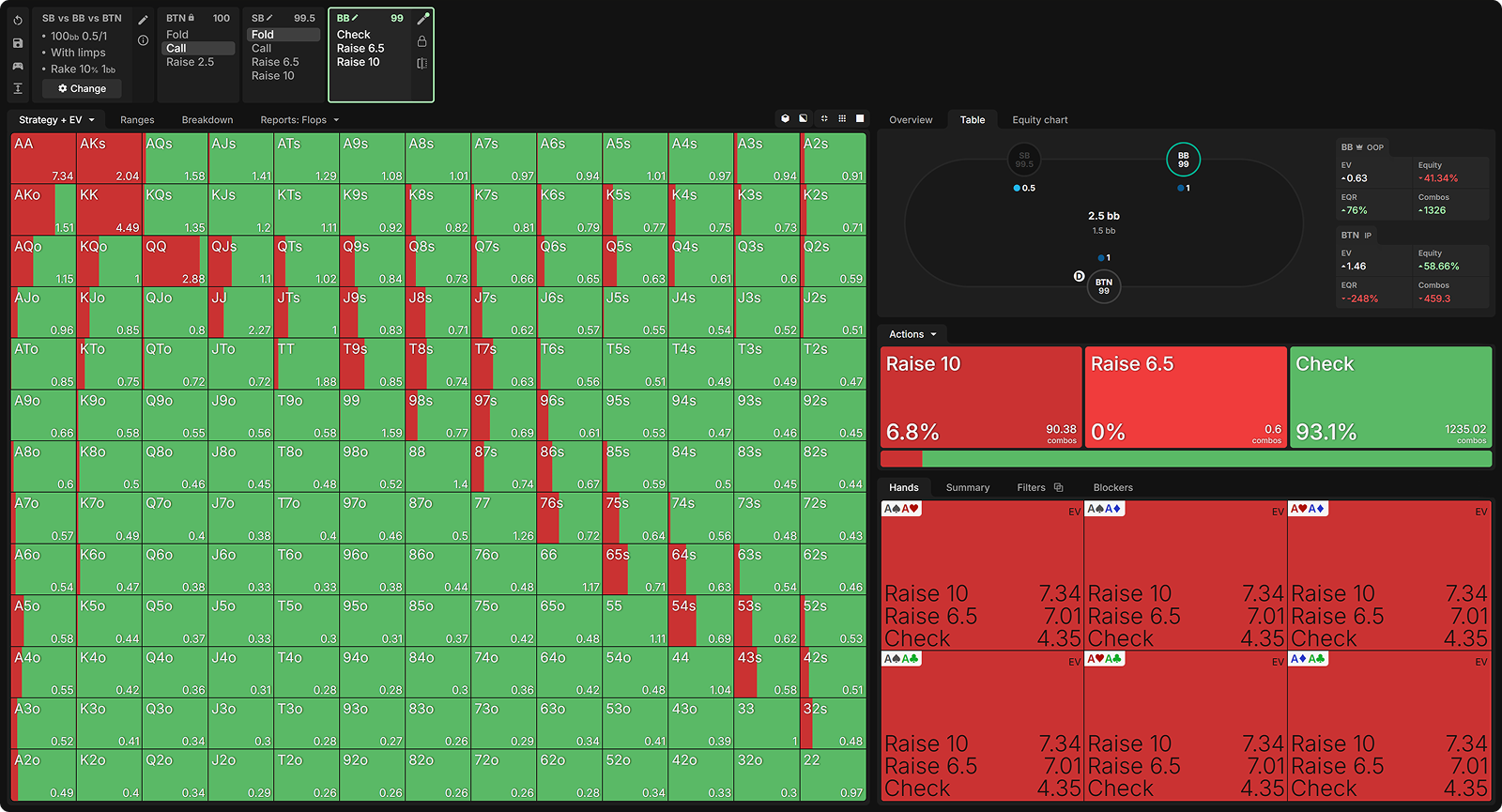
Interestingly, SB employs a healthy mix of smaller and larger raises, while BB strictly uses the larger raise size. SB also has a higher raising frequency than BB, and a somewhat different “shape” to their raising range. What do you think explains these differences?
Everything in game theory is driven by incentives.
When SB acts, BB is still holding cards. This incentivizes them to raise some hands that want to push BB out, even if they aren’t thrilled to raise into BTN’s limp. These are hands like suited Aces and medium pocket pairs that BB prefers to check if SB folds.
It’s also interesting to see which hands BB does and does not raise. Jacks and Tens mostly check, suited Aces rarely raise, and hands as strong as AQo and Queens mix checks. Meanwhile, BB finds raises with even their weakest suited connectors and gappers.
Several factors explain these choices:
- The appeal of checking. When constructing their raising range, BB doesn’t just ask which hands are the highest-EV raises. Rather, they consider which hands gain EV from raising. This requires considering not only how well the hand plays as a raise but also how well it plays as a check. The incentive for raising 52s is not so much that it is a great raising hand as that it is a poor checking hand.
- Board coverage. Even a 10bb raise will result in an SPR greater than 4 when BTN calls. This means BB must prepare for significant postflop play from out-of-position, which requires a diverse and unpredictable range capable of value betting and bluffing any board.
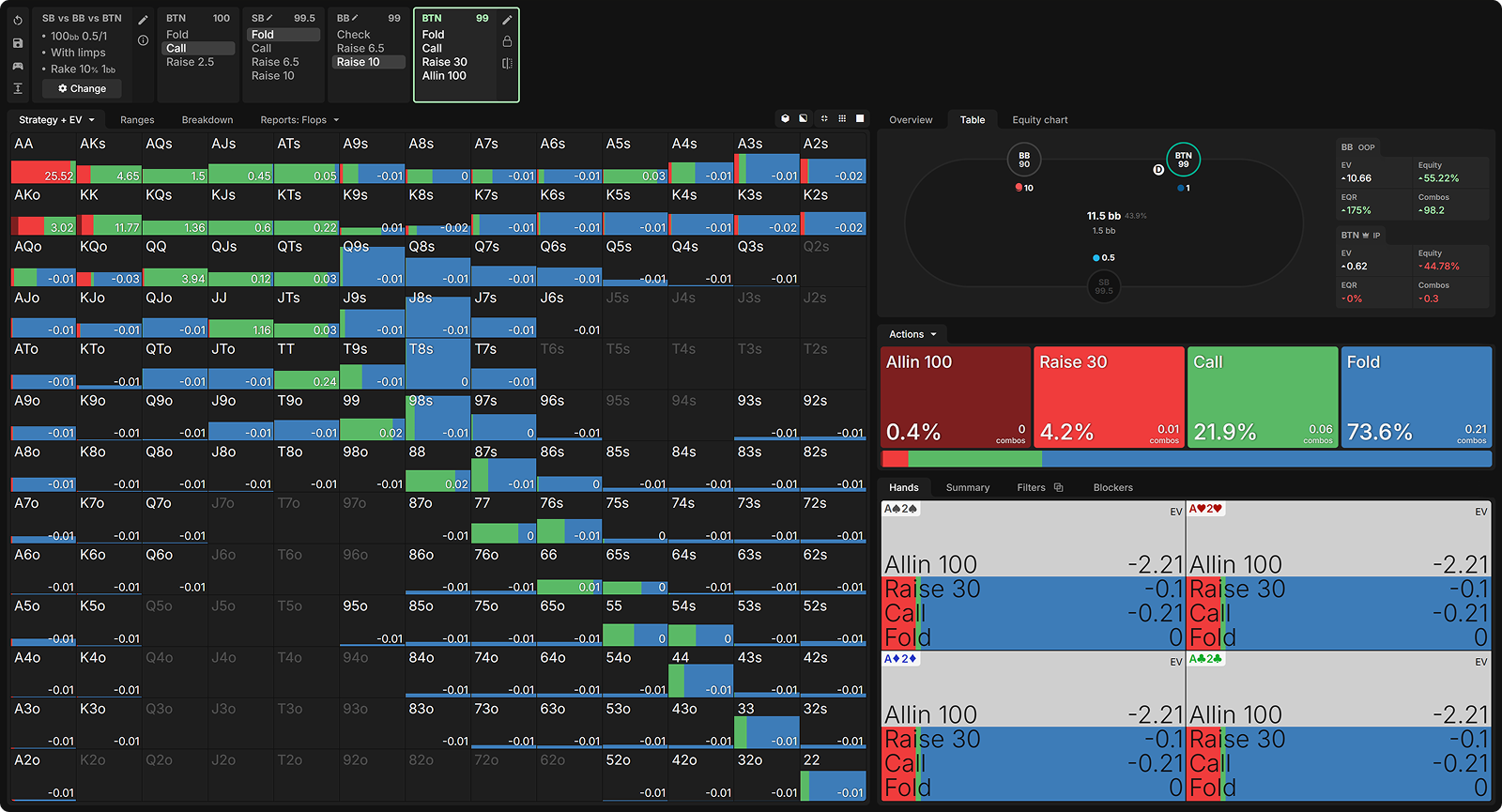
- Domination. Part of the appeal of raising 52s and similarly weak hands is getting hands that could make dominating pairs and draws to fold. Raising a suited Ace, on the other hand, would often cause BTN to fold hands that might flop dominated pairs and draws. As discussed above, the solver doesn’t really advise BTN to limp in the first place, but if they were to do so, here’s how it would have them respond to a 10bb raise from BB:
This made me wonder whether BB would use an even larger raise size if allowed. Would they ever want to raise to 15bb? 20? All in?
Not really. Looks like 10bb is more or less the sweet spot:

What if BTN Isn’t Allowed to Raise?
For our next experiment, I took away BTN’s option to raise. I didn’t stipulate anything about which hands they limped or how they would respond to a raise, just that they couldn’t open raise themselves. This is extreme (even passive players who love to trap with big hands raise sometimes), but investigating extremes can be useful for identifying how and why incentives and strategies change.
Here’s BTN’s limping range when raising is not allowed:
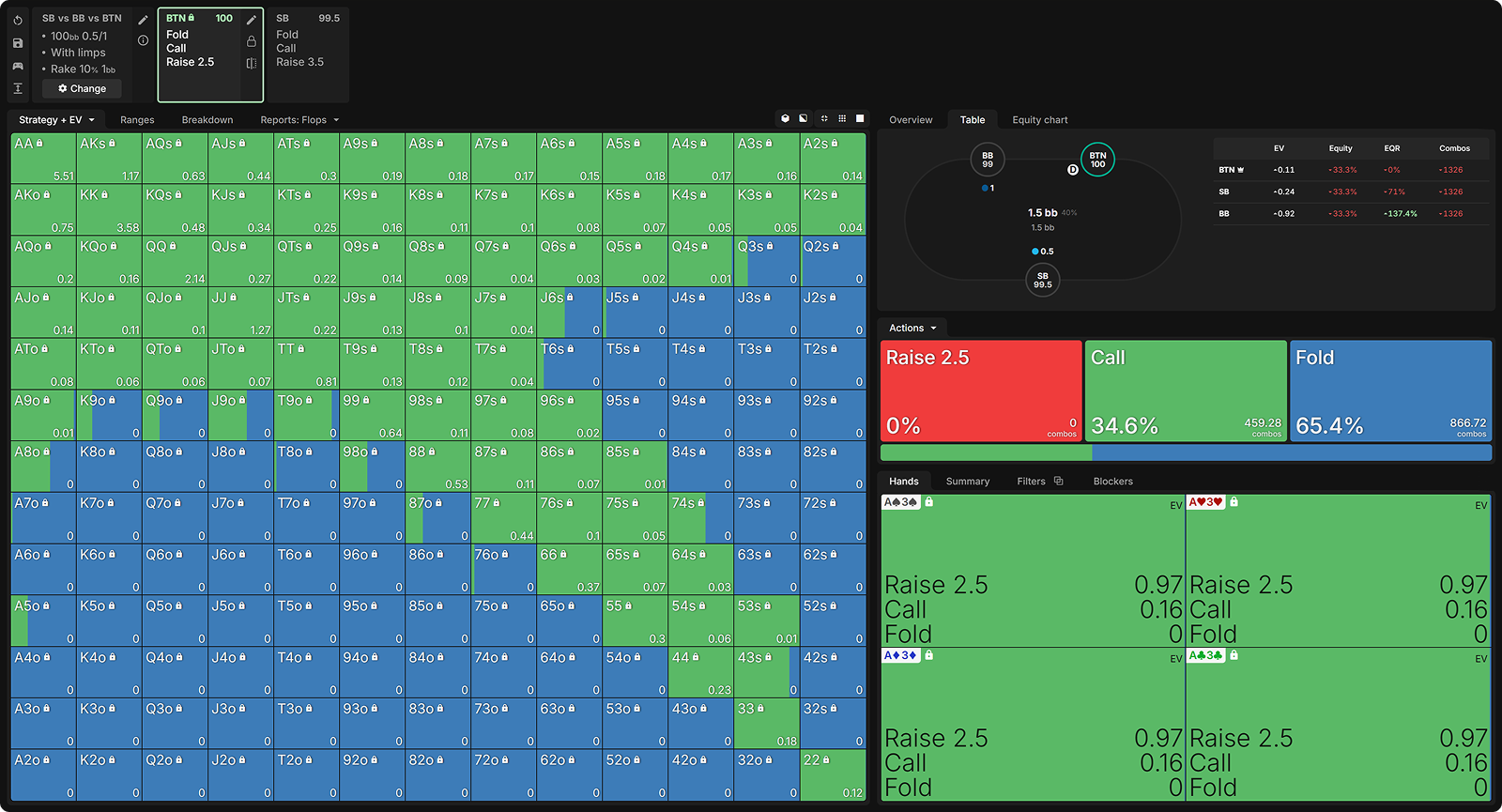
Naturally, this limping range contains all of BTN’s best hands, making a 3-bet a real threat. Consequently, SB shifts to a more polarized raising strategy and mostly prefers the larger raise size:
BB’s strategy is comparable to the GTO baseline, which was already polarized, but a bit tighter. Now not even AKo is a pure raise!
What If BTN is Capped?
Let’s reduce the risk of a 3-bet and see what happens. I kept BTN’s range the same but forced them to raise just their best hands: TT+, AQo+, AJs+, and KQs. This doesn’t stop them from limp-raising altogether, but it greatly reduces the likelihood. After all, with all the best hands in their raising range, not many of their limps are strong enough to play for stacks against the blinds’ raising ranges.
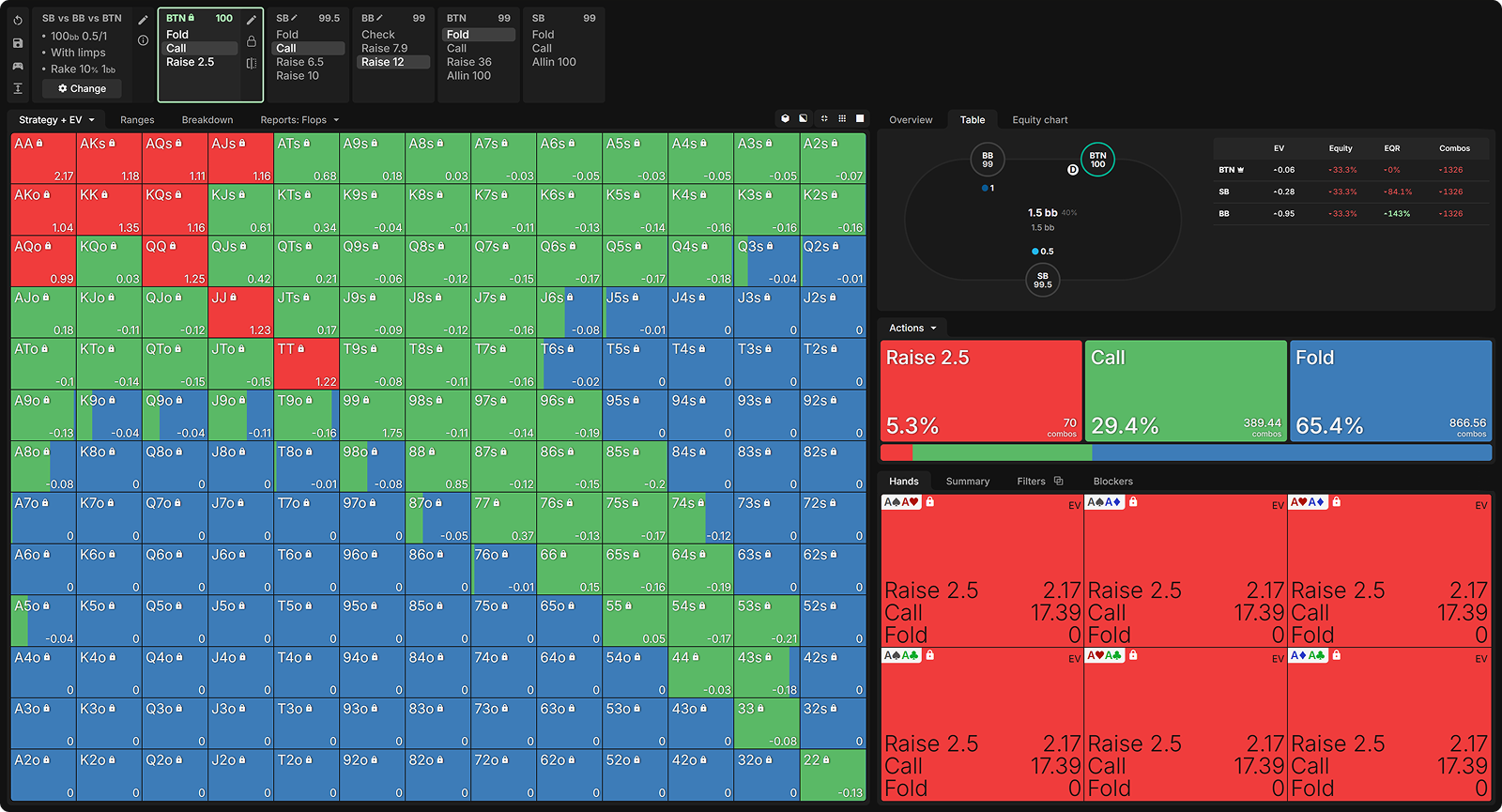
SB still prefers the larger raise size, but their range isn’t polarized anymore. Facing a weak and capped limp, they basically just raise big for value, retaining a few strong hands in the limping range to jam over a BB raise:
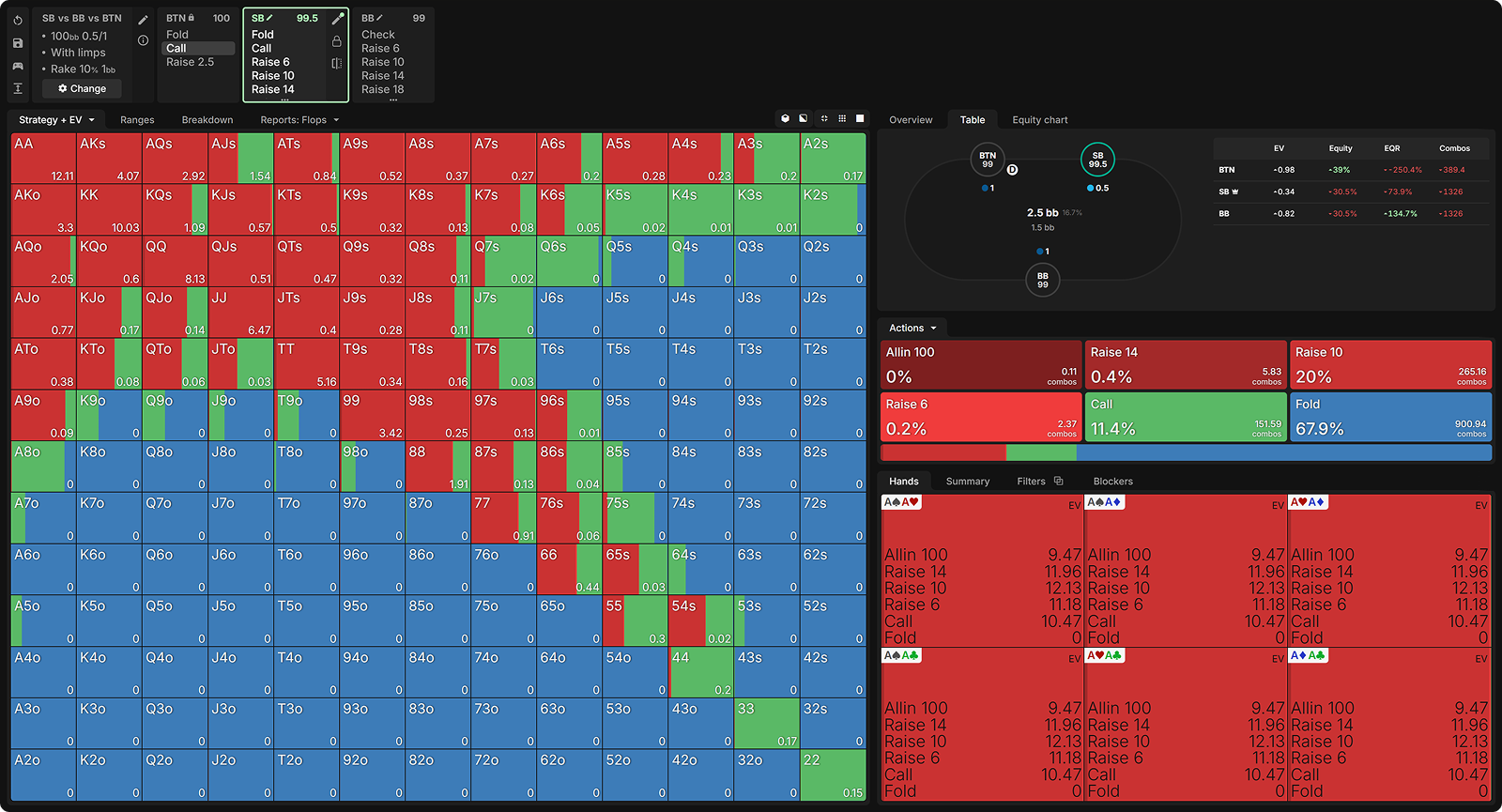
If SB folds, BB’s 10bb raising range is comparable but wider:
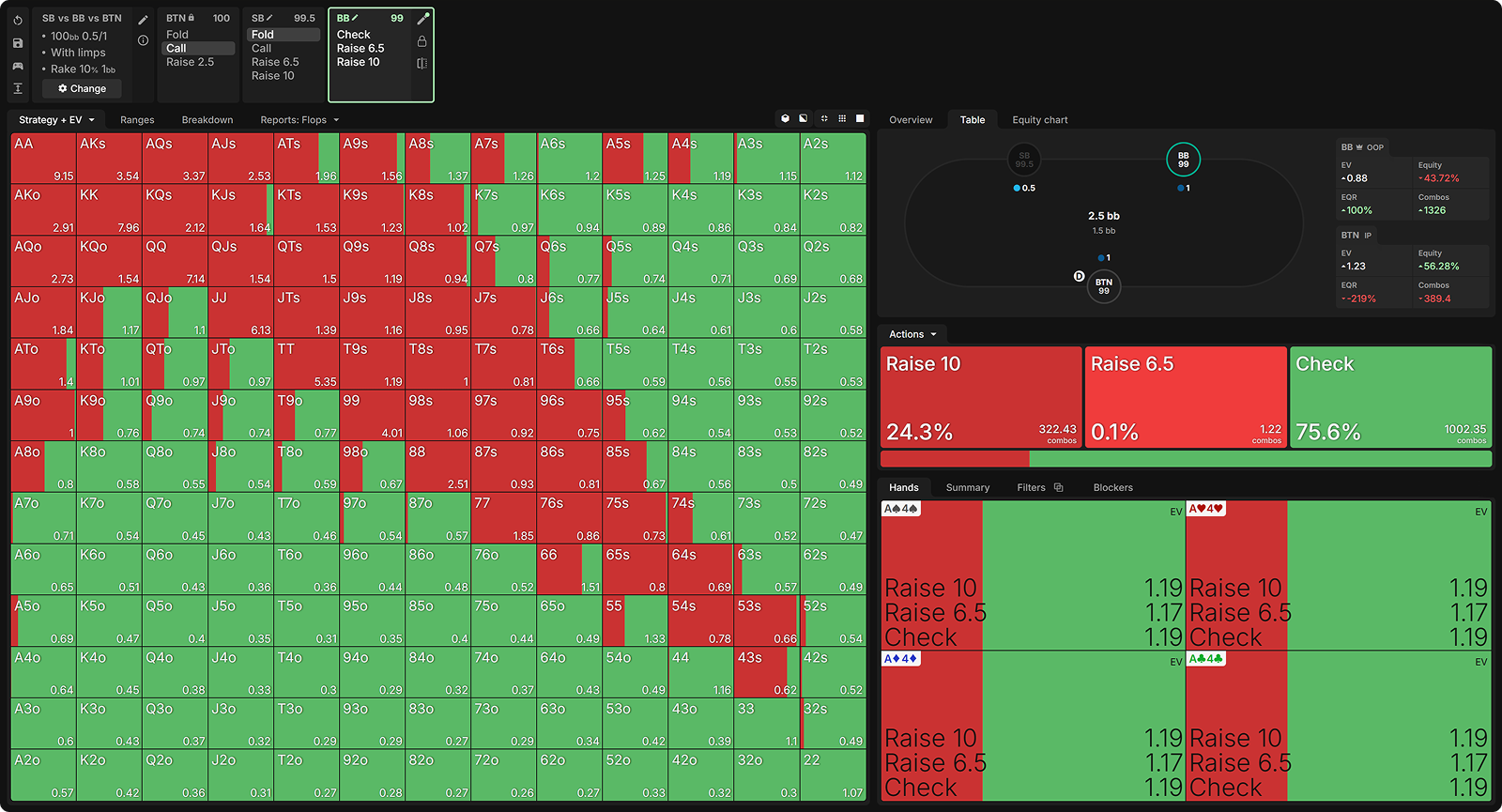
Facing the weaker limper range, BB shows more interest in even larger raise sizes. 14bb is a frequently used option, and even jamming is on the table:
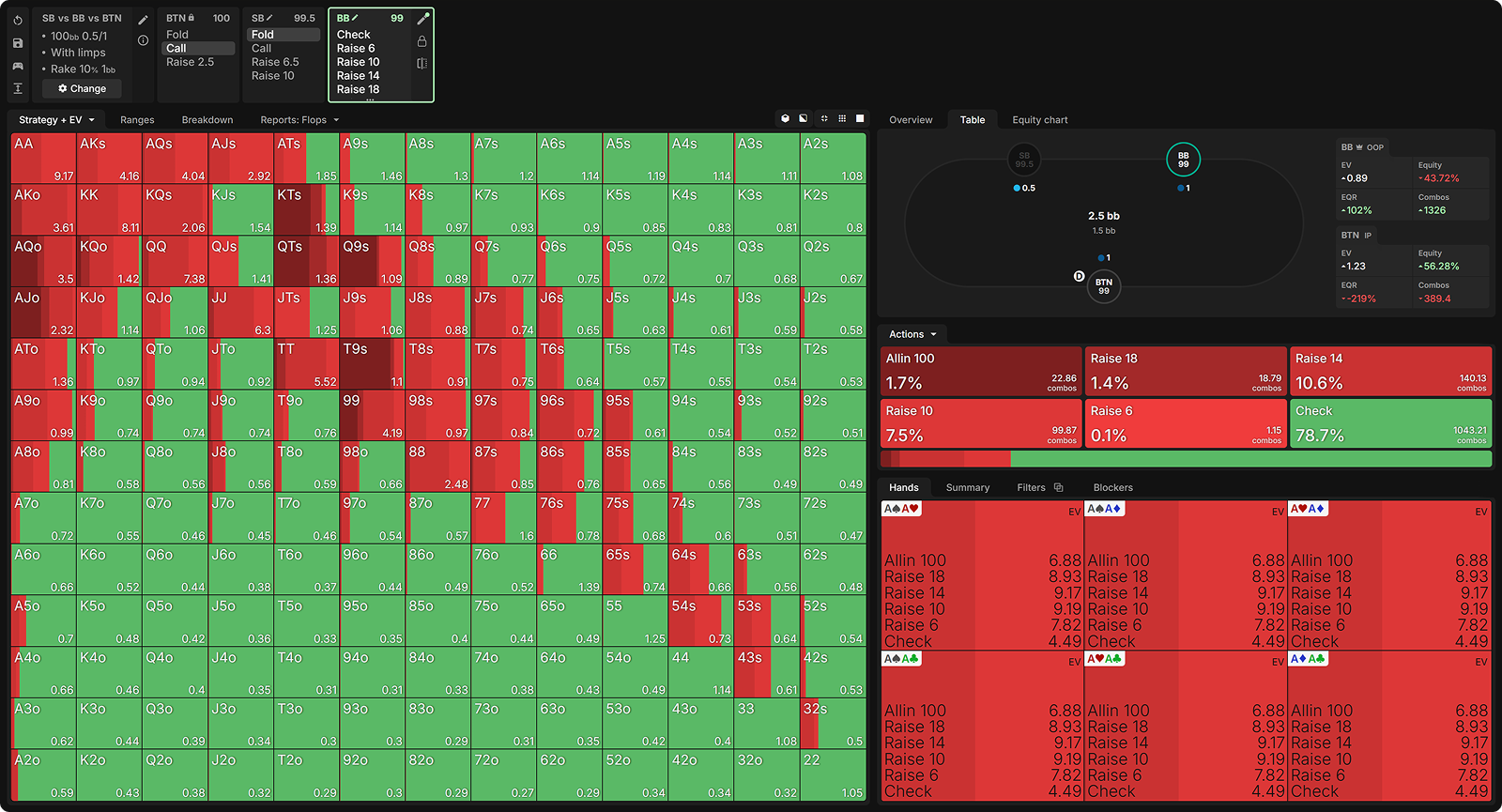
To be clear, this is the solver seriously contemplating a 100bb shove into a 2.5bb pot!
Preflop equities run close enough, and playing out of position is tough enough that very few hands are strong enough to want action. A big raise forces your opponent either to fold, giving you a risk-free 2.5bb, or put a lot of money in from behind. Even AQo doesn’t mind just taking it down pre as a “worst case scenario”.
It’s worth noting that SB, with an uncapped BB remaining to act behind them, does not make use of these larger raise sizes.
Conclusion
We’ll start with an easy heuristic you can implement immediately: when raising limpers out of the blinds, raise larger. This isn’t even an exploit. The baseline GTO strategy for BB is to raise (at least) 10bb vs a BTN limp. A formula like “4bb plus 1bb per limper”, derived from playing in position vs limpers, is not going to get you to the optimal raise size.
If you believe the limper(s) would have raised their best hands, then you can raise larger still. Against these weak and capped limpers, it’s nearly impossible to raise too large, as long as your raising range is strong. The bigger the raise, the larger the mistake the limper will be making if they stubbornly call. And if they fold, that’s almost always a welcome outcome. Playing postflop from out of position is tough, so taking down 2.5bb guaranteed is great for a “worst case” scenario.
You also don’t need to worry about polarizing vs a capped limper. Just raise strong hands and perhaps some smaller suited connectors that play well from out of position and you’re good to go.

Exploiting Profiles: Episode V – The LAG
LAG players are uncomfortable to play against. They barrel, they lead, they never seem to fold, and somehow they keep winning pots they have no business being in. In this article you'll learn how to perfectly exploit them so you start taking their money instead.
Exploiting Profiles: Episode IV – The TAG
They're not a fish. They're not a maniac. The TAG reg is the opponent you'll face most often, yet most players have no idea how to exploit them.

Exploiting Profiles: Episode III – The Maniac
There's a maniac at your table. They bet every street, call everything, and somehow keep winning pots they have no business being in. So what's the adjustment? Do you start blasting back?