Betting Draws in Position: The Real Rules

Overview
When should you bet a draw? The answer is, “It depends.”
In theory, to understand how often we should bet out draws, we must consider our entire range and how all our other hands want to play. It’s common for draws to be overbluffed by real-life players. The idea of folding out better hands whilst still being able to make a hand that can be bet for value eventually provides a clear reason why this hand class is prone to be played like that.
This article will offer insights as to why we don’t want to bluff all of our draws and concentrate on understanding patterns we can apply in-game to keep our betting frequencies under control.
Low (<50%) C-Bet Boards
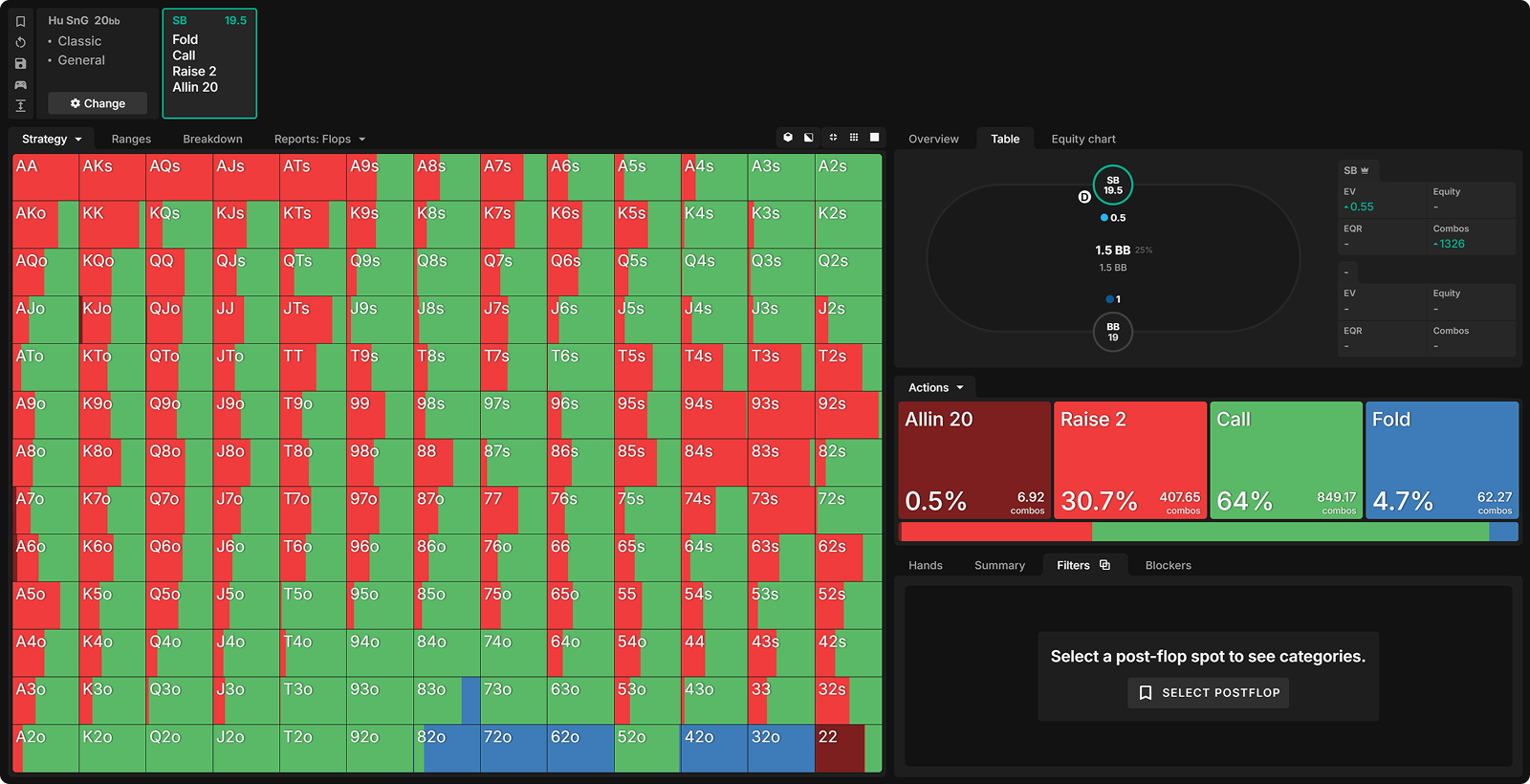
Let’s start with a flop where our entire range has a relatively low c-betting frequency.We are HU as the SB, 20bb deep, and min-raise, which the BB calls.
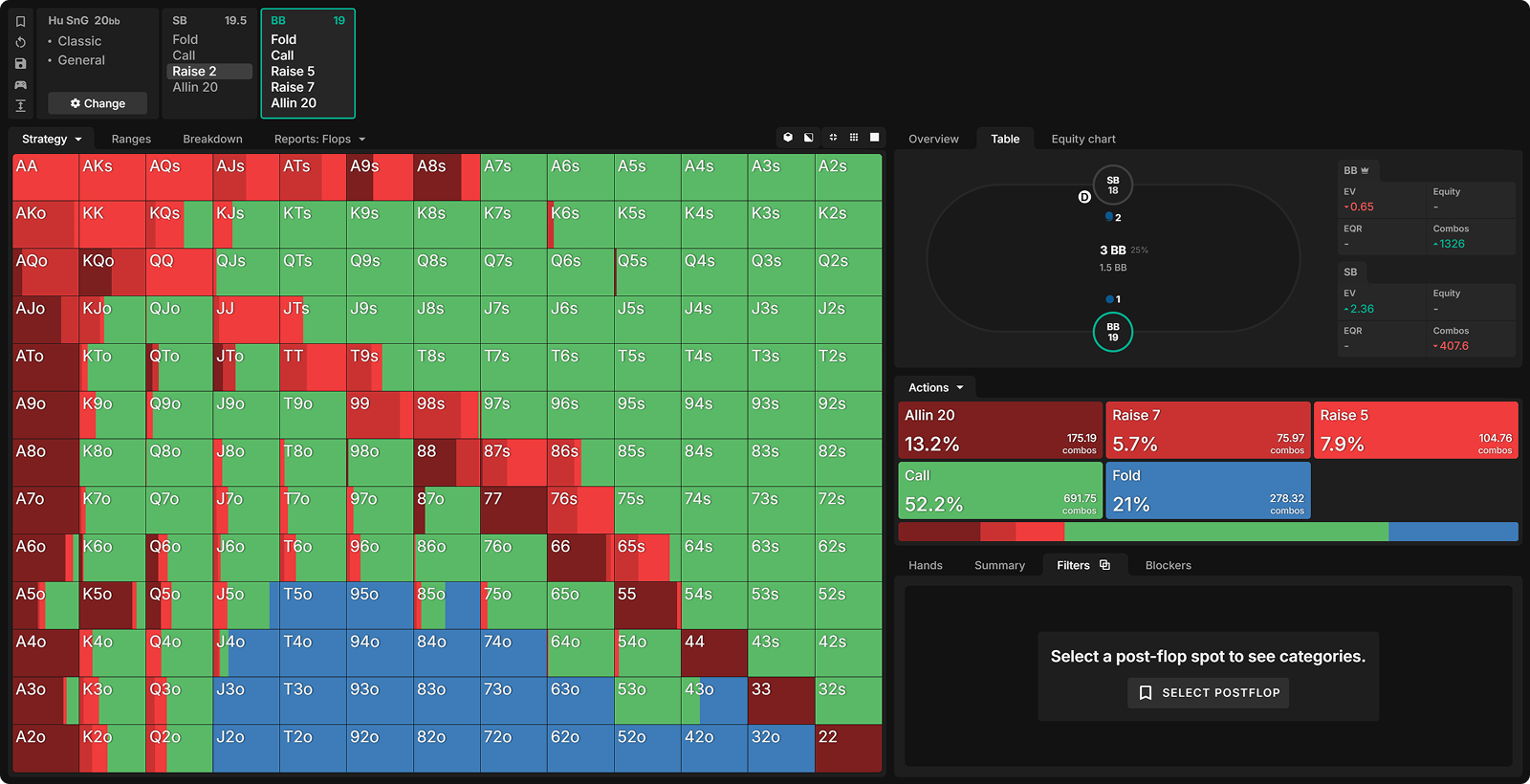
The flop comes down 8♥7♥3♣.
Our entire range c-bets ~45% of the time, and so checks ~55%.
On this board, we have many different types of direct draws (flush draws/open-ended straight draws/gutshot draws).
{{question-mark}}
How often do you bet your draws on this board?
{{/question-mark}}
Many players will bet the majority, if not all, of their draws on such a board, recognizing they have plenty of equity to continue barreling on future streets, with the possibility of hitting a hand they can value bet on certain runouts too.
Let’s see how often draws are bet at equilibrium and dive into the why behind the solver’s decisions.
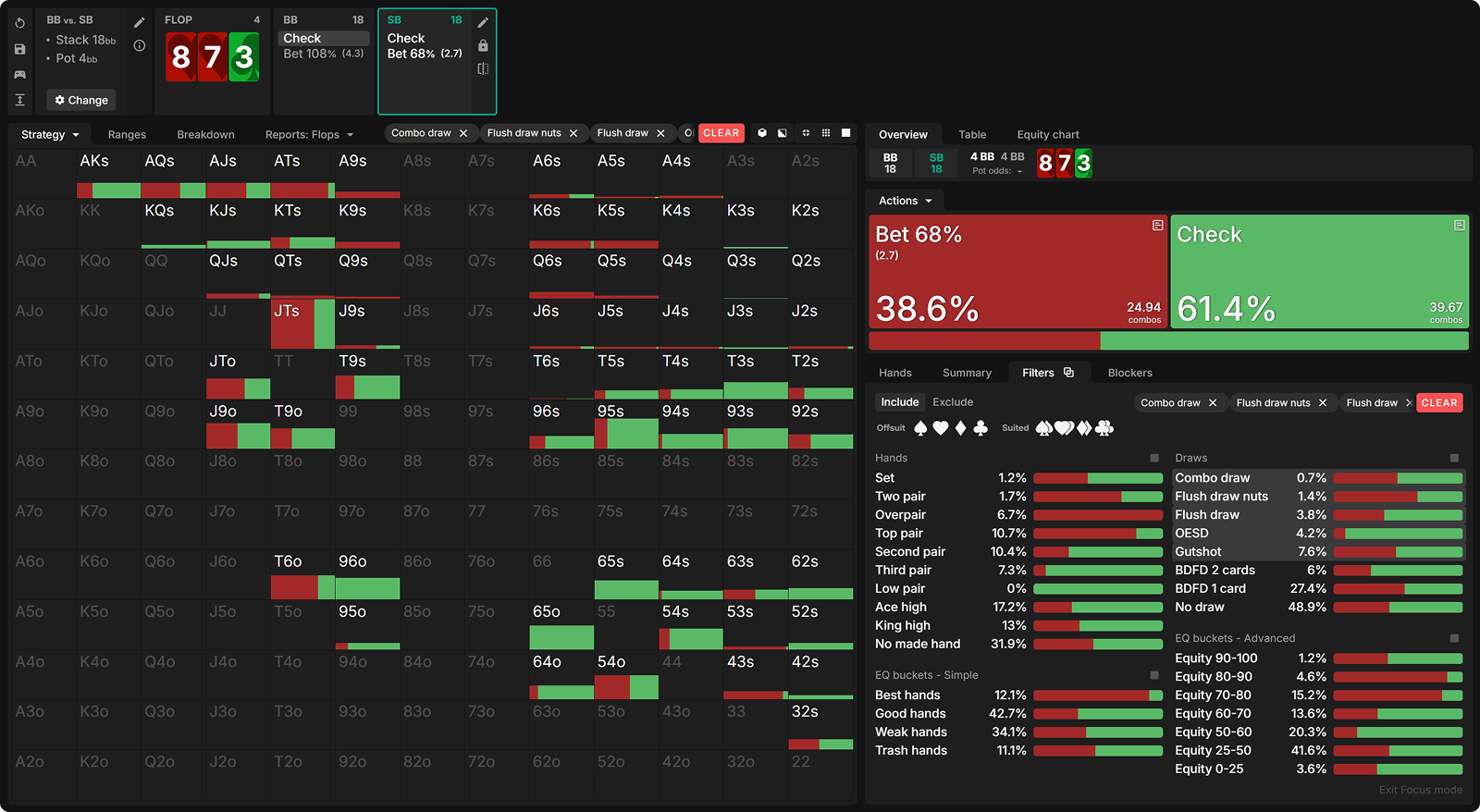
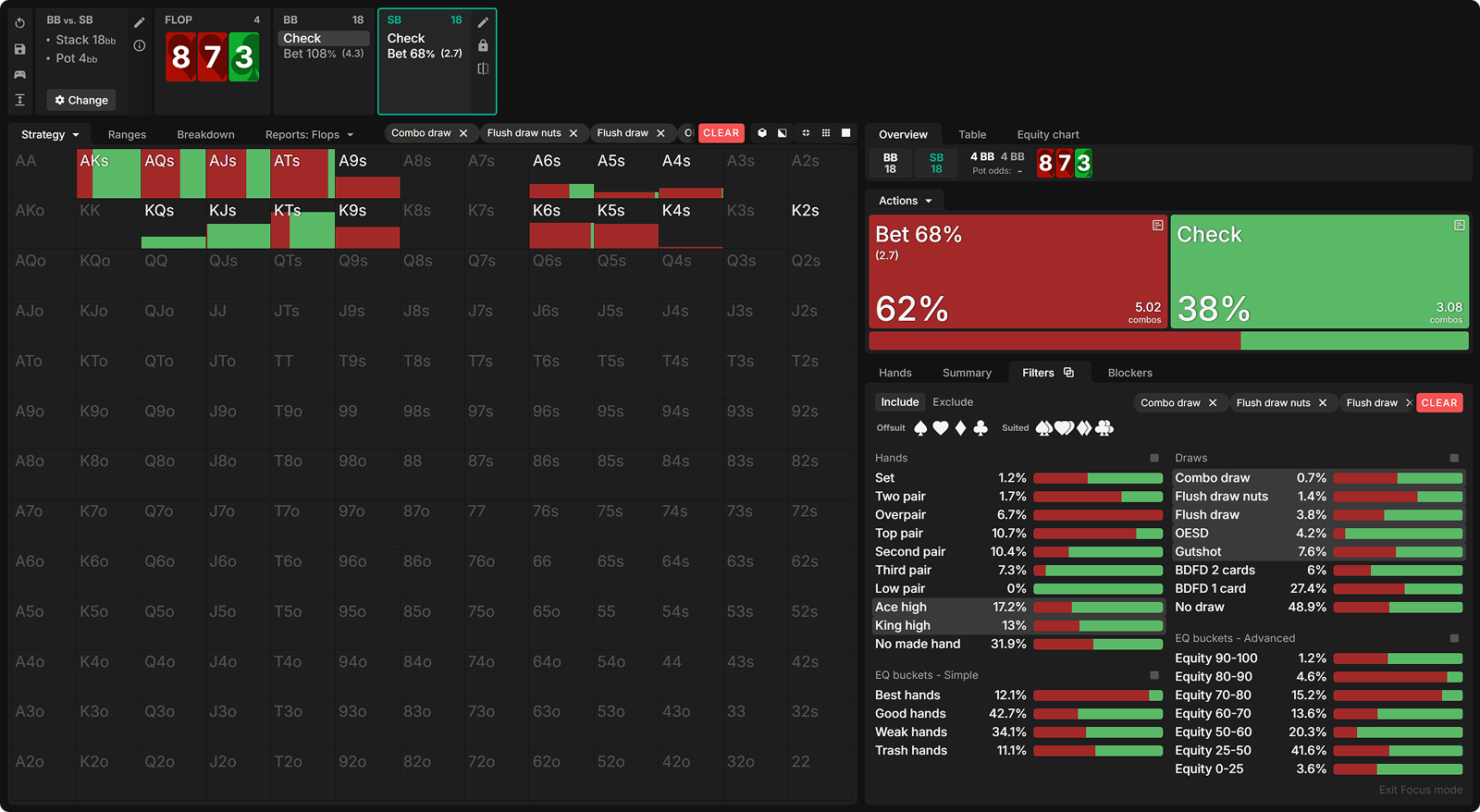
We can observe that draws are being bet slightly less frequently than the overall betting frequency of our entire range. Can you spot any patterns regarding the types of draws that seem to be betting more than others?
Our highest card draws bet considerably more often. Below you can see the Ace- and King-high draws:
Compared to our other draws, Queen-high and lower:
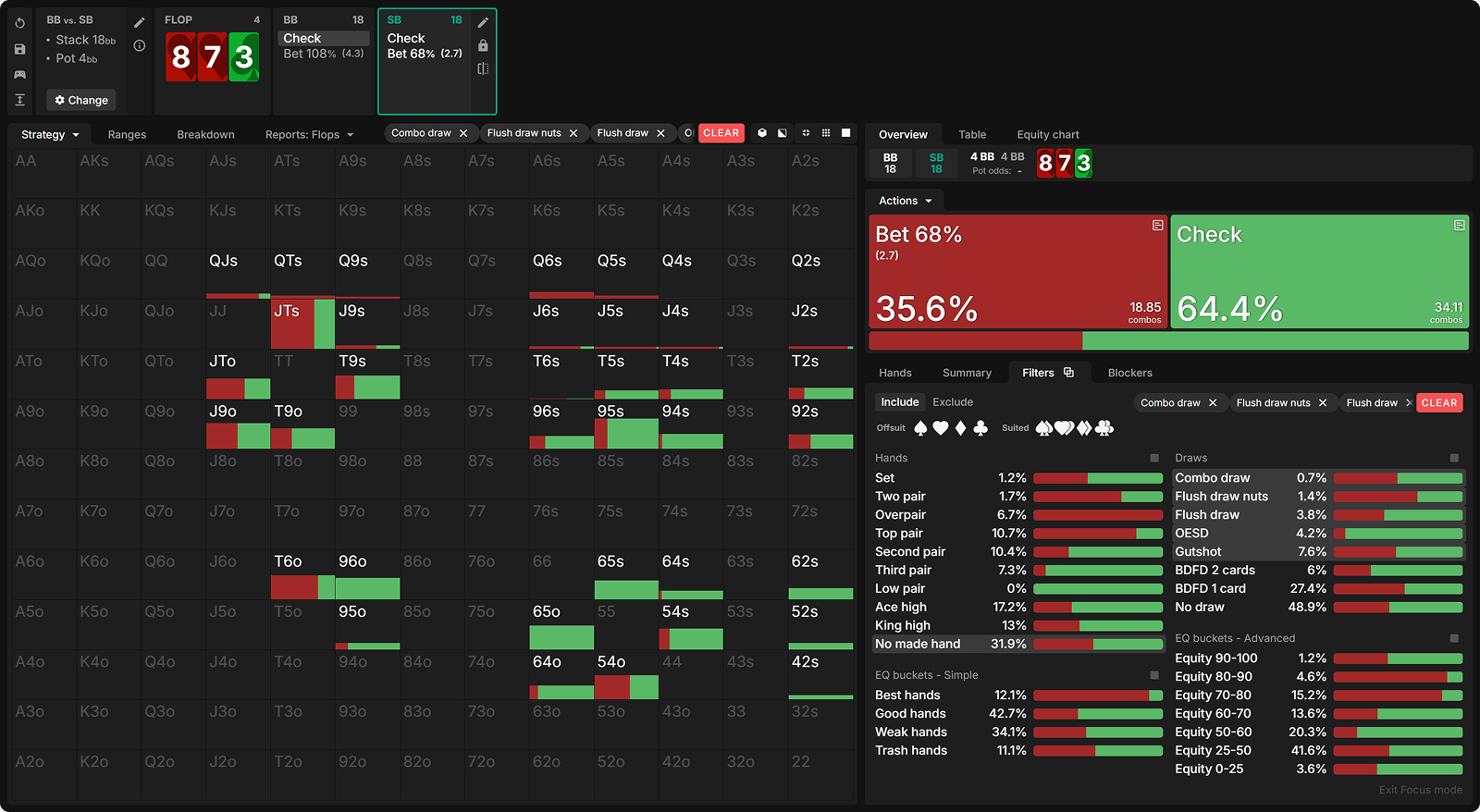
To some people, this may seem like “solver noise.” They’ll attribute it to the need to mix frequencies and think nothing more of it. But the more we understand ranges, the clearer it becomes why this is not just about mixing; there is a clear strategic reason for this.
{{question-mark}}
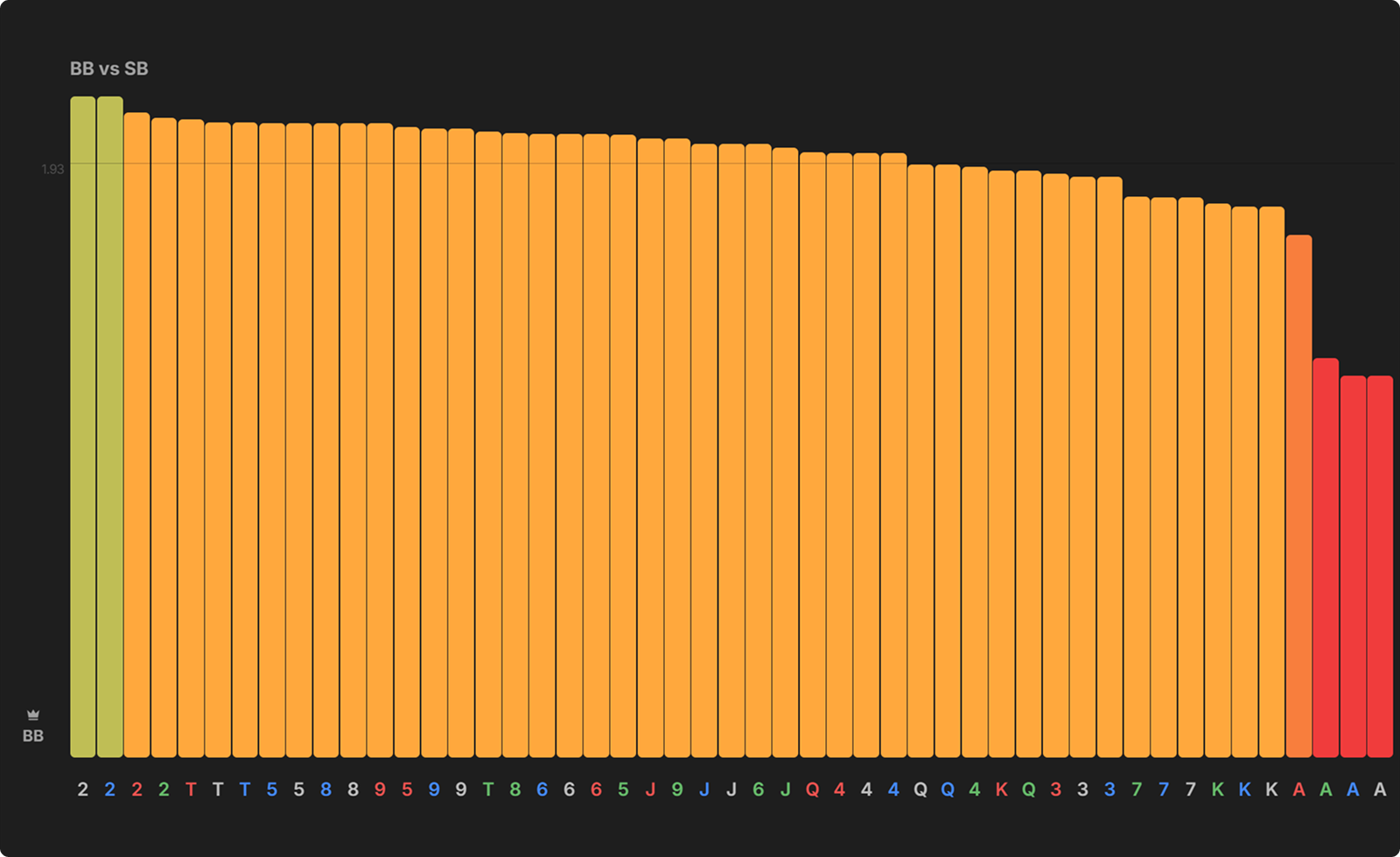
Imagine the flop goes check-check, and we arrive at the turn. Which group of cards do you think is the most favorable for the BB?
{{/question-mark}}
- High-card turns: Ace, King, Queen
- Paired turns: 8, 7, 3
- Medium-card turns: Jack, Ten, 9
- Low-card turns: 6, 5, 4, 2
{{toggle: Reveal Answers}}
From most to least favorable:
- Low-card turns: 6, 5, 4, 2
- Medium-card turns: Jack, Ten, 9
- Paired turns: 8, 7, 3 (with the 8 being a very good turn for the BB, but the 7 and 3 being good for the SB)
- High-card turns: Ace, King, Queen
{{/toggle}}
Notice how the cards that are best for the BB after a checked-through flop interact with the draws that the SB most frequently checks back on the flop.
This is the main reason for checking so many low and medium card draws on this flop. We expect the BB to be aggressive on these turns with probe bets; therefore, we want to check hands on the flop, which can make strong hands on these turns.
To improve your intuition of these flop spots, here is a drill to practice deciding whether or not to c-bet flop with your draws.
1) How often does my entire range want to c-bet?
2) Which turn cards are best for the Villain after the flop goes check-check?
Close To Range (85%+) C-Bet Boards
A common situation we will encounter after range c-betting the flop is deciding when to barrel our draws on the turn.
For this spot, we min-open the BTN 3-handed at 25bb effective, which the SB folds to and the BB calls.
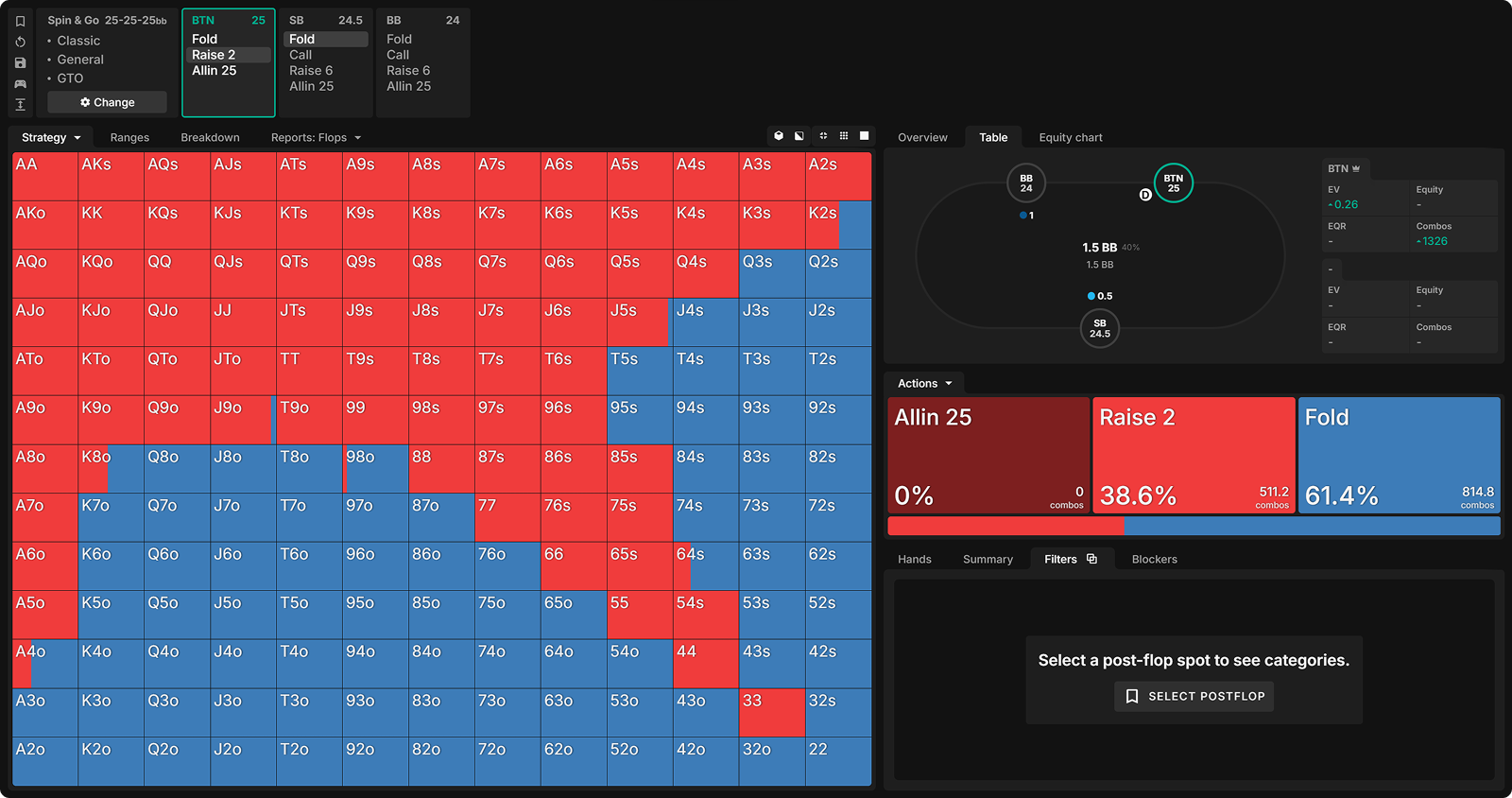
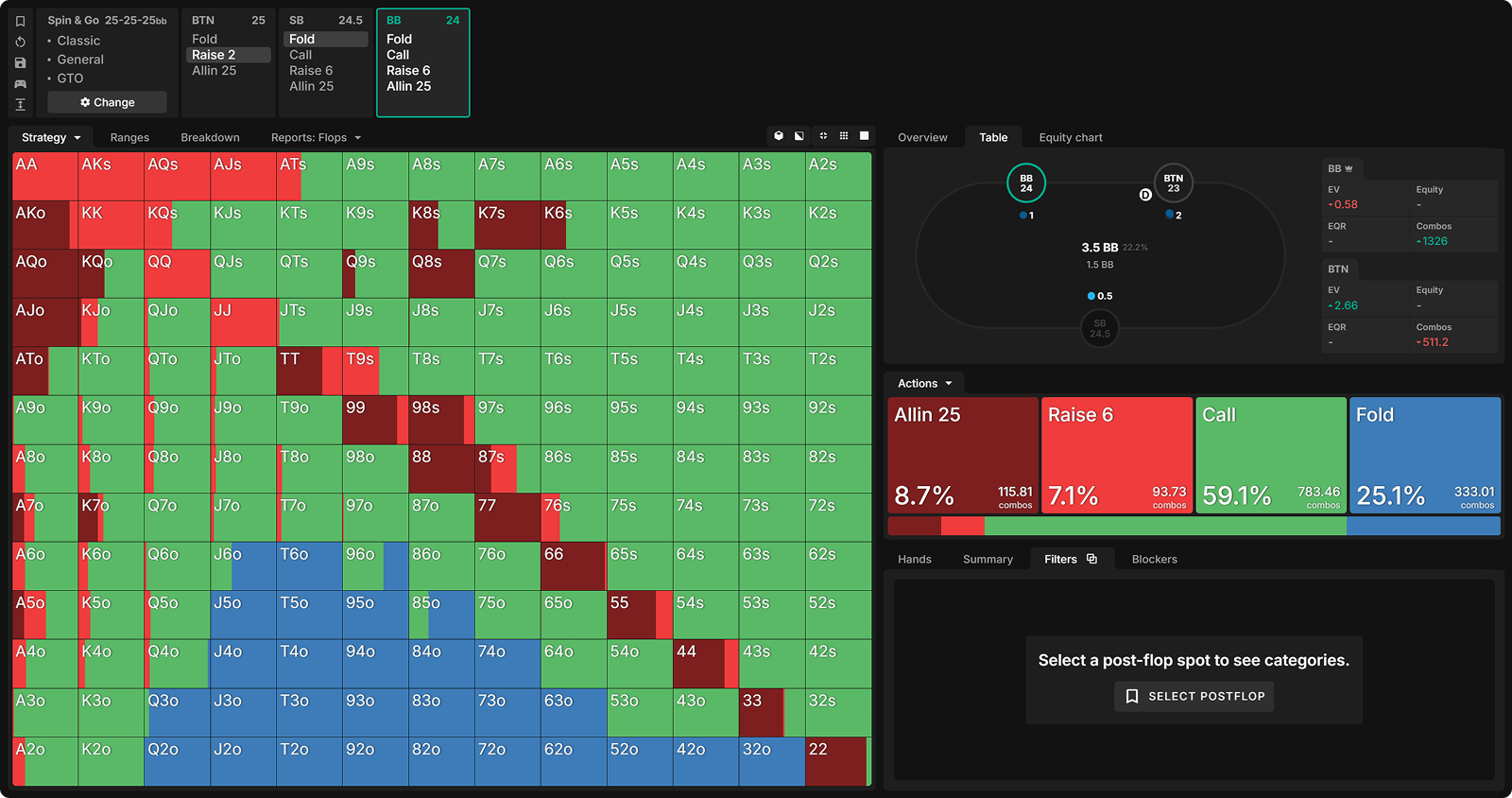
This time, the flop is K♥8♥2♣.
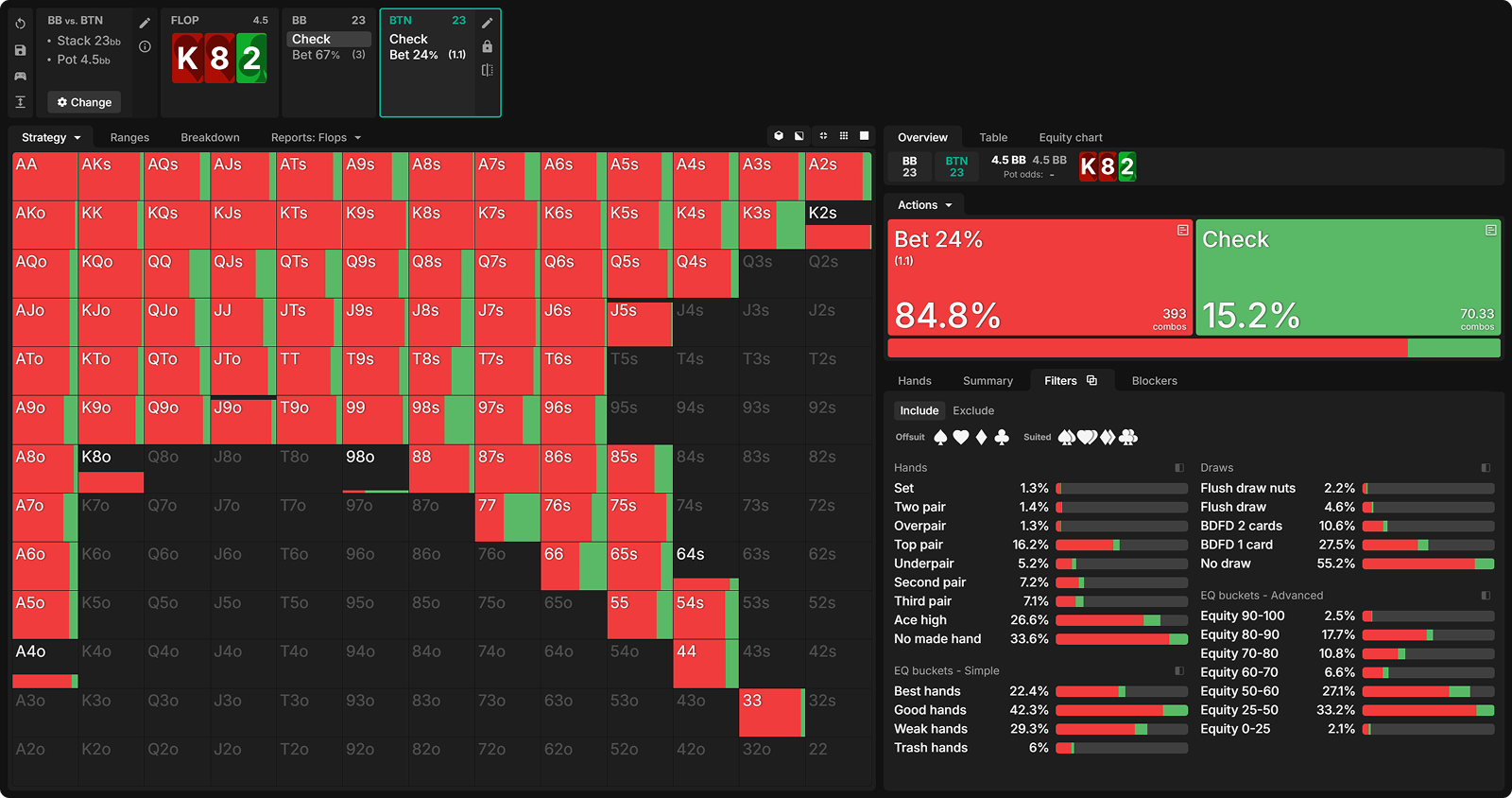
We see that a small size is being used at a high frequency. This will keep our range wide when we get called on the flop and arrive on the turn.
Let’s consider two different turns. One where we have a limited amount of new draws, the 3♠. And one that produces many new draws, the T♣.
Turn: 3♠
{{question-mark}}
On this dry turn (K♥8♥2♣ 3♠), how frequently would you bet (100% pot) with each of the following draws ? 6♠5♠, A♠4♥, A♥Q♥, 9♥6♥
{{/question-mark}}
{{toggle: Reveal Answers}}
6♠5♠ → Almost pure check
A♠4♥ → Almost pure bet
A♥Q♥ → Pure check
9♥6♥ → Mix but mainly check
{{/toggle}}
At first glance, this may seem a bit random.
Why do we bet one Ace-high draw and not the other?
Why would we not bluff a 6-high draw on the turn?
By exploring the ranges, we can find the answer to these questions.
{{question-mark}}
Firstly, let’s tackle the question of: why A♠4♥ prefers to bet over A♥Q♥?
{{/question-mark}}
When we barrel, this is how the BB is expected to respond:
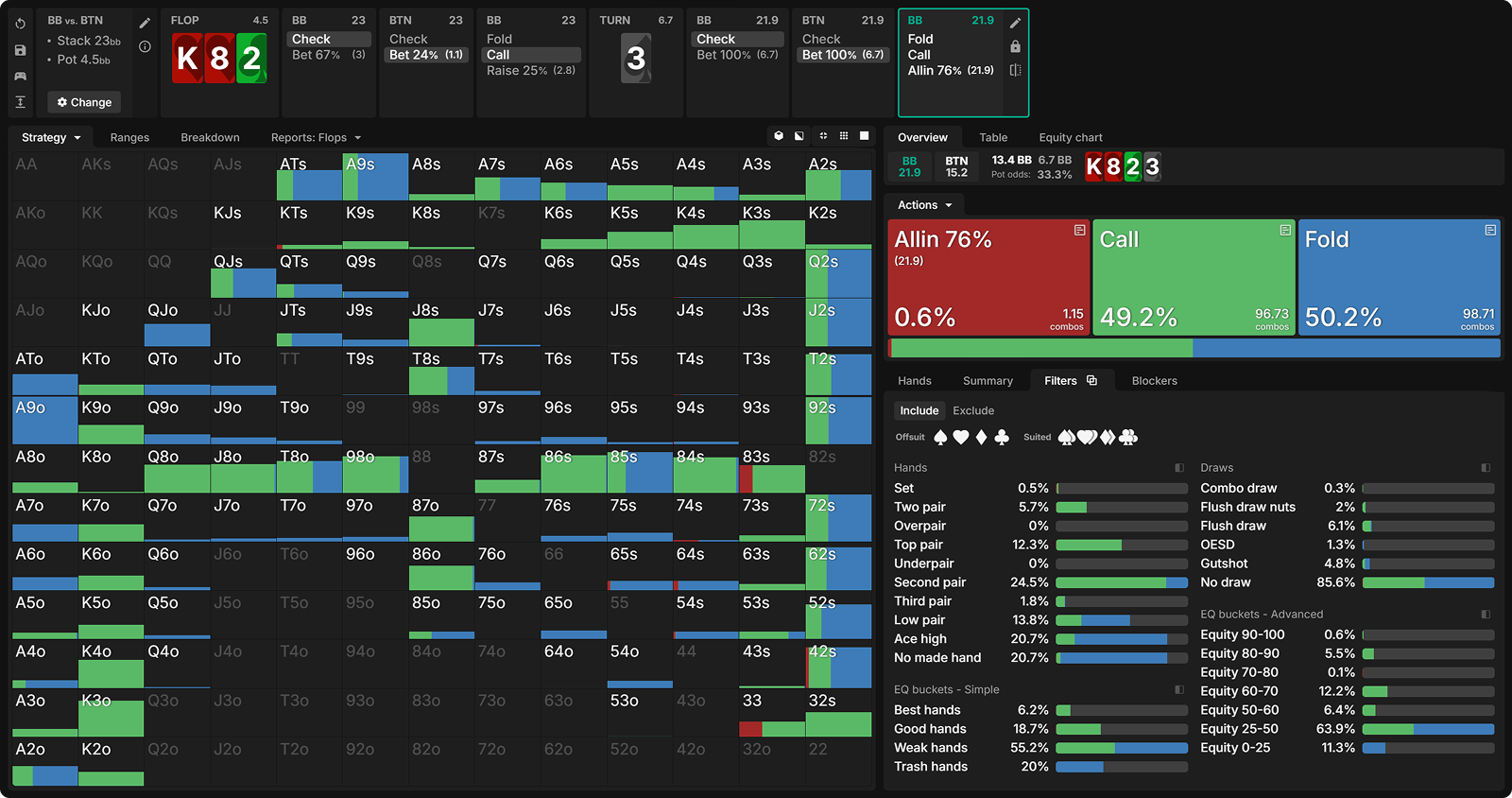
The majority of folds on this turn are coming from Ace-high holdings, unpaired Broadway holdings that contained a backdoor flush draw on the flop, and a small portion of lower pairs.
A♠4♥ is thrilled about getting folds from all of these hands.
Folding out the Ace-high holdings prevents many cooler situations compared to when the action goes check-check and an Ace peels off on the river. It also ensures that when we do bluff on the turn and hit our Ace on the river, it will be clearly good enough to play for stacks.
A♥Q♥ is the opposite.
It does not benefit from folding out all the dominated Ace-high holdings or hands like QJ. So it makes logical sense as a turn check, which will protect our range on flush-completing rivers and dominate Villain’s high card holdings in the bet-check-bet line on high card rivers.
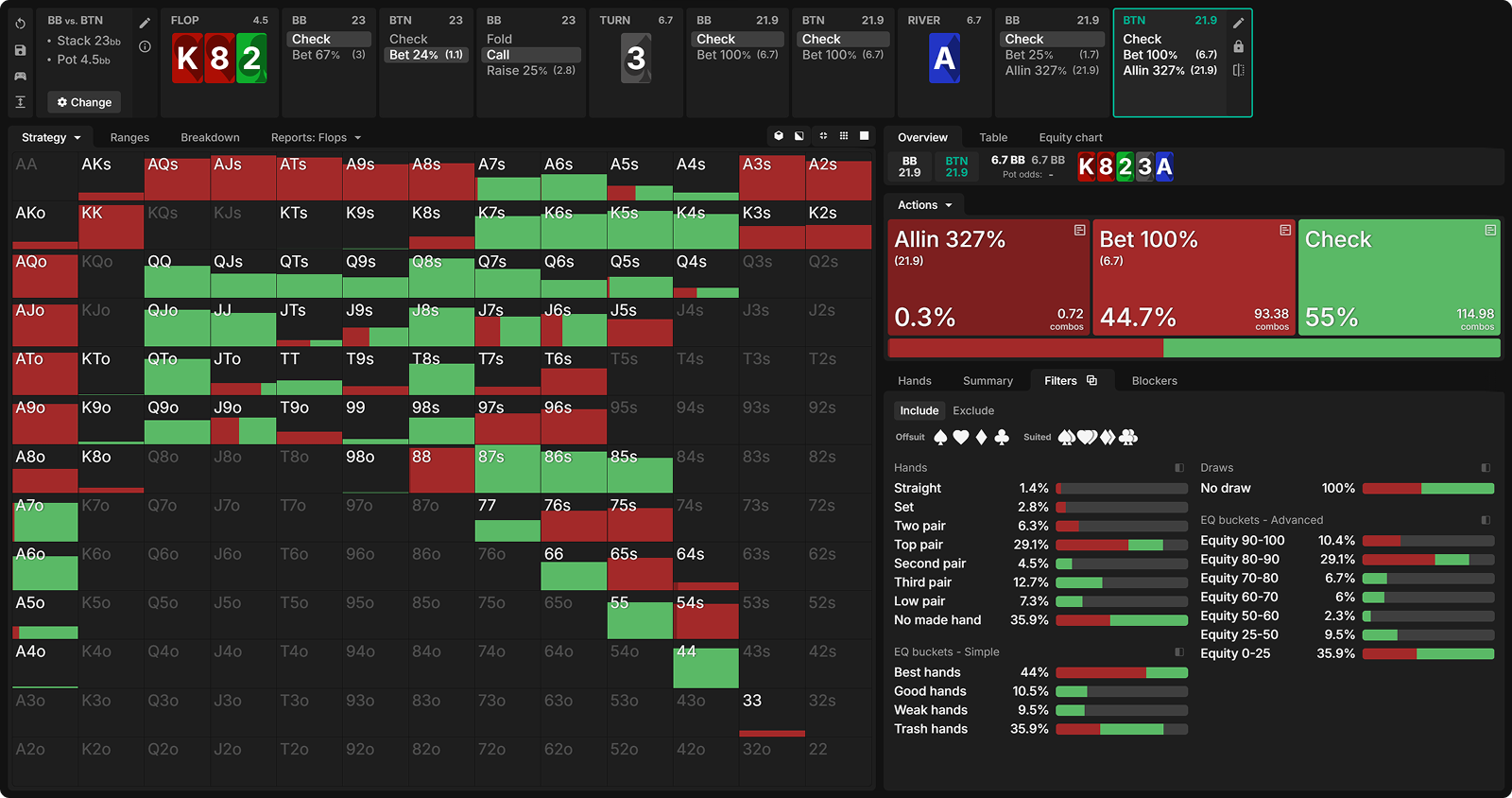
Triple barrel line: A♠4♥ is clearly strong enough to get it in on a non-flush-completing Ace river.
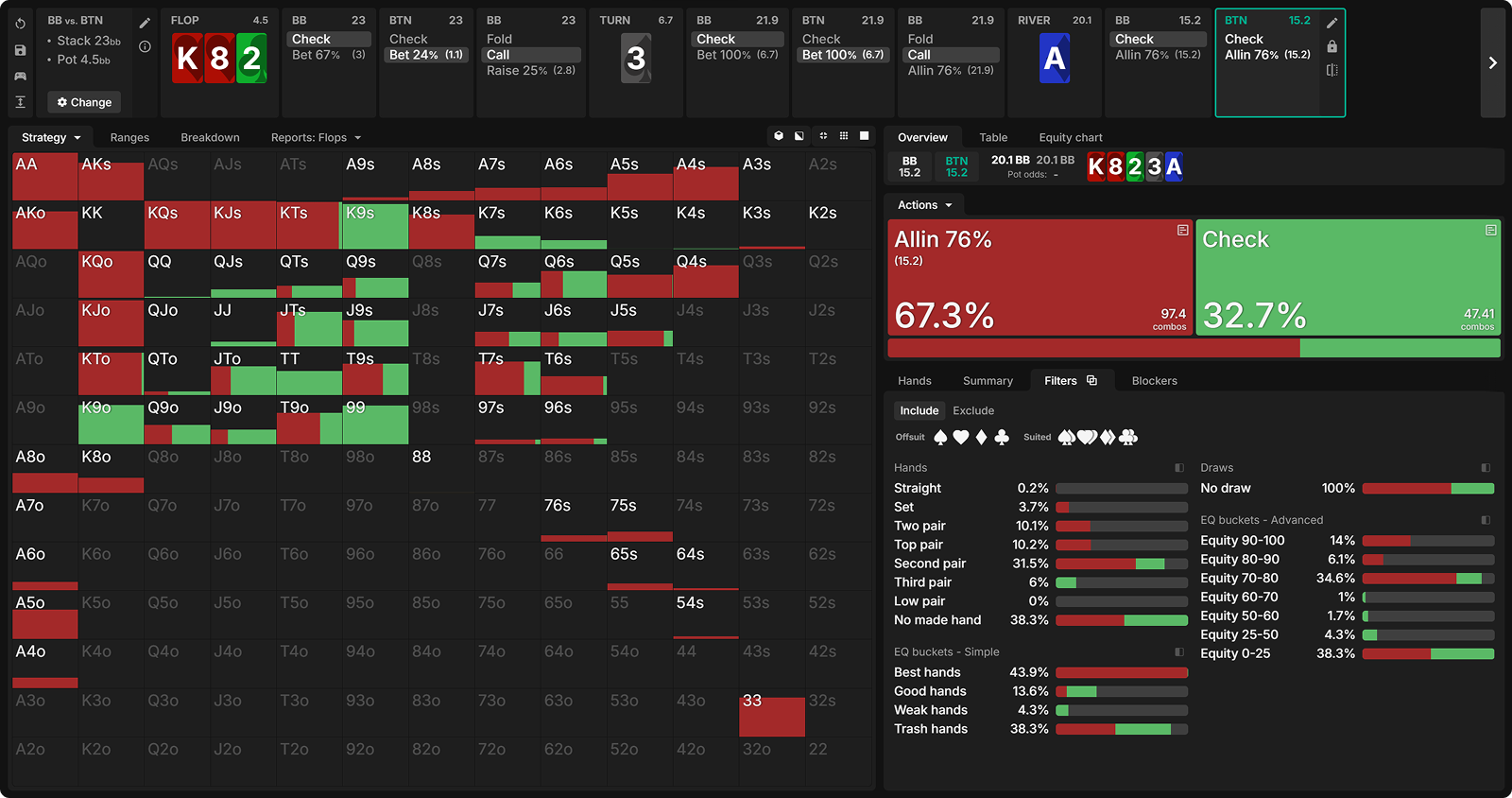
Bet-Check-Bet line:
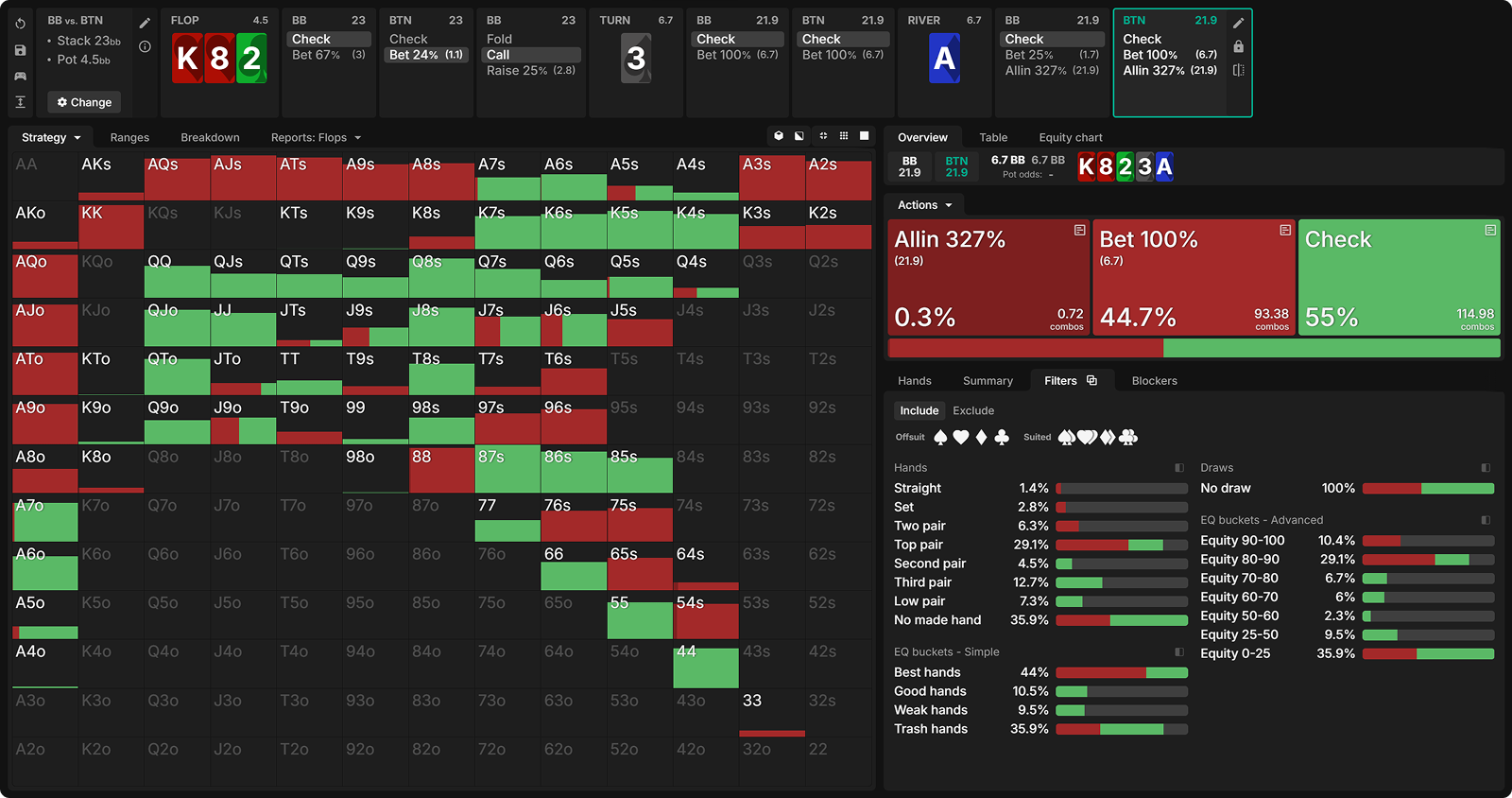
In comparison, we see that in the bet-check-bet line, the top pairs (Ace) with low kickers are not strong enough to value bet as the BB has many Ace-x or stronger to call with. This is why those hands prefer barreling the turn to fold out the better kickers. Meanwhile, our strongest suited Ace-x hands actually benefit from checking the turn, since this allows them to collect extra chips from hands that would have folded had we fired a second barrel.
{{question-mark}}
What about 6♠5♠, why do we not bluff with 6-high?
{{/question-mark}}
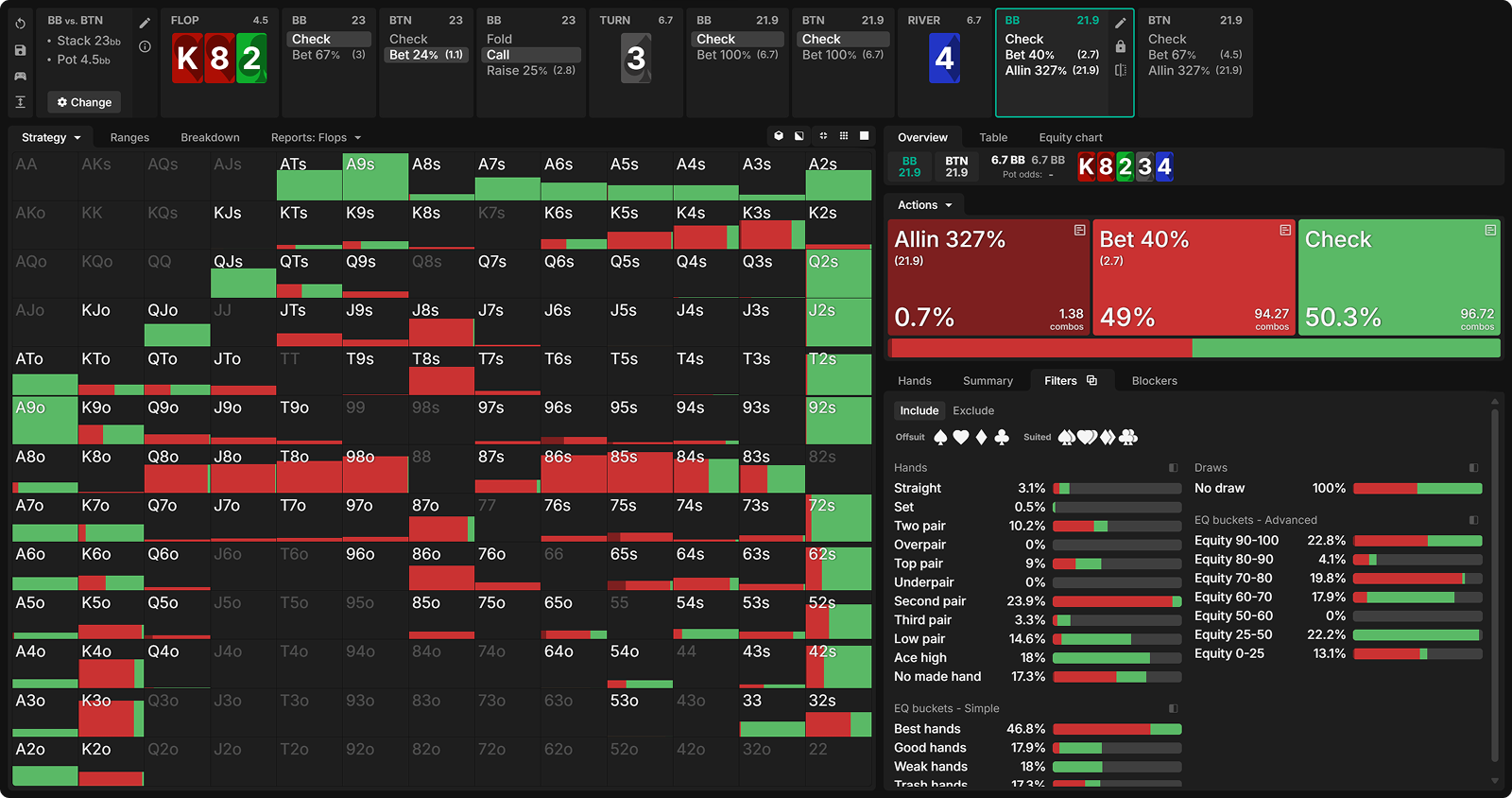
The BTN’s range is very well defined to be mainly two cards above 9-x or a pocket pair. We are limited to a few suited connectors like our 6♠5♠. This means when we check and the river comes a low card below the 9, it is going to be more advantageous for the BB. Conversely, cards from 9 and above are more advantageous for the BTN.
This is why we opt to mainly check our low card draws; we expect the Villain to invest a larger amount of chips on rivers that this type of hand improves on. It also allows us to have some natural bluffs in the BXB line on the rivers that are good for our range (i.e., 9 and above).
Comparing BB Probes on Different Rivers
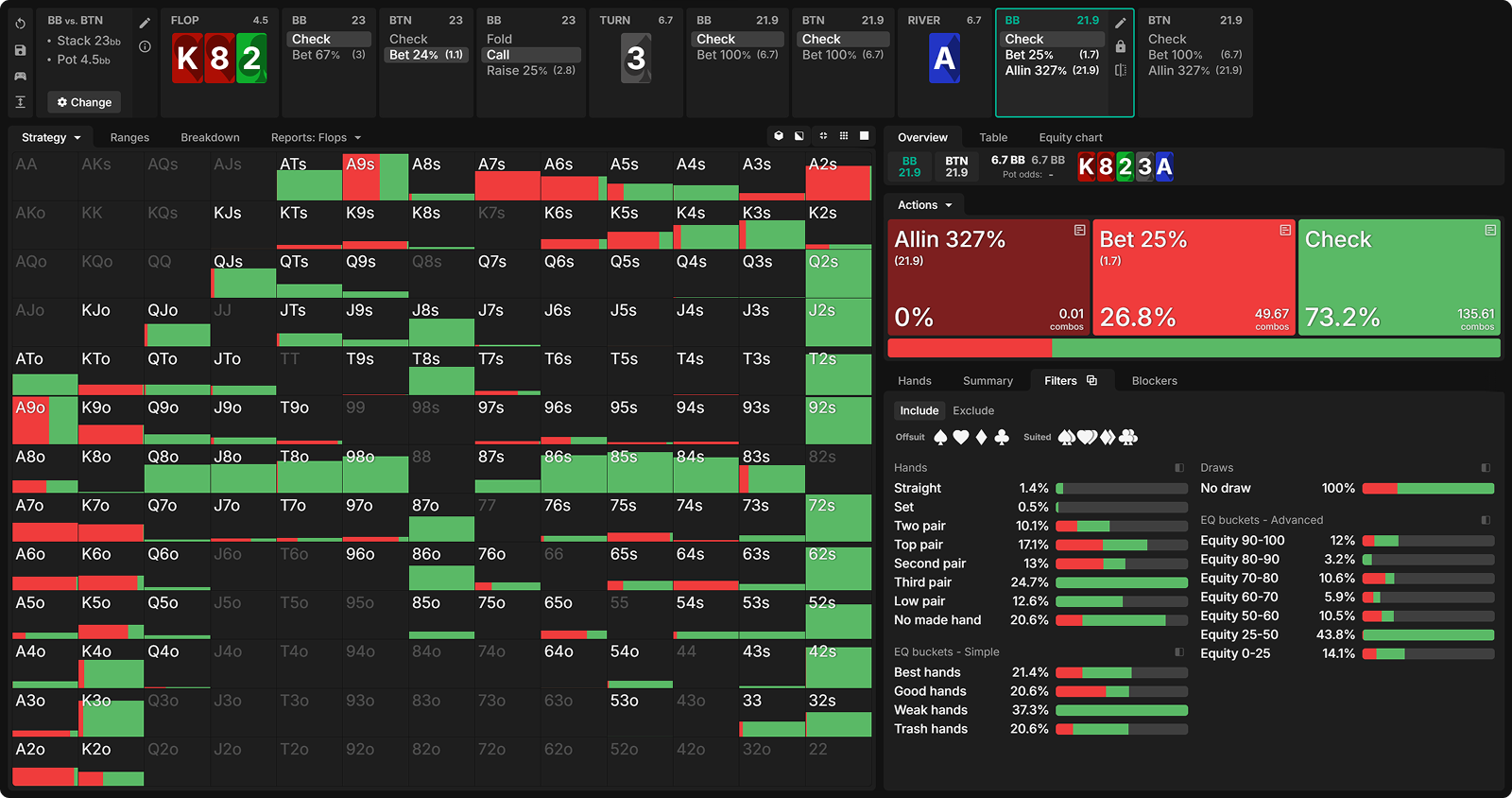
BTN’s Delayed Double Barrel on the A♦ River
As you can see, some of the natural bluffs are coming from our low-card turned draws.
Turn: T♣
{{question-mark}}
On this wet turn (K♥8♥2♣T♣), how frequently would you bet (100% pot) with the following draws? 6♥5♥, 9♥7♥, Q♠J♠, A♦Q♠
{{/question-mark}}
{{toggle: Reveal Answers}}
6♥5♥ → Almost pure bet
9♥7♥ → Almost pure check
Q♠J♠ → Mixing but mainly check
A♦Q♠ → Pure check
{{/toggle}}
Hopefully, you evaluated A♦Q♠ correctly based on the analysis of the previous spot. Following the same logic as the 3♠ turn, we don’t want to fold out all of the dominated hands.
However, this time, 6♥5♥ is opting to bet almost purely instead of an almost pure check. What has changed from the 3♠ turn to the T♣ turn to justify this? Previously, on all non-flush 4 rivers, our 6♥5♥ would have made the nuts on a river card that is beneficial overall to the BB range. This is no longer the case, so we instead chase the fold equity.
We do still have some hands that can make the nuts on cards beneficial to the opponent’s range. Specifically, 76/96/97 suited. These hands can all make either the nut straight or the second nut straight on 6/7/9 rivers. Applying the logic we learnt earlier, we would expect these hands to check.
Draws example on the T♣ turn:
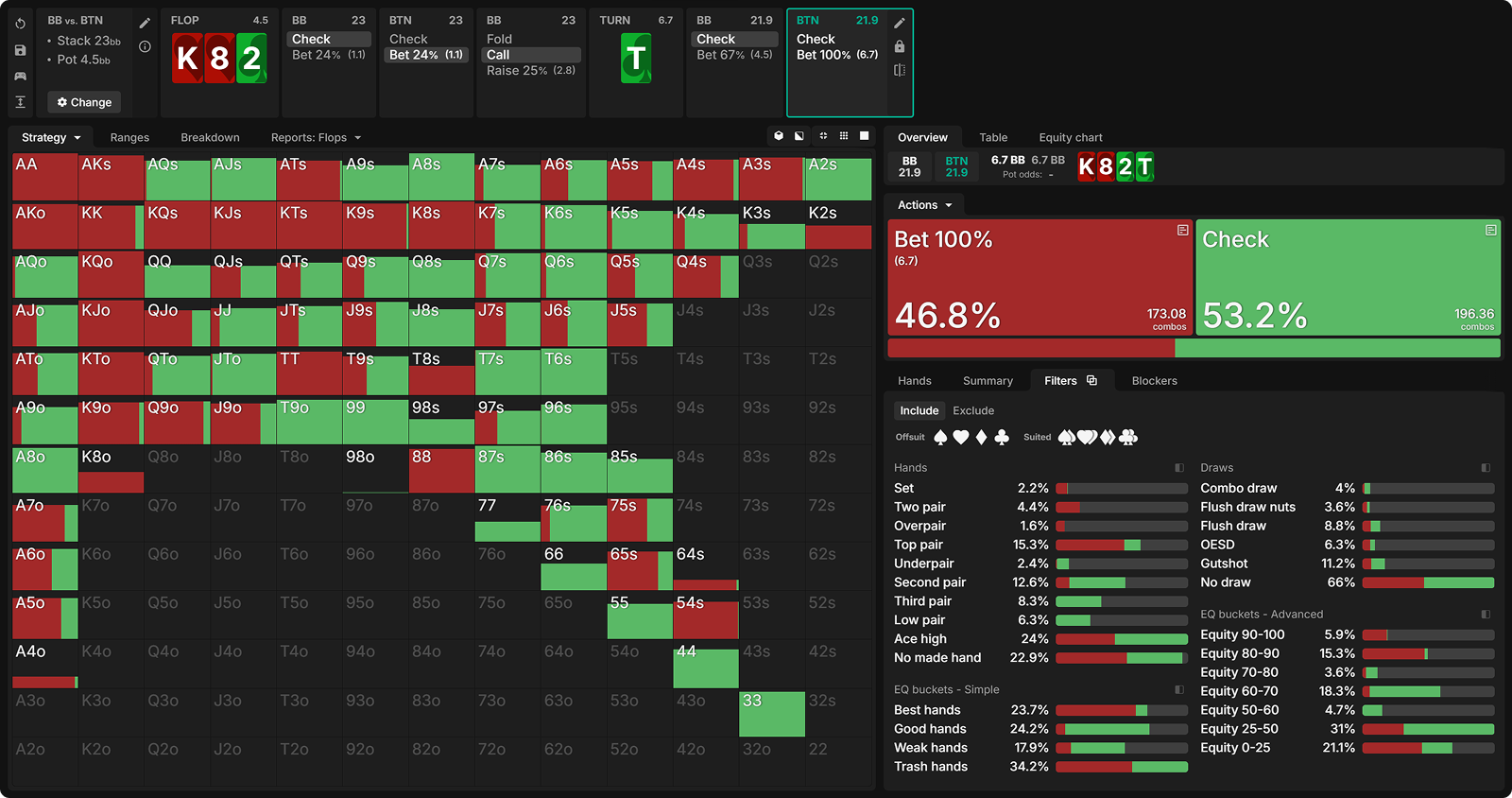
And indeed we see this is the case, the draws which can make the (effective) nuts on cards that are bad for the BTN range, whilst also not making strong hands on cards which are good for the BTN range (9+) opt to check. Ready to collect value when they do hit their straight and bluff in a BXB line when they miss on cards good for the BTN’s range.
Key Takeaways
1) Which river cards are good for my range, and which for my opponent’s range?
2) Does my draw complete when the river is good for my range or my opponent’s range?
3) Does my draw dominate many folding hands were I to barrel?
Note: Prioritizing draws that benefit the most from fold equity for betting doesn’t always mean we just choose the ones with the least showdown value!
Here is a drill to practice deciding whether to barrel turn with draws in BTN min-raised pots vs. BB.
What If Somebody Does Barrel ALL Draws
There will be players who simply barrel all their unpaired draws that they chose to c-bet on the flop. Let’s revisit our first example: 8♥7♥3♣ flop in a SB min-raised HU pot, 20bb effective.
We will stick with the GTO c-bet frequencies and look at the 4♣ turn after receiving a call on the flop.
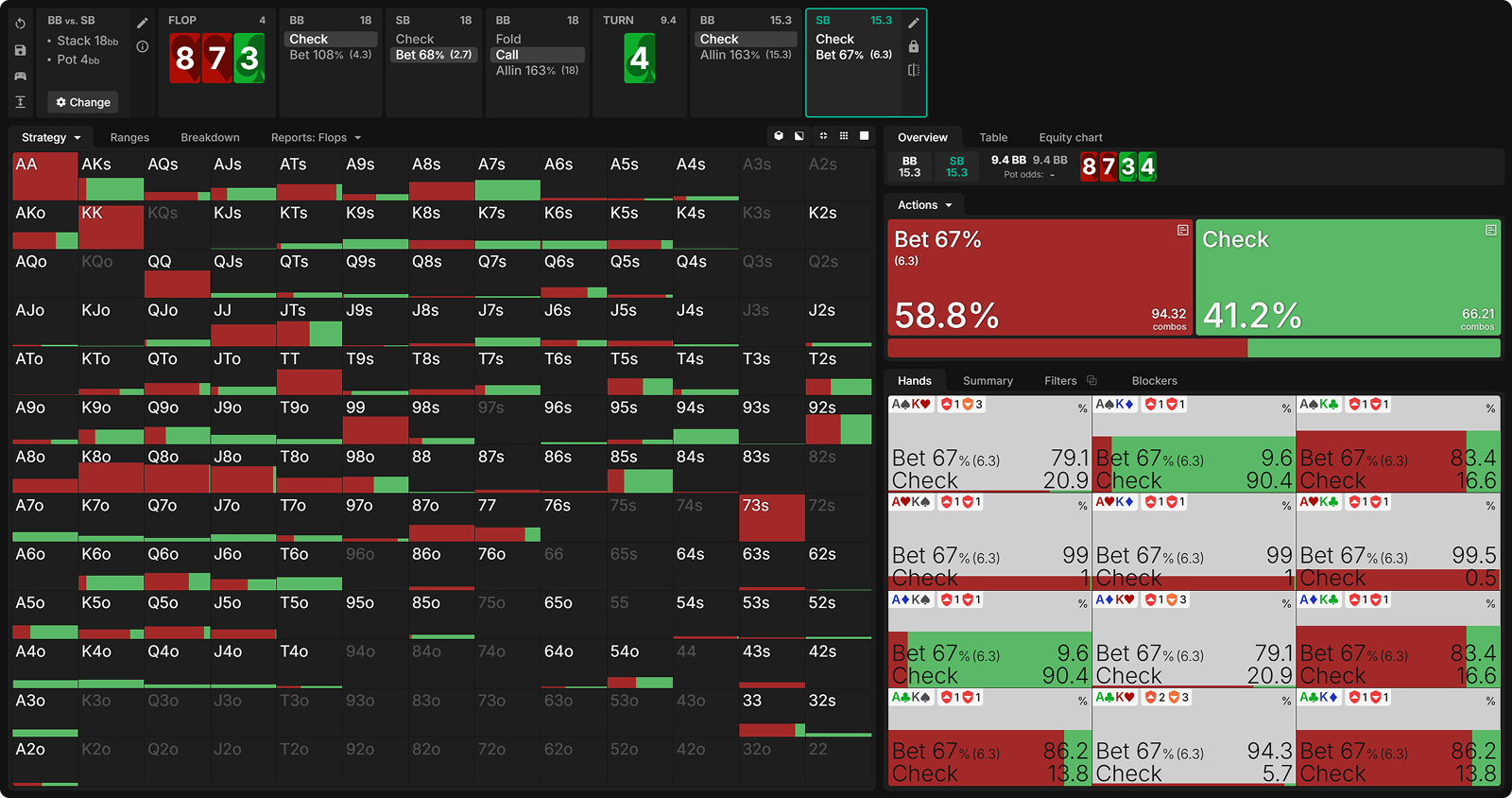
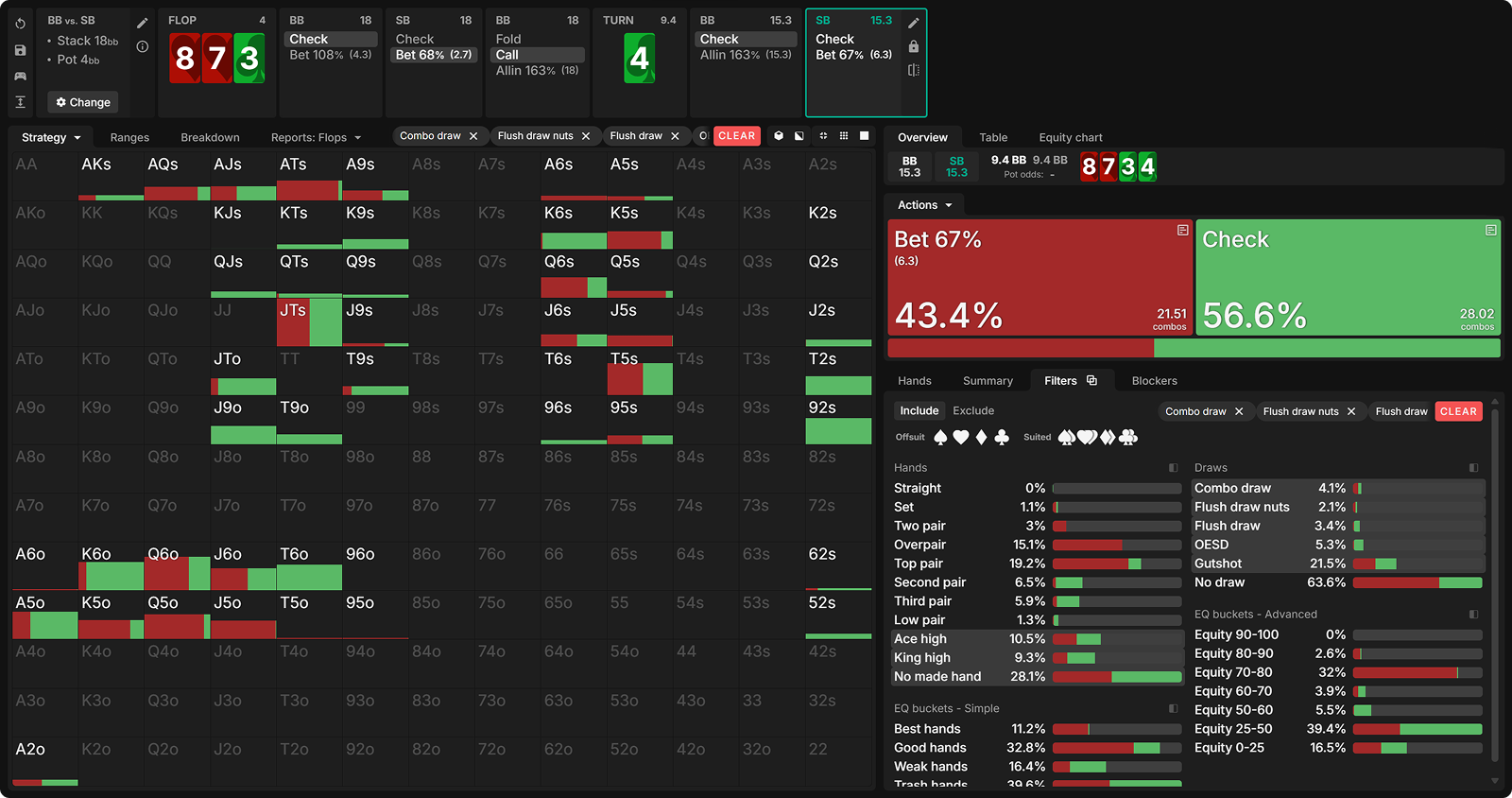
The theory strategy has us barreling ~58% of our range, yet checking ~56% of our draws, as seen above. Let’s nodelock this to barrel 100% of our draws, while the overall betting frequency is kept the same.
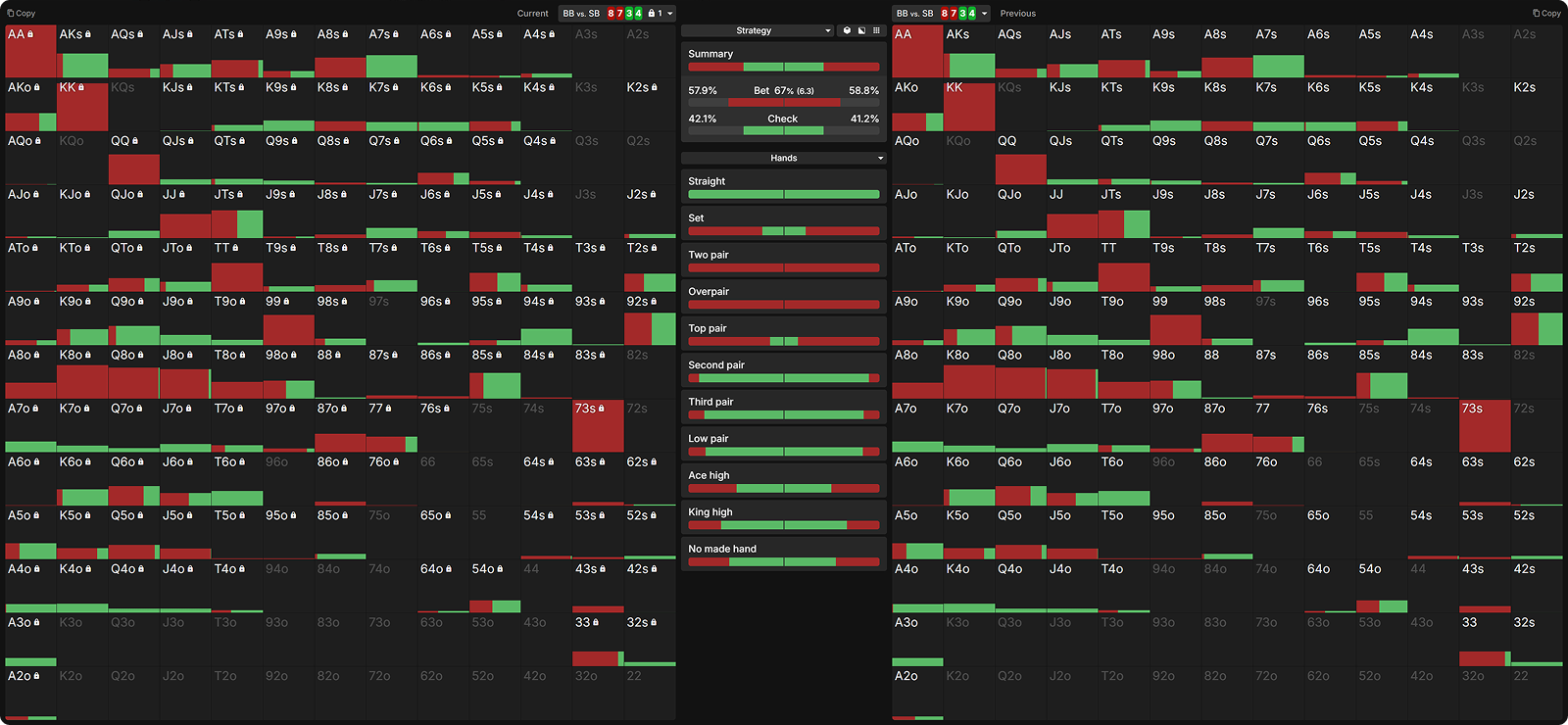
Let’s see how the BB response changes now that the SB is barreling with more draws than before:
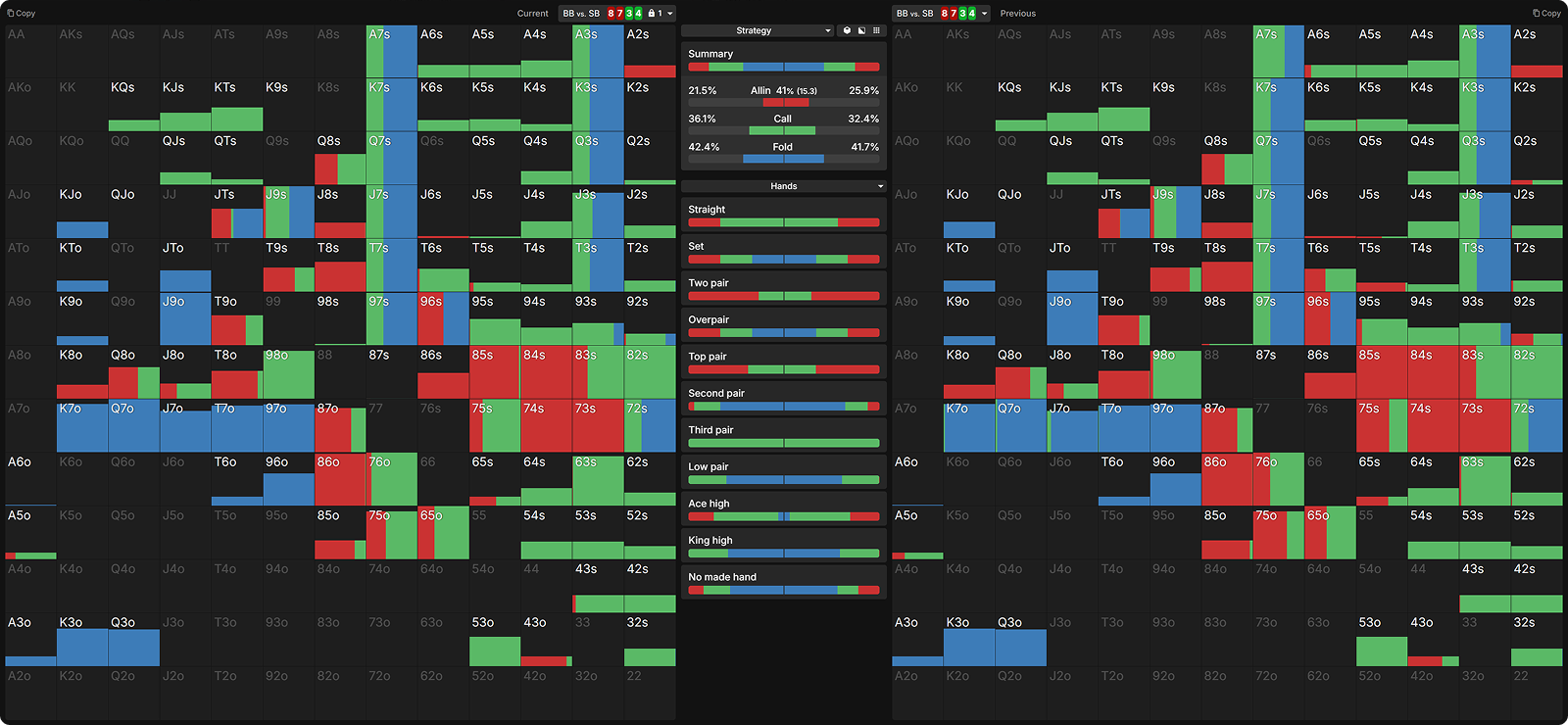
Here, barreling more draws and keeping the betting frequency the same means the SB barrel range has actually become stronger. Drawing hands have more direct equity than polarized bluffs. So the BB now cuts their worst SDV bluff-raises from before, such as T♥5♥, and now just calls them.
Conclusion
When deciding to c-bet or barrel with a draw, try to think deeper than immediate fold equity; instead, try asking yourself the following questions:
- How often does my range want to c-bet?
- Which turn/river cards will be best for the Villain’s range/worst for my range?
- If I c-bet/barrel my draw, am I folding out many dominated hands?
- What will my bet-check-bet bluffs be on the river on different runouts?
Contemplating these questions will deepen your understanding of your overall range constructions and help to keep betting frequencies under control with your drawing hands.
When bluffing the turn IP, it’s crucial to include many polarized bluffs, as this ensures you can still have bluffs across all types of draw-completing rivers. Using only direct draws can result in your range becoming too strong on those runouts.

We Are Hiring
We are looking for remarkable individuals to join us in our quest to build the next-generation poker training ecosystem. If you are passionate, dedicated, and driven to excel, we want to hear from you. Join us in redefining how poker is being studied.
Check out the available positions here.
The Four-Point Checklist for Calling Turn Barrels
This article will provide a 4-point checklist of questions to ask yourself when facing a barrel, each one giving you an information point on whether our holding is a threshold hand or a clear decision one way or the other.
Small Blind, Big Problems: When to Size Up From OOP BvB
This article will give you a plan of action for establishing which types of boards prefer which sizing schemes and which types of hands fit into these schemes (both for value and for bluffs) when OOP BvB in Spin and Gos.
The Art of Value Bluffing From the Button
Playing “OK” from the Button in Spins often comes relatively naturally. Our relatively tight preflop range makes almost all boards favorable for us against the much wider range of the BB.