Mississippi Straddles: Building a C-Betting Strategy vs. BTN


Overview
A Button straddle, also known as a Mississippi straddle, changes the preflop incentives of all players. If you’re interested in learning more about exactly how those incentives change, you can read about opening ranges and responding to opens in Mississippi straddle games.
In this article, we will investigate the consequences of those changes for postflop play, specifically for continuation betting into a BTN caller. That may sound like a niche topic, but the single biggest change to preflop incentives introduced by the Mississippi straddle is that the BTN will almost always call a small raise if no one else does. That means you should expect to play heads up against the BTN quite often when you open-raise in these games.
This is true even if the BTN is playing perfectly, because the straddle offers them a significant discount on a call that will also close the action. However, in games where the Mississippi straddle is optional, you should expect a player who chooses to straddle to call with an even wider range than a solver would recommend. After all, this player has already voluntarily put money into the pot without looking at their cards, so they are presumably looking for excuses to gamble and play hands.
Practice Predictions
We will investigate a few configurations, all of which entail a preflop raiser deciding whether or not to bet the flop when heads up against a BTN caller. We will compare c-betting strategies in a traditional two-blind game with 100bb stacks to a Mississippi straddle game with 200bb stacks (which translates to 100 straddles, a roughly equivalent stack depth). Postflop SPRs will be matched across both simulations to isolate the effect of differing preflop ranges on postflop betting strategy. Both simulations are cEV (unraked), as this produces the greatest disparity between the opener’s raising range and the BTN’s calling range.
Before you read ahead, try to predict the results for yourself.
{{question-mark}}
1) Do you expect the raiser to c-bet more or less often in the Mississippi straddle game? Why?
2) Do you expect the raiser to use a smaller or larger bet sizing in the Mississippi straddle game, relative to a two-blind game? Why?
{{/question-mark}}
All experiments in this article are based on Custom solutions. I started by letting GTO Wizard determine bet sizes automatically, to set the bet sizes for all other decision points (and to see what it identified as the ideal c-bet size). Then, I manually adjusted it to consider 25% pot and 75% pot flop continuation bets.
Low Connected Flop
Low connected flops like 7♥6♥3♦ are among the very worst for UTG in the two-blind game, and their equilibrium strategy is basically just to check their entire range. Against a BTN straddler, however, they c-bet more than half their range, sometimes even using a large size. Why do you think that is?


In the two-blind game, BTN enjoys a slight nut advantage, but that’s not UTG’s main problem. Both players have sets, straights, and two pairs; BTN just has slightly more of them.
Two-Blind on 763tt
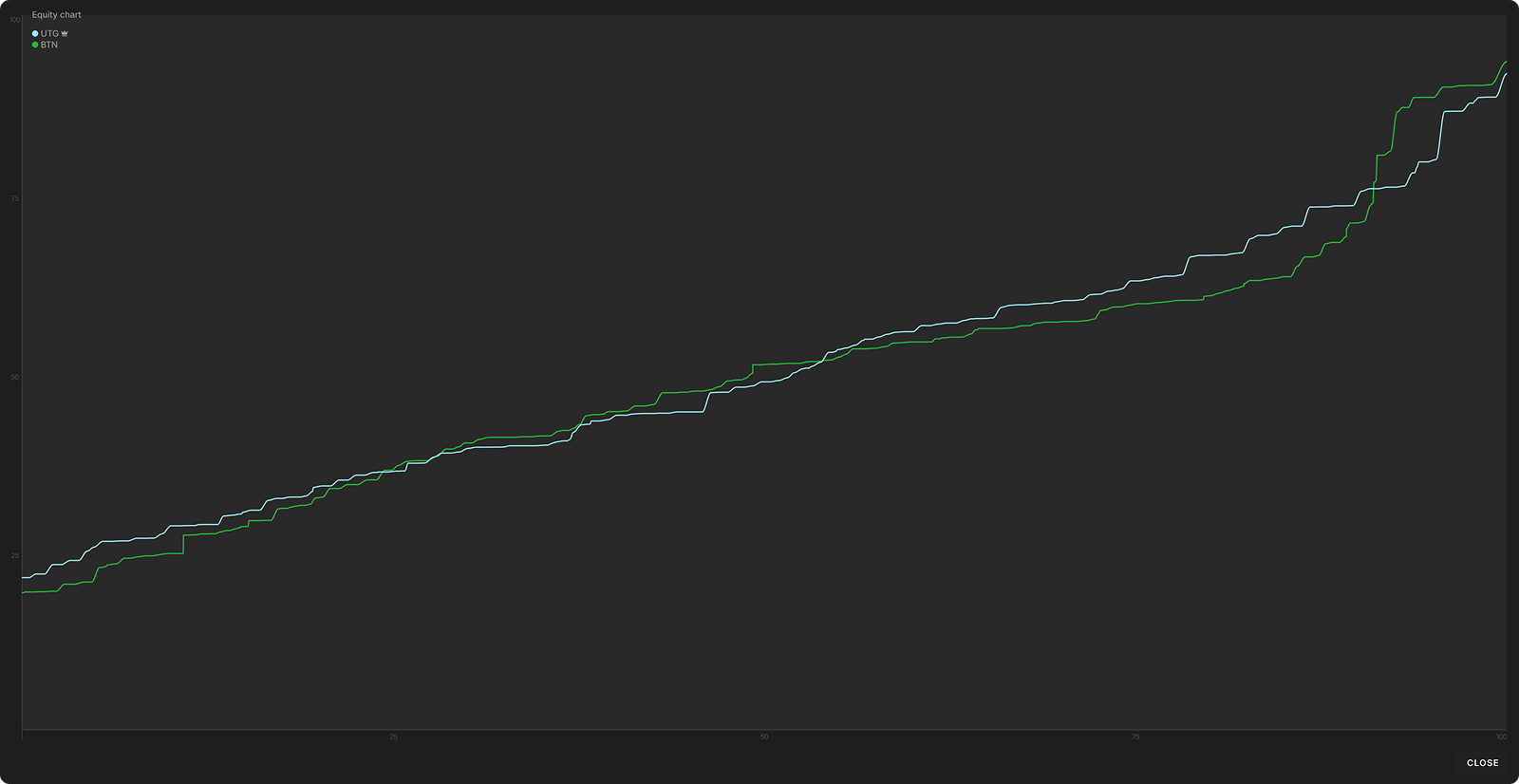
UTG’s real problem is that this is an extremely dynamic flop, and they are out of position. Almost any turn card will meaningfully change the board texture, causing some hands that were previously strong to become weaker and some hands that were previously weak to become stronger, whether that be by turning a straight or simply top pair. This makes it risky to grow the pot from out of position, because they will have to react to that change in board texture without the benefit of seeing how BTN reacts to it.
UTG’s other problem is that they don’t get much reward from betting. Because the equities of both ranges run quite close, they can’t push an equity advantage with a small bet. BTN’s preflop calling range is fairly strong, so they don’t flop a disproportionate amount of trash.
A BTN straddler, however, has a much wider preflop calling range and so flops a lot more trash. They actually have more combos of straights and two pairs, because they call 54o and 76o, but these monsters are diluted by even more combos of trash like J8o and QTo. Against this wide range, UTG can push an equity advantage with a small c-bet.
Button Straddle on 763tt
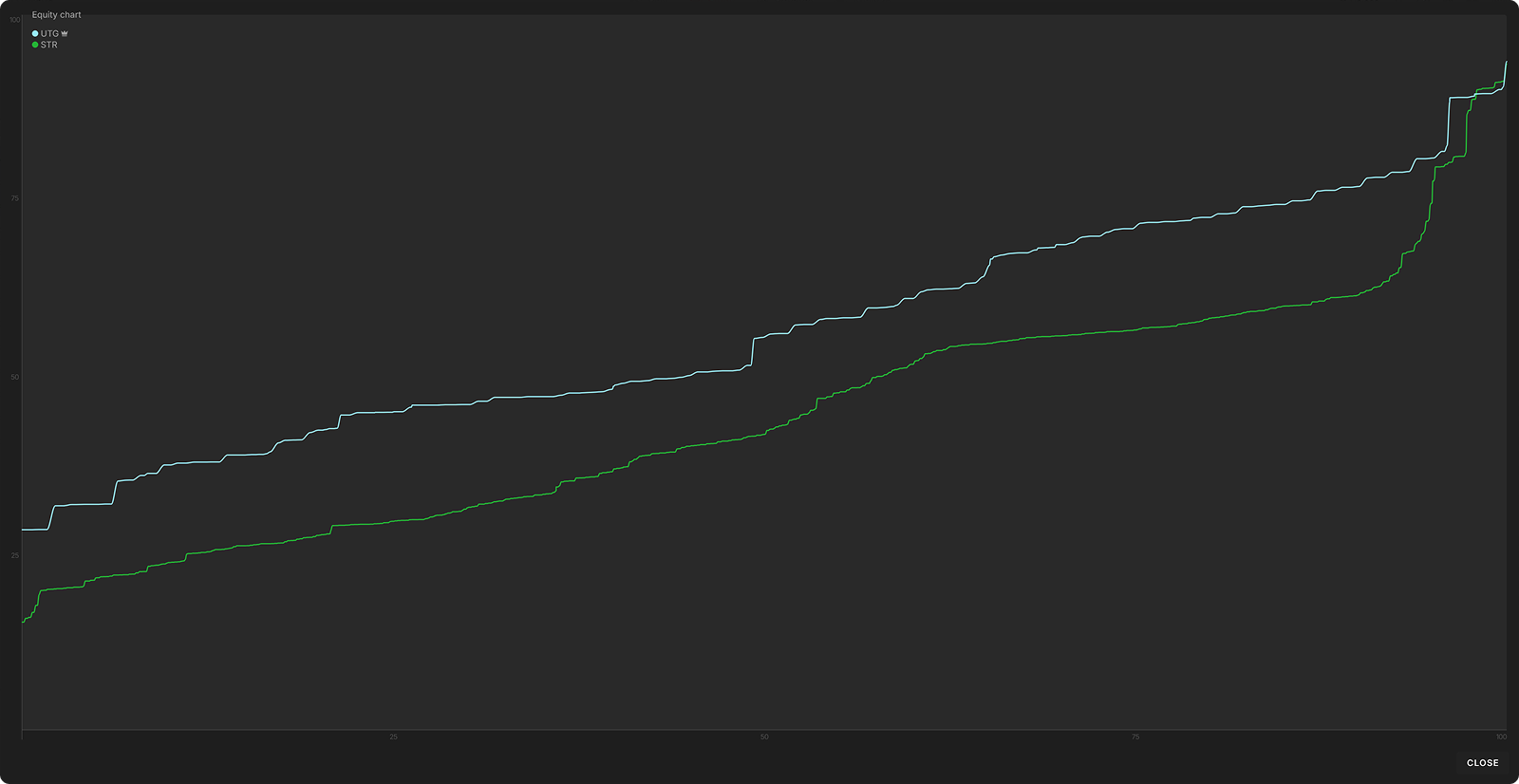
Importantly, that “trash” in BTN’s range is far from hopeless. It has a lot of equity. Even when UTG has AK or 99, they don’t particularly want to give free cards to QTo.
Medium Connected Flop
We see a similar effect on 986tt. UTG does a bit of c-betting on this flop even in the two-blind game, but they are much more interested in c-betting into the wider, weaker range of a BTN straddler.


Broadway Flop
Unlike the low and medium connected flops, a Broadway flop like AQJr is a very static board. If you flop top pair or a straight, you don’t need to worry about your opponent turning a higher one. This makes it one of the best boards for UTG to c-bet in the two-blind game.
Their c-bet in that scenario is small, however, because they have more of an overall range advantage than a nuts advantage. BTN never has Aces, but they do have KTs, JJ, and even QQ in their range.
Two-Blind on AQJr

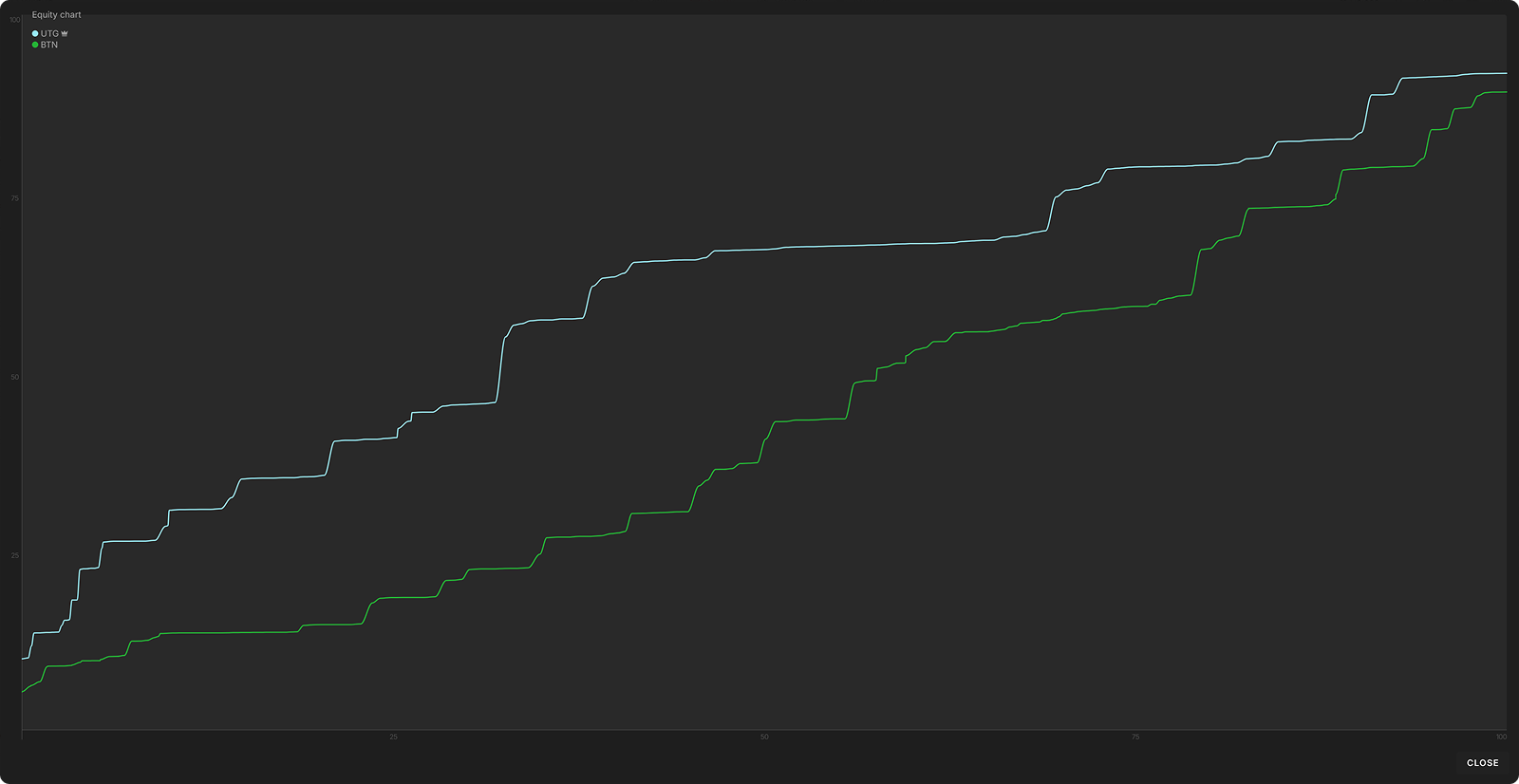
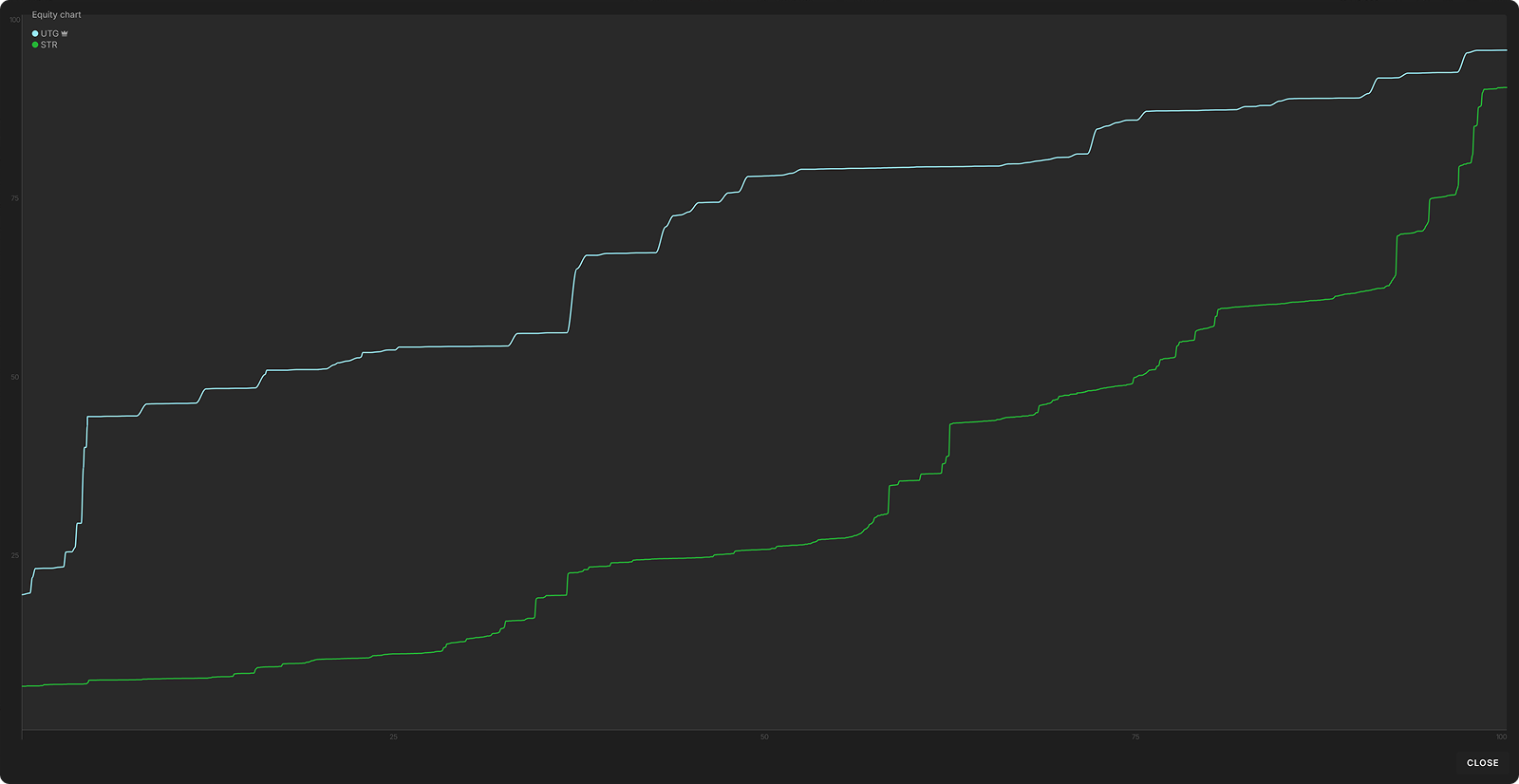
A BTN straddler still has those hands, but they have them much less frequently because their range is diluted by all their weak calls. This magnifies UTG’s advantage at the bottom end of the ranges but also gives them more of an advantage at the top end, which is why we see so many larger c-bets in their strategy.
Button Straddle on AQJr

Low Disconnected
742r plays out a lot like 763tt. Remember, it was not really the threat of the straight that deterred UTG from c-betting; it was the dynamism of the board. 742r is almost just as volatile for pairs, and while it does not have a flush draw, it still has a decent amount of straight draws.


Without the risk of running into a straight or monster flush draw, UTG has more leeway to bet wider and larger into a BTN straddler than they would on 763tt.
Low Paired
A low paired flop like 552tt is nearly as dynamic as 763tt or 742r, but it’s harder to get a piece of.
This is a rare instance where larger c-bets show up in the two-blind strategy but not when playing against a BTN straddler. This is because a BTN caller in the two-blind structure will almost never flop trips, while the BTN straddler’s wider preflop range actually gives them a higher proportion of nutted hands. Their range is overall weaker, which is why UTG bets more often, but they are less interested in growing a large pot even with their best hands.


Medium Paired
On 886tt, we’re back to the familiar dynamic where UTG c-bets more often into a BTN straddler but strictly uses a smaller bet size in both structures. Unlike on 552tt, BTN has a meaningful amount of trips even when they are not calling off a straddle.


High Paired
KK5tt is a really good flop for UTG in both structures. They bet even more often into a BTN straddler, but they have a high betting frequency either way. As on 886tt, the presence of trips in BTN’s range makes large c-bets less desirable.


There are many more flop textures we could look at, but I think the patterns are pretty clear by now. A BTN straddler will have a very wide and weak calling range, more akin to a BB calling range than a BTN cold-calling range in a traditional, two-blind structure.
Thus, UTG’s c-betting strategy looks more like how it would be against a BB caller than against a BTN cold caller. That is, they mostly want to bet small at a high frequency, even on board textures that would be quite bad against a cold caller. Only on the best board textures, those UTG would c-bet at a high frequency even into a BTN cold caller, do they start using larger c-bets against a BTN straddler.
Being out of position makes betting a little less appealing on the most dynamic boards, but even then, they can bet something like half their range. The critical thing is to keep your focus not on how BTN might have hit the flop, but on how many hands they will have that missed it entirely. The wider calling range of a BTN straddler means they will always have a lot of those, and they are your primary targets when you c-bet small.
When Ranges Run Closer Together

The formation we’ve been looking at so far, with UTG min-raising and the BTN straddle calling, is one of the most extreme in terms of the disparity between the ranges.
- UTG takes on enormous risk raising into five opponents, including a BTN straddle who will very likely call if no one else does. Consequently, they have a very strong range.
- BTN receives a 50% discount on their call and closes the action, resulting in an extremely wide and weak range.
This is why UTG gets to c-bet so often despite their positional disadvantage.
Let’s briefly consider a different formation where the ranges run closer together, just to see how it influences the patterns we’ve identified. This time, we’ll look at a 3x open from CO and a call from the BTN, both in a two-blind game (where a 3x open is 3bb) and in a Mississippi straddle game (where a 3x open is 3str or 6bb).
Despite the larger size, CO’s raise is less risky than UTG’s, because they have only one player behind them. Thus, they have a wider range than the open raiser in our previous scenario. The BTN straddler, meanwhile, gets less of a discount on a 3x raise and so folds more of their worst hands. The raiser still has the stronger range, but the disparity is less than in the UTG vs BTN formation.
KK5tt


763tt


AQJr


We see familiar patterns on many flops.
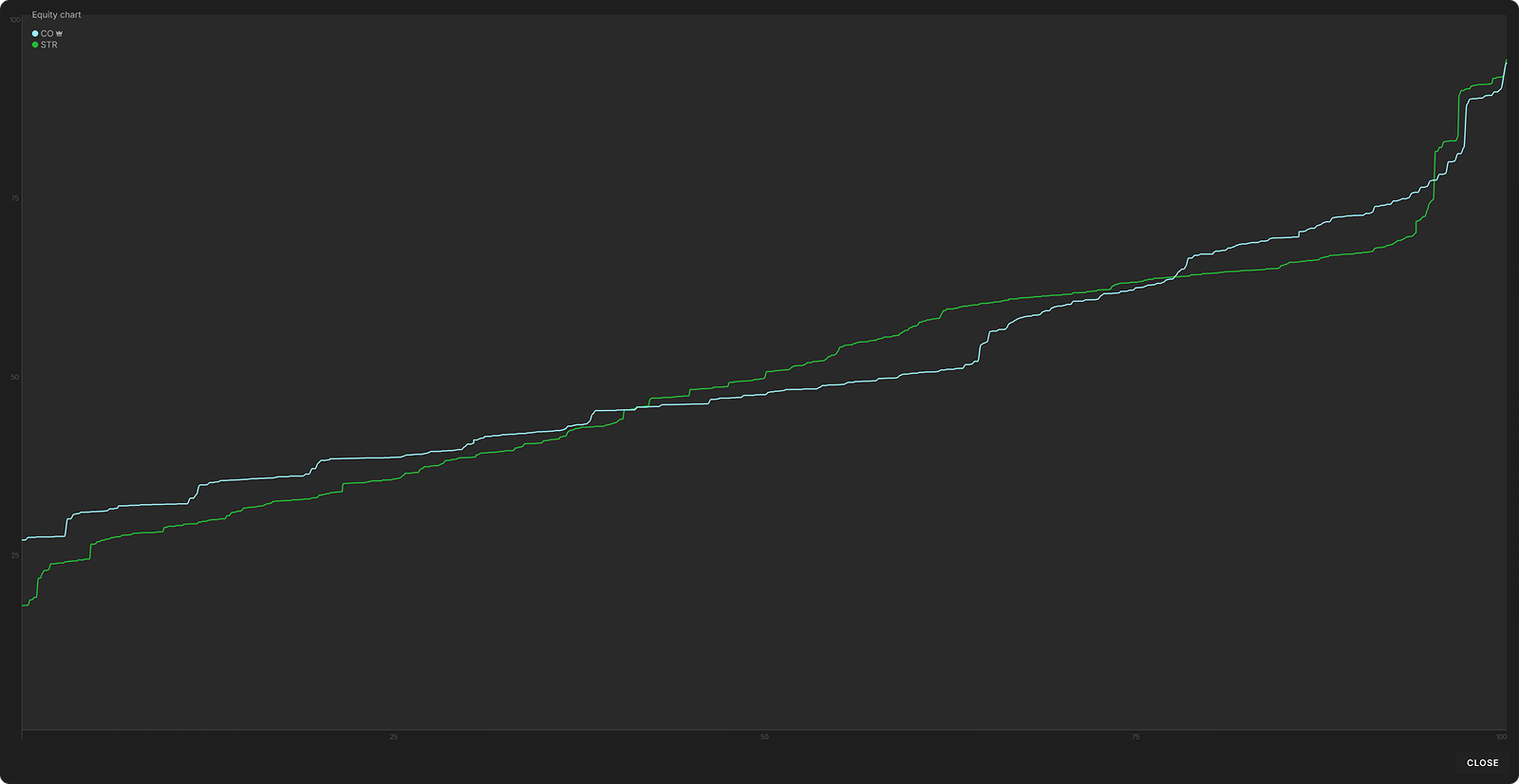
KK5tt is not such a good flop for CO in a two-blind game, so they bet less often, with a more polar range. All the trash in the BTN straddler’s range incentivizes CO to c-bet much more often, but for a smaller size.
AQJr is a great flop for CO even in the two-blind game. It gets even better against a BTN straddler, so CO adds some larger c-bets to their strategy.
763tt is an interesting one, though. CO bets rarely even against the BTN straddler. The equities run quite close on this board, but unlike UTG, CO does have 54s in their range, which facilitates some bigger bets.
Conclusion
You may have internalized the idea that the preflop raiser should often check the flop if their raise is called by an in-position opponent, as opposed to by one of the Blinds. You may even have learned this from me! This is good heuristic, but as with all poker “rules,” you must understand the underlying mechanics in order to apply it correctly in circumstances other than those in which it was derived.
In traditional two-blind Hold‘em, a BTN caller is considered a cold caller, meaning they had no money committed to the pot prior to their call. This means the risk they take on is roughly symmetric with that of the raiser, causing the equity of the two ranges to be quite close. With the extra liability of their position, the raiser should seriously consider checking the flop rather than continuation betting.
A BTN straddler who calls your preflop raise is not a cold caller. They are closing the action and getting a discount on their call, just as BB would in a two-blind game. However, they still have the advantage of position, so you can’t bet quite as aggressively as you would into BB, especially on dynamic boards. But your c-betting strategy vs. a preflop caller in the BTN straddle should have more in common with how you’d play against a BB caller in a two-blind game than with how you’d play against a BTN cold caller.
The key is to recognize how much incentive BTN has to call with weak hands preflop. This translates into their holding many weak hands on the average flop, hands to which you can deny equity with even a small continuation bet. On flops where you would frequently use a small c-bet even against a cold caller, you can use larger c-bets against a BTN straddler to deny even more equity!
Mississippi Straddles: How to Defend vs Raises
This is the second in a series of articles about playing in games with a Button or Mississippi straddle. You don’t need to read the first to make sense of this one, but as this article is about responding to raises, you may get more out of it if you understand the incentives around open raising when

Opening Strategy When the Button Straddles
A Mississippi straddle is when you straddle the button (put out a third blind). Action starts on the SB (after the straddle) and ends with the BTN. Straddling the Button, is considerably less disadvantageous than straddling Under The Gun, to the point where some people even think it’s advantageous (