Mississippi Straddles: How to Defend vs Raises


Overview
This is the second in a series of articles about playing in games with a Button or Mississippi straddle. You don’t need to read the first to make sense of this one, but as this article is about responding to raises, you may get more out of it if you understand the incentives around open-raising when there’s a Button straddle on. The most important things to know are:
- Open raises don’t have much chance of stealing the pot preflop, so they should be tighter and, in particular, oriented towards hands that will play well out of position after the flop.
- This is especially true for the SB, who is opening into seven uncapped ranges.
- BB opens wider, even compared to players in slightly better positions, because they already have 1bb committed to the pot.
- Early-position openers do best with minimum raises at equilibrium, but human players may employ larger sizes, and those larger sizes may even work well as an exploit.
Aggregate Data
Now let’s see how all this influences players’ responses to raises. We’ll start by looking at some aggregate data, then we’ll investigate some of the trends in greater depth. Try to notice some patterns in the data for yourself before you read on.
Response to 4bb Open in an Unraked Mississippi Straddle Game
[[[!TODO! INSERT FLOURISH]]]
Response to 4bb Open in a game with 10% Live Rake
[[[!TODO! INSERT FLOURISH]]]
Responses to an SB Open Are Extremely Tight
Logically, this makes sense. When SB has to act first, opening into seven in-position opponents, including a BTN who already has money invested in the pot and is quite likely to call if no one else does, they need a strong hand to open. So, other players need strong hands to contest their open, especially if they themselves are also in early position. But the extent to which this is true may still be surprising.
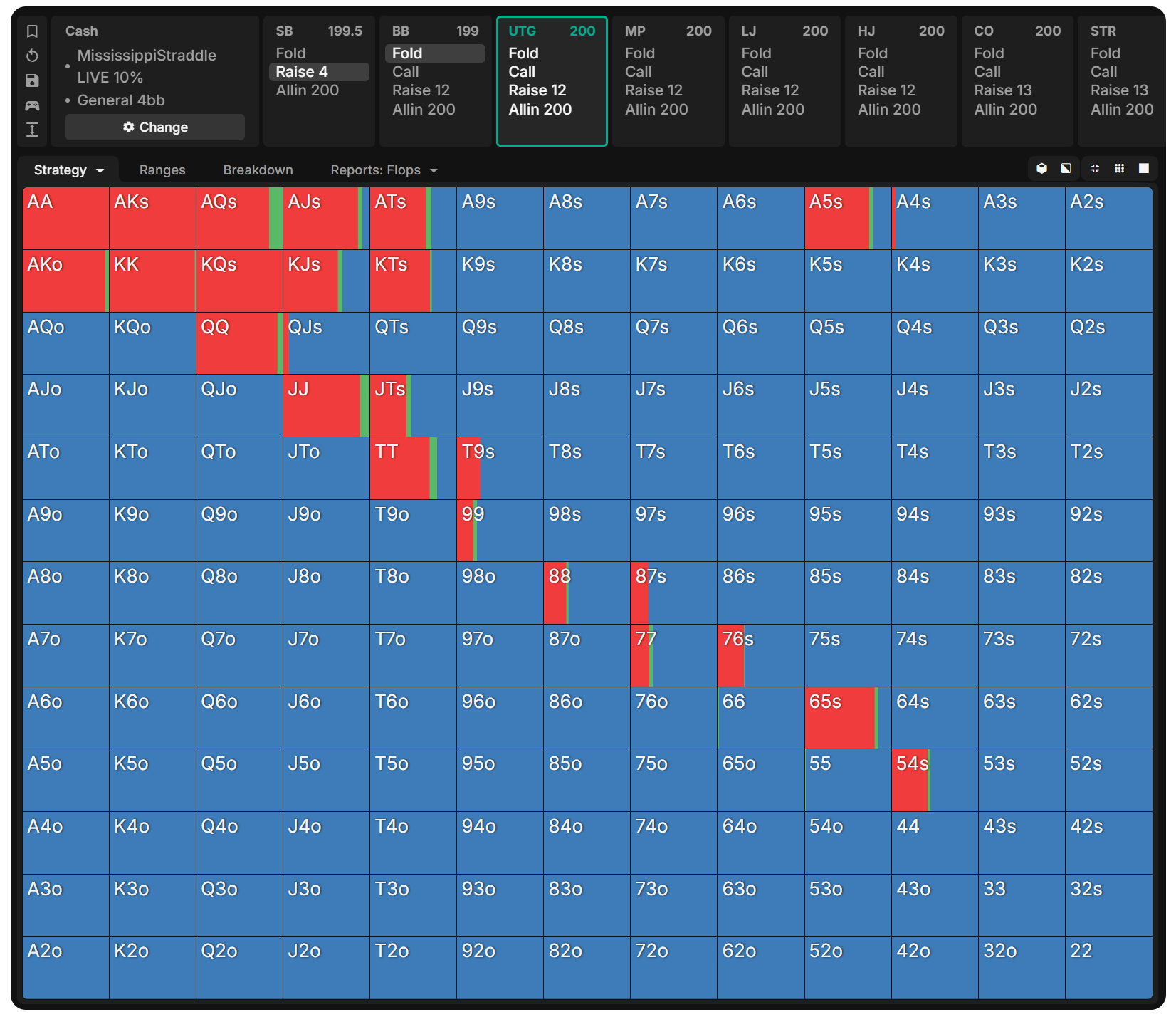
That’s the tightest possible configuration (BB contests a SB raise more often because they already have money in the pot), so other players don’t respond quite so tightly. But it gives you an idea of just how strong SB’s opening range ought to be!
BB’s response isn’t just looser than UTG’s. We have to get all the way around to the HJ before we find another player who VPIPs as often as BB does against an SB min-raise.
That’s primarily a function of SB using a min-raise in this simulation. That’s the solver’s preferred raise size, but it may not be a human player’s first choice. Facing a larger raise, BB still plays a few more hands because of the money they already have in the pot, but that money represents a smaller fraction of the raise, so the difference is less dramatic.
Calling Is an Option, Even in a Raked Game
The straddle substantially improves the odds for calling relative to a traditional, two-blind game. Alternatively, 3-betting a strong open is risky.
In the raked game, most calling frequencies are below 1%, but I’m not rounding them to 0. That’s because the VPIPs in these configurations are very low to begin with.
For example, LJ calls an SB raise 0.7% of the time. That may not sound like much, but it amounts to about 10% of their VPIPs. If we hone in on the CO, roughly a quarter of their VPIPs against most min-raises are calls.
All these calls are mixed strategies, so in a tough game, you could simplify your response to 3-bet or fold without giving up much. In a soft game, however, calling small raises is worth exploring, even when the pot is raked.
The fact that CO calls so much more often than other seats suggests the major risk of calling is getting squeezed. Once the only player remaining to act is the BTN, that risk goes way down, because BTN’s straddle gives them a lot of incentive to call with hands they might otherwise raise, especially when the opener’s range is strong.
When you’ve got KJs in the LJ facing a UTG raise, calling could be appealing if it will invite a loose HJ or CO to call behind with dominated hands like KTo or QJo. Calling is especially appealing when facing a strong, early-position opening range.
BTN’s Responses Are Extremely Loose and Passive
Unlike in a two-blind structure, a BTN straddler gets a discount on calling and typically closes the action with their call. This makes calling quite appealing for them, relative to both raising and folding. BTN makes some concessions for very strong opening ranges, such as when SB raises, but they hardly ever fold to late-position raises in an unraked game.
BTN does 3-bet relatively more often against late-position raisers, as more hands are strong enough to want to play a larger pot against a late-position opening range. Facing an early-position open, BTN is generally happy to take a cheap flop IP but rarely wants to grow the pot or open themselves up to a 4-bet.
Because so many of their calls are motivated by pot odds, BTN’s responses are more influenced by rake and raise size than those of other players. Mostly, they fold more often in raked games or when facing a larger raise. Rake also incentivizes them to 3-bet more often, while a larger raise size reduces the incentive to 3-bet, as it indicates a stronger range.
Overcalling
Overcalling is an option, especially in an unraked game, even in tight configurations. For example, facing an SB open and a UTG call, MP can overcall some hands that have good multiway equity, mostly big suited cards and medium pocket pairs:
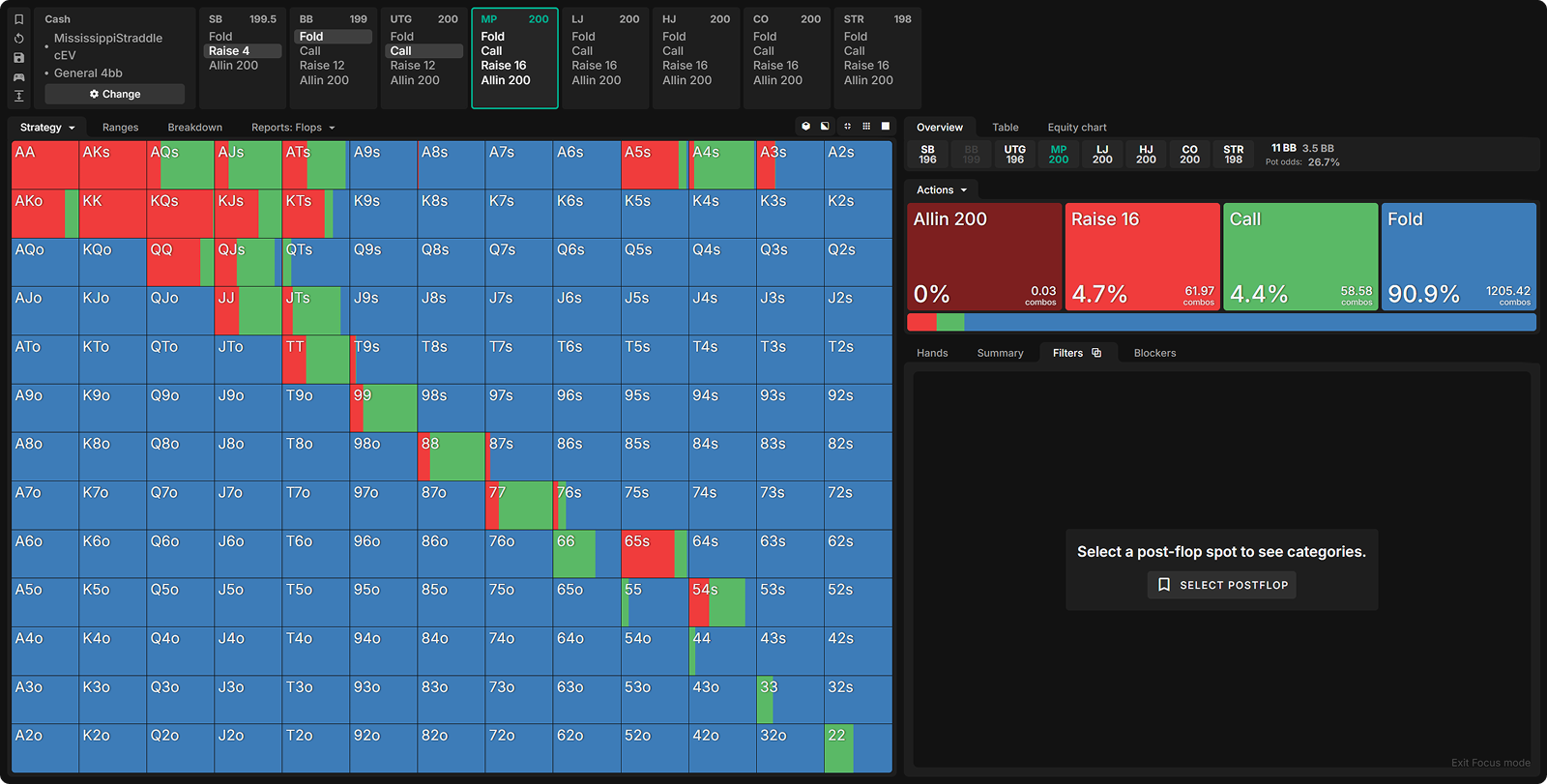
As with the first caller, the overcaller is mostly constrained by the risk of squeezing. In passive games, you should be a little more inclined to call with these sorts of hands. CO, having less to fear from squeezes, gets in there with all the pocket pairs and suited Broadways:
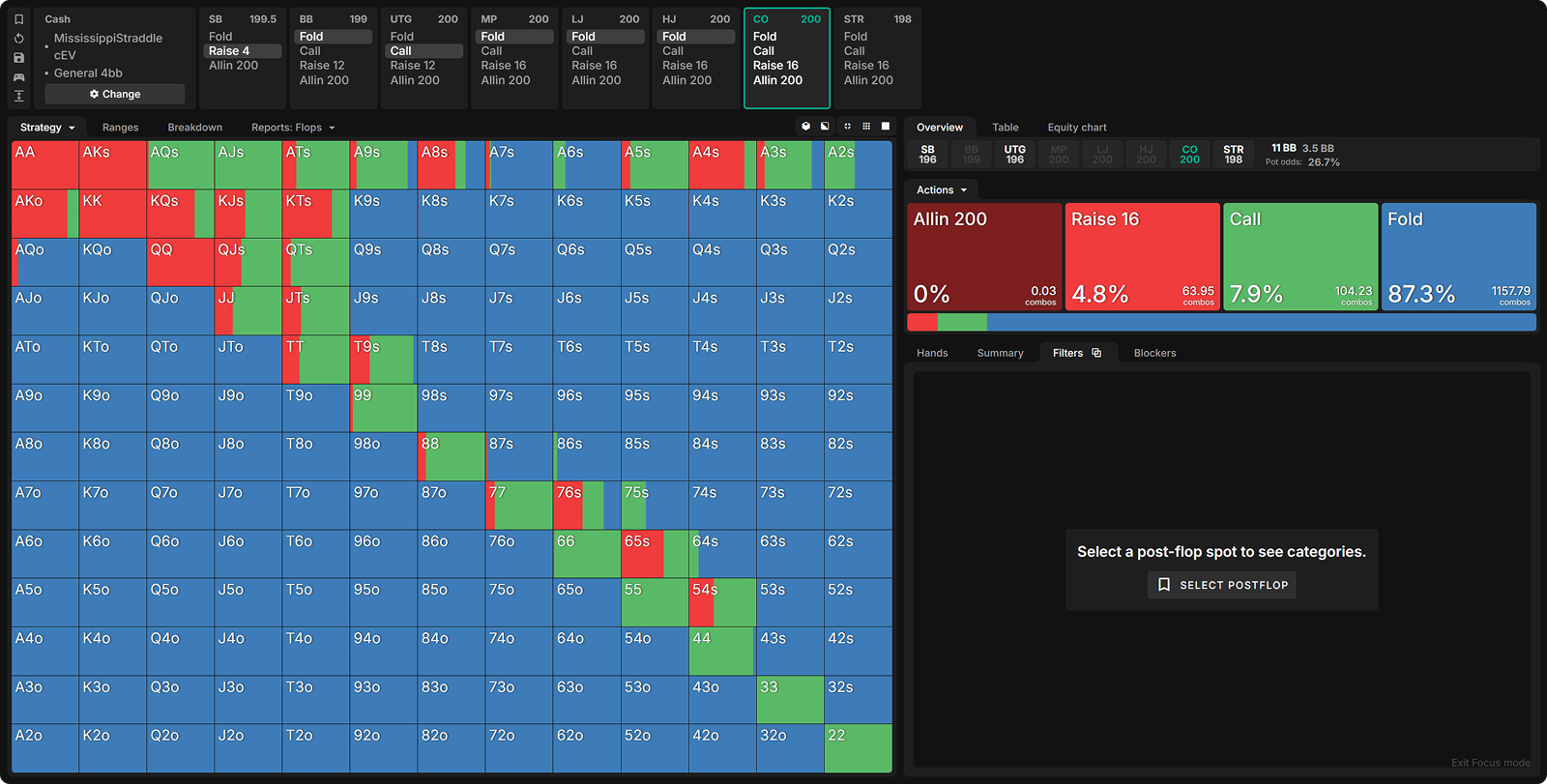
A looser configuration adds some suited Ace-x and offsuit Broadways to CO’s overcalling range, but the biggest change is much more aggressive squeezing with the suited Broadways that were overcalling in the tighter configuration:
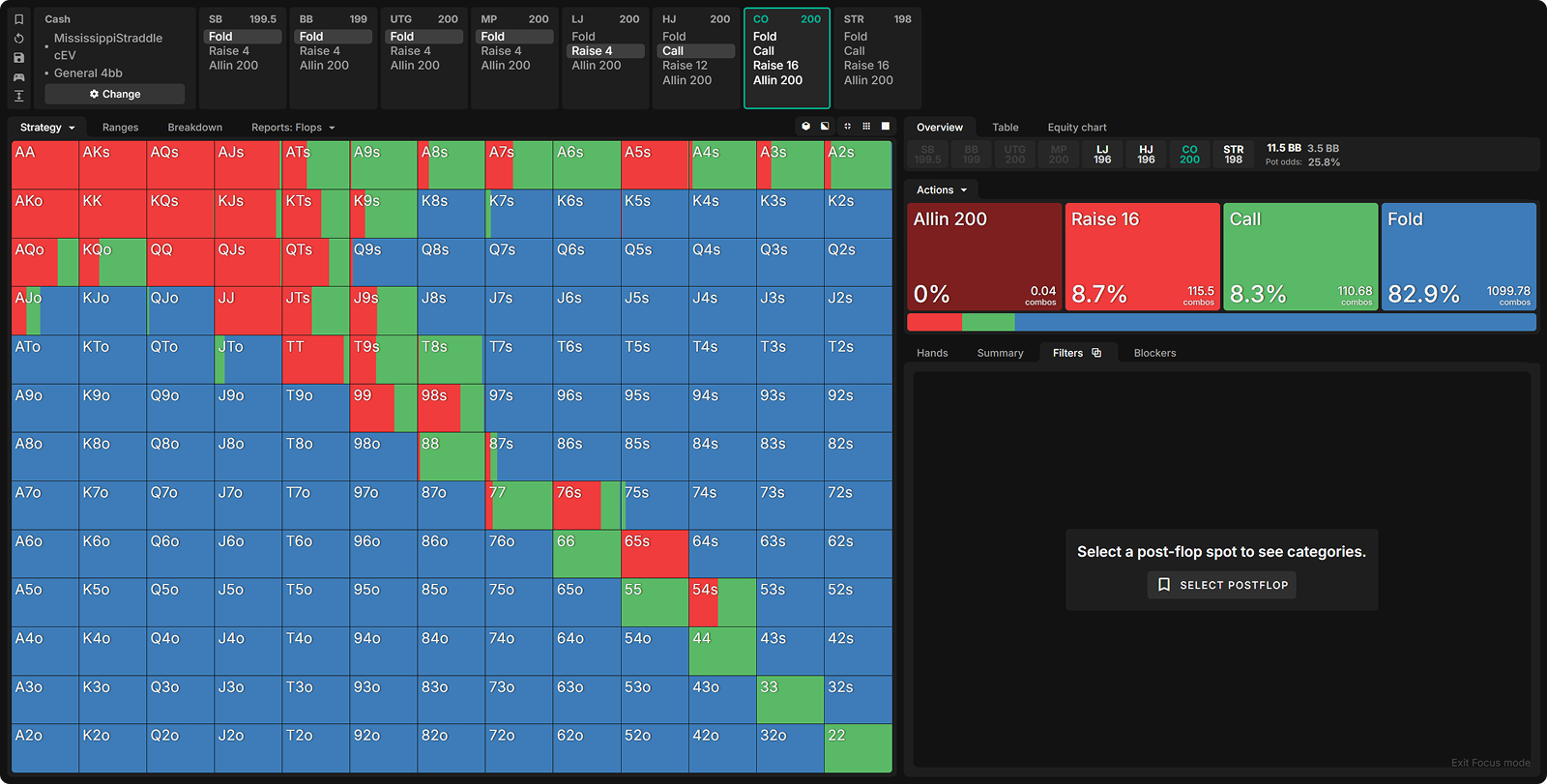
Introducing (10%) rake compels CO to overcall even less than MP would in an unraked game:
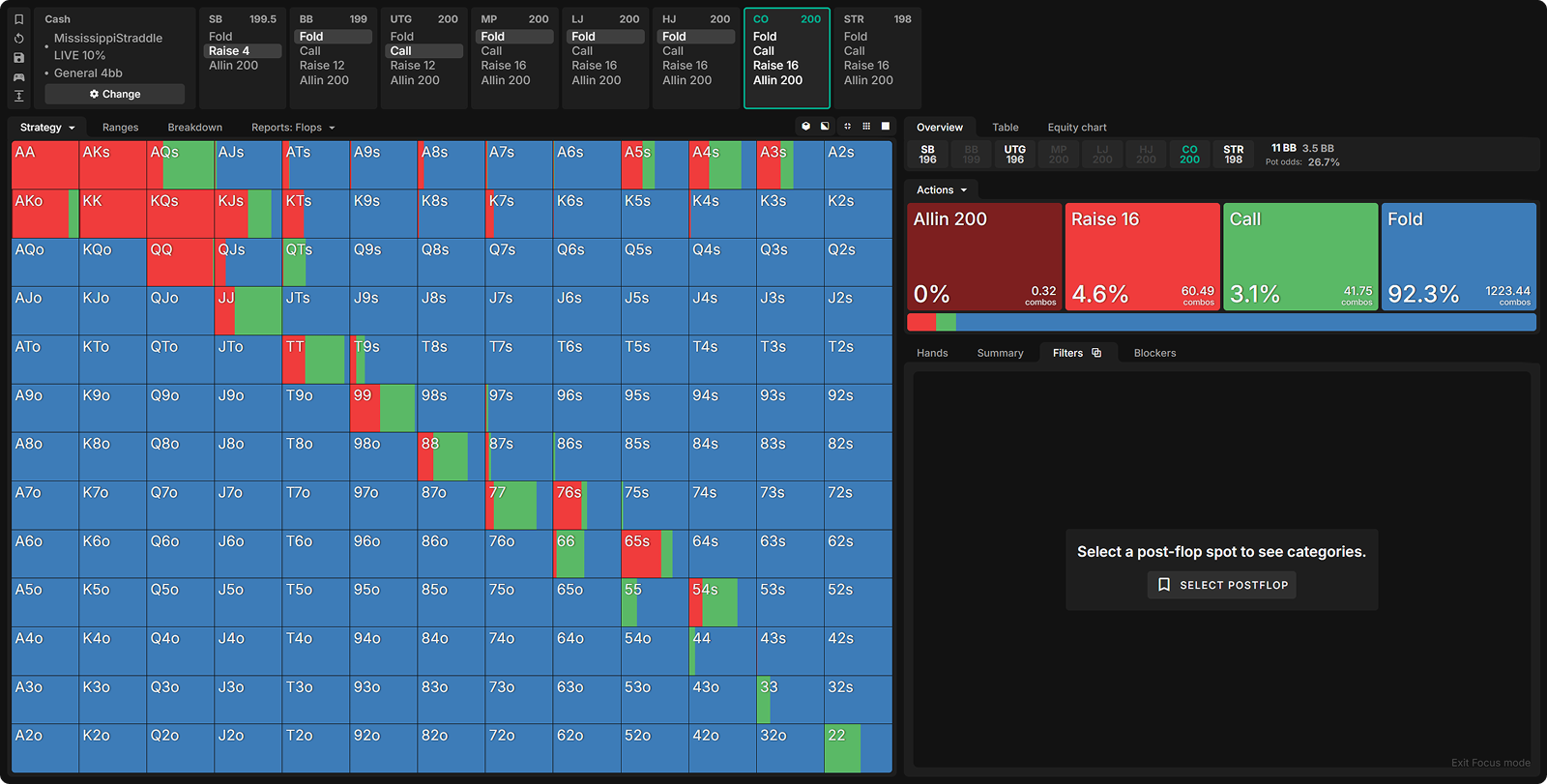
Even BTN overcalls a lot less in a raked game:
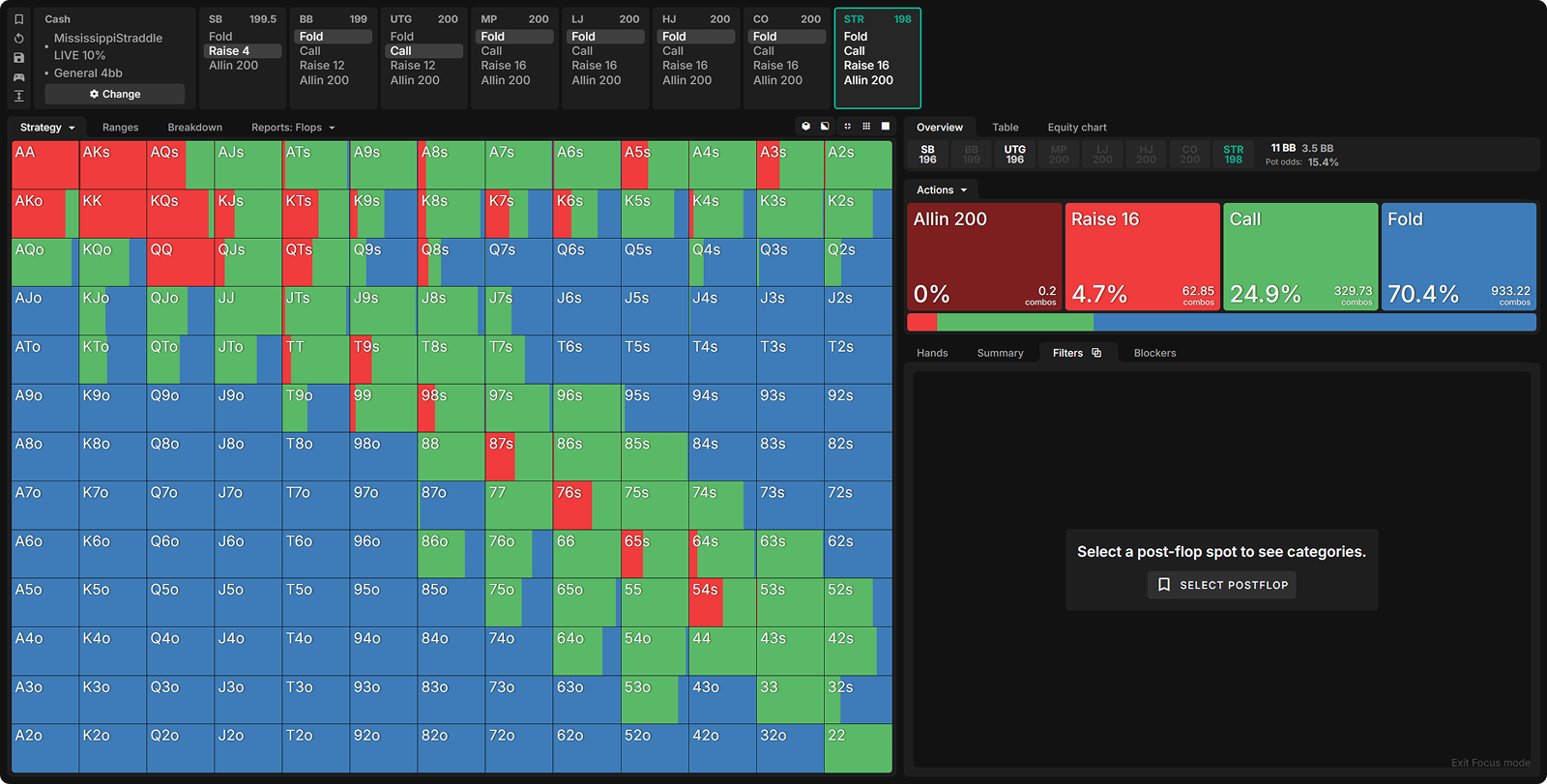
Without rake, BTN can overcall with pretty much anything suited and all offsuit Broadways, even in the tight configuration:
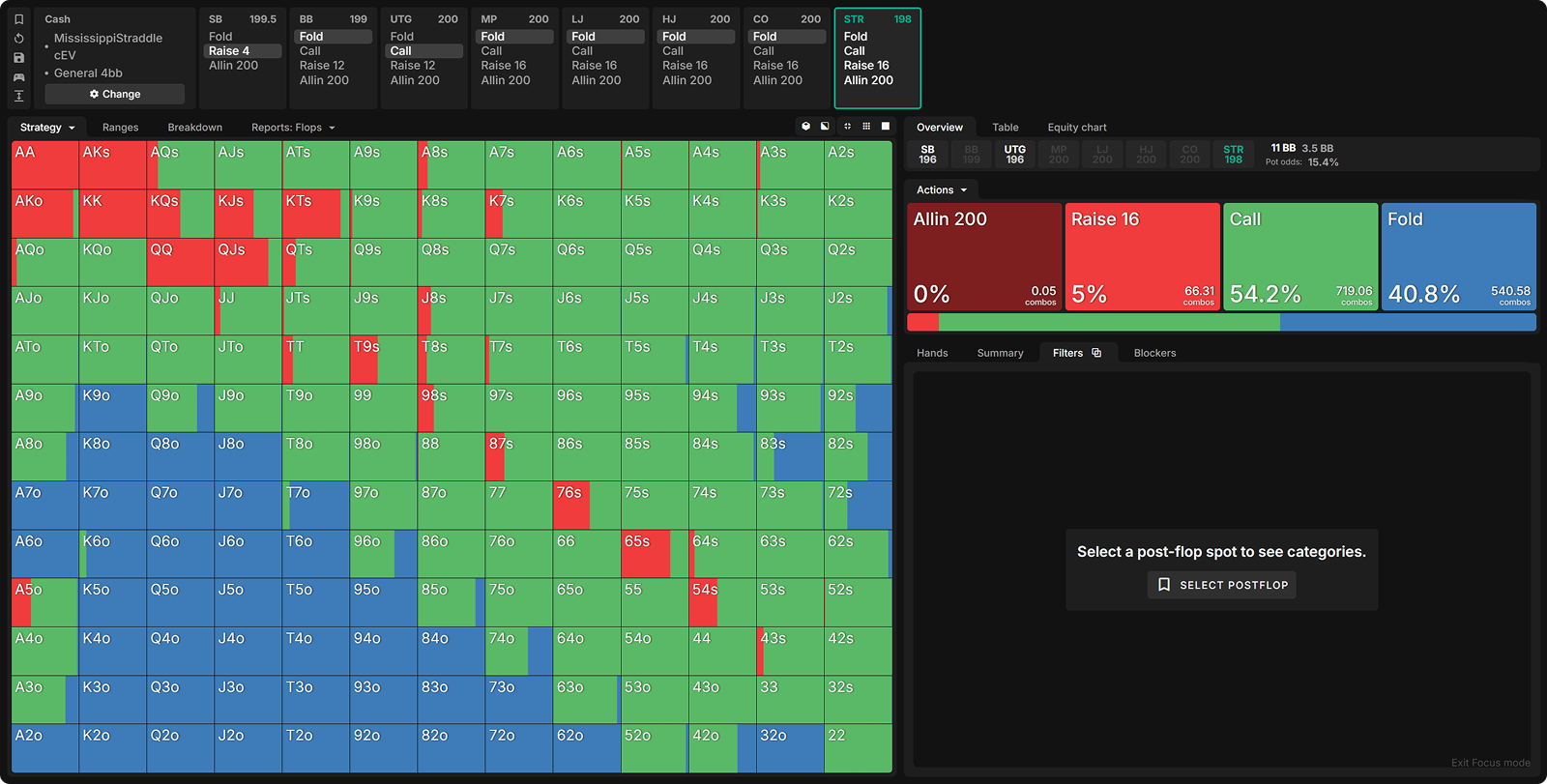
As with CO, a looser configuration incentivizes BTN to call with more offsuit hands and to squeeze the suited Broadways:
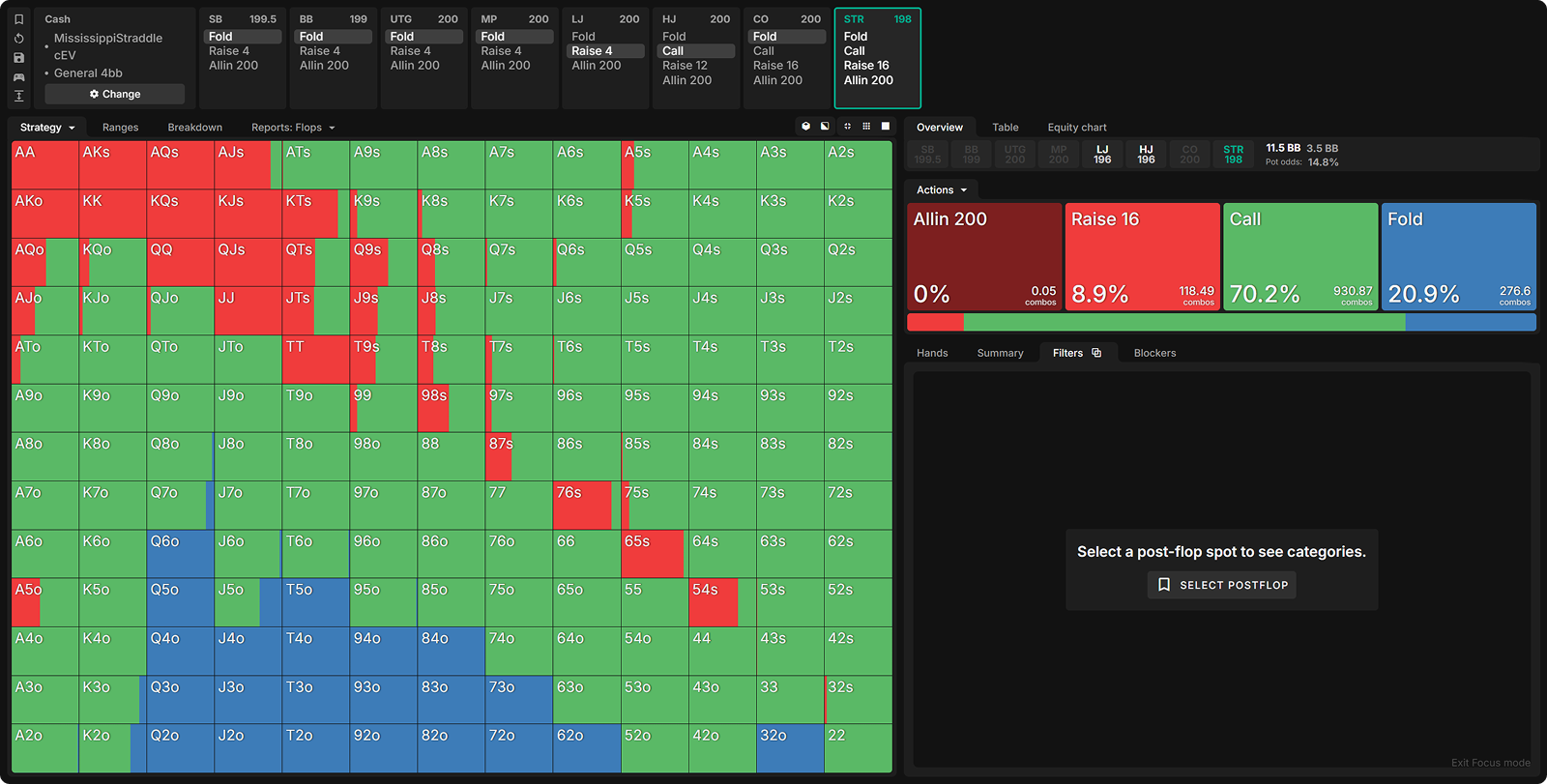
Conclusion
You’re in a tough spot when facing a raise with a Mississippi straddle behind you. You’d like to 3-bet to discourage BTN from calling behind you, but raising into what is presumably a strong opening range is a dicey proposition. The upshot of all this is you mostly just need to respond quite tightly, folding often even to small raises.
When you do have a hand with which to contest the pot, 3-betting is more common than calling at equilibrium, even in unraked games. In raked games, calling is even less preferred, though it is still in the mix and so an option to consider in more passive games.
With a raise and call in front of you, you should be tighter yet. How much you call versus squeeze depends on the position of the original raiser. Against a tight early position open, you rarely squeeze and call only with hands that play well multiway, mostly pocket pairs and suited Broadways, and not even all of those. Against a wider late position open, the better pairs and suited Broadways make good squeezes, and you can call with some offsuit hands that will dominate some of the opener’s wider range.
Only BTN gets to have a wide calling range, thanks to the money they already have in the pot and the fact that their call closes the action. In fact, calling is so good for them that they 3-bet less than players in worse positions. This is especially true facing small raises in unraked games, as rake cuts dramatically into their otherwise appealing pot odds.
Ready to practice your new skills? This drill tests your ability to react to different positions, stack depths, and raises in unraked games. This drill does the same for 10% Live rake games.

Mississippi Straddles: Building a C-Betting Strategy vs. BTN
A Button straddle, also known as a Mississippi straddle, changes the preflop incentives of all players. If you’re interested in learning more about exactly how those incentives change, you can read about opening ranges and responding to opens in Mississippi straddle games. In this article, we will i

Opening Strategy When the Button Straddles
A Mississippi straddle is when you straddle the button (put out a third blind). Action starts on the SB (after the straddle) and ends with the BTN. Straddling the Button, is considerably less disadvantageous than straddling Under The Gun, to the point where some people even think it’s advantageous (