Opening Strategy When the Button Straddles


Overview
Games that involve straddling are usually pretty good.
A Mississippi straddle is when you straddle the Button (put out a third blind). Action starts on the SB (after the straddle) and ends with the BTN. Straddling the Button is considerably less disadvantageous than straddling Under The Gun, to the point where some people even think it’s advantageous (which it is not). Point being, players are more likely to straddle when they can do so on the BTN, so you should actively seek out games where that’s allowed.
Adapting to a BTN straddle is less intuitive than adapting to a UTG straddle. This article will discuss how a Mississippi straddle changes the incentives of other players contemplating an open-raise.
A Few General Notes About Straddles
A BTN straddle changes the game more dramatically than a UTG straddle, and we will examine those differences in this article. That said, a Mississippi straddle is still a straddle, so much of the general advice applies here as well. You may wish to read our article on straddles before proceeding. There are a few key points to note, which are explained further in that article:
- Straddling the BTN is less bad than straddling UTG, but putting money into the pot without looking at your cards is still a money-losing proposition and not generally something you should do if you can avoid it.
- Straddles essentially cut the effective stack in half (slightly more than half, actually) by doubling the big blind. We will look at 200bb simulations for this article, because that translates to 100 straddles, which most closely resembles the 100bb ranges most cash game players will be used to from two-blind games.
- If the entire table agrees to Mississippi straddle, this could be to your advantage as a winning player. The shallower stacks will probably lower your win rate as measured in big blinds, but because a straddle is twice the size of a bb, winning something like 5 str/100 in a Mississippi straddle game would be better than winning 7 bb/100 in a traditional, two-blind game.
What’s Special About a Mississippi Straddle?
UTG Straddle
Playing with a UTG straddle mostly feels like playing a two-blind Hold‘em game. People double their raise sizes, but other than that, things proceed as usual. Action still starts to the left of the players who bet blindly (of which there are three rather than two) and proceeds clockwise.
BTN/Mississippi Straddle
A BTN straddle changes the tenor of the game more fundamentally. The Blinds act first, which, as we will see, puts them in an extremely awkward, unprofitable spot. Everyone else acts with the advantage of knowing what the Blinds did, but also with the “disadvantage” that the Button already has 2bb (1str) invested in the pot, and so is more likely than usual to contest a raise.
This is especially true when the Mississippi straddle is voluntary, i.e., when someone chooses to do it even though it has not been agreed that the entire table will do so. A person who voluntarily puts money into the pot blind has signaled a willingness to take -EV gambles, so while it is theoretically correct for them to defend their straddle vigorously anyway, you should expect that a voluntary straddler may be even more reluctant to fold.
It’s generally a good thing for you if other people are straddling and you are not. However, if a player on your right is routinely straddling the BTN when you are in the Blinds, that’s fairly bad for you, and it would be worth changing seats if you can.
Opening From the SB
The Blinds are always the worst seats at the table, of course, but usually this is offset by acting last preflop. Acting first means they lose their blind bet far more often, because of scenarios where the only action is a late position open, which they could have contested had they known everyone else was going to fold.
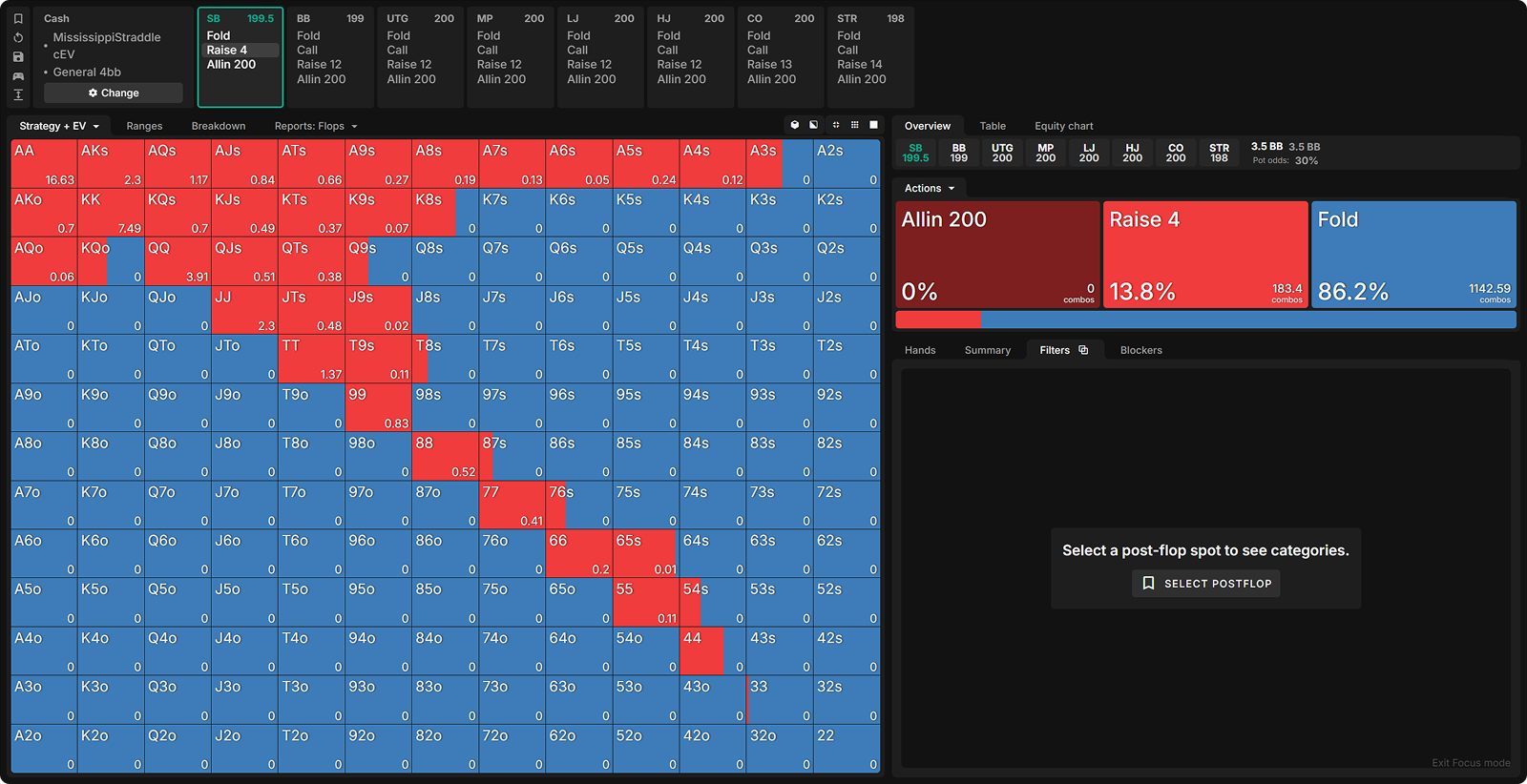
SB opens actually not that much tighter than UTG, as their worse position is somewhat offset by already having live money in the pot. The actual disadvantage of playing from the SB is losing half a blind on ~86% of hands that fold.
Here is SB’s strategy for opening with a minimum raise (the simulations in this article all come from 200bb unraked games unless otherwise specified):
Raising larger only makes matters worse. The only hands with a higher equilibrium EV, as part of a 7bb raising strategy, are AA and AK. Quite a few hands fare worse, including many that simply {{tooltip-title: fold}} because they cannot profitably put so much money at risk from such an early position:
{{tooltip-content: fold}}
Folding frequency increases from ~86% to ~90% (as the allowed raise size increases from 4 to 7bb)
{{/tooltip-content}}
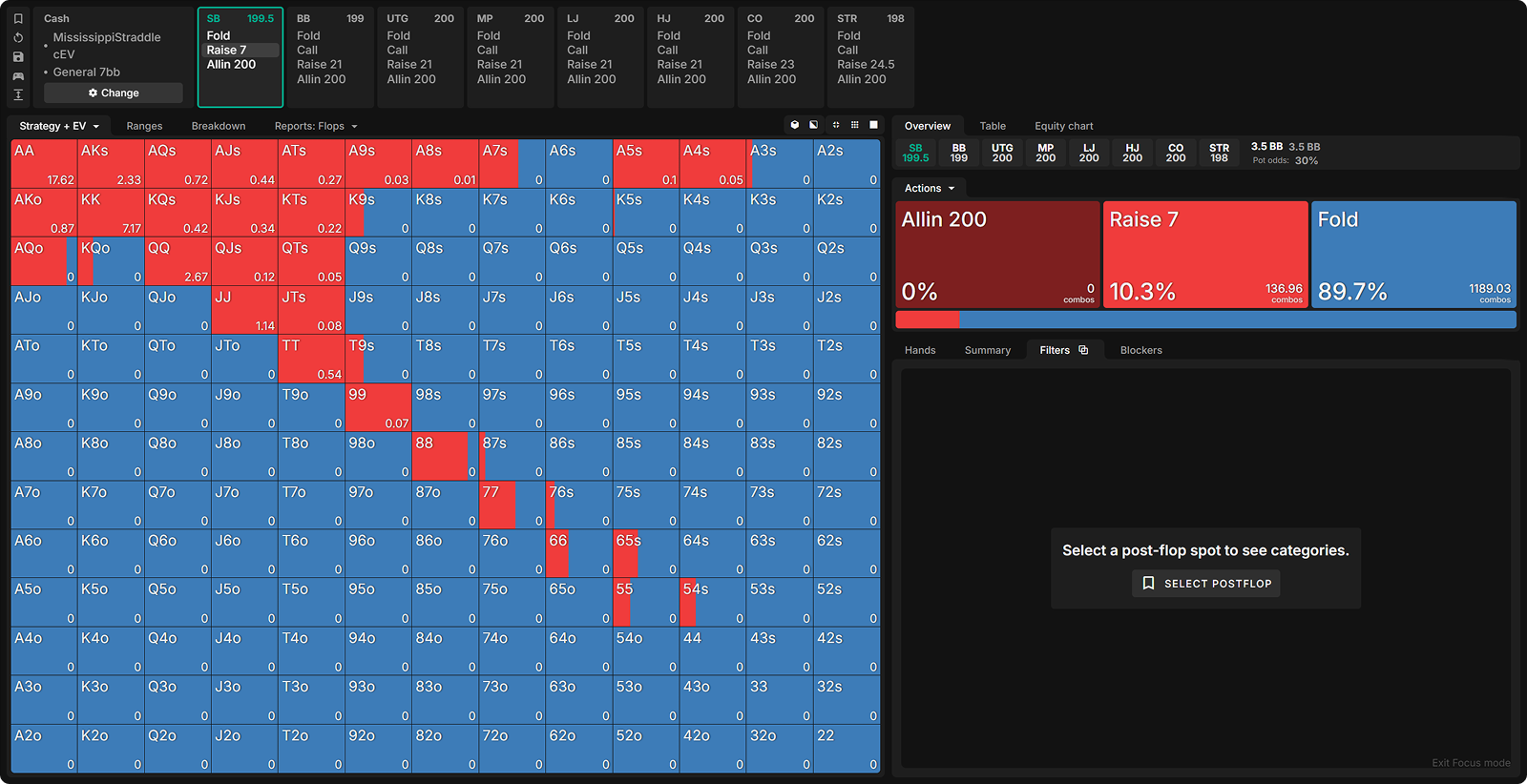
That said, larger raises could still be an appealing exploit under the right game conditions. Much of the appeal of a small raise for strong hands like KK is that they should often induce 3-bets. Against looser and more passive opponents, folding some of the weaker opens in this chart but raising larger (with a stronger range) could be an appealing adjustment, even from early position.
When SB opens, they are very likely to end up contesting a pot postflop from out of position (OOP). Even if everyone else folds, BTN will be getting a great price to call thanks to their straddle. So, SB’s opening range is constructed with this in mind. They open only the very best offsuit hands, and even suited connectors and small pocket pairs are dicey. Mostly, they want to play big pocket pairs, suited Broadways, and suited Ace-x.
Opening From the BB
The BB faces a similar dilemma. However, when playing a 4bb raising strategy, {{tooltip-title: the BB can open a good deal more hands than the SB}}. In fact, they open even more than UTG! This is because they get a 25% discount on a 4bb raise.
{{tooltip-content: the BB can open a good deal more hands than the SB}}
Raising (4bb) frequencies by position:
SB ≈ 14%
BB ≈ 19%
{{/tooltip-content}}
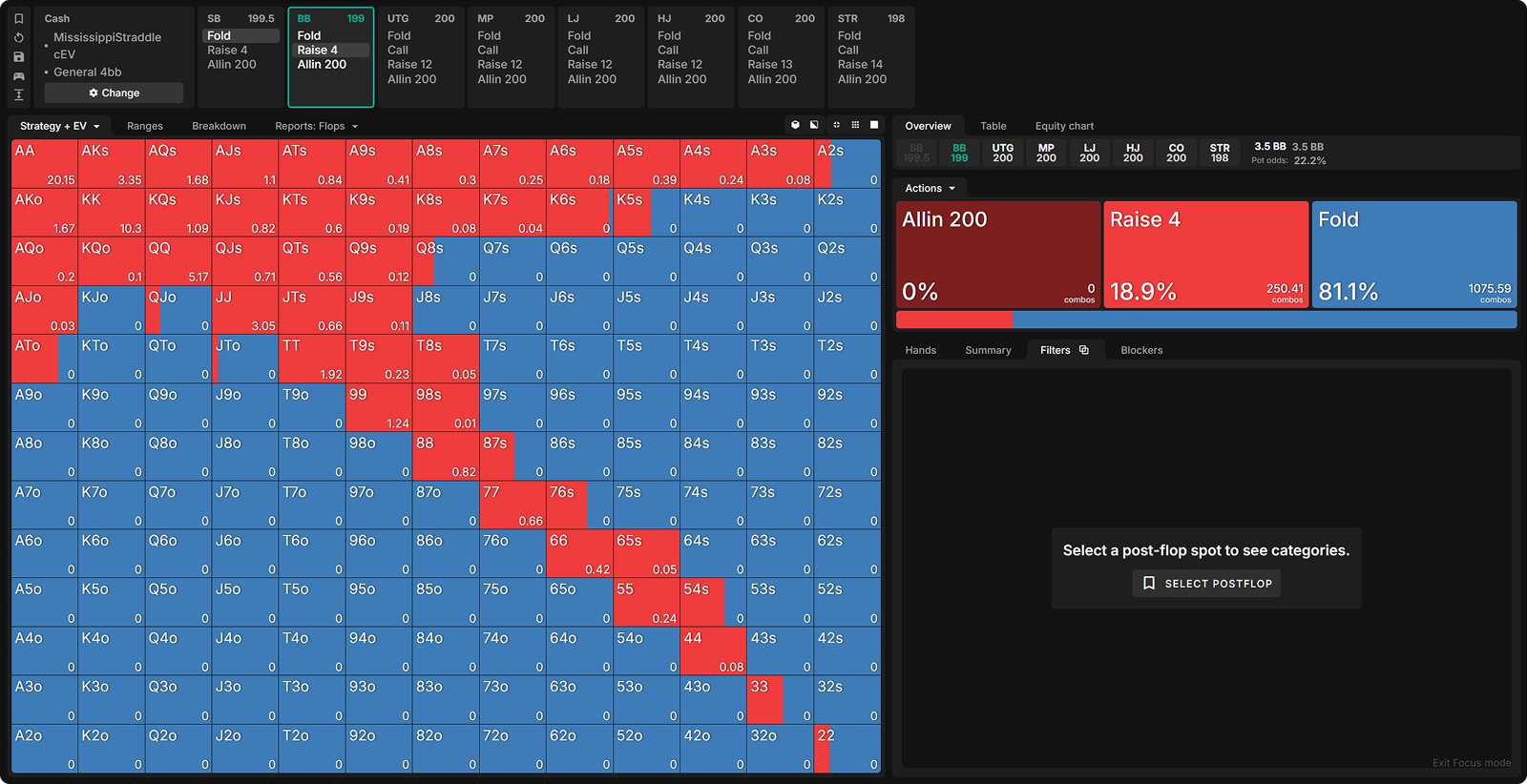
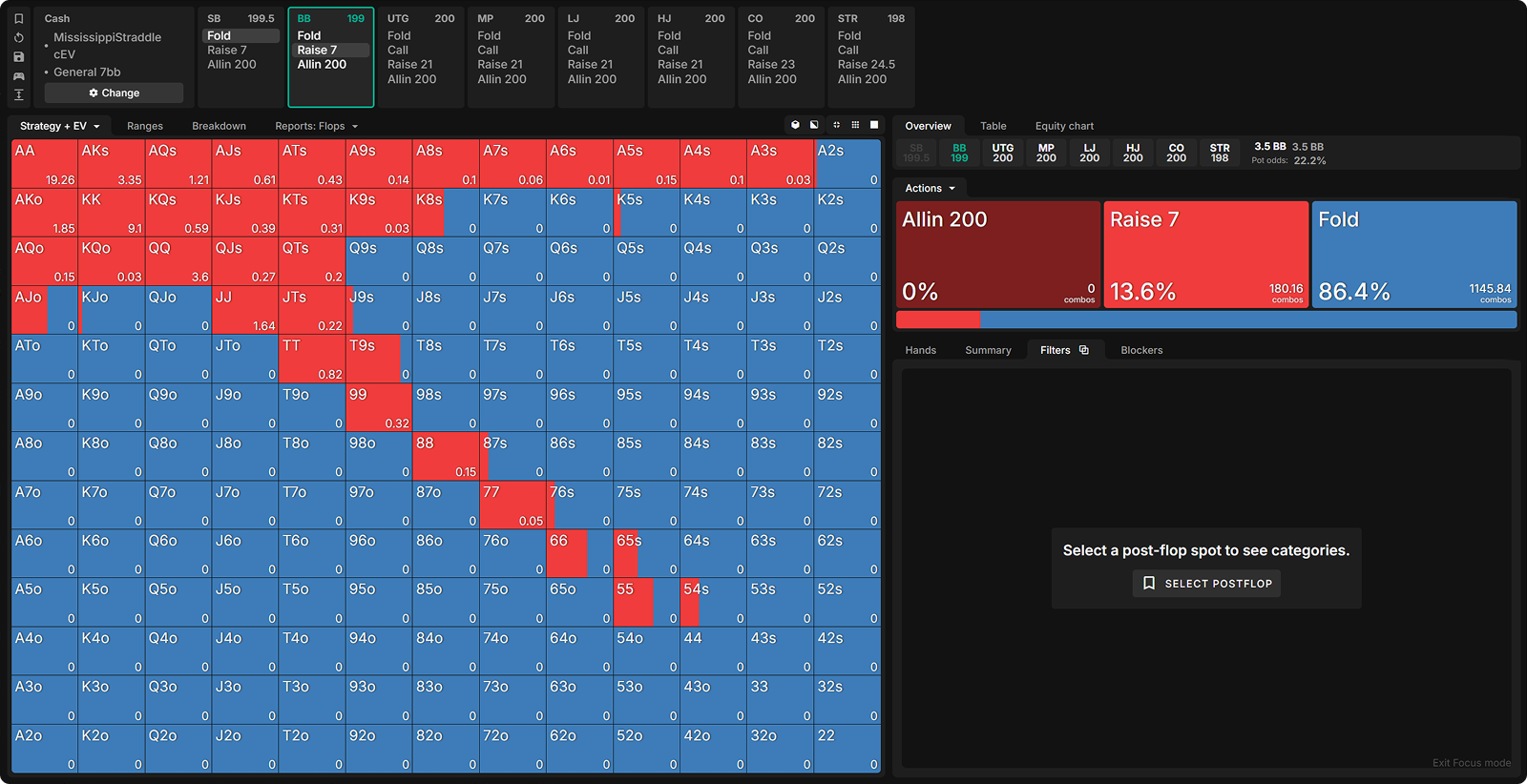
This also makes a 7bb raise strategy even worse for them than for SB, as it dilutes the “discount” they are getting for already having 1bb in the pot. The only hand that performs better for the BB at equilibrium, as part of a 7bb strategy, is Ace-King offsuit. Even pocket Aces achieve a higher EV when min-raising!
The best way for BB to take advantage of their “discount” is by calling, which will cost them half as much as any other player (excl. the SB)! Unfortunately, calling is not part of the game tree in our simulations, so we can’t say for certain whether it would be part of BB’s equilibrium strategy. I strongly suspect it would be, however. And in any event, it’s well worth experimenting with against human opponents that are often too passive and won’t punish us for it.
You probably aren’t accustomed to open-limping in traditional cash games, but then, you aren’t accustomed to getting 3.5:1 odds for doing so, either (except in the SB, where it often does make sense to limp).
Some of these hands will end up folding to a raise, but that’s ok. You don’t know for certain that someone will raise, and when you’re getting such good odds, it’s essential to distinguish between “someone will probably raise” and “someone will definitely raise.”
You may limp hands that will call or even 3-bet raises from later-position players, especially the BTN straddler, but fold to raises from earlier-position players. Because you are limping many hands that are not strong enough to raise, you can also limp along strong hands, hoping to induce raises. You can even limp and then 3-bet as a bluff to represent that you limped with a strong hand!
The major disadvantage of limping is that it eliminates most of the possibility of winning the pot preflop unless someone re-opens the action. This makes it more appealing in unraked games or against opponents who refuse to fold to a raise preflop.
The thing is, it’s quite rare to get a small raise through in a Mississippi straddle game. Even if the action folds all the way to the BTN, they should fold less than a ¼ of the time when getting a great price to call in position (IP). So, you probably aren’t going to take the pot down with a raise anyway. Alternatively, limping limits your exposure the most while still being in the hand and being able to wait and see what other players do.
Opening From UTG
As discussed above, UTG’s opening strategy is quite similar to SB’s, as their superior position is offset by not having money already committed to the pot.
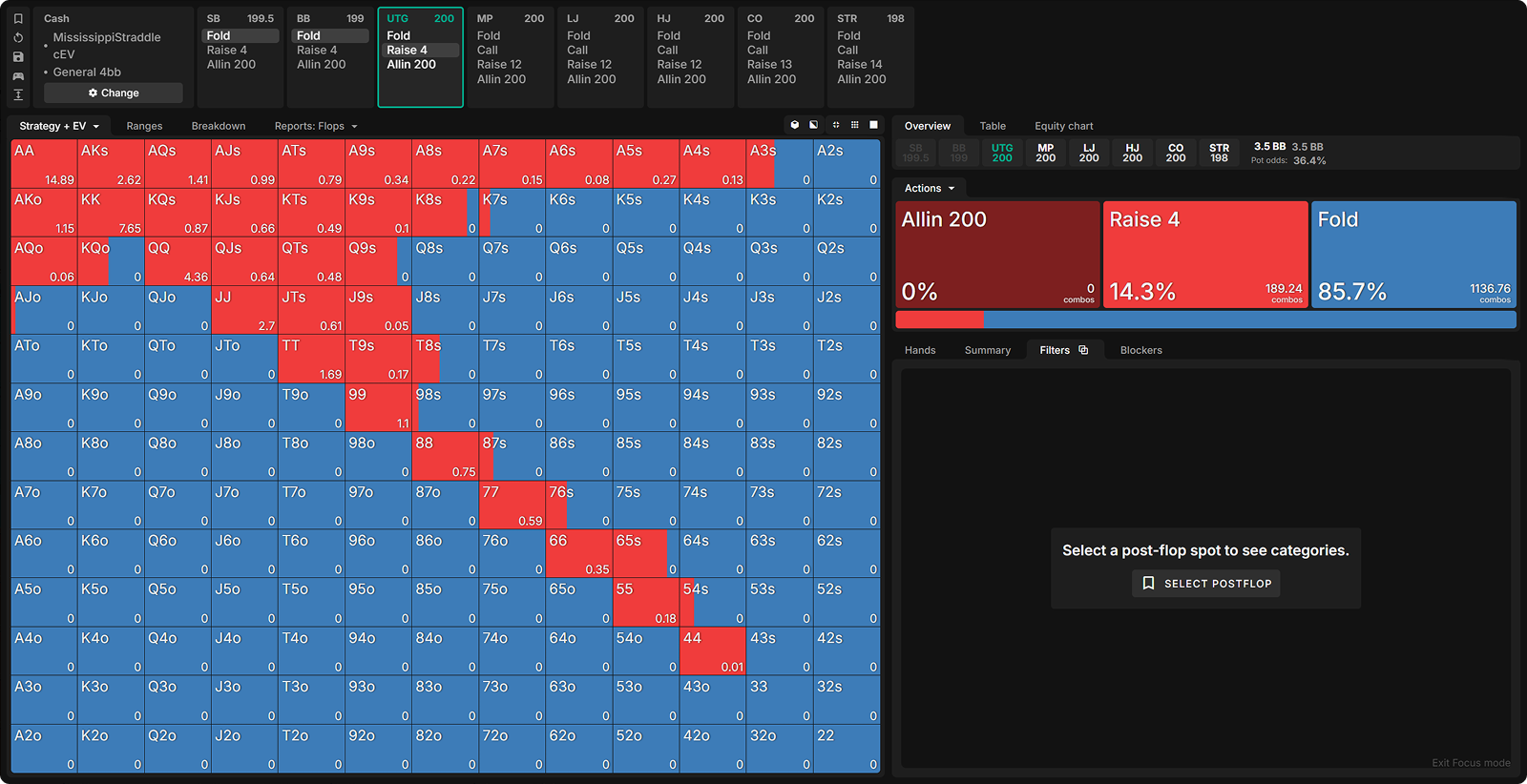
Larger raises are somewhat more appealing for UTG than they were for the Blinds, both of whom were getting significant discounts on smaller raises. At equilibrium, UTG gains value with KK–AA, AK, and AQ in a 7bb raising strategy, and around 2% of hands become folds:
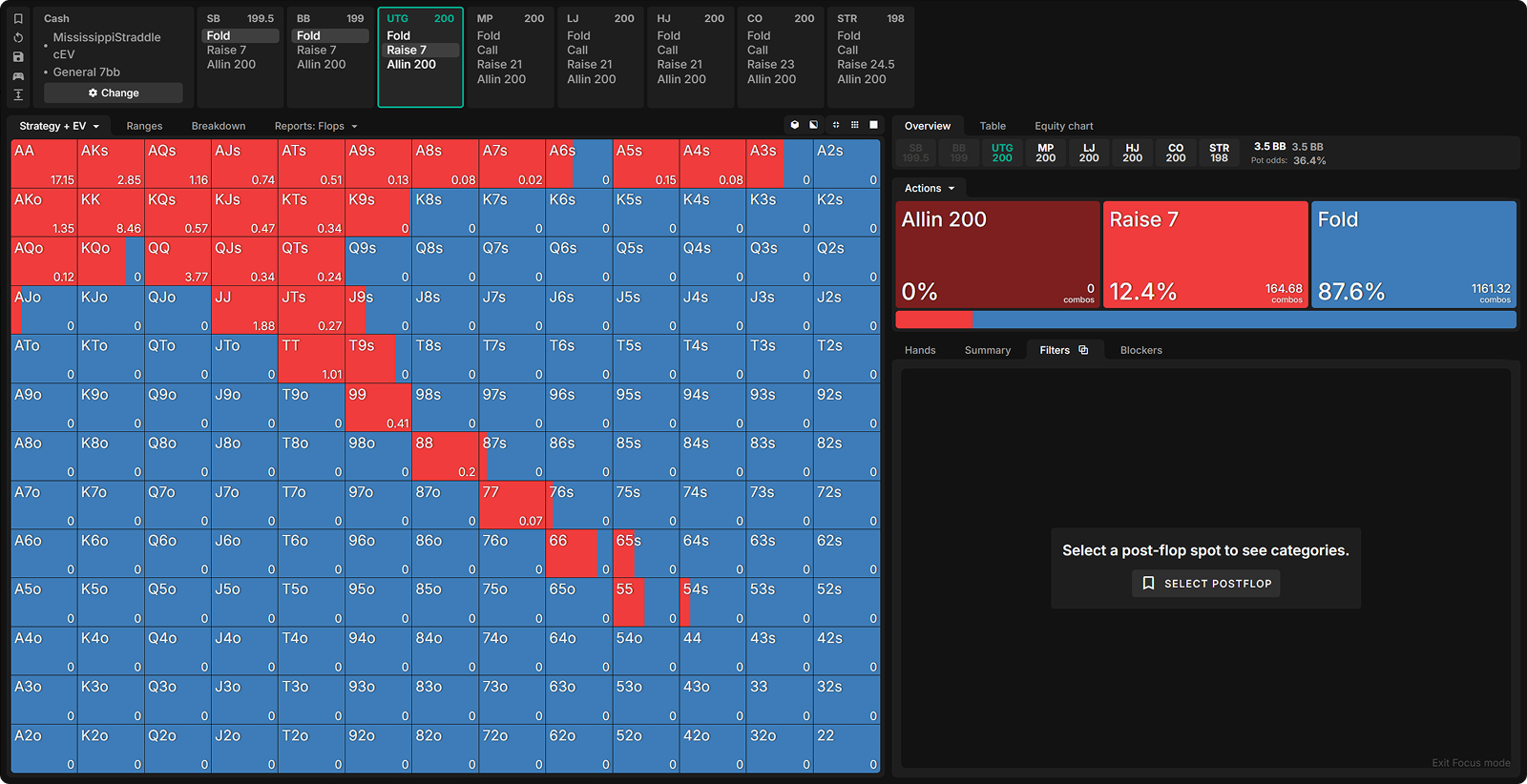
The small raise still looks better at equilibrium, but it’s a lot closer, suggesting that larger raises could be an even better exploit for UTG than for the Blinds.
Reminiscent of SB’s range, UTG’s range is also heavy on suited hands and pocket pairs. They’re a bit more liberal, adding some suited 9-x, some additional pocket pairs, and suited Ace-x, but range construction is in principle the same.
Opening From Later Positions
We don’t need to investigate every position in depth in order to understand the principles at work. Nor should your goal be to memorize exact solver ranges for every scenario. You will play few pots, if any, where all players have exactly 200bb and where you have no insight into mistakes (against theory) any of them will make, and those are the only game conditions where the solver ranges would be perfectly accurate.
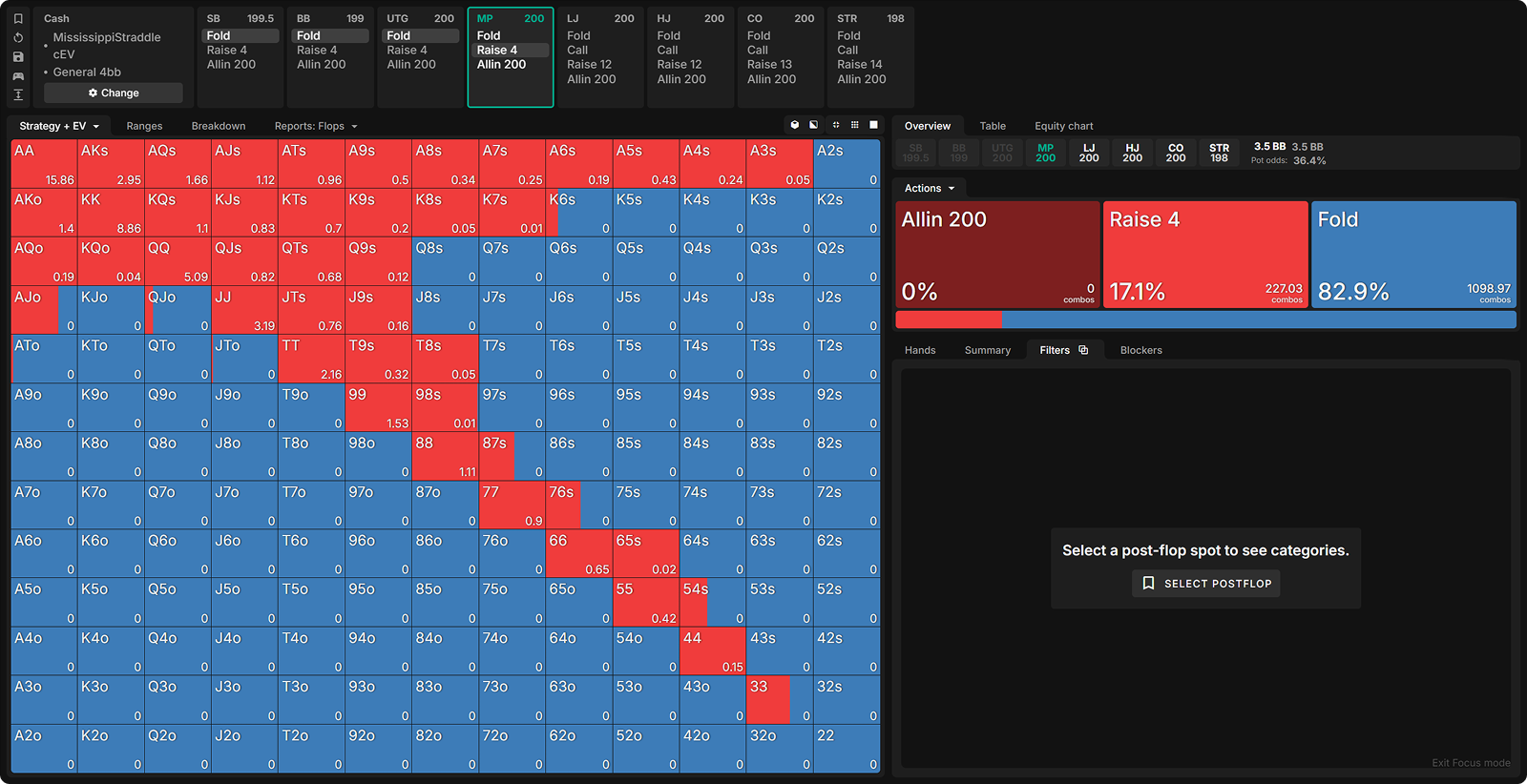
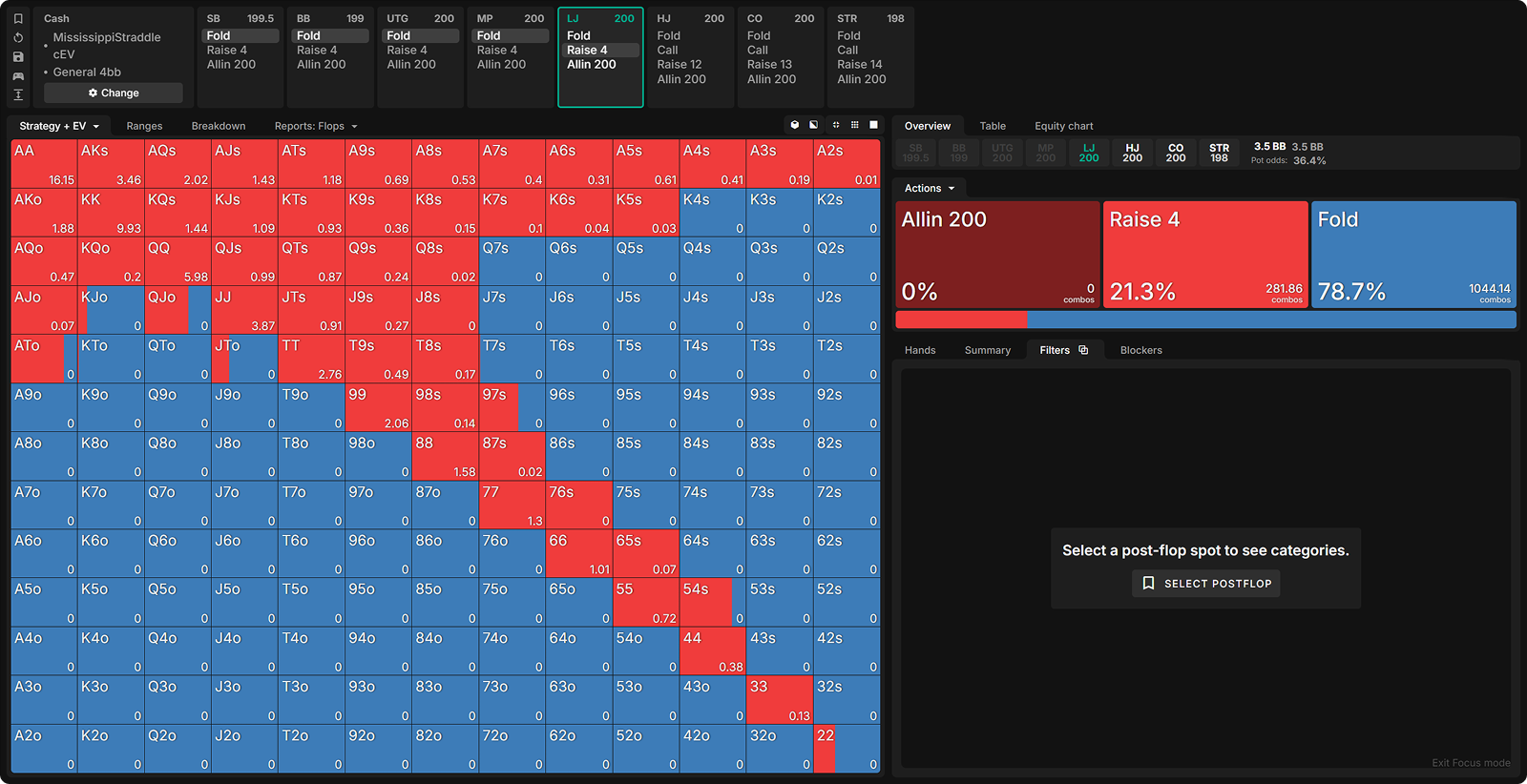
We have already considered the unique incentives of the Blinds. By comparing UTG’s opening strategy to CO’s, we can see how position influences the solver’s opening strategy. For the positions in between, these incentives function essentially as a dial: the earlier your position, the more your opening strategy should resemble that of UTG, and the later your position, the more it should resemble CO’s.
As you look at the opening ranges for the various positions, notice how slowly offsuit hands are added to the opening range. Even HJ is on the fence about opening the worst offsuit Broadway combos!
{{toggle: MP 4bb Opening Range}}
{{/toggle}}
{{toggle: LJ 4bb Opening Range}}
{{/toggle}}
{{toggle: HJ 4bb Opening Range}}
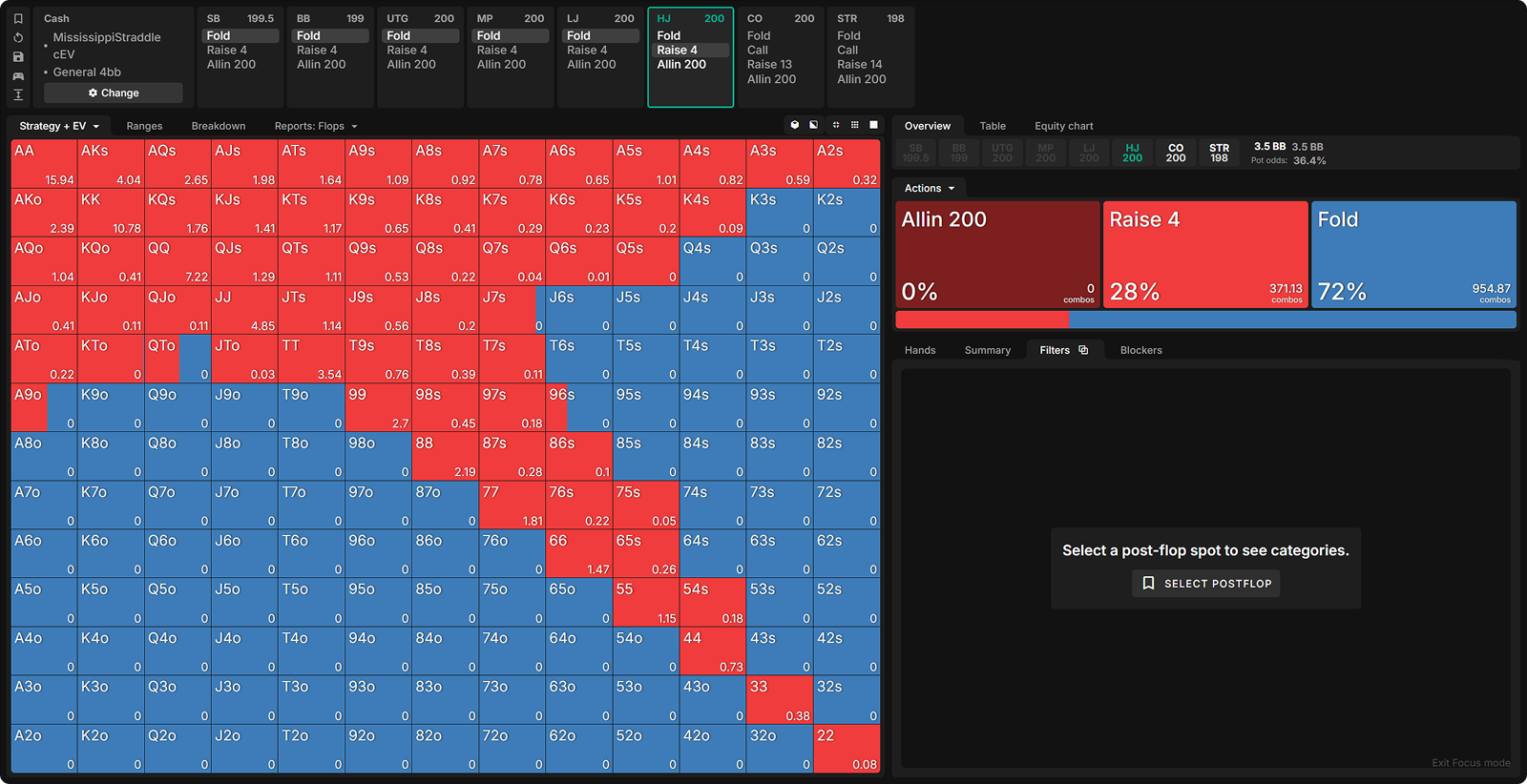
{{/toggle}}
{{toggle: CO 4bb Opening Range}}
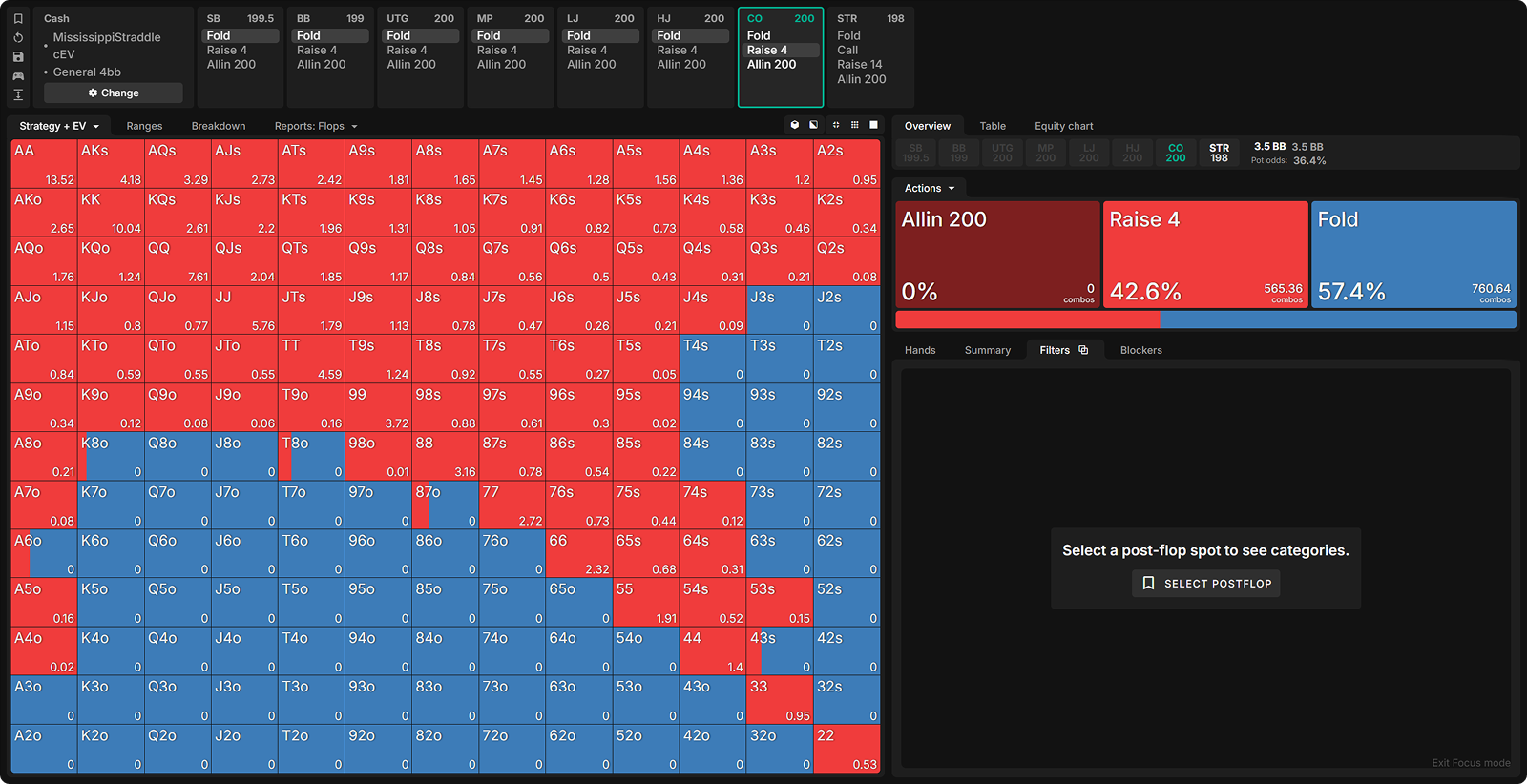
{{/toggle}}
There’s a big jump when we get to CO, whose opening range is roughly 150% of HJ’s. CO is the only player to have no opponents between themselves and BTN. In fact, the CO’s situation closely mirrors SB vs BB dynamics in a standard no-straddle game, so it’s not surprising that the CO’s opening range looks a lot like the SB’s in that context. The fact that there’s only one player behind significantly reduces the risk of a 3-bet, because BTN, with half a call already committed to the pot and no one to drive out behind them, has less incentive to 3-bet than other players would. BTN’s response to a CO min-raise is to fold virtually never but raise (to 14bb) just 13.6% of range:
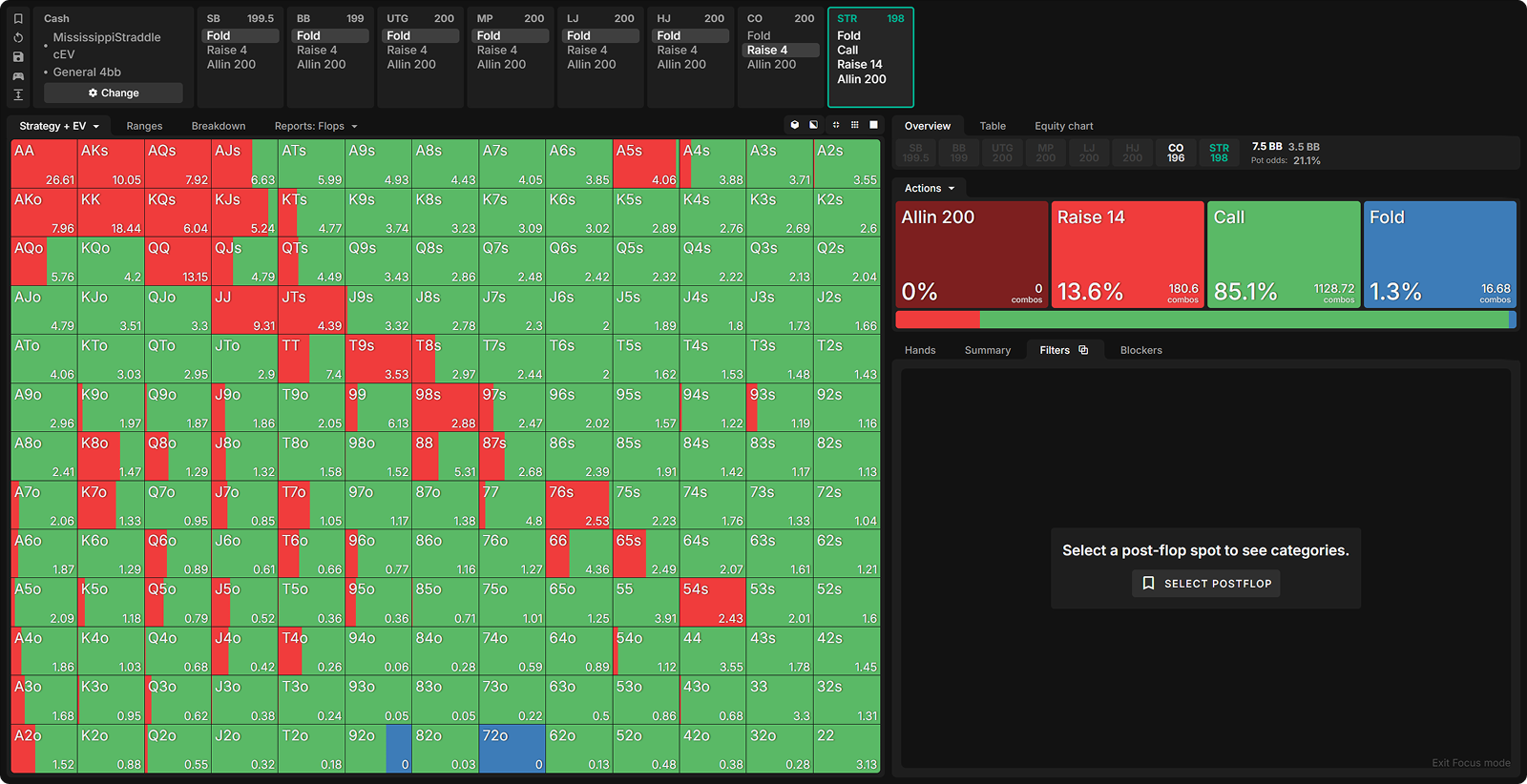
The near-guarantee of playing out of position (OOP) after the flop is what compels CO to remain conservative with offsuit hands but open rather weak suited hands (such as Q2s and 95s) against a range as wide as BTN’s calling range. Equity realization is the rub, and for that, suitedness makes a world of difference.
Has Open-Raising Larger Become Optimal From the CO?
The fact that CO is now heads up with BTN and unlikely to get 3-bet also makes larger raises more appealing for them than for other positions. There’s no need to hedge against the risk of another player in the field calling or raising; CO can focus exclusively on hands that perform best when playing heads up against BTN, and, because they are playing the stronger range, they have some interest in putting more money into the pot despite their positional disadvantage. In fact, a larger raise will yield a lower SPR, thereby slightly reducing CO’s positional disadvantage.
However, this is still not a slam-dunk case for opening larger, but it’s much closer than for other positions. Hands as weak as ATo and 99 have a higher EV in the 7bb opening range, and relatively few hands become unprofitable as a result of the larger raise:
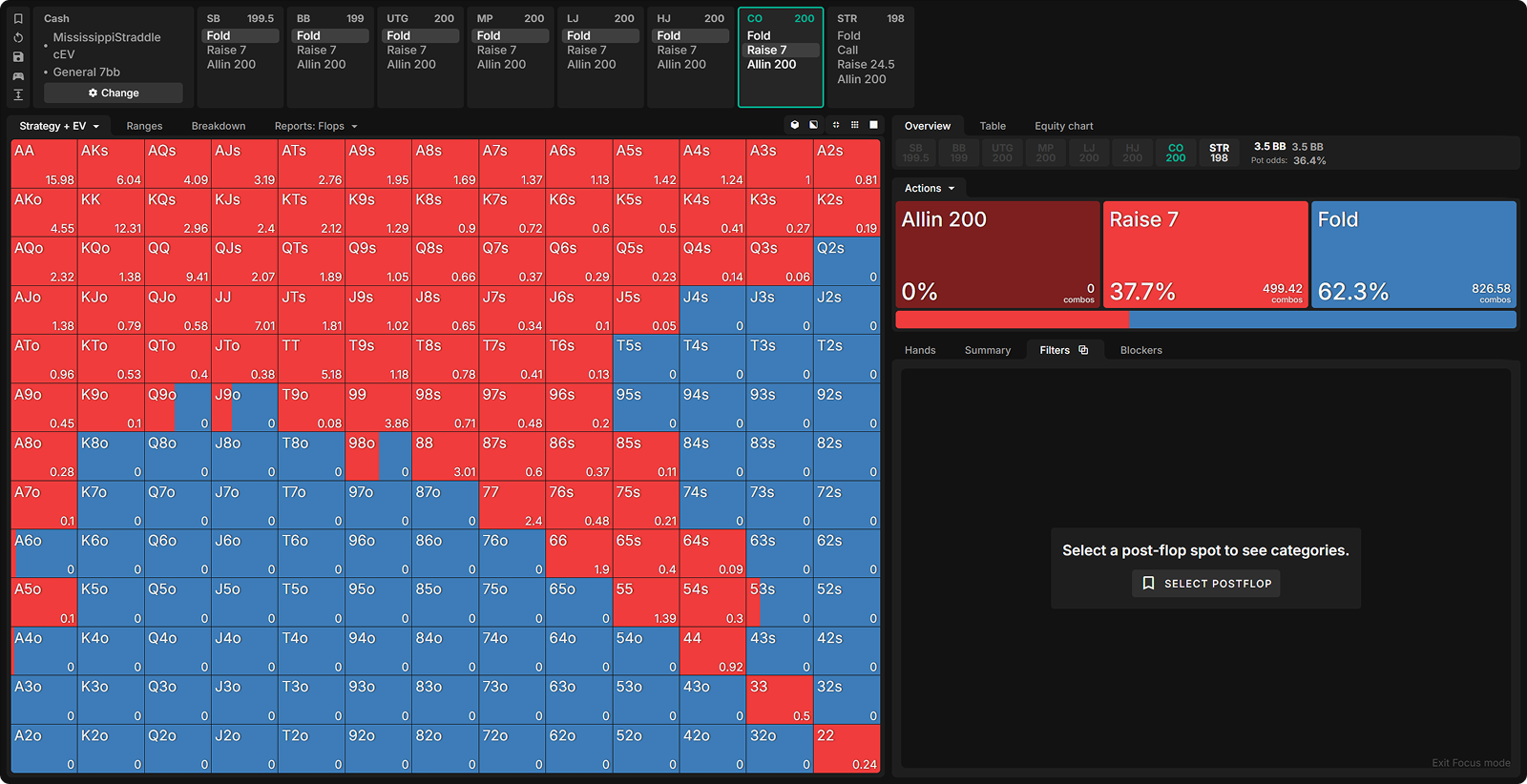
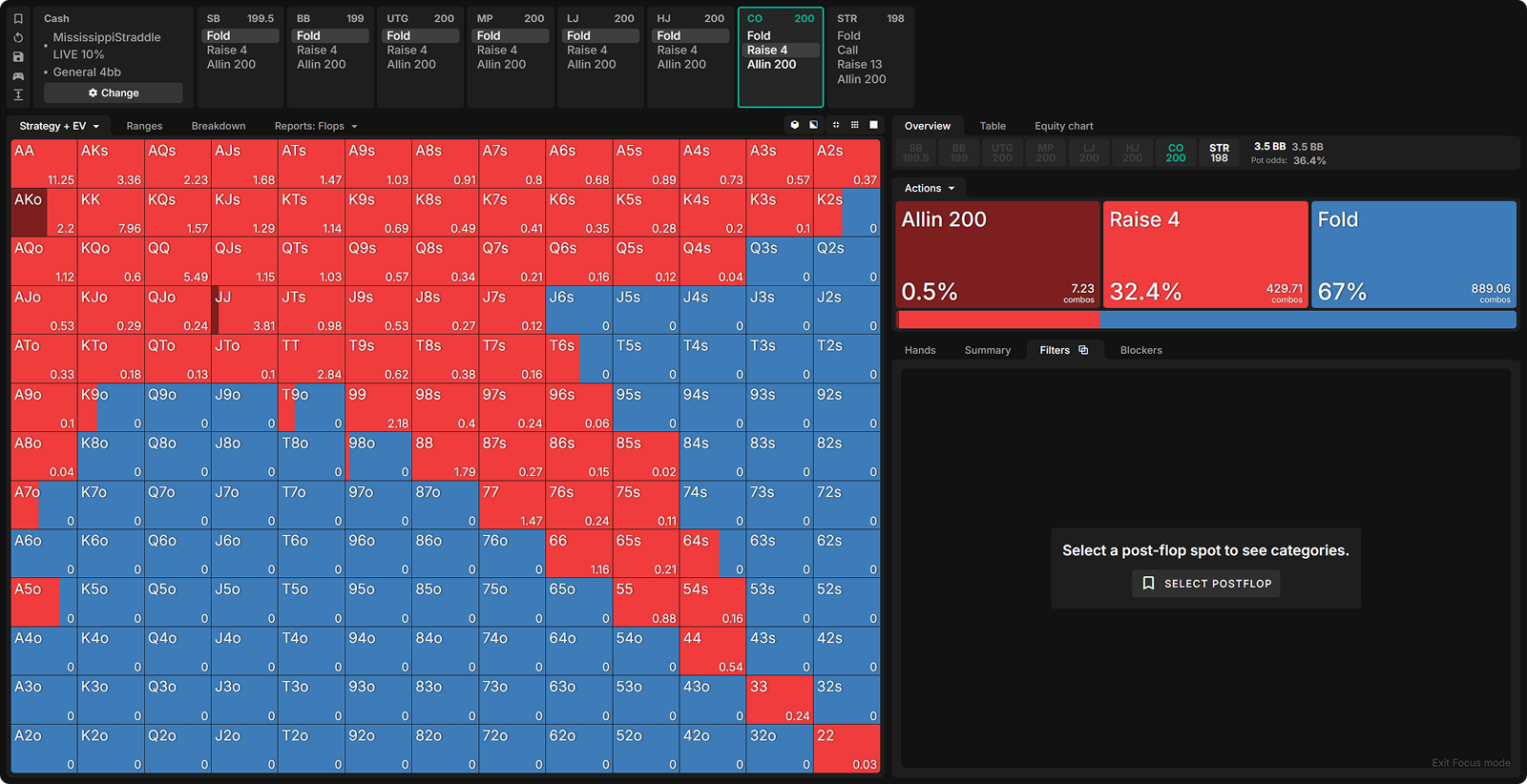
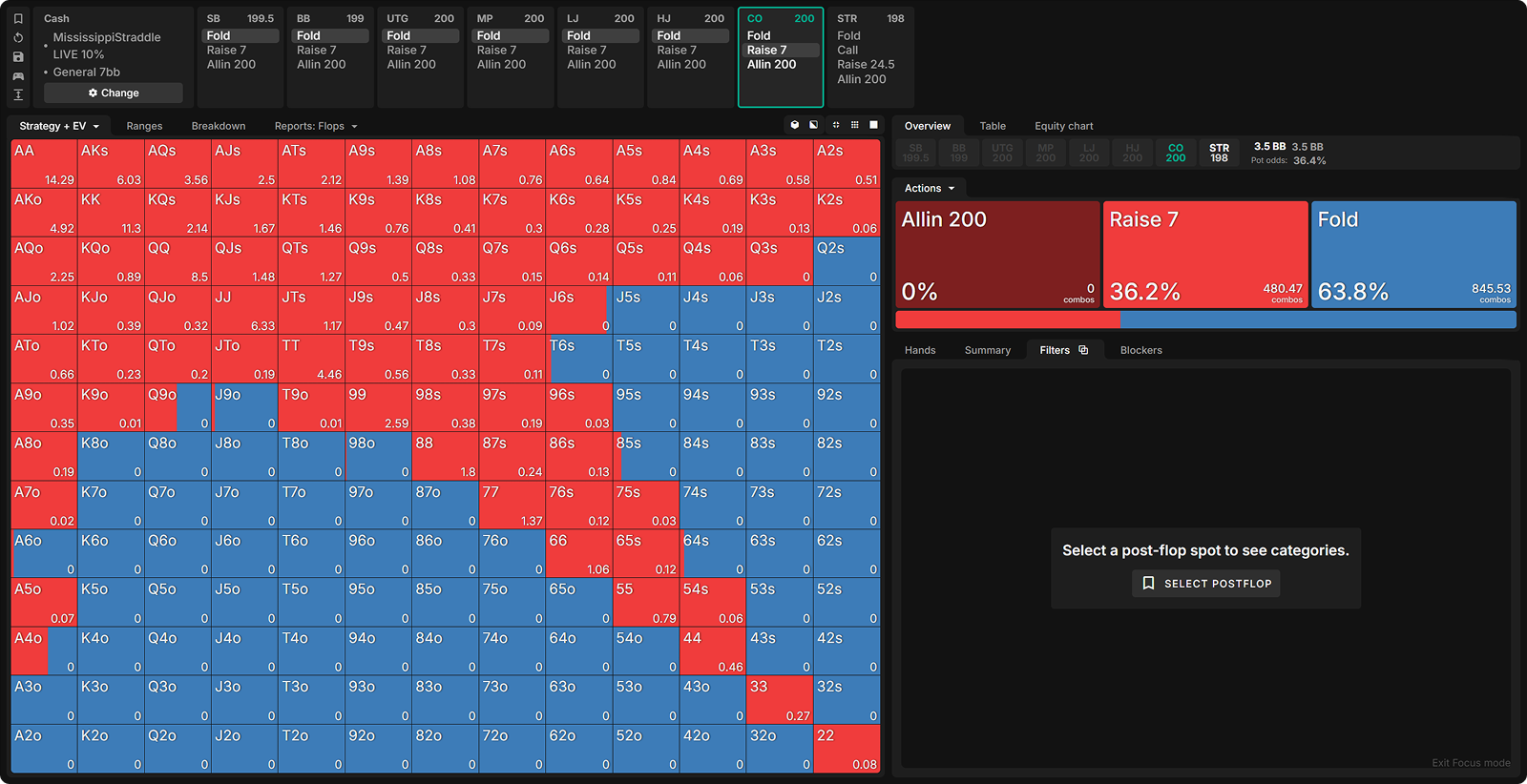
CO’s risk calculus is quite different in a raked game. Min-raising in full expectation of getting called is no longer so appealing because that will mean going to a flop where rake will have to be paid. The 7bb raise holds much more appeal, with hands as weak as Q2s gaining EV relative to a 4bb raise and relatively few hands that can no longer be opened profitably:
{{toggle: CO 4bb Opening Range, 10% Live Rake}}
{{/toggle}}
{{toggle: CO 7bb Opening Range, 10% Live Rake}}
{{/toggle}}
Conclusion
Mississippi straddles are sometimes considered “bad for the game,” and they kind of are, if everyone adapts correctly to them. They encourage quite tight play from OOP, and forcing the Blinds to act first undermines one of the core design features of the traditional two-blind game, which is that the Blinds are offered some extra incentive to play from what would otherwise be an extremely disadvantageous position.
Accept that when you open, you will likely end up playing postflop out of position. So, construct your range accordingly, with emphasis on suited hands and pocket pairs.
Experiment with unconventional plays like large raises (mostly from late position) and limps (from the Blinds and CO). They may lead to unfamiliar situations, but keep in mind that those situations will also be unfamiliar to your opponents. If you’re better at adapting on the fly than they are, you will come out ahead even if your adjustments are not perfect!

Mississippi Straddles: Building a C-Betting Strategy vs. BTN
A Button straddle, also known as a Mississippi straddle, changes the preflop incentives of all players. If you’re interested in learning more about exactly how those incentives change, you can read about opening ranges and responding to opens in Mississippi straddle games. In this article, we will i

Mississippi Straddles: How to Defend vs Raises
This is the second in a series of articles about playing in games with a Button or Mississippi straddle. You don’t need to read the first to make sense of this one, but as this article is about responding to raises, you may get more out of it if you understand the incentives around open raising when