Responding to 3-bets in Straddle+Ante Games


Overview
Straddle+Ante Hold'em games incentivize players to contest the pot with wider ranges than they would in traditional Hold'em. They also complicate decisions around raise sizing, forcing players to choose between offering a worse price to the player most likely to contest the pot with them and minimizing their exposure to other players who have not yet acted.
As a late position raiser, you should attack these inflated preflop pots aggressively. You should also be prepared for aggressive pushback from the Blinds and Straddle.
In this article, we’ll examine BTN’s response to 3-bets from each OOP opponent to see how position, raise size, and stack depth influence their range construction.
Raise Sizing
Even more so than in two-blind Hold‘em, your response to re-steals should depend heavily on the size of your initial raise, the size of the 3-bet, and the size of the remaining stacks.
There is not necessarily a single “correct” opening size, especially when it comes to opening from the BTN. We offer sims for 4x, 5x, 6x, and 7x opening strategies, and each has its pluses and minuses. Most importantly:
- Smaller raises benefit the Straddle (STR) at the expense of the Blinds. The STR can profitably call more hands to a small raise, while the Blinds must consider not only their immediate pot odds but also the risk of other players calling or squeezing behind them. They should still continue wider to a smaller raise, but not proportionately wider.
- Conversely, larger raises benefit the Blinds at the expense of the STR. Larger steals cause the Blinds to win more when they wake up with strong hands, and their weaker hands often would not have been able to call even if faced with a smaller raise. The STR, however, misses out on many calls that would otherwise have been profitable when the BTN opens for a larger size.
More important than the opening size you choose is that you tailor your opening range and your response to 3-bets appropriately.
When opening for a smaller size, you should have a wider opening range and expect to face smaller (in absolute terms) 3-bets. This means you can anticipate playing postflop with a slightly higher SPR, which will incentivize you to continue with a wider range than you would have had you faced a larger 3-bet after opening for a larger size.
For example, let’s compare two scenarios. In the first, BTN opens for a min-raise (4bb), and SB 3-bets to 20bb. In the second, BTN opens 7bb and SB 3-bets to 24.5bb. In which scenario do you expect BTN to have a higher calling frequency, and why?
Comparison of BTN’s Responses vs. SB 3-Bets
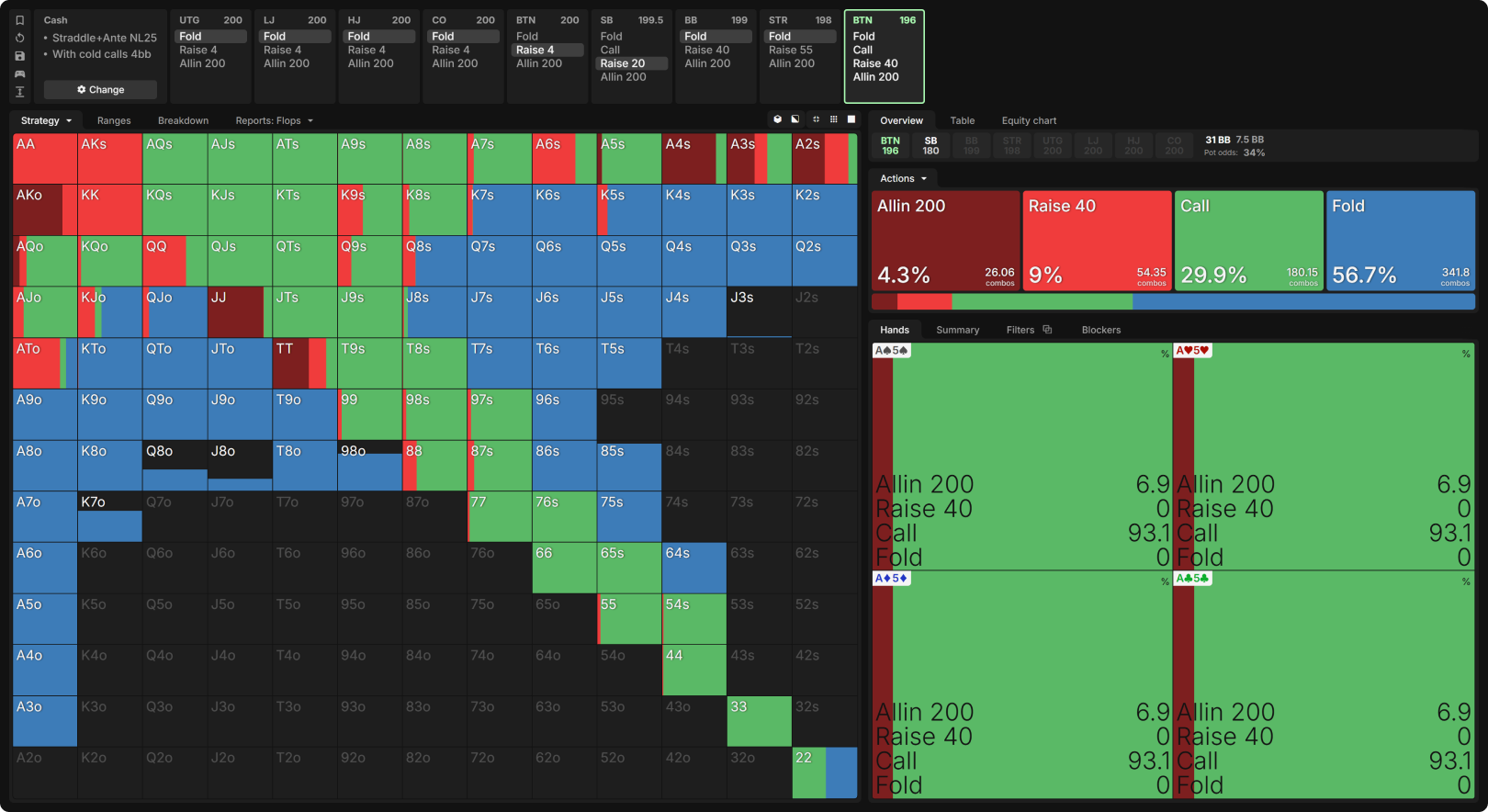
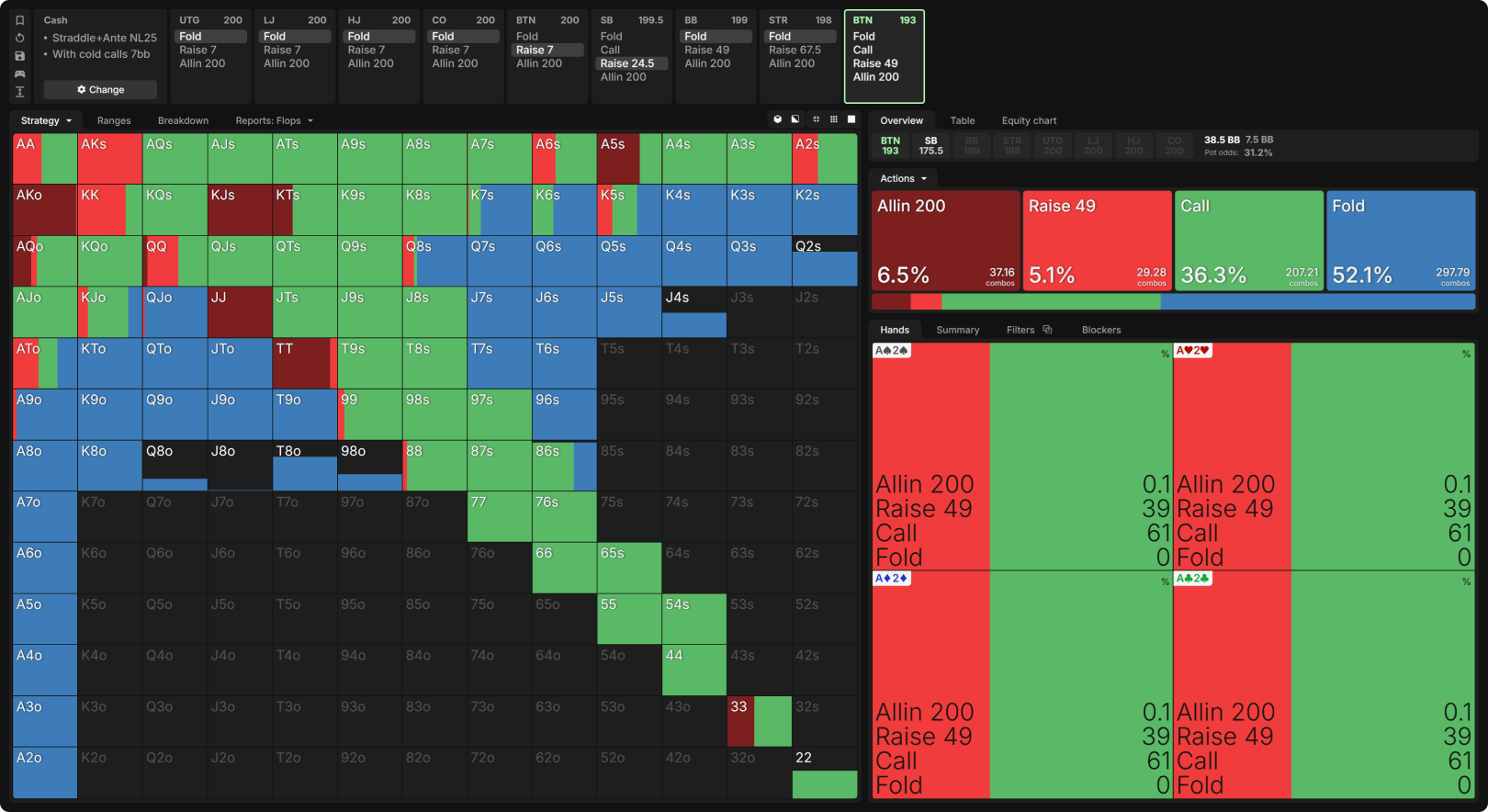
BTN actually calls a good deal more often after opening larger themselves and then facing a larger raise! There are a few reasons for this:
- Better odds – This is the most important factor. SB’s 3-bet is larger when facing a larger BTN open but not proportionately larger. This means BTN is getting better odds facing the larger raise in the second scenario. BTN needs to realize 31.3% equity to call in the second scenario but 34% in the first.
- Less 4-betting – The larger SB’s 3-bet, the less incentive to 4-bet for the BTN. 4-betting light puts more at risk, and their strongest hands have less incentive to grow the pot when it is already going to be large. So, some hands BTN 4-bets in the first scenario become calls in the second. This includes very strong hands like AA and KK, which provide cover for also calling some weaker hands than they would in the first scenario, such as 22 and 86s.
- Tighter opening range – The BTN needs a stronger hand to open 7bb than to open 4bb. Of course, they should also defend more hands when they open wider, but because they are not the only player remaining to act after SB’s 3-bet, they do not defend a proportionate amount of their opening range. Because of the risk posed by BB and STR, SB’s 3-bet must be relatively strong, even if they know BTN will fold disproportionately many weak hands.
It is important to understand these factors because, in real-life game situations, your opponents may not use the same raise sizes as the sims. Nor is this necessarily a mistake on their part. Just as with BTN’s opening size, SB’s choice of 3-bet size (within a reasonable margin) is less about claiming EV for themselves than about how EV is distributed among the remaining players. Smaller 3-bets offer better calling odds to the BTN but lose less when the BB or STR wake up with strong hands. Larger 3-bets take the pot down preflop more often but lose more when the BB or STR wake up with strong hands.
Over the felt, you’ll need to assess the size of the 3-bet you face and be aware of your opening range when constructing your response.
Responding to Re-Steals From Other Positions
Part of the reason why BTN folds disproportionately many of their weakest hands after attempting a small steal is that a SB 3-bet is an unfortunate occurrence. Relative to any other action BTN could face (calls from OOP players, or even raises from players in other positions) a SB 3-bet is the strongest and scariest.
It is fine and correct to cut your losses with many of your weakest hands when the worst case scenario happens.
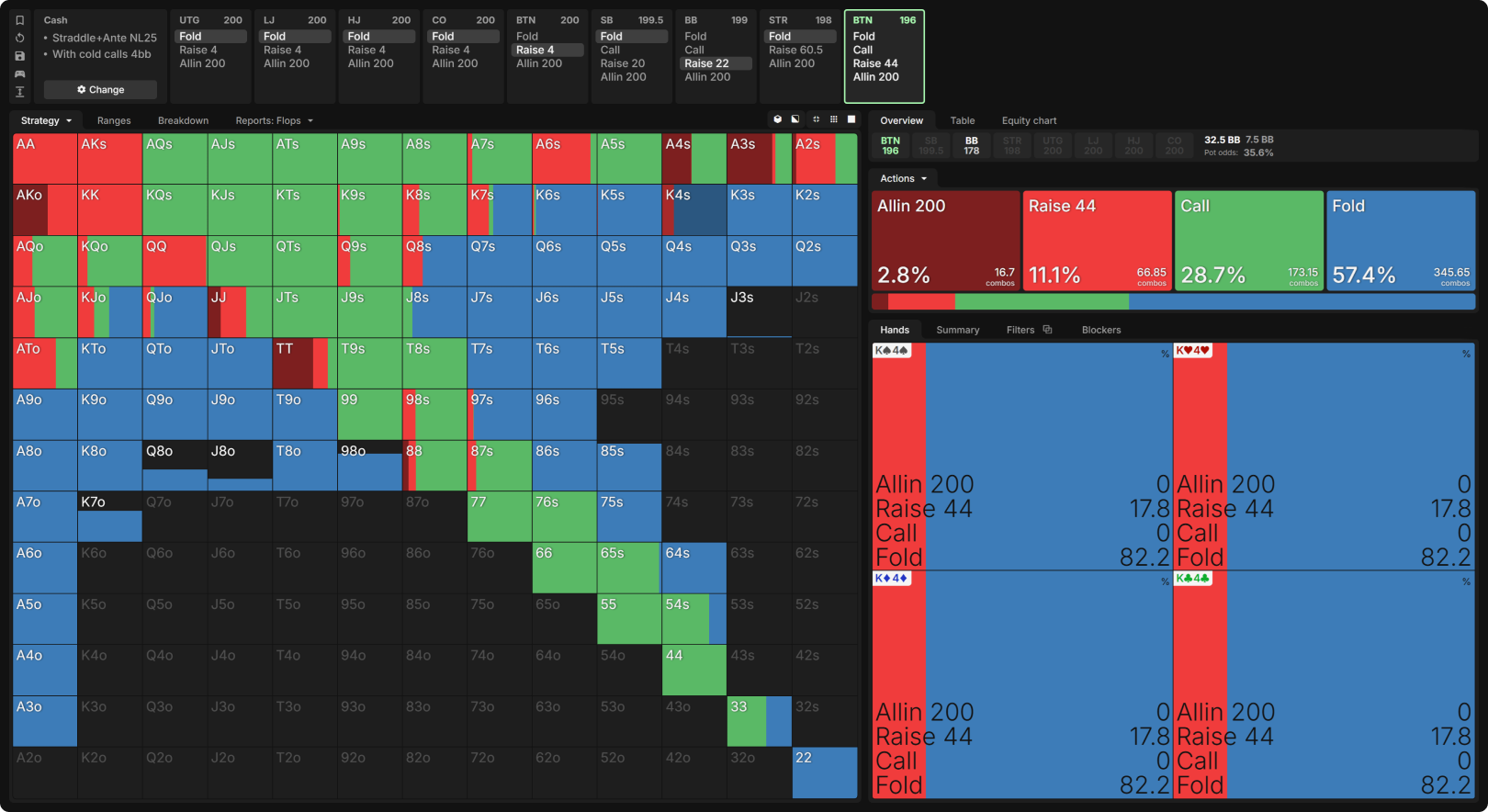
As the position of the 3-bettor improves, the gap between BTN’s calling frequencies in the 4bb and 7bb opening scenarios decreases. This is true even though all the other factors incentivizing BTN to call more often in the 7x scenarios are present.
In fact, BTN calls slightly more often in the 4bb scenario vs. STR, relative to the 7bb scenario. Why do you think this is?
Comparison of BTN’s Responses vs. BB 3-Bets
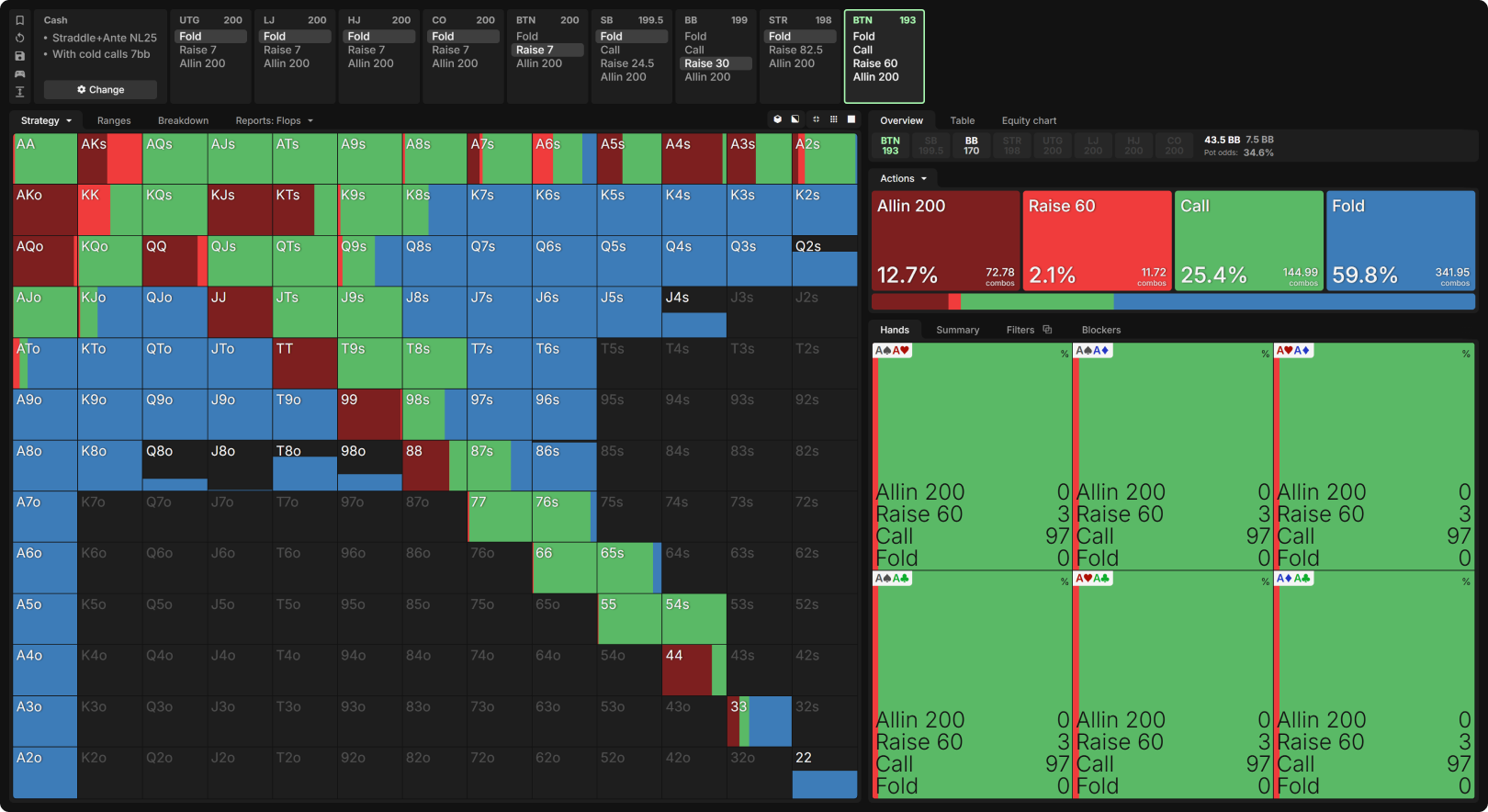
Comparison of BTN’s Responses vs. STR 3-Bets
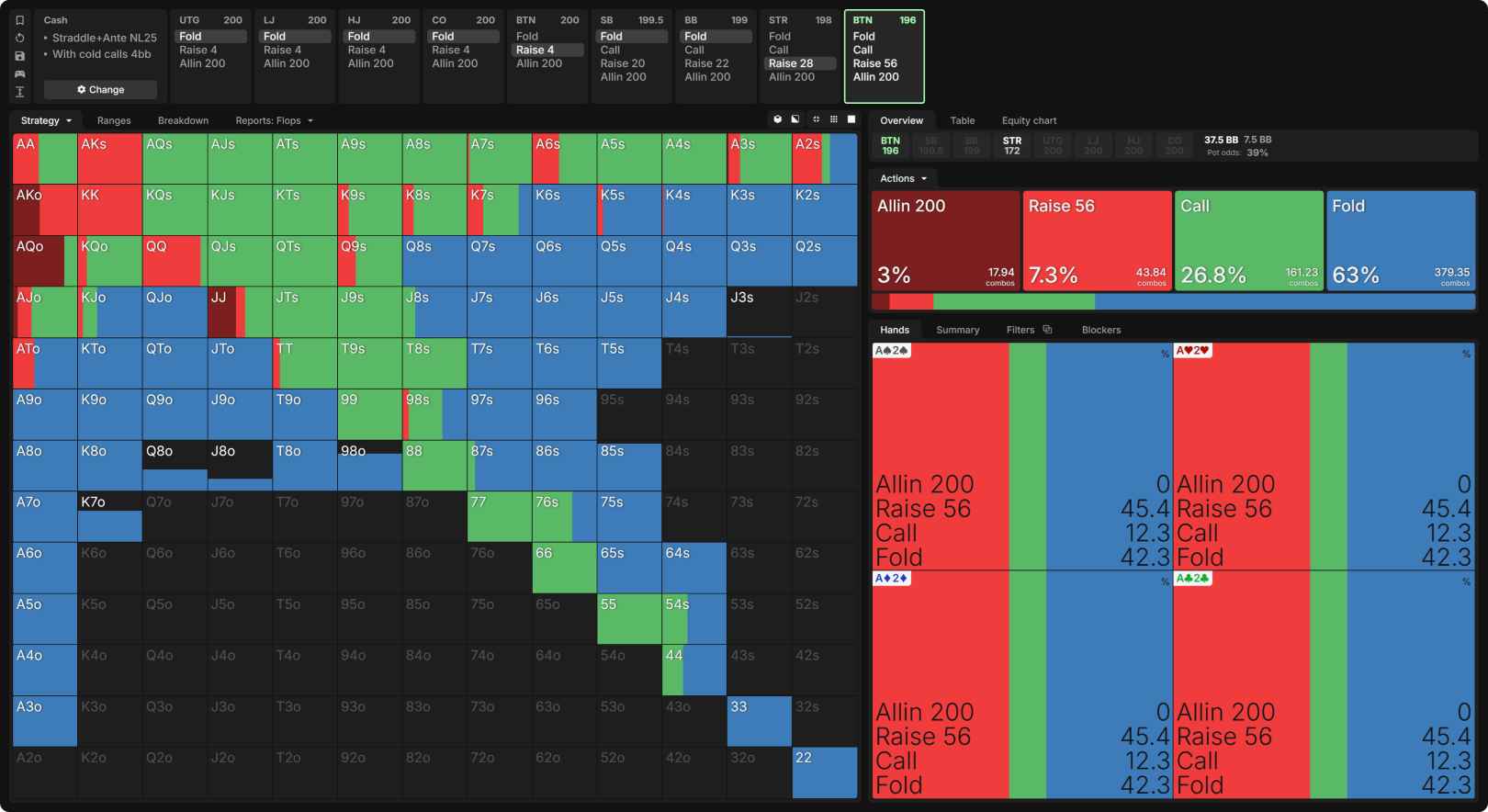
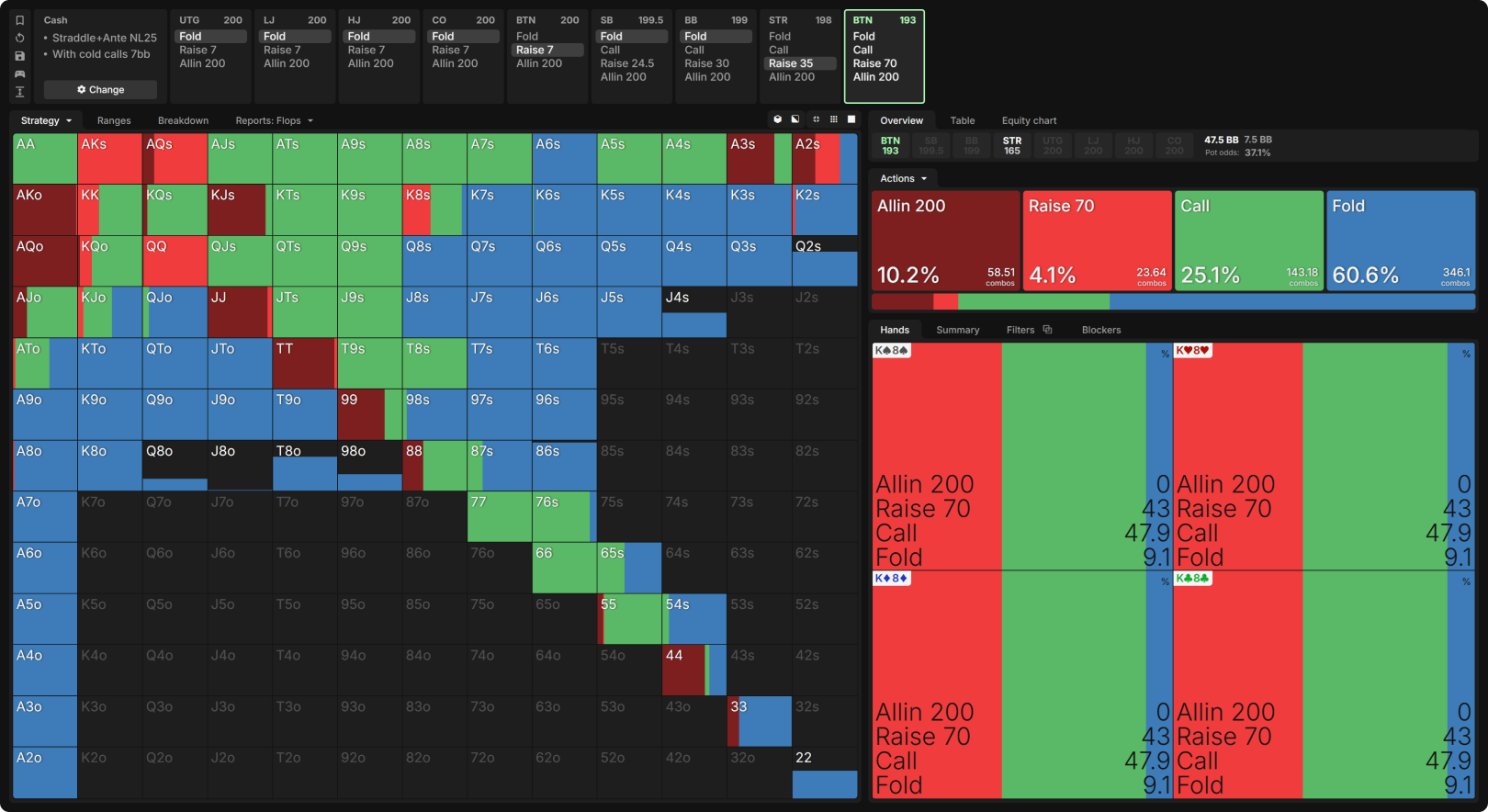
Unlike the other seats, the STR in these sims actually does make a proportionately larger 3-bet when facing a larger open. This means BTN is getting better calling odds in the 4bb scenario than in the 7bb scenario, and they will also get to play with a higher SPR after the flop, which favors the in-position (IP) player.
You might also have noticed that BB uses larger 3-bets than SB in these sims and that STR’s 3-bets are still larger. This is a common occurrence in poker: the fewer players there are behind, the larger bets and raises tend to be. The difference is more dramatic when facing a 7bb open than when facing a 4bb open, which is why STR’s 3-bets vs the 7bb open actually offer worse calling odds than their 3-bets vs the 4bb open.
A larger bet size usually indicates a more polar range, and that’s exactly what’s going on here. With more money in the pot and fewer players remaining to act behind them, BB has more incentive to call BTN’s raise than SB does, and STR has even more incentive to call than BB. That means when these players do 3-bet, their ranges should be more polar because they mostly prefer to call the middle of their continuing ranges.
Returning Fire by 4-Betting
BTN has the option to jam or to 4-bet small when facing a 3-bet, and both are an important part of their strategy in our sims. Naturally, they jam more often when facing larger 3-bet, because there is more money in the pot. But even after opening to 4bb and facing a 20bb SB 3-bet (the smallest of the 3-bets in any of these scenarios), BTN has a few jams.
These jams are the usual suspects: AKo, JJ, TT, and some suited wheel Ace-x. All of these hands have poor postflop equity realization, but at the same time solid equity when called after 4-bet shoving.
The wheel Ace-x have the worst equity when called, but they also have the best blocking effects (in addition to blocking calls, they unblock folds) and the most to gain from fold equity. Stronger pocket pairs gain less from preflop fold equity and have better postflop equity realization, especially when the SPR is low, so they prefer small 4-bets to shoves.BTN’s small 4-betting range is more polar, containing very strong hands that want to induce further action and very weak hands that don’t give up much when they fold to a shove.
Medium hands that would have tougher or more painful decisions when jammed on prefer either to jam themselves or to call and play after the flop.
These patterns persist in the other scenarios, but because the 3-bets are larger, more hands make their way into the jamming ranges. Specifically, two new types of hand jam in the 7x scenarios but not in the 4x scenarios: small pairs and suited Broadways.
As discussed above, the larger pots incentivize more jamming from BTN, but they also incentivize more calling of those jams from the 3-bettor. The suited Broadways and smaller pairs make their way into these jamming ranges because they have better equity against these wider calling ranges than they would against tight ones. In the case of the small pairs, they also make better jams than medium pairs because they unblock folds and play less well as calls.
Once again, the important skill here is not to memorize these sims but to understand the reasons why the ranges are constructed the way they are. Your opponents, for reasons that may or not be strategically sound, may use different 3-betting strategies than the ones shown in these sims.
Improvising a sound response on the fly will require understanding your incentives and how they influence your range construction.
Deeper Stacks
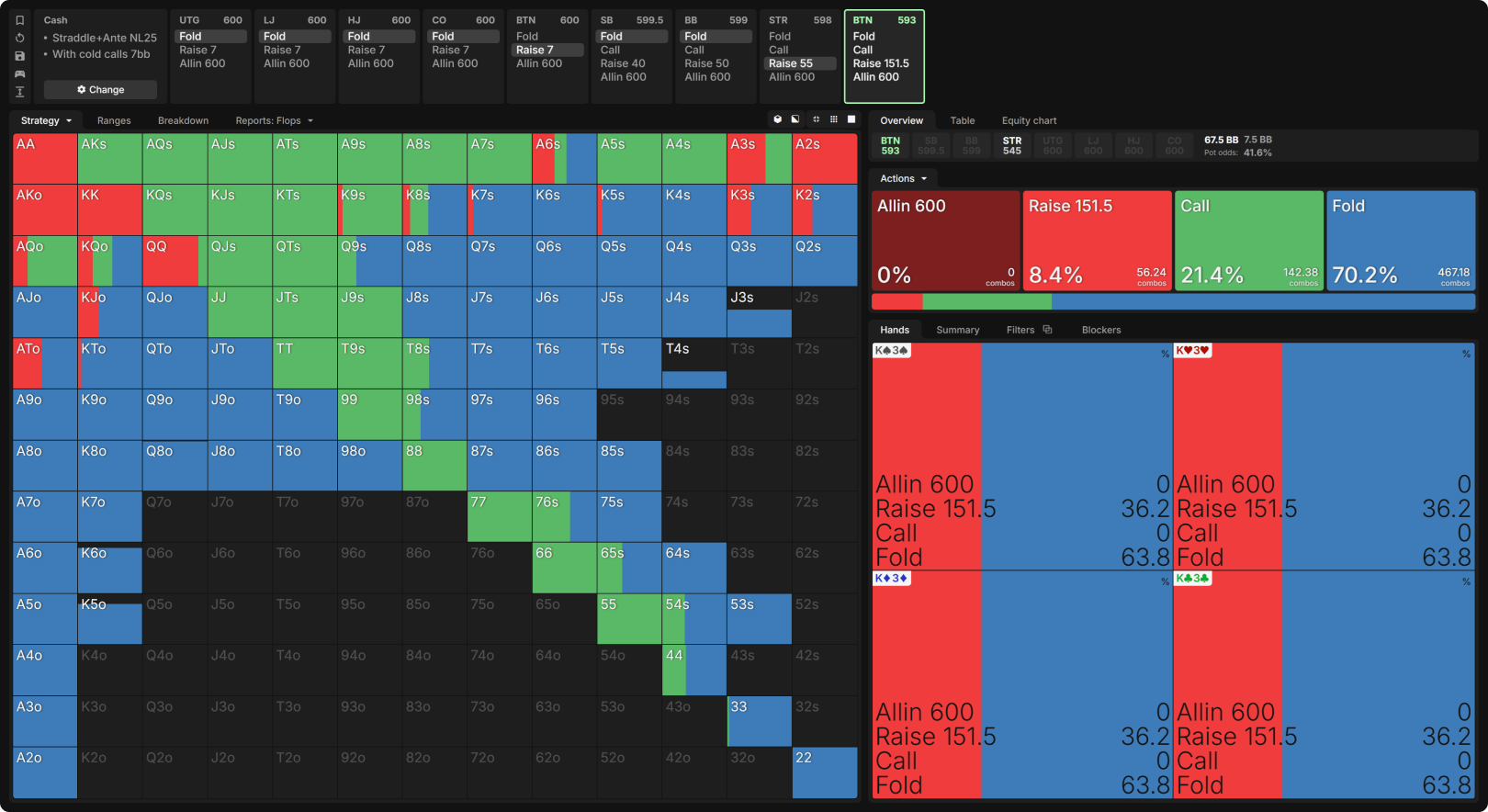
Speaking of opponents not using the same raise sizes as the sims, check out SB’s 3-bet size in this 600bb sim:
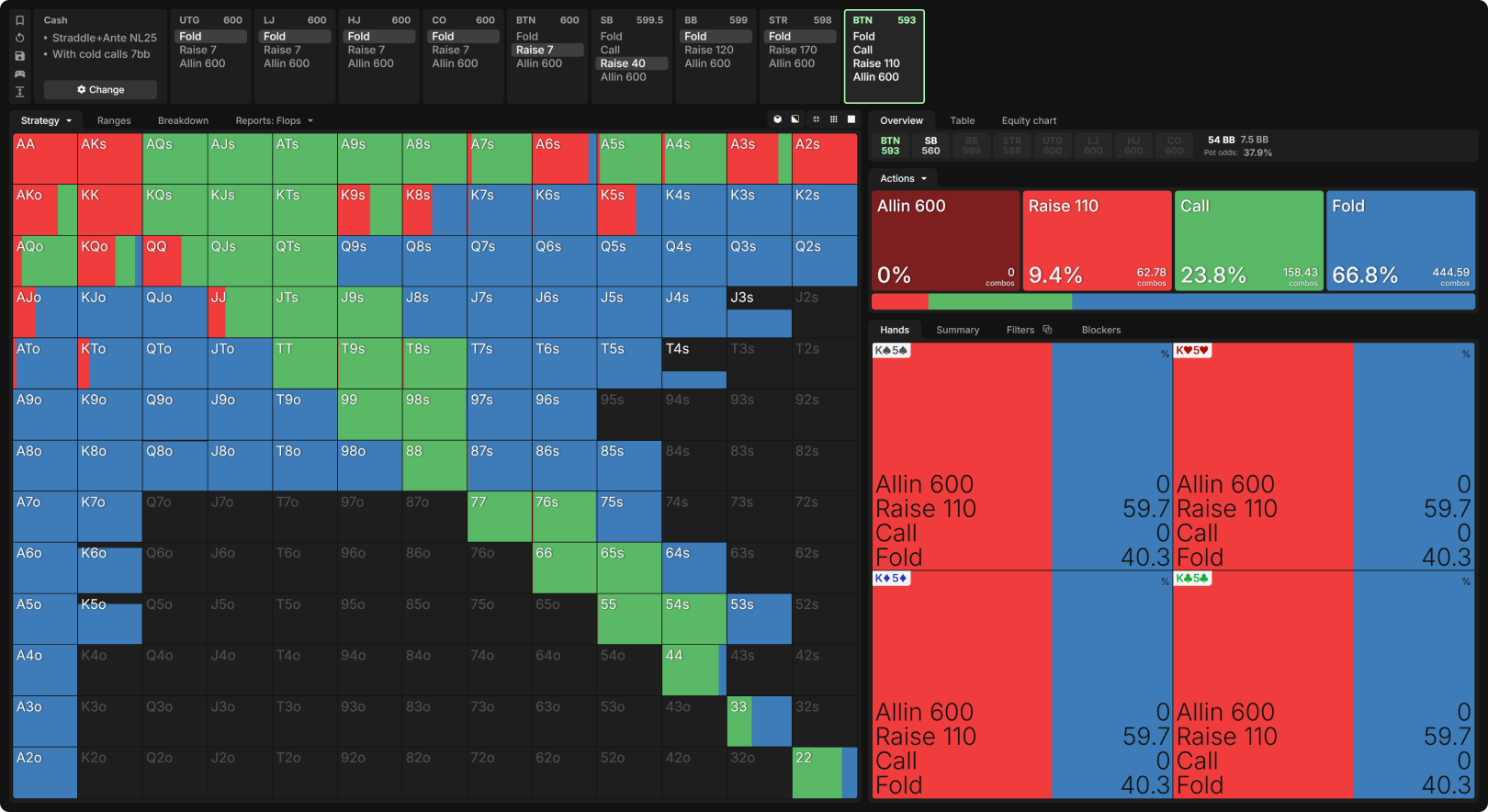
They’re raising to 40bb, and that’s still not enough to deter BTN from calling with pretty much all their pairs, suited connectors, suited Broadways, and suited Ace-x!
With such deep starting stacks, the SPR when BTN calls the 3-bet will be around 7 despite the enormous raise size. Consequently, BTN’s calling range is oriented towards making straights, flushes, and sets. Of course, these hands will more often make one pair, and that will sometimes be enough to win if the pot doesn’t get too large, but it’s plain to see how much they value the potential to make something stronger.
Aces, Kings, and Ace-King 4-bet not only because they are strong but because most of their strength lies in making one pair. In the 200bb sims from earlier, BTN often flats AA to a 3-bet. That’s because the postflop SPR will be low enough to comfortably stack off with one good pair in a 3-bet pot. When stacks are deeper, Aces needs to 4-bet to get that SPR down to where an overpair will be worth the rest of their chips on most flops.
BB’s 3-bet size is even larger, and BTN’s response is similar, just a bit tighter than it was versus SB:
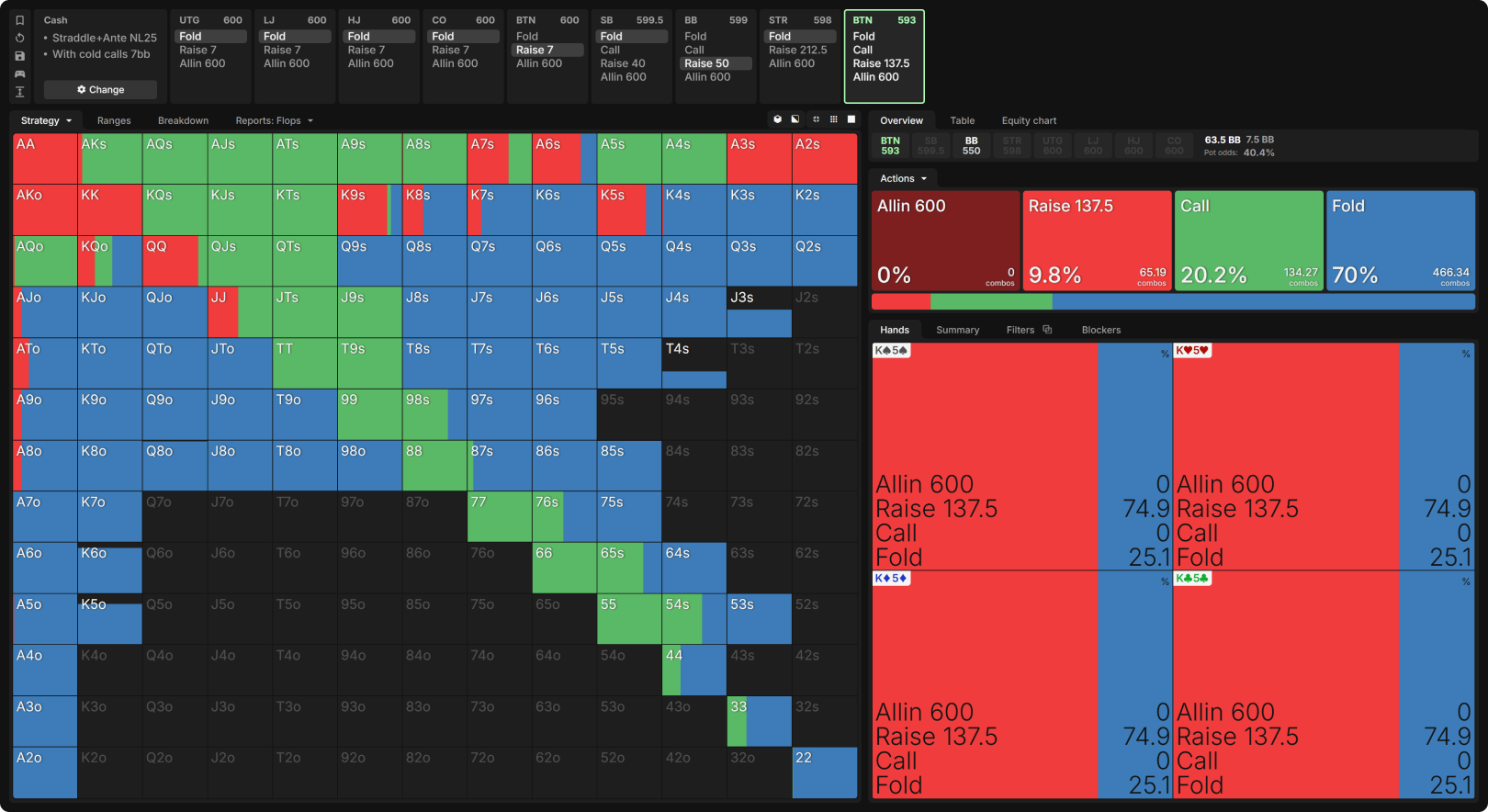
STR’s size is larger still, and because their 3-betting range is the most polar of the three, BTN is a bit more conservative with their 4-bets:
Adapting to Smaller Raises
Should you encounter smaller 3-bets in deep-stacked scenarios—and you probably will—what does all this tell us about how to respond to them?
You should be ruthless about calling with suited and connected hands, especially when the cards are large.
Here’s BTN’s response when they open 4bb and face a 20bb 3-bet from SB:
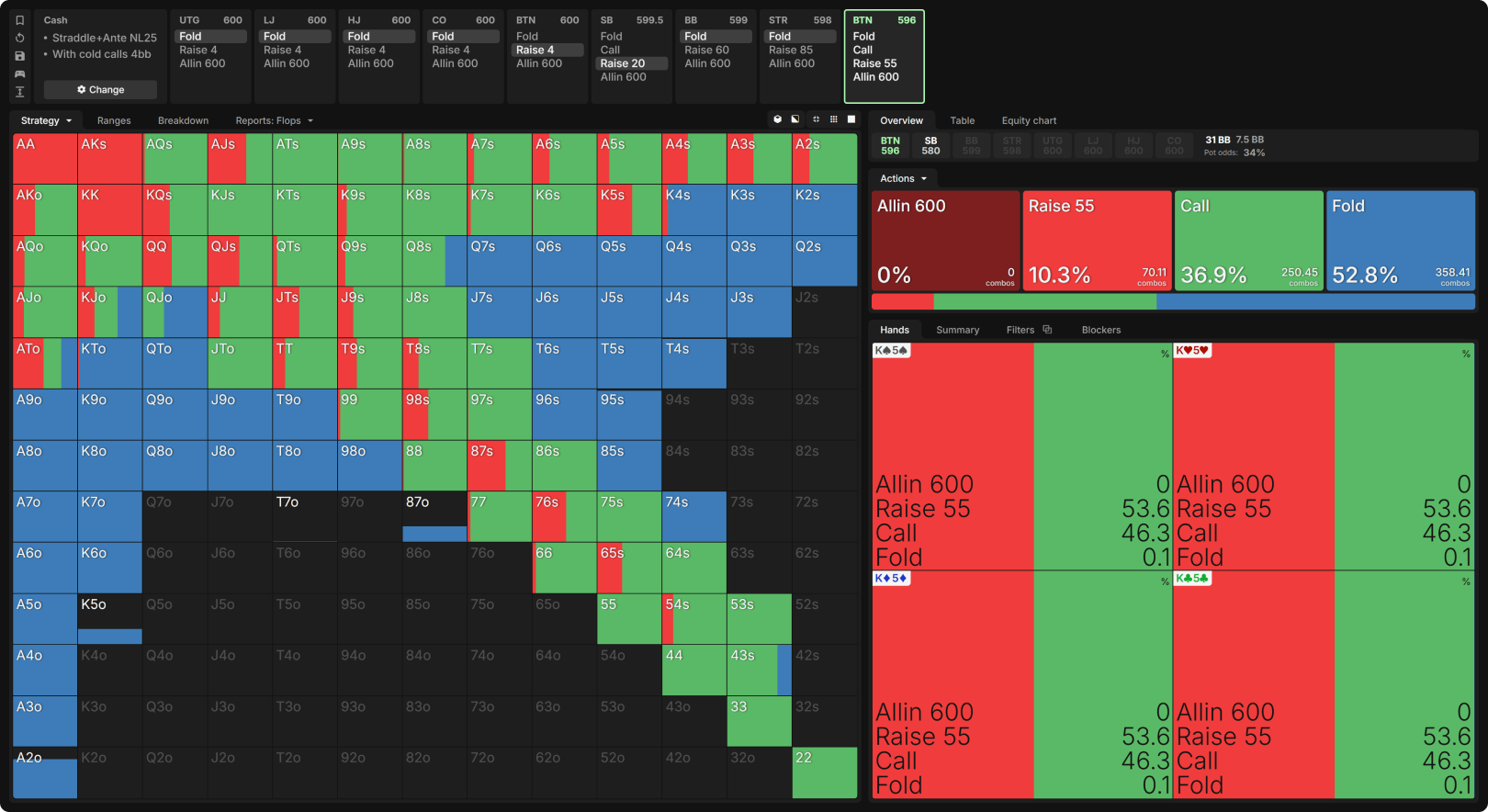
With so much money remaining to wager after the flop, BTN’s superior position is enormously valuable. This subsidizes calls with not just suited Ace-x and suited connectors but most suited King-x and suited gappers. Had you used a larger open raise size and faced a similarly small 3-bet, you should call wider still.
4-betting a less polar range that includes some suited connectors is viable against a smaller raise, as it will be a lot riskier for SB to deny your equity by jamming over your 4-bet. Big pairs and offsuit Broadways remain the very best 4-bet candidates, though.
Conclusion
Straddle+Ante games present players with complex, often competing incentives. Most people playing them have more experience in traditional, two-blind games, and that may (mis)lead them to pursue suboptimal range construction and/or bet sizes. So, you should expect to encounter a variety of re-stealing strategies in these games, and you won’t be able to memorize responses to all of them.
Instead, focus on understanding the principles that should guide your response: position, pot odds, polarity, and stack depth:
- The worse an opponent’s position, the stronger their 3-betting range, and the tighter your response to that 3-bet.
- Smaller multiples of your opening size offer better calling odds, even if the raise is large in absolute terms.
- Larger raises and raises from later positions are more polar, incentivizing more calling and less 4-betting.
- Playing with deeper stacks favors the IP player after the flop, incentivizing more calls. They can also incentivize more 4-bets as long as they don’t make a 5-bet jam too enticing. Your calls should mostly come from hands with the potential to make straights, flushes, and sets.
Put your newfound knowledge into practice with this drill, which will present you with tough decisions based on the scenarios in this article and some new ones as well!

Stealing and Restealing in Straddle+Ante Games
Most players treat straddle games like a regular game with higher stakes. They're not. It's a chain reaction that starts preflop and reshapes the entire hand. If you're playing straddle games the same as regular games, you're leaving a lot on the table.