Stealing and Restealing in Straddle+Ante Games


Overview
Late position openers in Straddle+Ante games face different risks and rewards than they do in traditional two-blind Hold'em. The larger preflop pot creates a stronger incentive to steal, but the additional player behind the Button (who could call or, worse, 3-bet) makes opening riskier.
The players behind the Button also face different incentives when responding to a steal. The antes and the Button's wider opening range increase the value of both calling and 3-betting. At the same time, the larger pot gives the opener greater incentive to call a 3-bet, which in turn affects the hands the Blinds and Straddle choose to 3-bet and the sizings they use.
We’ll begin by unpacking BTN’s incentives when attempting a steal and when responding to a re-steal. This will provide important context for understanding why the Blinds and Straddle construct their 3-betting ranges the way they do.
The Incentive To Steal
Despite the increased risk of a re-raise, BTN opens a wider range when there are antes in the pot. Stealing the antes is obviously the optimal outcome for those loose opens, but if someone calls the raise, BTN will still do well postflop when playing in position (IP). Even when faced with a 3-bet, which is generally the worst outcome, many mediocre hands will be able to defend thanks to pot odds provided by the antes.
BTN Steal
BTN opens 47.1% of hands for 7bb (3.5str) in an unraked Straddle+Ante game, compared to 40.5% for a 3bb raise in an unraked two-blind game. The composition of the ranges is similar; the antes simply incentivize BTN to open slightly weaker versions of the same hands they would in a traditional structure.
BTN Response vs Re-Steal (From the Last Actor)
Faced with a 3-bet from the BB in a two-blind game, BTN continues by calling with 36.6% of their opening range. In contrast, when facing a 3-bet from the STR in a Straddle+Ante game, BTN calls with as much as 53.1% of it. Despite this difference, 4-betting frequencies remain similar in both scenarios.
Players responding to a steal in a Straddle+Ante game can expect a wider stealing range but also a more stubborn (call-heavy) response to a re-steal.
Let’s see how those competing incentives affect each player’s range construction.
SB Facing BTN Open
Traditional two-blind Hold‘em offers the SB little incentive to call a steal. Even in an unraked game, they respond mostly by raising or folding.
Antes, however, fundamentally change this dynamic. SB still responds quite tightly to a BTN open, as their position is terrible, but they actually call more than they raise:
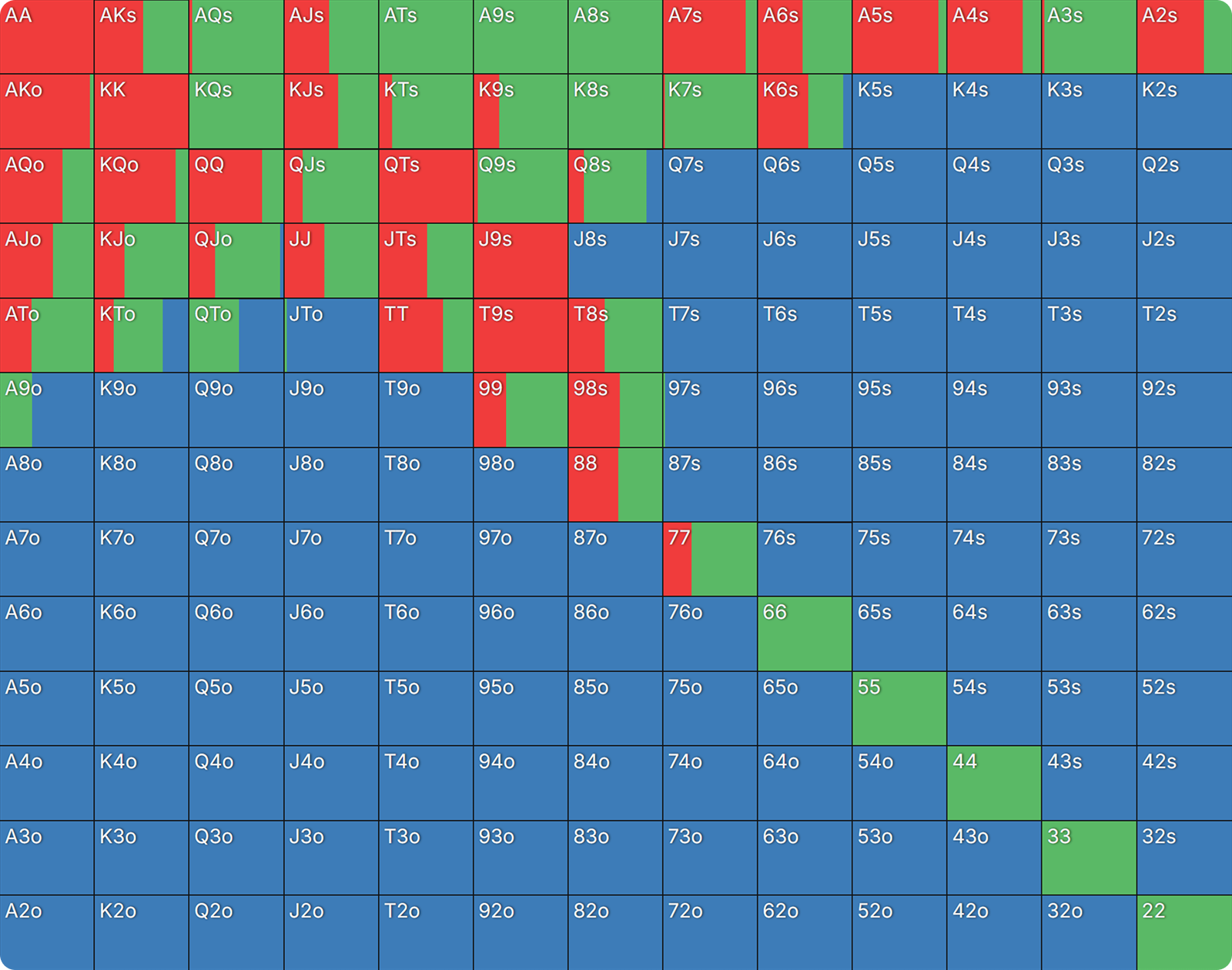
We can broadly describe their ranges as follows:
- Raise: Best pocket pairs, best offsuit Broadways, lower suited Broadways, and lower suited Aces
- Call: Lower pocket pairs, best suited Broadways, best suited Aces, lower offsuit Broadways with straight potential
Preflop hand selection is essentially choosing which tools to bring to a job.
SB Re-Steal
When SB 3-bets, they will often end up playing heads up after the flop with a relatively low SPR. Big pocket pairs and offsuit Broadways are the best tools for this kind of job, because they flop strong pairs relatively easily. And that’s generally all you need to stack off when heads up with a low SPR.
SB Call
SB’s calls, on the other hand, are geared toward playing with a higher SPR and/or multiple opponents. Their calling range includes many combos that are often described as “speculative.” They don’t make strong hands as often as the big pairs and Broadway cards, but when they do, they make stronger hands like sets, straights, and flushes, which can put more money into the pot against more opponents. Just what the job calls for.
BB Facing BTN Open
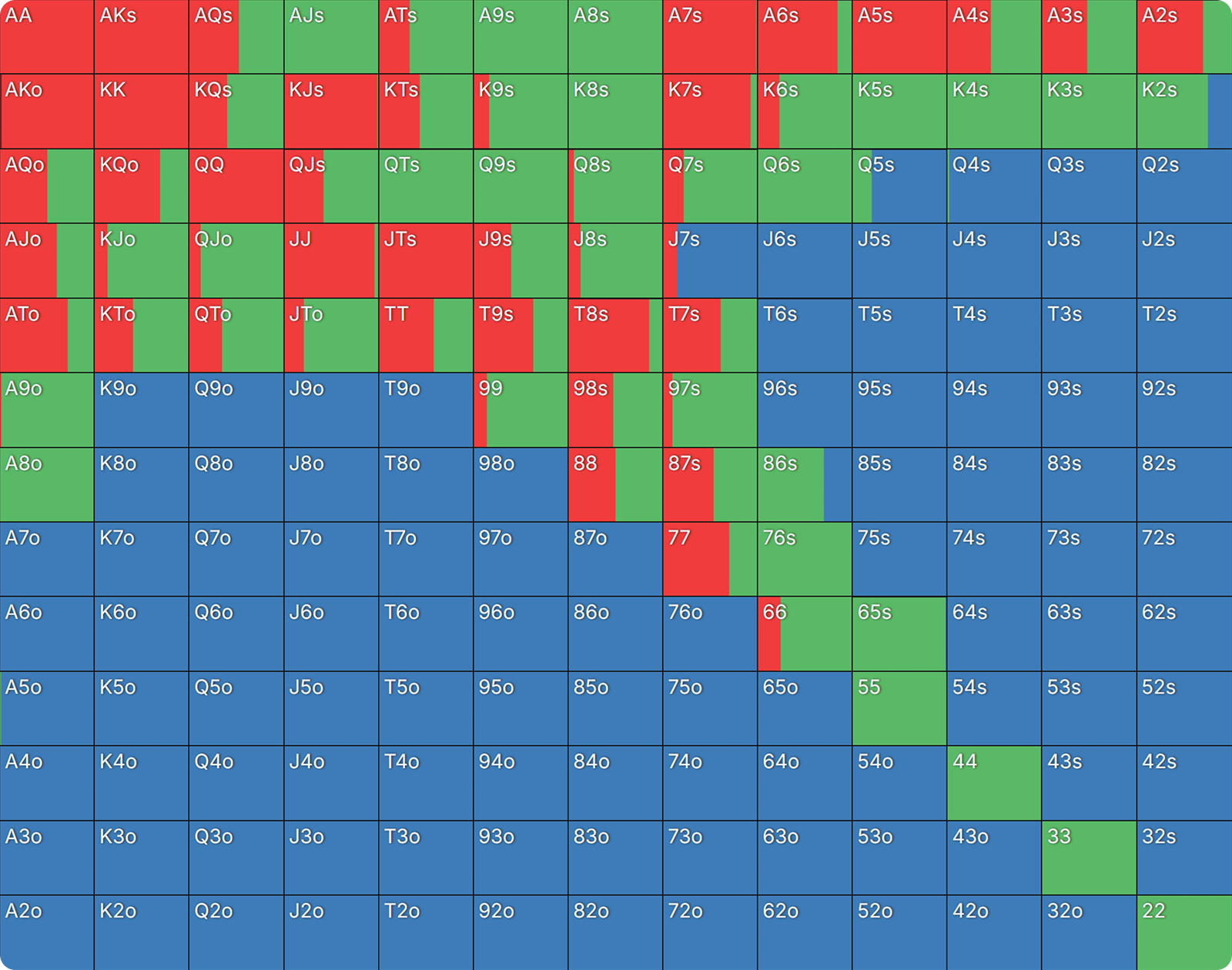
BB’s response is not terribly different from SB’s. In fact, their 3-betting strategy is nearly identical. The major difference is that, getting a better price and with only one player remaining to act behind them, they can call with weaker speculative hands. BB’s calling range includes suited connectors, suited gappers, and suited Kings and Queens, which SB’s does not. It also includes some weaker offsuit Aces, which nevertheless dominate a substantial portion of BTN’s opening range.
STR Facing BTN Open
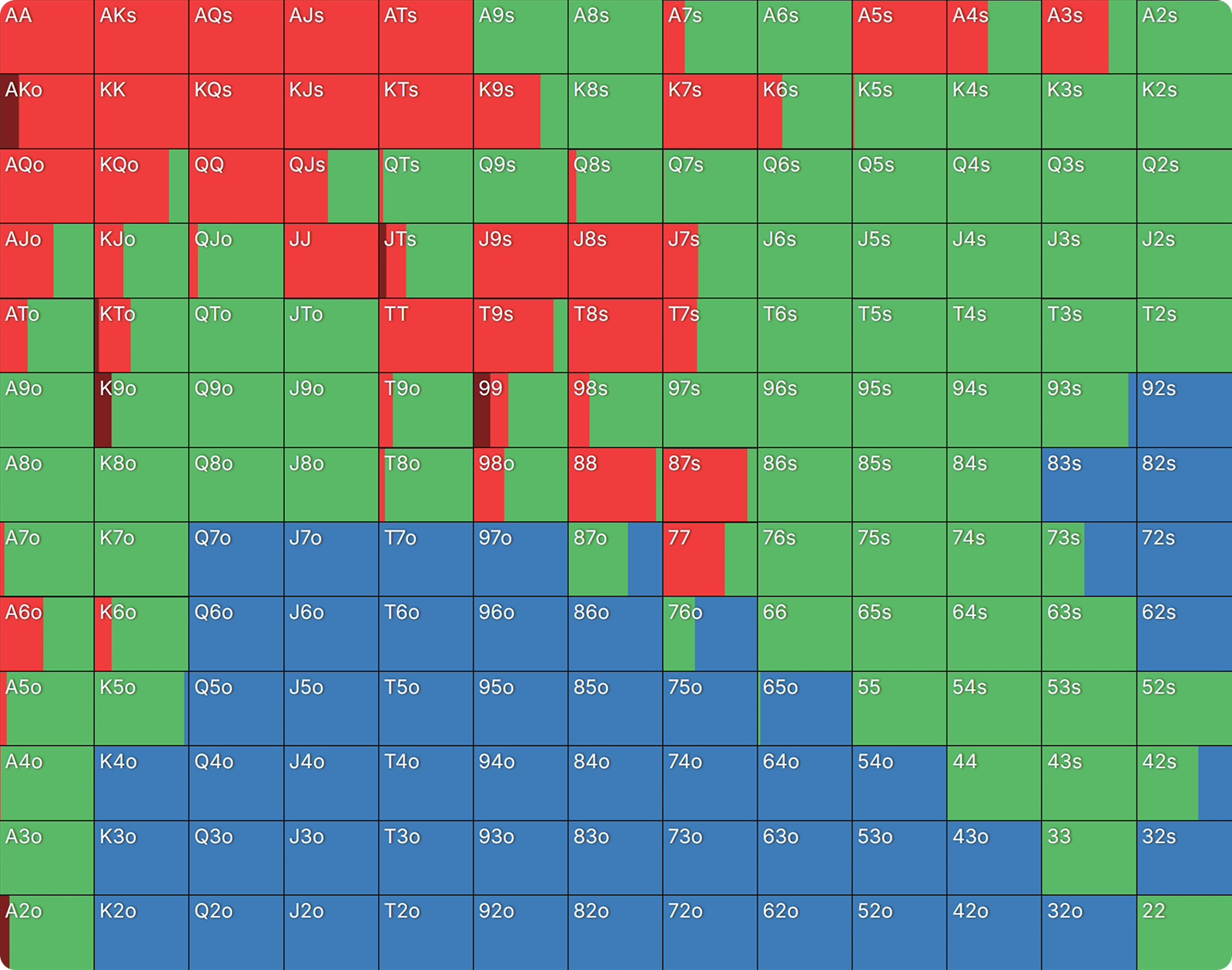
STR responds a bit differently than the Blinds. In particular, they 3-bet more of their best hands, such as bigger pocket pairs and suited Broadways. With no one to act behind them, they will never induce a squeeze or contest a pot multiway after calling. That makes their calling range more obviously capped than those of the Blinds.
The diversity of STR’s calling range ensures they will make strong hands on virtually all flops, even if they never carry forward any strong preflop hands in their calling range.
The large preflop pot and the small number of players remaining to act also put a new option on the table for STR: jamming all-in. This isn’t much used at equilibrium, but unlike in two-blind Hold‘em, it’s an option worth considering in real-life game situations. The hands that jam are mostly AKo, JTs, and 99, hands with good raw equity but poor postflop equity realization. These jams win 14.5bb when BTN folds, and they aren’t in terrible shape against BTN’s calling range. Other jams, like A2o and K9o, perform less well when called but block BTN’s calling range while unblocking their folding range.
Continuation Betting
We’ll need to approach this topic with a grain of salt because the only aggregate reports available for two-blind Hold‘em cash games are for raked games, while the Straddle+Ante reports do not include rake. Even so, the differences between the two are dramatic enough to draw some larger conclusions about how postflop play differs in Straddle+Ante games as a result of the different preflop incentives.
Here’s BB’s aggregate c-betting strategy for a raked, 9-handed 100bb cash game with a 2.5bb open from the BTN:
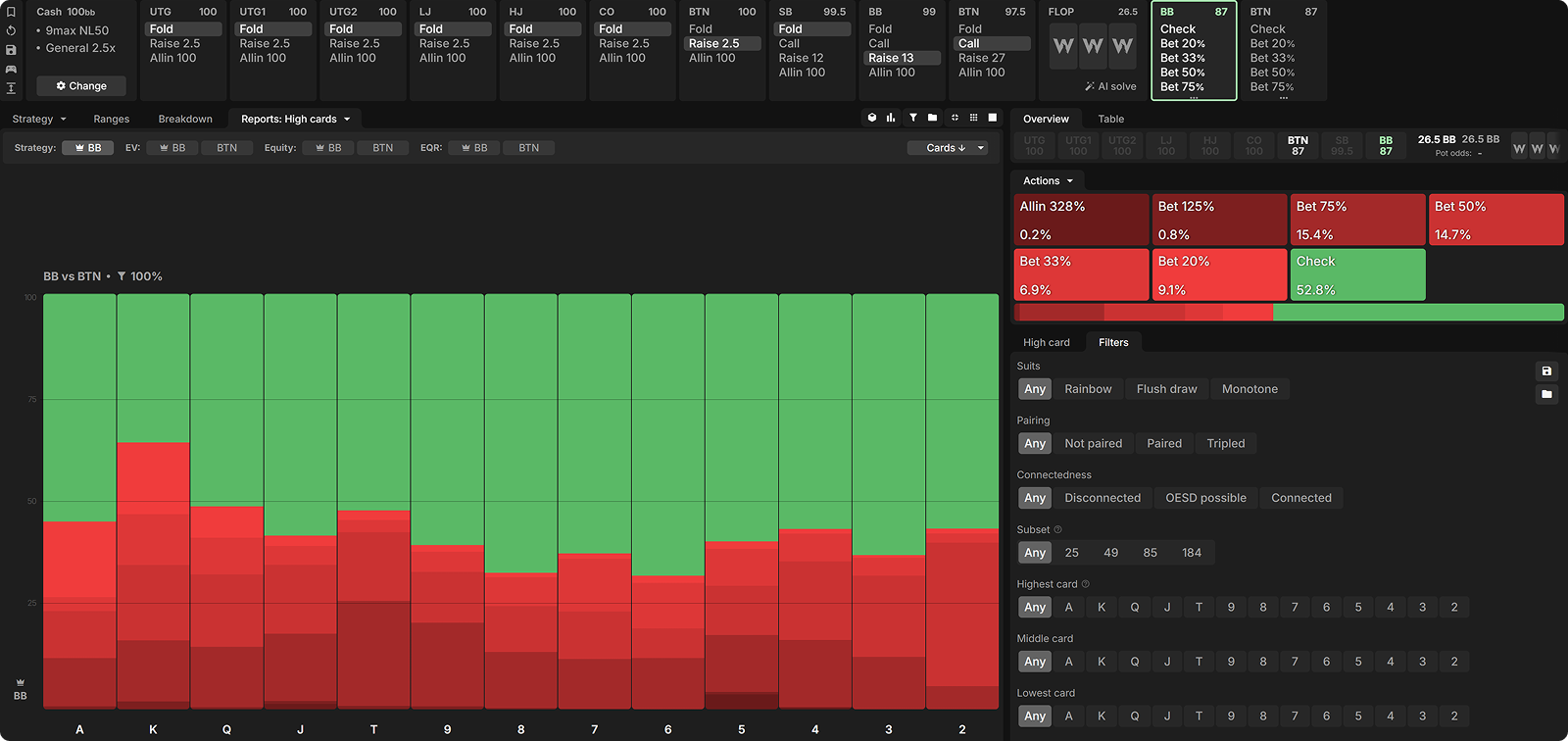
BB checks a little more than half their range on average after their 3-bet (to 13bb) is called. When they do bet, they mostly bet 50% or 75% pot, suggesting a more polarized strategy.
BB’s worst flops are heavy on medium cards and mostly monotone. On these flops, they do not c-bet at all.
Compare this to a STR vs BTN 3-bet pot (unraked, with a 3.5str opening size and a 14str 3-bet size):
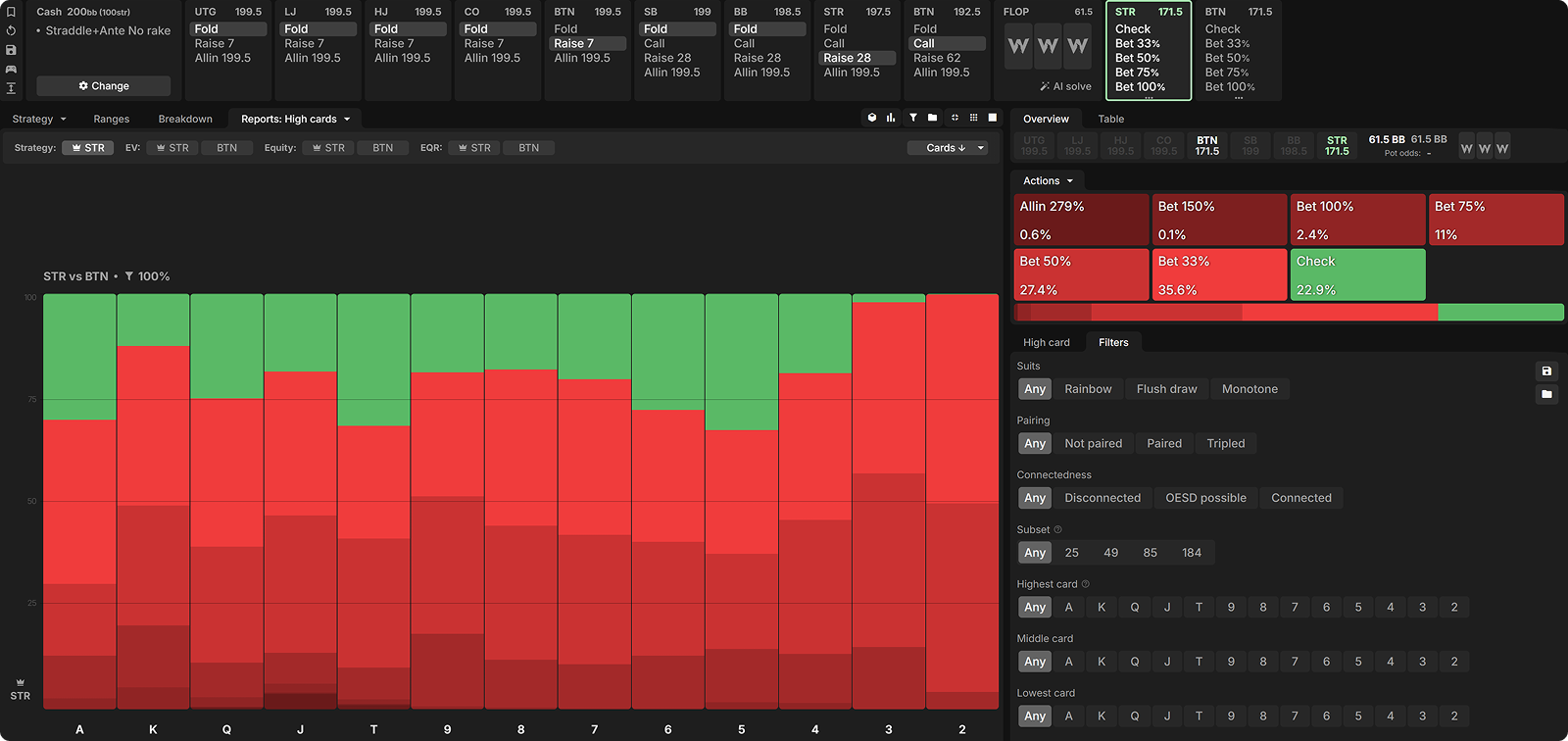
STR checks less than a quarter of their range, and 33% pot is their most used size. This suggests a more linear c-betting strategy and a bigger equity advantage, which makes sense. Whereas BB in a two-blind game favors a polar 3-betting strategy, STR expects BTN to call more often because of the antes, and so 3-bets a more linear, equity-dense range. This, along with BTN’s wider calling range, means STR flops more equity on average and so bets more often. The small bets, in particular, target BTN’s total whiffs, of which they will have more when they call with more weak hands preflop.
The worst flops for c-betting are still mostly monotone, but for the STR, they are more often high and disconnected. BTN’s expanded calling range includes a lot more offsuit Broadway hands, which increases the risk that a light c-bet will be drawing nearly dead to top pair on these flops.
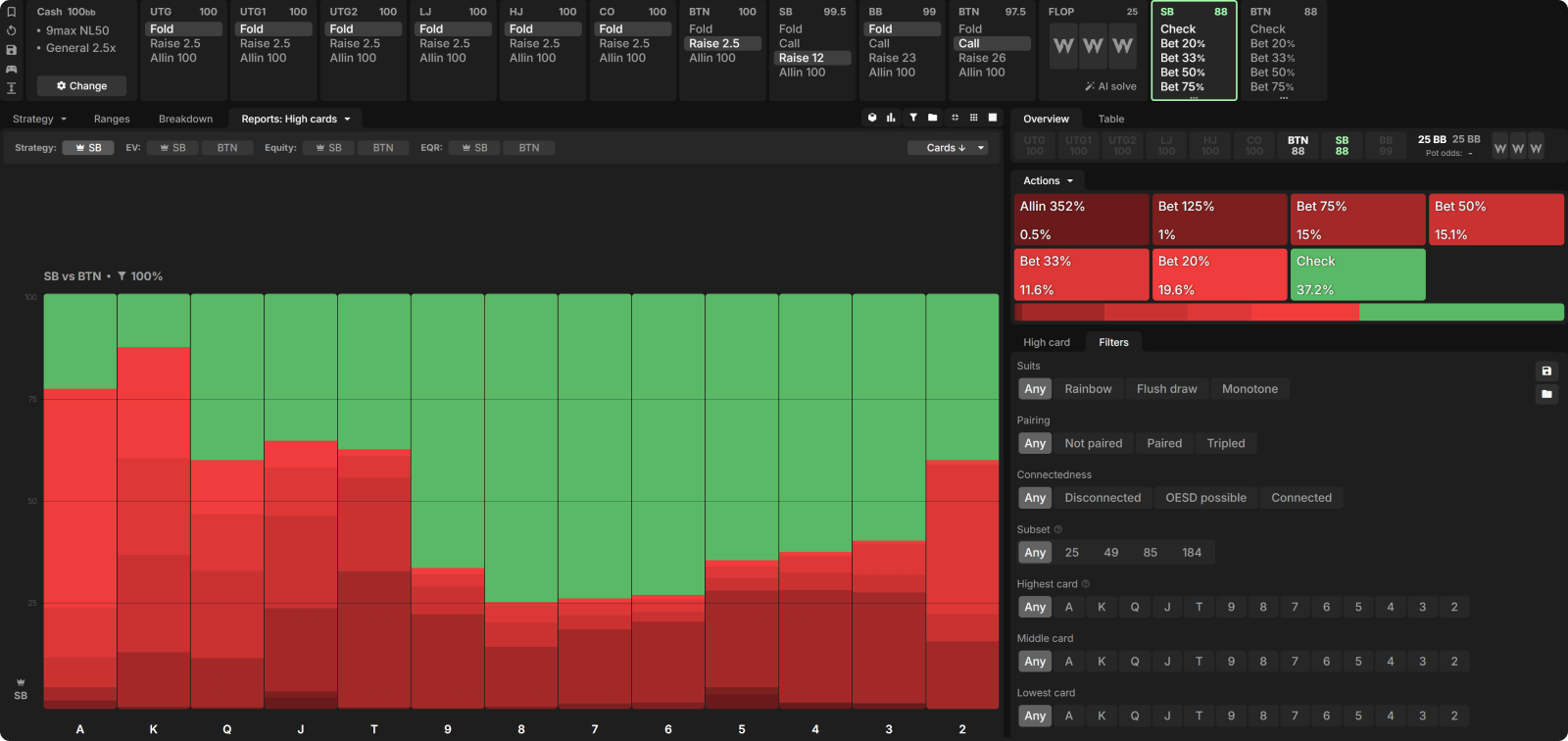
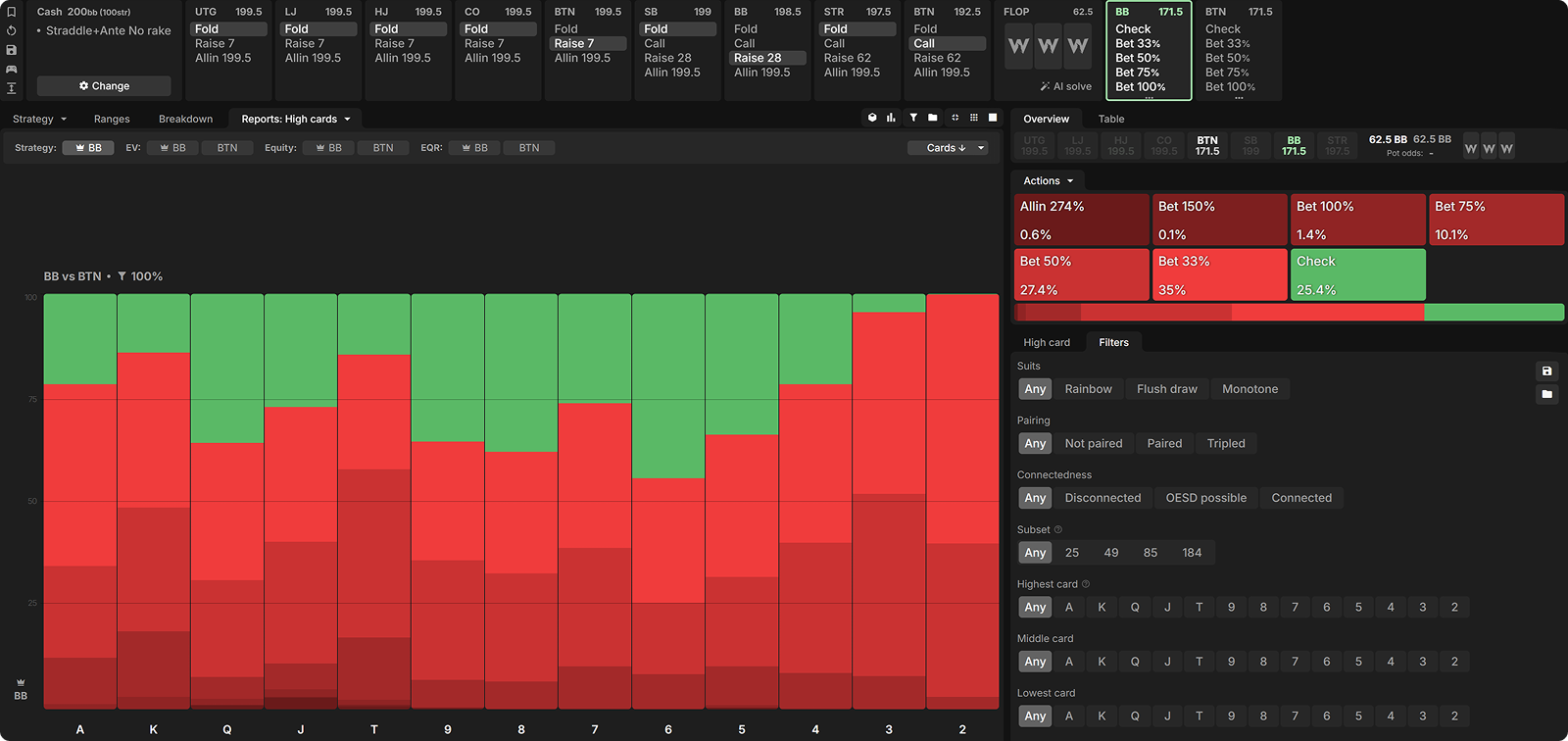
We see a similar pattern when we compare SB vs BTN c-betting in a two-blind game to BB vs BTN c-betting in a straddle+ante game:
Conclusion
Antes change everything. By incentivizing a wider stealing range and a more stubborn response to re-steals, they also incentivize a more linear, equity-dense 3-betting range from the defending players. This, in turn, incentivizes more and smaller flop c-bets to capitalize on the 3-bettor’s equity advantage.
Ready to practice your new skills? This drill throws you into the action as either SB, BB, or STR facing a BTN steal.

Responding to 3-bets in Straddle+Ante Games
Previously, we explored opening and 3-betting in Straddle+Ante games. In this article, we wrap up the topic by examining how to respond to 3-bets.