The Hidden Cost of Late Reg in PKOs


Overview
Most PKO experts, including those who have written about late registration and PKOs for the GTO Wizard blog, advise not to register late for PKOs. But just how -EV is it to register or re-enter late at various stages of the registration period?
In my previous article on late registration in non-bounty MTTs, both theory and real-world data indicated two prominent factors to consider when evaluating the potential ICM ROI boost from late registering:
- How much of the field remains, or how close we are to the ITM bubble
- How flat the payout structure is, or how many buy-ins a min-cash is worth
In regular tournaments, a low percentage of the field remaining and flatter payout structures have an uplifting effect on the value of our stack when we enter at the last moment. In PKOs, however, these two factors—the large number of earlier eliminations and the fact that we usually win fewer buy-ins when we min-cash—have the opposite effect on our stack value when we register late.
1) PKO Late Registration by Percentage of Field Remaining
In a regular MTT, the prize pool stays fixed until the bubble bursts. Therefore, as players are eliminated, the stacks gain in value. The exact size of your stack matters much less than simply staying alive in the tournament.
In a PKO (and in SKOs), however, money is removed from the bounty prize pool (BPP) with every elimination from the tournament. And because the bounty prize pool is Chip EV and not influenced by ICM like the regular prize pool, the value of the bounties removed from the bounty prize pool as each player is eliminated has a greater, outsized negative impact on the value of late registration stacks than any positive increase in a late registrant’s stack share of the regular prize pool (RPP). A detailed breakdown of the data can be found in one of the sections below called “The Math of PKO Late Registration.”
2) PKO Late Registration and Payout Structures
The regular prize pools in PKOs tend to look similar to the prize pools of non-bounty MTTs in terms of their distributions, with a few notable exceptions. One key exception that influences the value of a late registration stack in PKOs is that, since 50% of the buy-in goes to the bounty prize pool in most PKOs, the regular (placement) payouts tend to be about half of what they would be if there were just one prize pool instead of two.
For example, the min-cash in a regular MTT is typically around 1.5 to 2x the entry fee. However, in a PKO MTT where 50% of the buy-in goes to the bounty prize pool, only half the buy-in can go to the regular prize pool. Thus, it’s common to see PKO structures where a min-cash from the regular prize pool is only .75 to 1x the entry fee.
A big part of the benefit package of max late registering a regular tournament or satellite is the value of a min-cash, since we start the tournament so much closer to the ITM bubble. A common scenario when we enter late is that we are less likely to be a big stack on the bubble and more likely to be below average. The shorter our stack, the greater the value and importance of min-cashing.
But when a min-cash isn’t even as much as the entry fee to the tournament, min-cashing becomes less valuable, as does late registration. A min-cash in a regular MTT might immediately return a minimum of a 50–100% positive ROI in the event, but in a similar PKO, a min-cash with no bounties won is usually going to return a negative ROI.
The Importance of Covering in PKOs
In PKOs, since typically 50% of the prize pool is paid out in bounties, our potential ROI is significantly limited when we don’t cover other players at our table. In the sample $5 + $5 +$1 PKO tournament from a large online poker site that I discussed in my first late reg article, 52/156 players remained at the close of late registration. {{color: #1EC39C}}Five players registered at the last moment{{/color}} with a 100,000-chip starting stack. Below is the actual stack distribution of the tournament at the close of late registration.
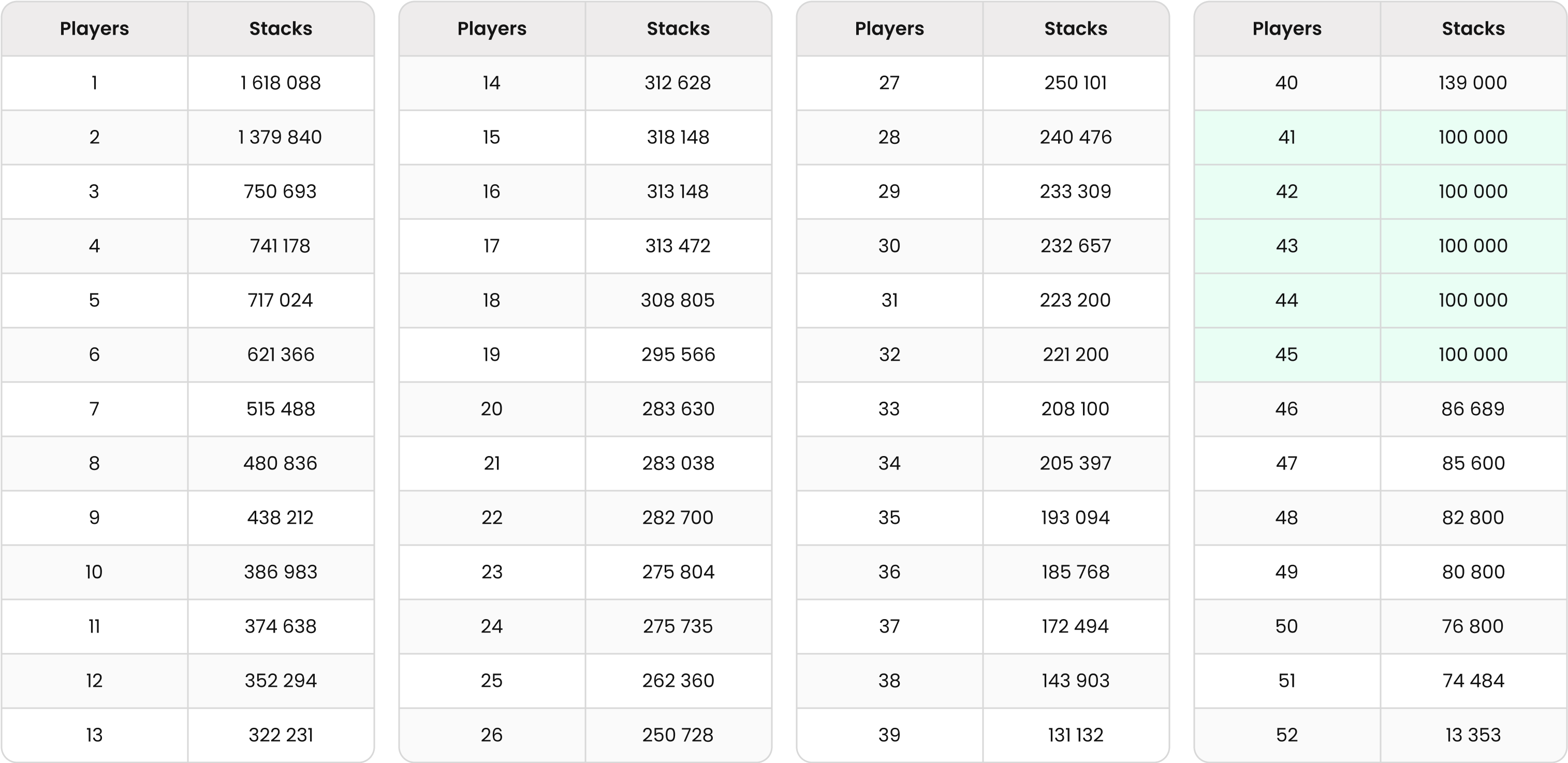
The late registrants began their tournament tied for 41–45th place. They covered each other plus 7 other shorter stacks. They were covered by 40 of the 52 remaining players, or about 77% of the field.
{{grid: 5fr 1fr}}
With approximately 6 tables left, assuming the operator distributes the late registrants evenly across the remaining tables (the best practice), the most likely table scenario for the late registrants is that they will be the shortest or second shortest stack at their table and rarely (if ever) will they be above the bottom 3 in chips.

{{/grid}}
It’s not possible to win part of the bounty prize pool if we don’t cover the other players in the pots we play. In this situation, we are far more likely to wind up in pots with players who cover us and who will be incentivized to go after our bounty, which will offer them around a 10–12% equity drop to play versus us at this stage. Conversely, optimal short/covered stack strategy at this stage will usually be to enter pots even less often than in regular MTTs at this stage because of the decreased fold equity they have against covering opponents. This also complicates the search for spots to play pots against the few (if any) stacks the late registrants cover.
Even if we double up the first hand after we enter the tournament, in this PKO MTT, we would still have been covered by 33–34 players, or around 65% of the field. This will continue to make it difficult to win bounties. This downside goes on top of the fact that at least 40% or more of the bounty prize pool will already have been drained by other players who won bounties.
The Math of PKO Late Registration
Most of the time, late registering a PKO will come with an insurmountable ROI disadvantage. While there is still some possibility that a player could register late and then quickly double several times to have a good chance of a positive outcome, that is an unlikely scenario to occur all of the time if a player is frequently entering or re-entering PKO tournaments deep into the late registration period.
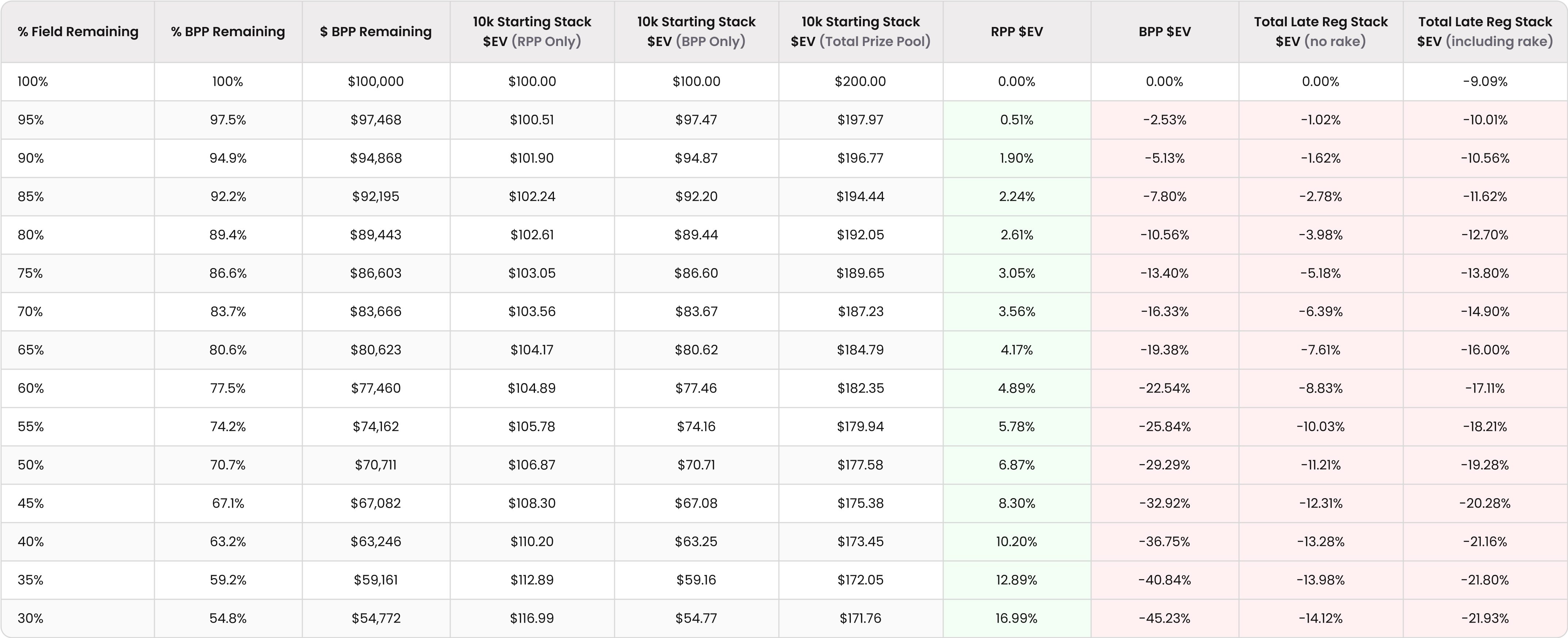
The table below demonstrates the negative impact on the value of a late registration stack in a typical PKO where 50% of the buy-in goes to the bounty prize pool (BPP):
{{toggle: Show Note}}
{{color: grey}}*This table is comprised of calculations run with the following parameters: $100+$100 PKO, 1,000 entrants, 10,000 chip starting stack, GTO Wizard 1,000-entrant PKO regular prize pool structure, and other stack distribution shape = .6. The remaining prize pool and average bounty were calculated with Tombos21’s PKO prize pool formula: Bounty Prize Pool ($100,000) * % Field Remaining ^ % of Buy-in to BPP (50%).{{/color}}
{{/toggle}}
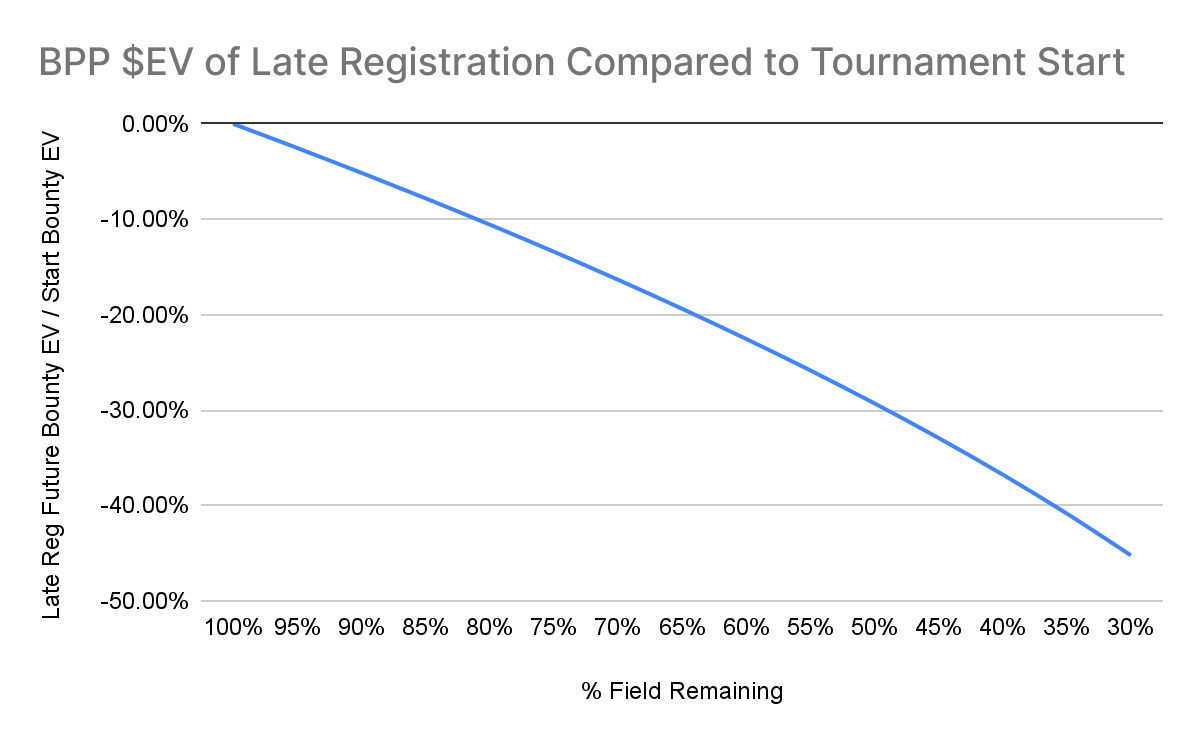
- After just 10% of the field has been eliminated, the bounty prize pool will, on average, have already been depleted by -5%.
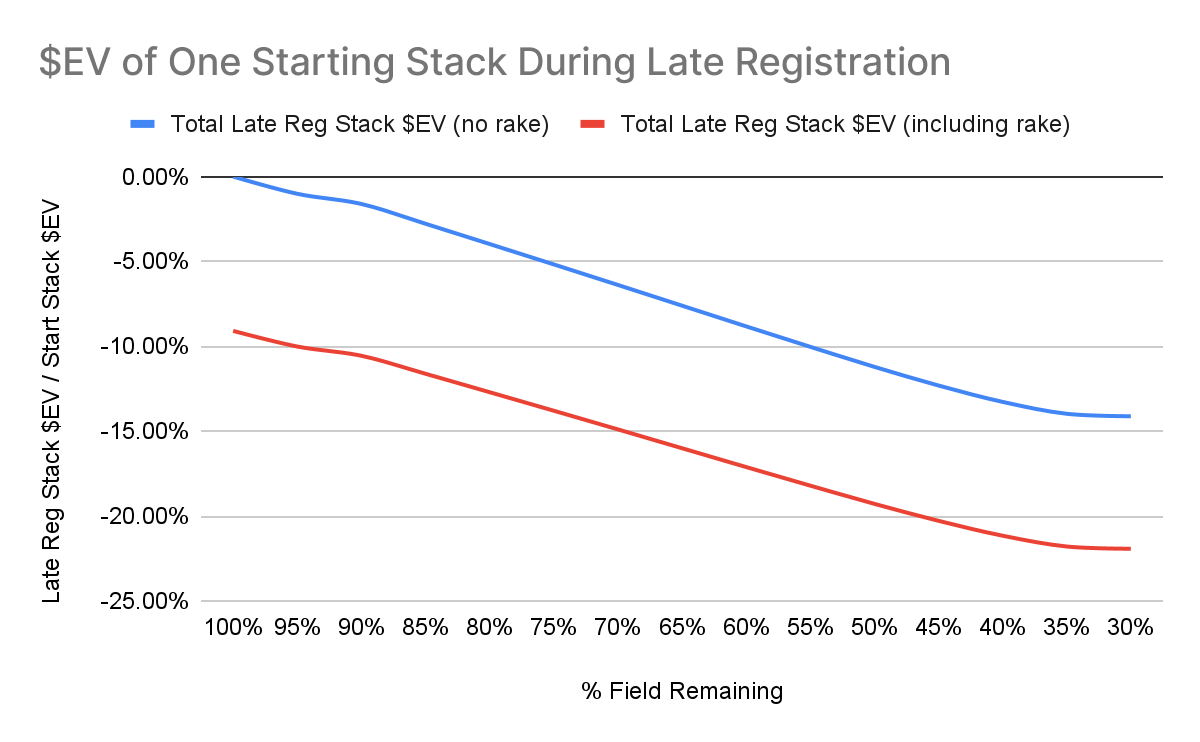
- With 25% of the field gone, -13% of the BPP has, on average, already been awarded. A starting stack will be worth -5% of what it was at the start of the tournament.
- When half the field has busted, roughly -29% of the bounty prize pool will be gone. A starting stack will have lost -11% in value.
On sites where late registration ends with approximately 30–35% of the field remaining, the bounty prize pool will have decreased by 40–45% on average, and a starting stack value will have decreased by approximately -14%. Note that the approximately -14% value of a starting stack in the $5 + $5 + $1 real-world PKO example discussed above and in the previous article, where 33.3% of the field remained at the close of late registration, is roughly the same as what this model predicts.
Conclusion
In regular tournaments, the ICM increase in the value of stacks as the tournament progresses helps to offset the disadvantages of entering a tournament late (learn more here). However, since only half the prize pool in a standard PKO is impacted by ICM, the risks/rewards of chip accumulation differ significantly.
There are more (and stronger) disadvantages to registering late in PKOs, of which these are the two most prominent:
- An immediate decrease in the start $EV value of a stack.
- Being covered by/not covering most or all of the other players at the table limits our ability to win a share of half the prize pool.
In PKOs, the chips we win at the early stages of a tournament are more valuable than in regular tournaments because ICM risk premiums are lower overall, and winning bounties at the early stages of the tournament is crucial to profitability and our overall ROI in the tournament. This heavily incentivizes registering PKOs at or before the start of the tournament.
We Are Hiring
We are looking for remarkable individuals to join us in our quest to build the next-generation poker training ecosystem. If you are passionate, dedicated, and driven to excel, we want to hear from you. Join us in redefining how poker is being studied.
Check out the available positions here.

How Payout Structures Reshape Postflop Strategy
Is all ICM pressure the same, or should we tailor our postflop strategy to different payout structures? How big of an error is it to take the same default final table strategy into a tournament that features a more top-heavy or a more flat payout distribution?
How ICM Quietly Shapes Postflop Strategy From the Start
How significant is ICM at the start—as in the very first hand—of a tournament? Have we been learning the wrong way all this time by using Chip EV ranges to study spots when stacks are deep and few players have been eliminated?

ICM vs. ChipEV: The Hidden Logic Behind BB 3-Bets
BB 3-betting is fundamentally different from 3-betting from any other seat, even the SB. Calling at a discount and closing the action is such an appealing option that many hands that may seem like “natural” 3-bet candidates have higher EV as calls. This is even more compelling when taking ICM into a