3-Way: How to Exploit a Calling Station?

Overview
In a recent blog article called Monkey in the Middle, I examined the GTO solution for a three-way pot between CO, BTN, and BB. Using a Ts7h4s flop, I concluded that BTN has extra incentive to raise a small c-bet from CO because they can compel BB to fold up to 40% more of their range!”
BB’s GTO response to this raise includes folding open-ended straight draws, non-nut flush draws, and even a fair bit of top pair. All that fold equity incentivizes BTN to raise even when they are not terribly excited to grow the pot vs CO’s betting range.
An astute blog reader named Chris pointed out that many human players will not play so tightly in the BB. Chris wondered how it would change BTN’s strategy. Let’s find out!
Constructing an Experiment
Chris’s question is a great example of how answering one question can generate fresh questions and hypotheses to test. Actually constructing the experiment was a good reminder for me that testing a hypothesis is rarely as simple as it sounds.
A good experiment tests a single variable, keeping everything else constant so that we can be sure any changes to the output are a result of changes to that variable. In this case, we’re interested in testing how changes to BB’s strategy for continuing to a raise affect BTN’s raising strategy.
Chris didn’t explicitly offer a hypothesis, so I’m going to formulate one on behalf of anyone who might be skeptical about the willingness of their human opponents to make folds like this:
Because the profitability of BTN’s raises derives from BB making some big laydowns, BTN’s raising frequency will decrease if the player in the BB is sticker.
Constructing the experiment seemed simple enough: apply the Calling Station Player Profile to BB, leave all the other parameters of the simulation untouched, and compare BTN’s response to a CO c-bet in both the original simulation and the one with the Calling Station BB.
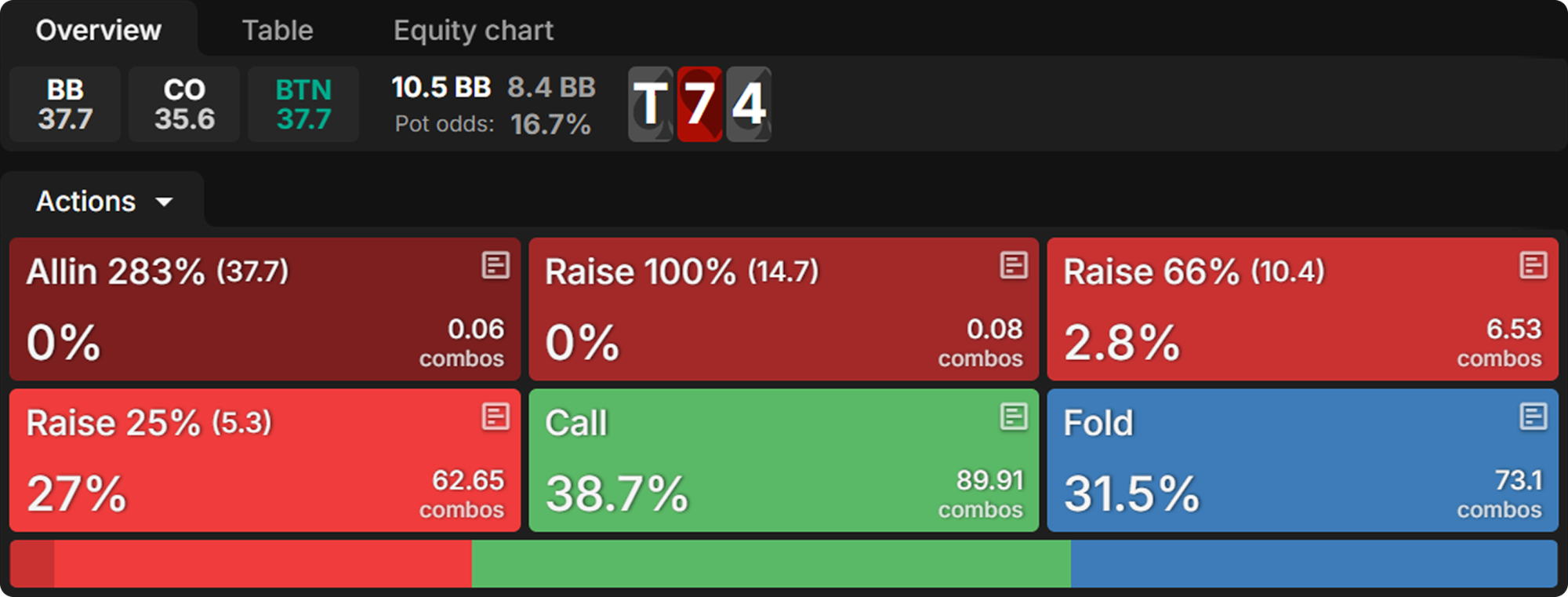
At first blush, the difference appears to be noticeable but unremarkable. BTN calls the c-bet less often with a Calling Station behind and both raises and folds more often. When they do raise, they still prefer the smaller raise size, but they use a 66% pot raise twice as often as when BB is a GTO player.

There are some important caveats here, however:
- CO’s c-betting strategy changes with a Calling Station in the BB. In the original simulation, they split between betting 25% pot and 50% pot, with a slight preference for the smaller bet. With a Calling Station in the BB, they almost always bet 50% pot. The change to CO’s betting range is a confounding variable that makes it difficult to determine how much of the shift in BTN’s strategy is a result of BB being a Calling Station.
- Even with the Calling Station profile applied, BB still folds a fair bit of their draws and top pair to BTN’s raise. So, this experiment does not fully address Chris’s question.
It’s important to understand that neither of these caveats makes the experiment “wrong”. As my podcast co-host Carlos Welch is fond of saying:
Solvers always give the right answer to the questions you ask them. Your job is to ensure you ask the right question.
In this case, the question I asked was, “Suppose the BB were somewhat too loose and passive, and the CO was allowed to adapt to that by using a larger bet size. How would this change BTN’s response to a small continuation bet?”
That’s a fine question, but not really the one that motivated this experiment in the first place. Let’s try again.
One Size Fits All
The new Single Size Solutions are a convenient way to eliminate the problem of CO changing their c-bet size. They’ll still adapt their c-betting strategy to having a Calling Station in the BB, but we don’t have to worry about them splitting between multiple sizes.
There’s not a way to apply a Player Profile to the Single Size Solution, but we can do essentially that by creating a Custom Solution using the same betting options as the Single Size Solution. We can force the BB to play extra loose by node locking them to never fold top pair, open-ended straight draws, or any flush draw.
As in the initial experiment, this results in slightly more folding from BTN and, this time, a good deal more raising. They raise 19% of hands with the loose player in the BB, as opposed to 13% with a GTO player behind.
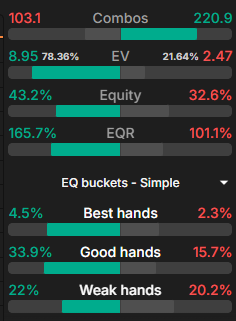
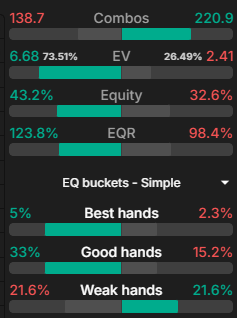
In theory, some of this difference could be owing to changes in CO’s betting strategy. CO bets 23% of their range with the GTO Player in the BB and 31% with the Calling Station in the BB. However, the composition of the ranges (the ratio of Best/Good/Weak hands) is virtually identical, and CO has the same equity vs both ranges.
{{grid: 2}}
{{/grid}}
That suggests BTN’s extra raises are aimed squarely at the Calling Station in the BB. Let’s dig into the details to see what exactly they’re up to.
BTN’s Raising Strategy
BTN slowplays less and raises for thinner value when the BB is excessively loose. With a GTO BB, BTN mostly slowplays 77 and 44 (they don’t have TT in their preflop calling range), because they don’t want BB to fold their top pair. Once BB is nodelocked to never fold top pair, these hands become more appealing raises (except for the combo of 77 that does not contain a spade).
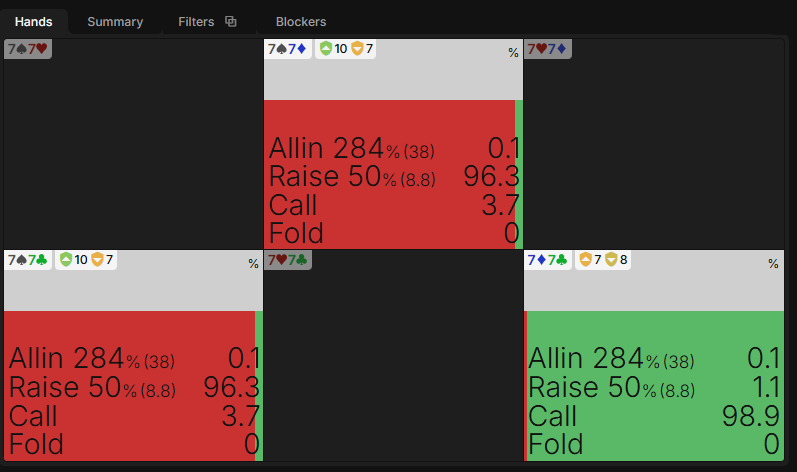
BTN also raises more of their AT, KT, and QT with a Calling Station behind. However, they are slightly less likely to raise JT.
The reasons for this are quite interesting and perhaps counter-intuitive. A GTO BB folds most of their Tx, including even some KT, to a raise. When BTN raises JT and QT into this player, they are not only denying equity to draws but sometimes causing the dominating top pair to fold, which is of course a fantastic outcome.
When BTN raises QT against the Calling Station, they don’t get any of that fold equity. Instead, they get called by the top pair they dominate! And while it’s nice to deny equity to the draws, getting called by them is not the end of the world, as many of them have eight or fewer outs. But with BB never folding QT, let alone KT, raising JT is less appealing. They still get called by some dominated top pair, but not enough to compensate for the risk of raising into dominating hands.
A Lesson About Equity Denial
In the original article, I concluded that much of BTN’s incentive to raise CO’s continuation bet came from denying equity to the BB. But now we see that BTN actually raises even more aggressively when the BB is a loose player who will not be denied the opportunity to chase a draw. Is it time to publish a retraction?
Nope. It’s time to learn a lesson about equity denial!
Just because it’s good for you when an opponent folds doesn’t mean it’s bad for you when they call.
What BTN is really doing by raising is increasing the price BB must play to realize their equity. A rational, profit-oriented player in the BB responds to this raise by correctly folding hands like the aforementioned draws and top pair even though they have substantial equity against BTN’s raising range. Denying them this equity is better for BTN than letting them realize that equity cheaply by overcalling.
Better still is if a less profit-oriented player in the BB is willing to pay too high a price to realize their equity. This gives BTN new incentive to raise: not to deny equity, but to profit from the loose player’s mistakes!
Betting (or raising, in this case) when you have an equity advantage isn’t necessarily about exploiting your opponent’s response to the bet. It’s about putting them in a double bind where there is no great response. They must either fold their equity or pay too high a price for it. One of those options is better than the other, but neither is as good as realizing the equity cheaply, which is the opportunity BTN would offer them if they did not raise.

Exploiting Profiles: Episode V – The LAG
LAG players are uncomfortable to play against. They barrel, they lead, they never seem to fold, and somehow they keep winning pots they have no business being in. In this article you'll learn how to perfectly exploit them so you start taking their money instead.

Exploiting Profiles: Episode IV – The TAG
They're not a fish. They're not a maniac. The TAG reg is the opponent you'll face most often, yet most players have no idea how to exploit them.

Exploiting Profiles: Episode III – The Maniac
There's a maniac at your table. They bet every street, call everything, and somehow keep winning pots they have no business being in. So what's the adjustment? Do you start blasting back?