Monkey in the Middle: 3-Way Pot Heuristics

Overview
In my experimentation with 3-way postflop sims, many of the most counterintuitive results I’ve come across have been when facing a small continuation bet with a third player still to act behind. This is a case where instincts and heuristics derived from facing a c-bet in heads-up pots are especially likely to steer you wrong.
In this article, we will discuss the key strategic differences between this scenario and one where you face a continuation bet in a heads-up pot, how those differences factor into the GTO responses to these bets in 3-way pots, and when those differences are more or less salient.
We will focus primarily on a CO-BTN-BB single-raised pot (SRP), as this is one of the most commonly occurring 3-way scenarios and also one where raising plays a large role in BTN’s response to a c-bet because equities run closer together than they would if the raiser were in early position.
Comparison With Heads-Up Strategy
In order to put the 3-way strategy into context, we will look first at how BTN responds to a ¼ pot c-bet from CO in a heads-up pot on T♠7♥4♠. BTN plays {{color: blue}}~10% folds{{/color}}, {{color: green}}~73% calls{{/color}}, and {{color: red}}~17% raises{{/color}}, heavily favoring the half-pot pot raise size. Their raising range is fairly polarized, as is appropriate when using a larger size and being last to act:

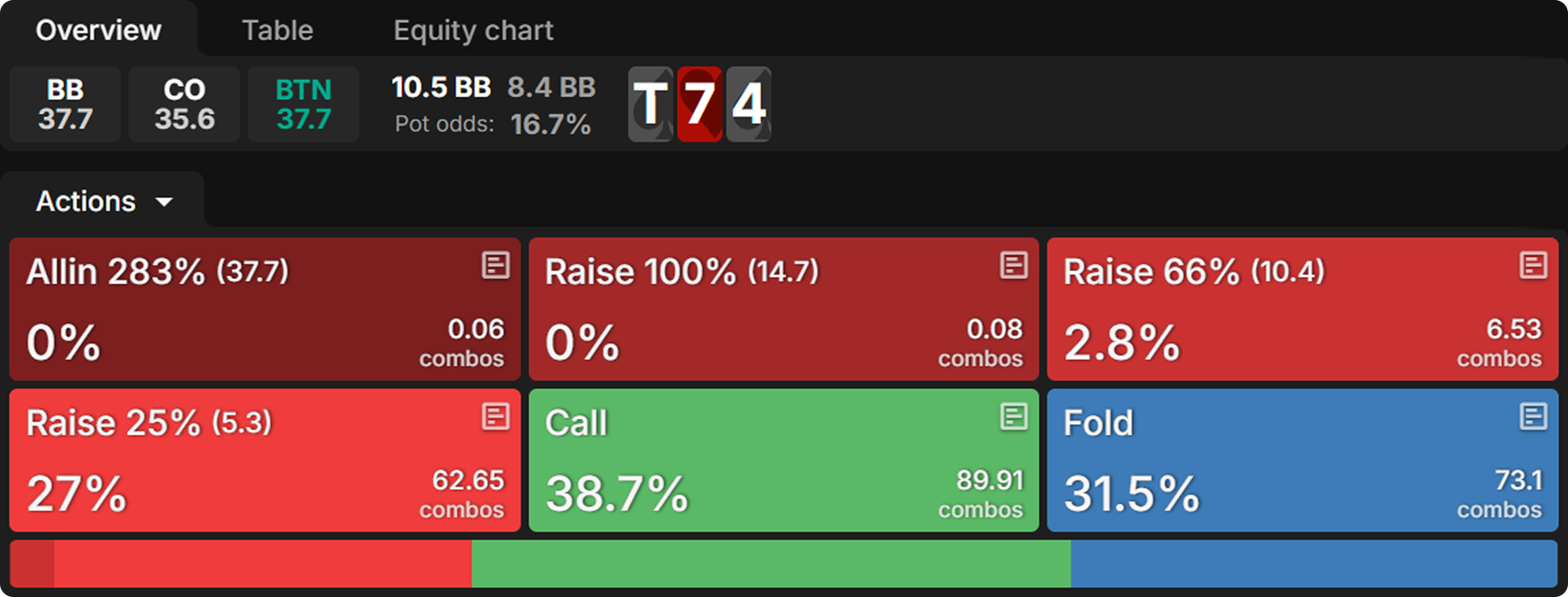
If BB is also in the pot, however, BTN responds to a ¼ pot c-bet with ~31% folds, ~39% calls, and ~30% raises, almost always preferring the smallest raise size of quarter-pot:
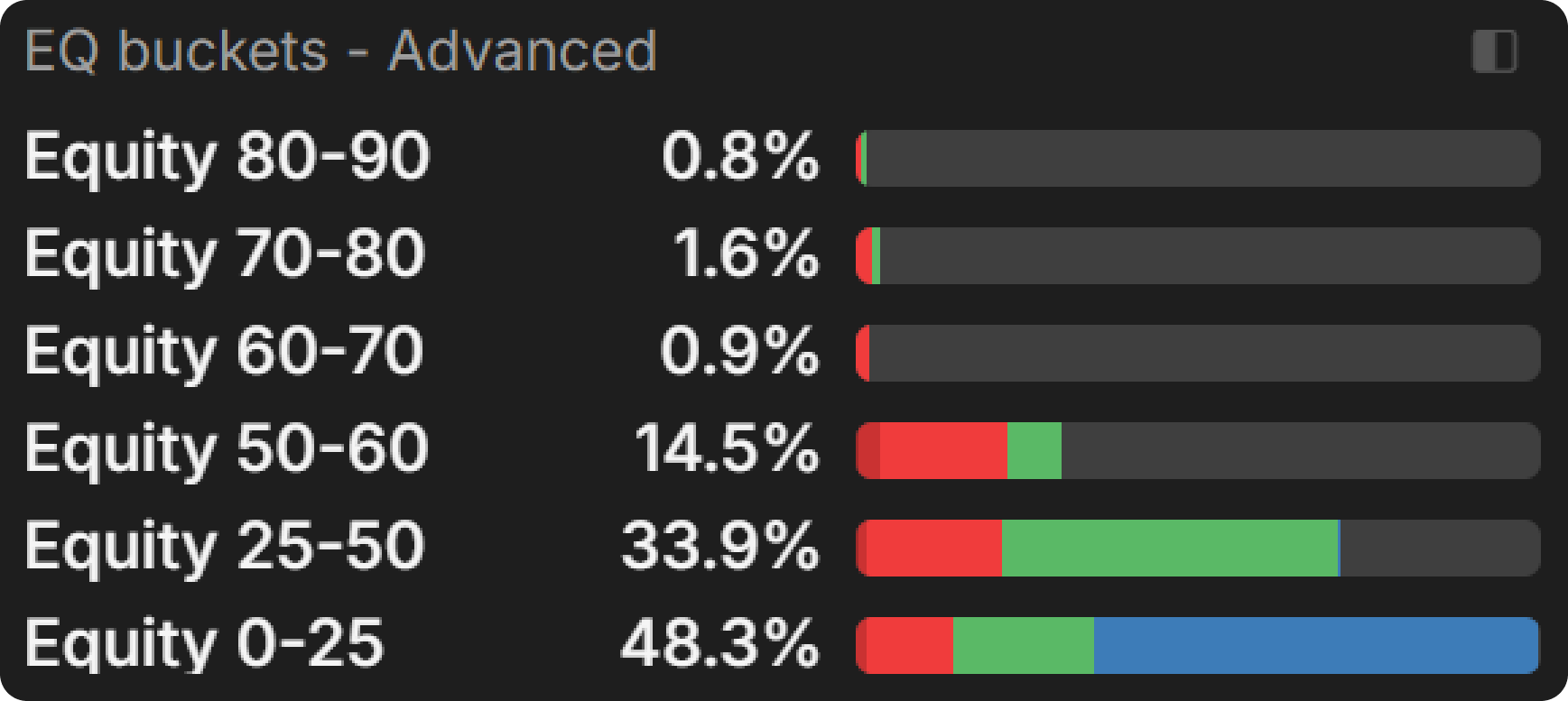
In the 3-way scenario, BTN quite frequently raises hands with 50–70% equity, like JTo that benefit from denying equity but are in an awful spot if CO jams over their raise:
{{width: 67%}}
{{/width}}
Key Differences
{{question-mark}}
How would you explain these differences between BTN’s response in a heads-up pot vs. a 3-way pot?
{{/question-mark}}
Before you read on, try to list for yourself all the relevant factors shaping BTN’s incentives. Formulating your own hypothesis before looking at the data will enhance your learning!
{{width: 67%}}

{{/width}}
From BTN’s perspective, the key differences between facing a continuation bet in a heads-up pot and facing one in a 3-way pot are:
- Not closing the action.
With a third player remaining to act, you can’t justify calls with weak hands based on pot odds alone, because you don’t yet know the pot or the odds. If that third player calls behind you, the pot will be larger, but you will need to beat two hands to win it, so it’s generally a net loss for you when they call. If they raise, you could end up losing your calling chips and not even getting to see the next card, an outcome so bad that even a small risk of it happening cuts meaningfully against the immediate calling odds offered by a small continuation bet. - Facing a stronger c-bet range.
A preflop raiser betting into two opponents should have a significantly stronger range than they would when c-betting the same flop in a heads-up pot. This means you cannot expect a weak flop pair to be ahead as often as it would in a heads-up pot, nor for a turned pair to give you the best hand as often. You may also have a harder time bluffing later streets against this stronger range. - More equity to deny.
Raising marginal hands is dangerous in a heads-up pot because it reopens the betting, thereby risking a reraise that could force you to fold significant equity. The same risk exists in a multiway pot, but it is mitigated when your call would not close the action anyway; that third player could still raise after you call. Moreover, raising offers additional reward when it enables you to deny equity to that third player who would otherwise be getting very good odds to overcall.
An Unexpected Source of Intuition
{{grid: 2fr 1fr}}
Because of these differences, you must be careful about relying on your experience with heads-up pots to guide your strategy in 3-way pots. However, there is another scenario from which you can derive some relevant heuristics for 3-way flop scenarios, one with which you have far more experience even than you do with c-bets in heads-up pots.
{{/grid}}
A significant part of your incentive for 3-betting preflop from any seat other than BB is to deny equity to the players remaining to act behind you, especially the BB, who will be getting a very good price to overcall if you just call. This is why BB 3-betting ranges are much more polarized than 3-betting ranges from other positions.
BTN’s response to CO’s c-bet in a 3-way pot looks similar to BTN’s response to a CO open preflop, with a robust mix of calls and raises. Raising JTo on T♠7♥4♠ can push BB off not just live overcards (the most common targets for equity denial in heads-up pots) but open-ended straight draws, weak flush draws, and even better top pair! When BB folds and CO calls, JTo has 60–63% equity (depending on suits), a significant improvement from the 47–52% it had when initially facing the c-bet with BB still in the pot.
Of course, some of the denied equity comes from CO’s folds, but CO does not often fold to such a small raise (with already having invested in the pot). The real target of this raise is the BB, who folds 85% of their range! Had CO just called, BB would fold only 45%
That last point underscores the power of raising relative to calling when BB remains to act. By putting an extra 3.2bb into a 12.8bb pot, CO can compel BB to fold 40% more of their range!
Caveats
It’s important to note that this play is less powerful when the third player is a preflop cold caller with a much stronger range than a BB overcaller. In a HJ-CO-BTN scenario, CO calls a ¼ pot c-bet 53% and raises 7% of the time.
BTN flops far fewer weak draws than BB would and, with the advantage of position, is less inclined to fold them. They never fold a flush draw (nor do they have the weaker flush draws BB would see the flop with) or an open-ended straight draw, which was a fold for BB unless it also had a flush draw. Combo draws (and sets) are a much bigger part of BTN’s range, meaning that when BTN is in the pot instead of BB, CO’s raises carry more risk and less reward.
BTN also has less incentive to raise on less coordinated boards. Let’s return to the CO-BTN-BB configuration to illustrate this. On K72r, a board where there are no draws to push BB off of, BTN plays {{color: red}}~16%{{/color}} raises and {{color: green}}~54%{{/color}} calls when facing a ¼ pot c-bet, instead of {{color: red}}~30%{{/color}} raises and {{color: green}}~39%{{/color}} calls in the same scenario on T74tt. After CO calls, the BB then folds {{color: blue}}~68%{{/color}}, compared to {{color: blue}}~45%{{/color}} on T74tt.
Finally, BTN raises less against larger c-bets for several reasons:
- Raising risks more relative to calling.
A big part of what makes raising a small c-bet appealing is that it buys a lot of fold equity cheaply. A larger bet forces you to risk more relative to the pot when you raise, and while this also means you deny even more equity to the BB, this reward does not scale with the risk you take. - Calling a larger c-bet offers less odds to BB.
Facing a ½ pot c-bet and a call, the BB folds ~70% of their range on T74tt, including gutshots, backdoor flush draws, and even some top pair! - CO’s range is more polarized when they use a larger bet size. As a result, raising is less profitable, because most of your range would be called only by stronger hands while folding out worse.
Conclusion
Denying equity is massively important in multiway pots. You may know this already from studying preflop strategy, but it’s an important consideration postflop as well.
There’s no easy answer to how to evaluate these risks and rewards. The best response is highly situational, depending on factors such as board texture, the position (and ranges) of the other player(s), and the bet size you are facing. But it’s crucial to recognize that your incentives are often quite different from what they would be in a heads-up pot, which means your response should be different as well.
Practice your new skills by playing as BTN facing a ¼ pot c-bet in a 3-way just like in the example we analyzed in this article. Or, see things from another perspective by playing as the BB.

The Trouble With Implied Odds
When we were brand new to poker strategy, many of us learned about concepts like equity, outs, and pot odds. When drawing, we were taught to count our outs, use those to estimate our equity, and then call or fold based on whether we were getting the right pot odds for the equity we had.

Poker Concepts You’re Using Wrong (and How They’re Hurting Your Winrate)
Language and poker are two of my great passions in life, so I’ve always been interested in poker’s unique and colorful vocabulary. As a poker coach, podcaster, and writer, I have particularly strong opinions about the language we use to explain poker strategy.

When Checking the Nuts Beats Betting Them
Poker is a complex game that requires a diverse skillset from someone who wants to excel at it. Think of emotional disciplinef, accurate hand reading, and a firm grasp of board texture dynamics. But in the pursuit of advanced strategy, we often neglect the fundamentals, such as extracting maximum va