Poker Concepts You’re Using Wrong (and How They’re Hurting Your Winrate)

Overview
Language and poker are two of my great passions in life, so I’ve always been interested in poker’s unique and colorful vocabulary. As a poker coach, podcaster, and writer, I have particularly strong opinions about the language we use to explain poker strategy.
It’s a tricky task, in this era of game theory solvers, to translate the complexities of computer-generated strategies into language and heuristics that humans can understand and use in real game situations. There’s a lot our existing poker jargon does well, and you can read all about the poker strategy concepts I like in my dozens of other articles on this blog.
Today, we’re talking about what I don’t like.
None of the examples below are wrong, necessarily. Players much better than myself understand them deeply and use them to great effect. The problem is that the language is misleading, lending itself to misunderstanding by those whose knowledge of poker strategy is not so deep. If you use any of the following terms yourself, read closely, because you might be doing your game more harm than good!
Protecting Your Range
This concept is not specific to checking ranges, but that’s where I see it used most frequently. The idea is that, when you have a checking range, you need to include some strong hands in it so that your opponent can not attack your capped range with big, polar bets.
For example, here’s a 100bb cash sim for a UTG vs BTN SRP. K♦Q♥T♥ is one of UTG’s most bet flops, but the solver wants to check about 20% of the time, especially when UTG has 99 or 88 without a ♥. But it also includes very strong hands like sets, two pair, and even the nut straight in its checking range at some frequency:
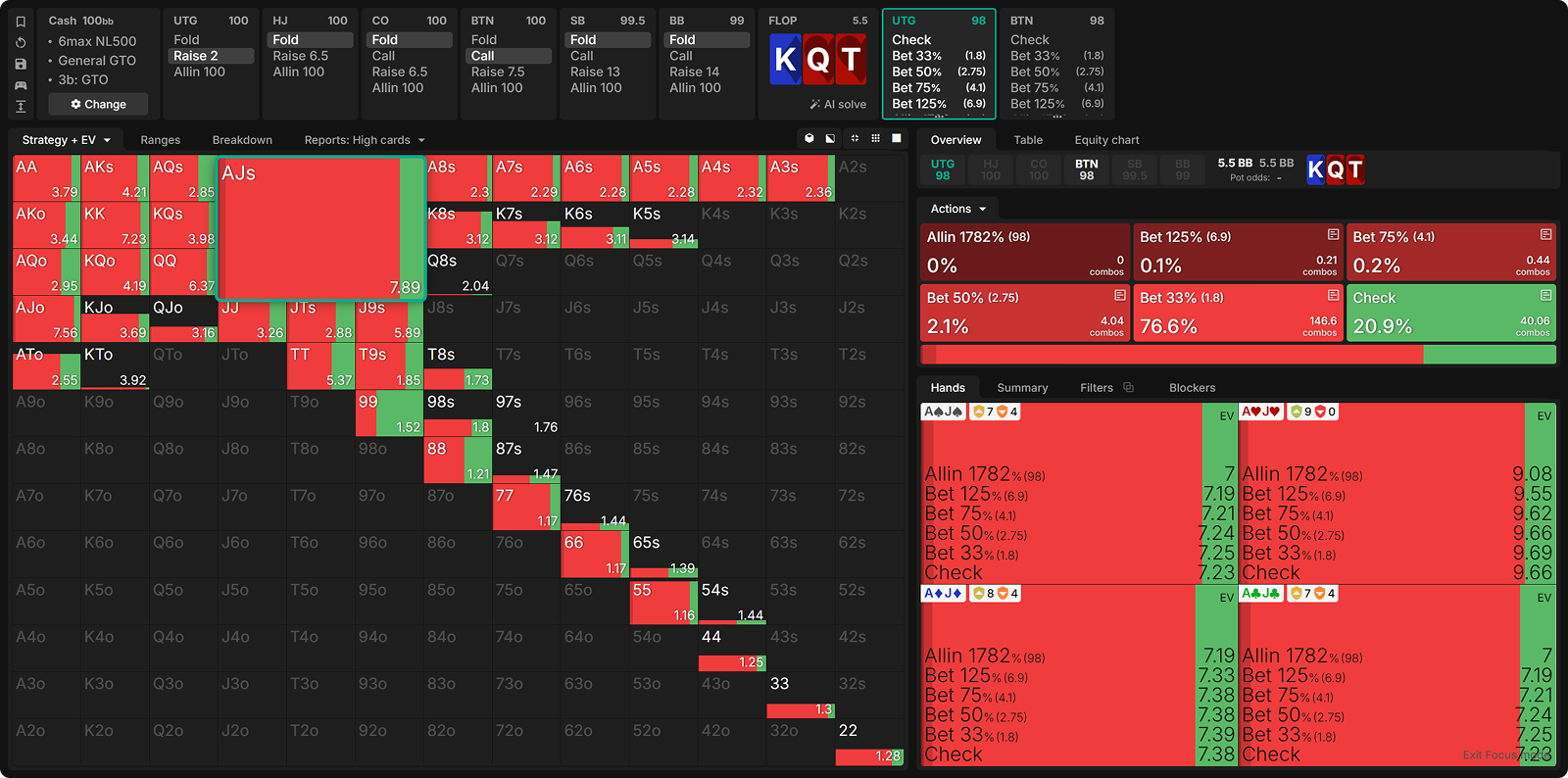
Many very smart poker players will tell you you {{color:red}}have to{{/color}} check strong hands occasionally in order to {{color: red}}protect{{/color}} the weaker hands in your checking range so that BTN {{color: red}}cannot{{/color}} attack your checks with big bets.(The language I dislike is bolded and colored red.)
First off, no one has to do anything, and checking strong hands does not prevent your opponent from making big bets. The fact that you would, theoretically, check a strong hand in this spot does not prevent your opponent from bluffing big after you check in practice. If you have 88, you’re going to lose to that bluff no matter how you would have played some other hand you hypothetically could have also checked.
Those might sound like minor semantic quibbles, but in my opinion, this language obscures the real reason to check a strong hand like AJ in this spot: your opponent may expect you to mainly have something weak like 88, encouraging them to make a big bet with a weak hand that would have folded had you bet.
The language of protection makes it sound like you are sacrificing something, playing AJ in a suboptimal way for the sake of adding value to some other hand in your checking range. This is sometimes called an “advertising play.” By showing your opponent that you are willing to check a strong hand, the argument goes, you will deter them from bluffing in the future, when you may be checking a weaker hand.
Solvers do not make advertising plays. They never sacrifice value with one hand in order to add value to another. If betting were the best way to play AJ, the solver would bet it every time. The fact that it’s a mixed strategy means the solver expects to make just as much from checking AJ as from betting it against an unknown opponent.
This brings us back to my first quibble: you don’t “have to” check AJ, nor does checking it prevent your opponent from attacking your check; they don’t “have to” stop betting big vs. check. Indeed, if you choose to check it, it’s because you hope your opponent will attack your check!
The reason I feel so strongly about this misleading language is related to my next gripe…
Balance
“Balance” is a broad term that potentially encompasses quite a lot, and it gets used in different ways. While it is an important concept, I fear that its broadness and vagueness cause people to lose sight of the ultimate goal of poker: making better decisions than your opponents.
When people talk about balancing their play or balancing their ranges, what they mean is approximating unexploitable strategies of the sort a solver produces. If your strategy is balanced, then you are denying your opponents opportunities to exploit you. As a result, with many parts of their range, they literally will not be able to find the single-best play, because there isn‘t one. That’s what it means to make them indifferent with a given hand.
The catch is that balance, especially on early streets, encompasses a lot more than just a correct ratio of bluffs to value bets or traps to weak checks. Solver strategies anticipate future streets and aim to keep a diverse set of hands in all their ranges (except their folding ranges) so that they will have good candidates for bluffing and value betting no matter how the board runs out.
Humans sometimes rely on simple heuristics that create the illusion of balance but actually make them quite predictable. For example, check-raising a mix of draws and strong made hands from the BB sounds like a balanced strategy. You’ve got value that incentivizes your opponent to fold and bluffs that incentivize them not to fold, and that can give them some tough decisions.
But what if they call, and the turn card completes multiple draws?
Suddenly, you’ve got no weak hands to bluff with, and your range is unbalanced in a way that will likely be predictable by your opponent. They don’t need to know anything about your personal strategy or playstyle to recognize a scary turn card where it will likely be correct for them to make some big folds.
To some degree, solvers account for this by check-raising a more diverse range of hands, some of which may seem strange or counterintuitive. For example, in a 100bb cash UTG vs BB SRP, the solver advises check-raising sets, two pairs, flush and straight draws, but also some less intuitive hands like A♥5x, 6♥8x, and bottom pair on J♥8♦2♥:
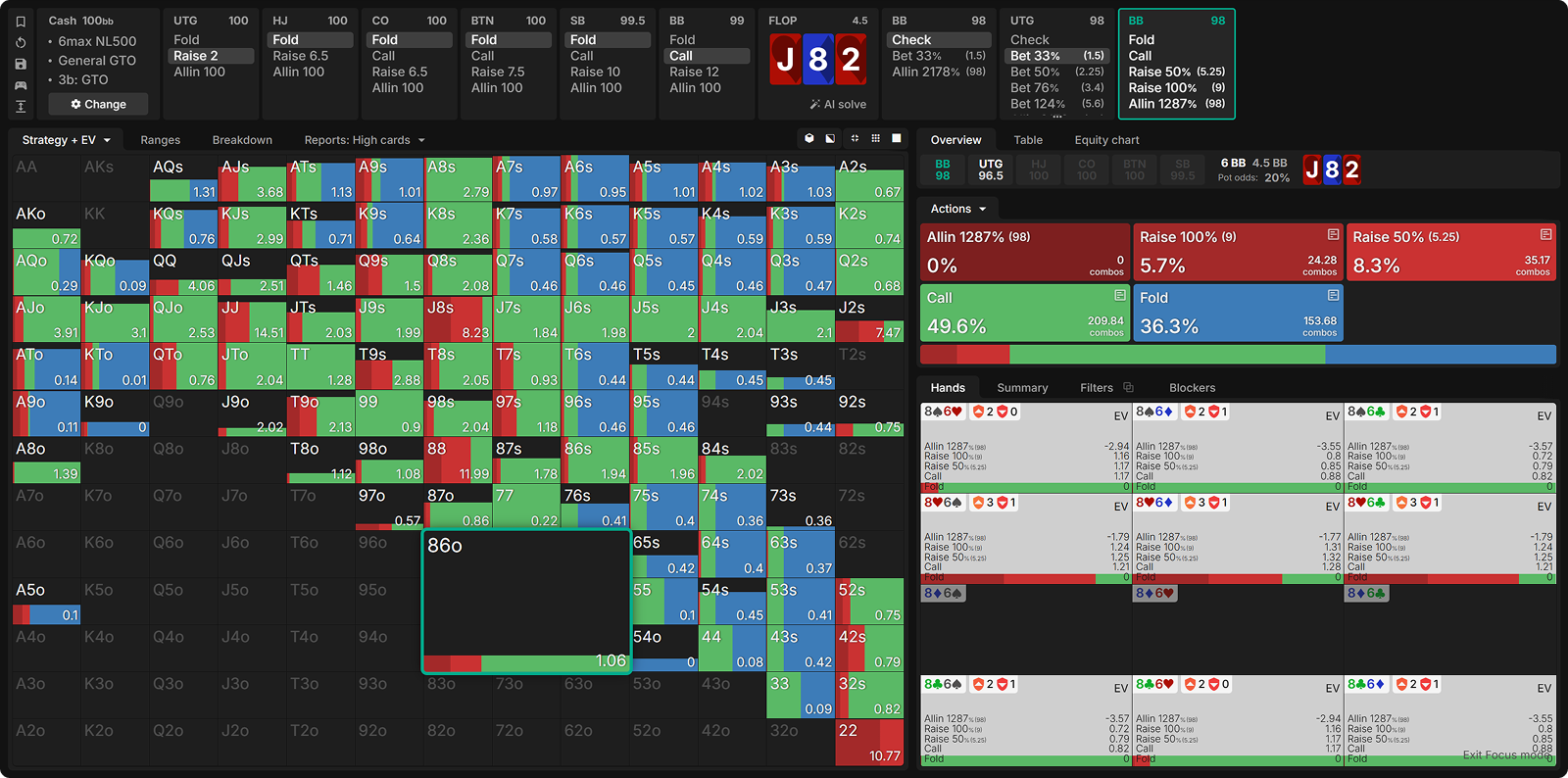
These raises accomplish many purposes, but one of them is to set up bluffs on turns where your range would otherwise be very strong. Also, the turn will sometimes pair the board, and a solver will want to have trips in its range when that happens.
But not even a solver is perfectly “balanced” in this broad sense of the term. When UTG calls the check-raise, BB’s EV varies dramatically depending on the turn card:
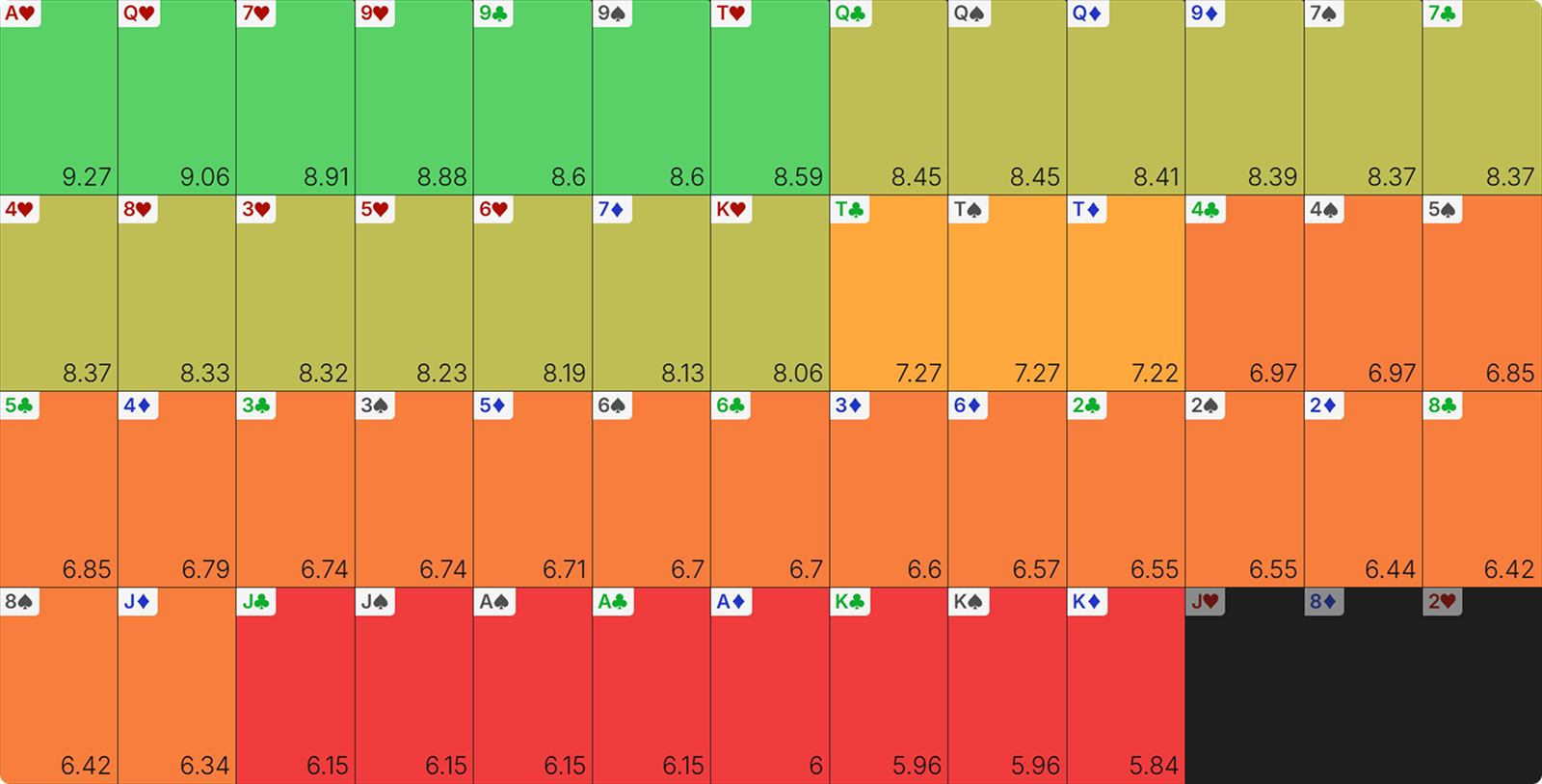
It’s important to understand that the BB is imbalanced on both the 9♥ and the K♦ turns. On the former, they are imbalanced toward strength and compensate by betting small. On the latter, they are imbalanced toward weakness and compensate with frequent checking (and folding).
In both cases, the solver could change its strategy on earlier streets to be more balanced on these specific turns. If BB check-raised more weak hands on the flop, those hands would get profitable bluffs when the 9♥ turns. If they check-raised more strong hands (or more King-x) on the flop, those hands would make more money on a turned K♦, when UTG would expect them to be weak.
The problem is that this balance could only be achieved by forcing certain hands to take suboptimal actions on earlier streets, something a solver would not permit.
This is part of what I mean when I say “Balance is a means to an end, not the ultimate goal.”Not even a solver aims to be balanced in all situations…
Exploitability
There’s nothing inherently wrong with being exploitable. “Exploitability, like balance, is a means to an end.” Against tough opponents, balanced play is often necessary because the risk of losing EV to exploitation is real, and this style prevents that.
Weaker opponents, however, will make poor decisions even when you are not balanced (“not balanced” being another way of saying “exploitable”). Against such opponents, you do not want to be balanced. Rather, you’d prefer to be imbalanced in a way that maximally exploits their imbalances.
This brings us back to the idea of checking strong hands to “protect” your checking range. There’s no sense in “protecting” against an attack that’s not coming. If you believe your opponent will play very passively against your check, then you will lose money (or miss out on potential winnings, which amounts to the same thing) by checking strong hands. Conversely, if you believe your opponent will bet too much when checked to, then you’d prefer to check your strong hands to induce those bets.
In either case, the question you want to ask yourself is “What is the best way to make money with the two cards I am currently holding?”, not “What are the implications of how I play this hand for how my opponent might expect me to play in the future?”
This is the same question a solver is essentially asking. If it arrives at a mix, that is only because it determined that multiple options are equally good against an unpredictable opponent. In the case of AJ on the KQT flop, the solver has determined your opponent has just as much incentive to put money into the pot after you check as they do after you bet. Checking the nuts is not preventing or protecting against those bets; it’s profiting from them.
Conclusion
Like any tool, it has limitations. There is no perfect language for talking about poker, only language that is more or less useful for a given purpose. Sometimes, language that is useful earlier in your poker journey, when you are trying to grasp concepts broadly, eventually becomes an impediment to deeper understanding.
The key to improving at poker is remaining open-minded and flexible in your thinking. Many things that I once understood to be facts or rules of poker strategy have turned out to be more like helpful guidelines, with many exceptions. The language we use to discuss these guidelines sometimes makes them seem more iron-clad than they are.
The rules serve you well up to a point. They help you get the majority of cases right, and in the beginning, that’s more important than finding the exceptions.
The process of improving is one of constantly revisiting “rules” you have mastered in search of exceptions. Perhaps you have fallen prey to some of the misunderstandings discussed here. If not, these examples can still serve as demonstrations of how other language you use may interfere with deeper understanding.
Again, the goal is not to discover the perfect language, but simply to be aware of the limitations of the language you use. In the words of the philosopher Alfred Korzybski, “The map is not the territory.”
Monkey in the Middle: 3-Way Pot Heuristics
In this article, we will discuss the key strategic differences between this scenario and one where you face a continuation bet in a heads-up pot, how those differences factor into the GTO responses to these bets in 3-way pots, and when those differences are more or less salient.

The Trouble With Implied Odds
When we were brand new to poker strategy, many of us learned about concepts like equity, outs, and pot odds. When drawing, we were taught to count our outs, use those to estimate our equity, and then call or fold based on whether we were getting the right pot odds for the equity we had.
When Checking the Nuts Beats Betting Them
Poker is a complex game that requires a diverse skillset from someone who wants to excel at it. Think of emotional disciplinef, accurate hand reading, and a firm grasp of board texture dynamics. But in the pursuit of advanced strategy, we often neglect the fundamentals, such as extracting maximum va