The Trouble With Implied Odds


Overview
In The Beginning…
When we were brand new to poker strategy, many of us learned about concepts like equity, outs, and pot odds. When drawing, we were taught to count our outs, use those to estimate our equity, and then call or fold based on whether we were getting the right pot odds for the equity we had.
For example, if we held 7♣6♣ on an A♠K♥8♣ 5♦ board, we would count eight outs to make the straight, multiply that by 2 to estimate 16% equity, and then call if the opponent’s bet offered 5.25:1 odds or better.
But in no-limit, we rarely faced such small bets, and eventually we learned that things were a little more complicated. Facing a $10 bet into a $10 pot, we could nevertheless call with an eight-out draw if there was $50 behind and we expected to always stack our opponent on the straight-completing rivers. Risking $10 to win the $20 already in the pot plus another $50 behind (in the stacks) meant we were effectively getting $70:$10 or 7:1, which was better than the 5.25:1 our equity required.
Of course, we couldn’t always calculate things so precisely over the felt, but we took the concept and ran with it. We began to think in terms of “implied odds hands” as early as preflop. We loved calling preflop raises with small pocket pairs because we could win so much if we flopped a set. It was just a small step from there to calling raises with lots of medium suited connectors because of how much we could win if we made a straight or a flush.
What’s Wrong With That?
“Implied odds” as a concept isn’t wrong, but it is overly simplistic. Like many guidelines that simplified our decisions early in our careers, it eventually became a barrier to deeper understanding of the game. Let’s unpack the assumptions inherent in the example above:
Assumption #1: You will always win the pot if you improve to a straight.
In this example, assumption #1 is trivially true. Because the eight outs you’re counting are all to the nuts, you are in fact guaranteed to win the pot if you hit them.
{{question-mark}}
But what if there were a flush draw on the board? Then only six of your outs would be the nuts. What if some of your outs made a higher straight possible? What if the board were paired?
{{/question-mark}}
This is particularly a problem for preflop set mining because players often implicitly assume that they will win when they flop a set. A set is obviously a very strong hand, but it is not unbeatable, and the math gets a lot trickier when you recognize that you could sometimes lose a very large pot after flopping one.
Assumption #2: You will always win what effectively remains in the stacks ($50) if you improve to a straight.
Assumption #2 depends on several factors, primarily how strong your opponent’s range is and how obvious your draw is. If your opponent’s range is very strong and your draw is not obvious (i.e., it’s well “disguised”), then you are more likely to get paid when you improve. Mathematically, if you expect to stack your opponent 50% of the time when you complete the draw, you can simplify the calculation by treating it as a guaranteed $25 win. In the above example, that translates to effective pot odds of 4.50:1, making the call unprofitable, since we’d need at least 5.25:1.
Assumption #3: You will never win the pot if you don’t improve to a straight.
Assumption #3 is an important one. There are, in fact, three ways you could win without improving to something super-strong like a straight or flush:
- You bluff. Of course, some rivers will be better than others for this purpose.
- You improve to a weak pair and win with it at showdown. A lot has to go right for this to happen, but it’s not impossible. You need your opponent to have a very weak hand, and you need them not to bluff with it when you river your pair (or you need to call their bluff).
- You miss everything, but your hand is strong enough anyway to win unimproved at showdown. As with (2), this requires actually getting to showdown when your hand is good. It probably won’t happen when you have 7-high, but it’s often relevant when you have the nut flush draw or a pair+draw.
The good news is that assumptions #2 and #3 depend on some of the same factors. If your opponent’s range is very strong, then it will be unlikely to win without improving, but you are more likely to get paid when you do improve. If their range is weak, however, you will get paid off less often when you get there, but have better prospects for winning when you don’t, whether that be by bluffing or by showing down something marginal.
These factors, taken together, explain why solvers rarely fold strong draws with so much money behind. It is not only because of the potential payoff for hitting strong hands (what is commonly thought of as implied odds) but also because of the possibility of eking out some equity by bluffing with weak hands or showing down marginal ones.
Example
In a 100bb cash game spot, UTG vs BB single-raised pot (SRP), BB holds T9o on a J♥8♦2♥ flop. Facing a 33% pot c-bet, the solver expects all combinations of T9o to realize more than 100% of their equity, whether they raise or call, though of course it’s better to have a ♥ and best to have both a ♥ and a ♦, to reduce the chance of being beat when we hit something:
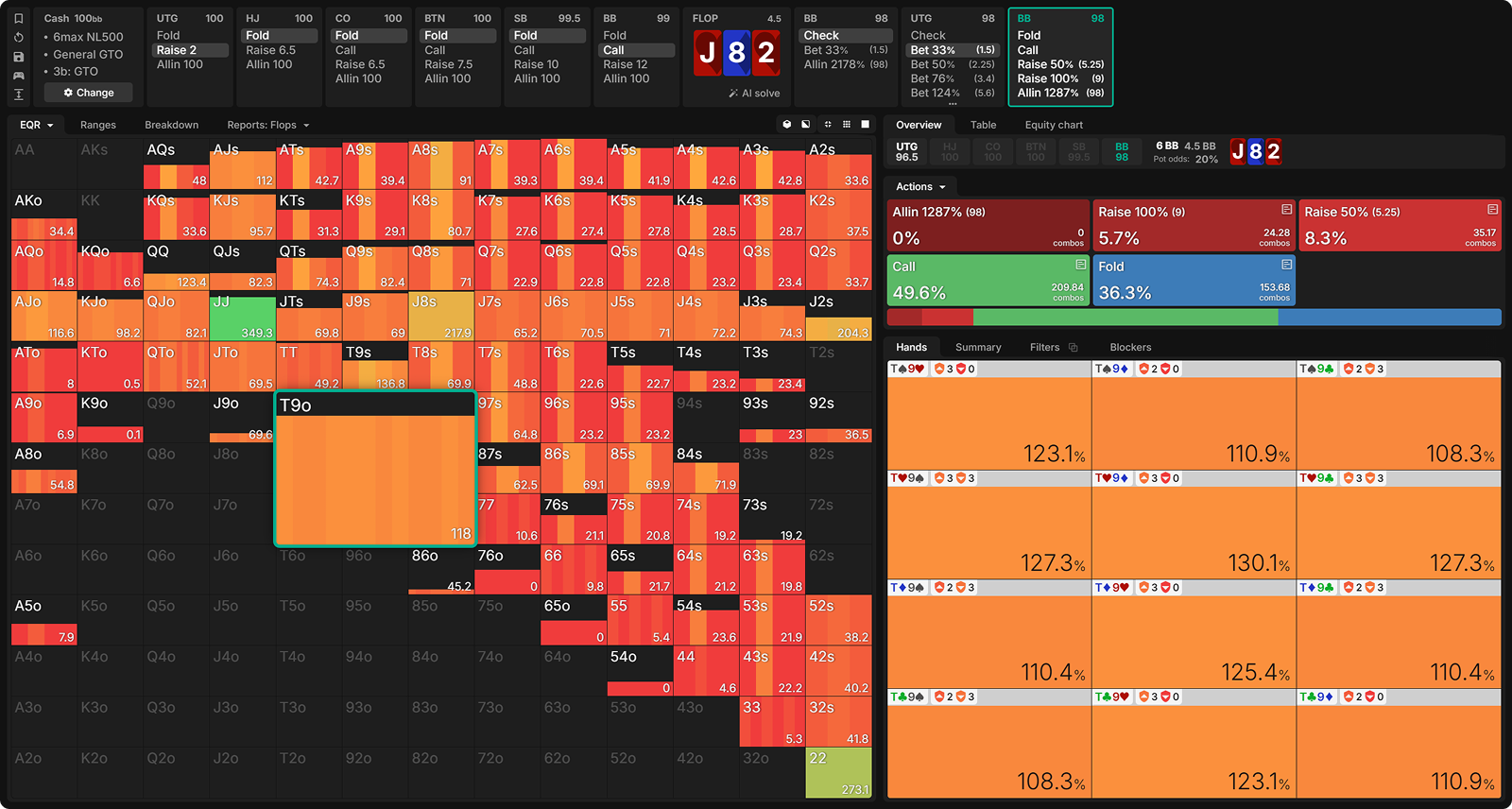
This is especially significant because equity realization is always tougher when OOP. That T9o over-realizes despite this disadvantage seems like a clear case of implied odds to the rescue!
But look what happens when BB instead faces a 124% pot c-bet, which is also in the solver’s arsenal on this flop:
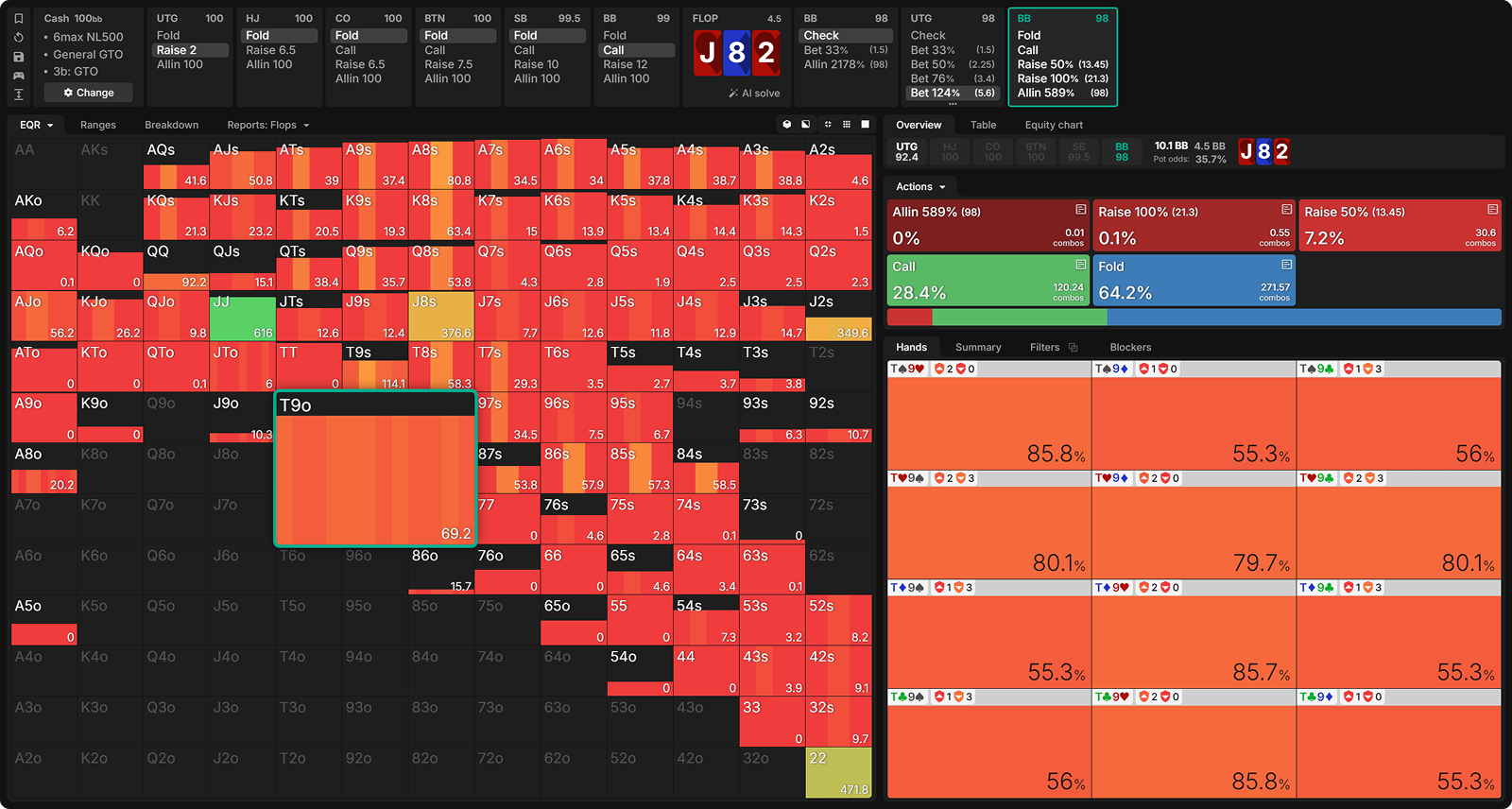
T9o realizes equity much less well against this large bet. The combos without a ♥ suffer the most, realizing barely half their equity. They still never fold, because they have enough equity that they can get away with realizing only half of it, but it’s worth digging into why the big bet is so much worse for them.
The biggest clue lies in the fact that the combos without a ♥ take a bigger equity realization hit relative to the 33% pot bet. When betting 33% pot, UTG has a flush draw 9.2% of the time:
{{width: 67%}}

{{/width}}
When betting 124% pot, UTG has a flush draw 13.3% of the time:
{{width: 67%}}

{{/width}}
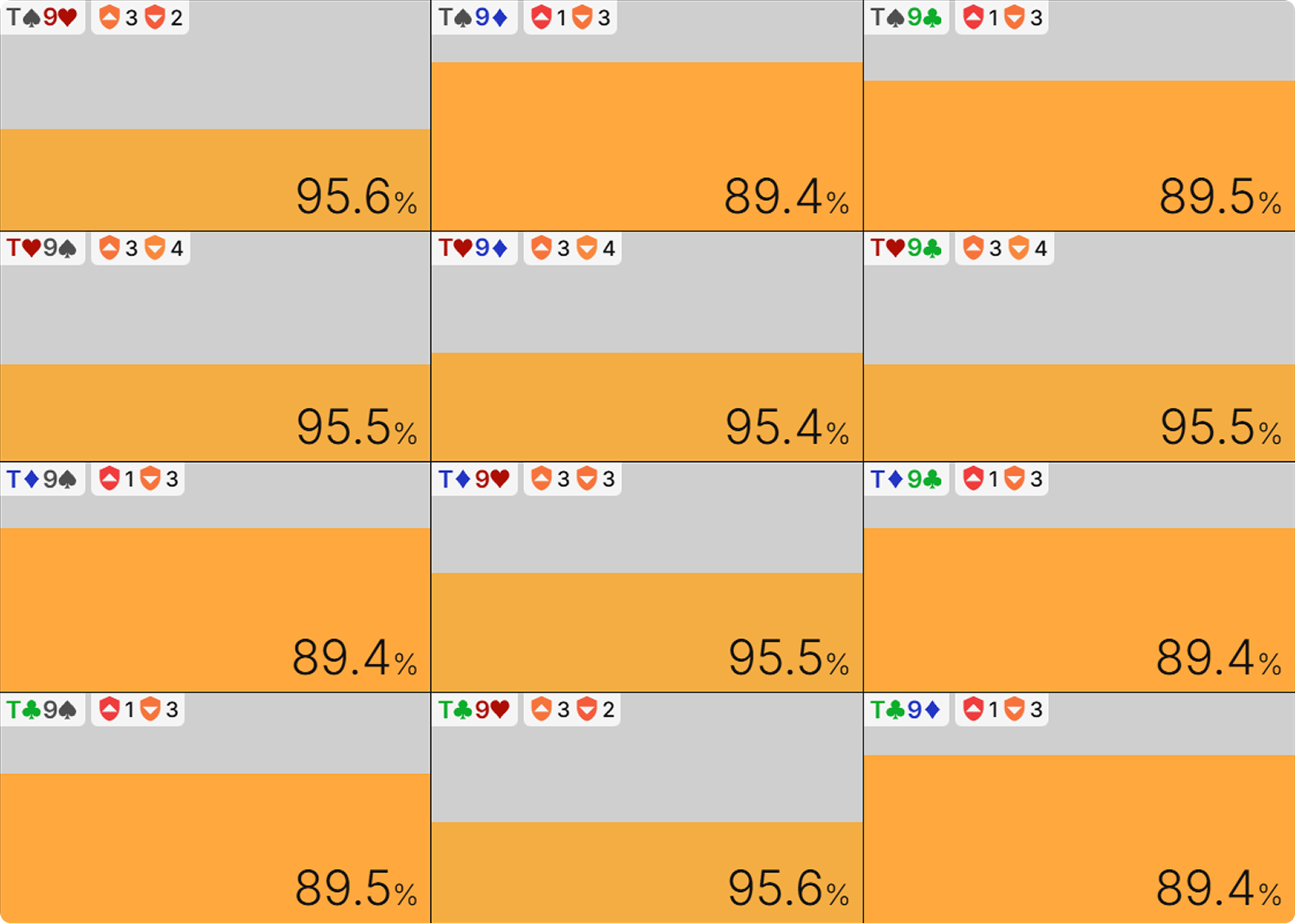
After calling the overbet, even T9o combos containing a ♥ under-realize their equity on a 7♥ turn (though of course they have quite a lot of equity and are still very good hands).
{{width: 67%}}
{{/width}}
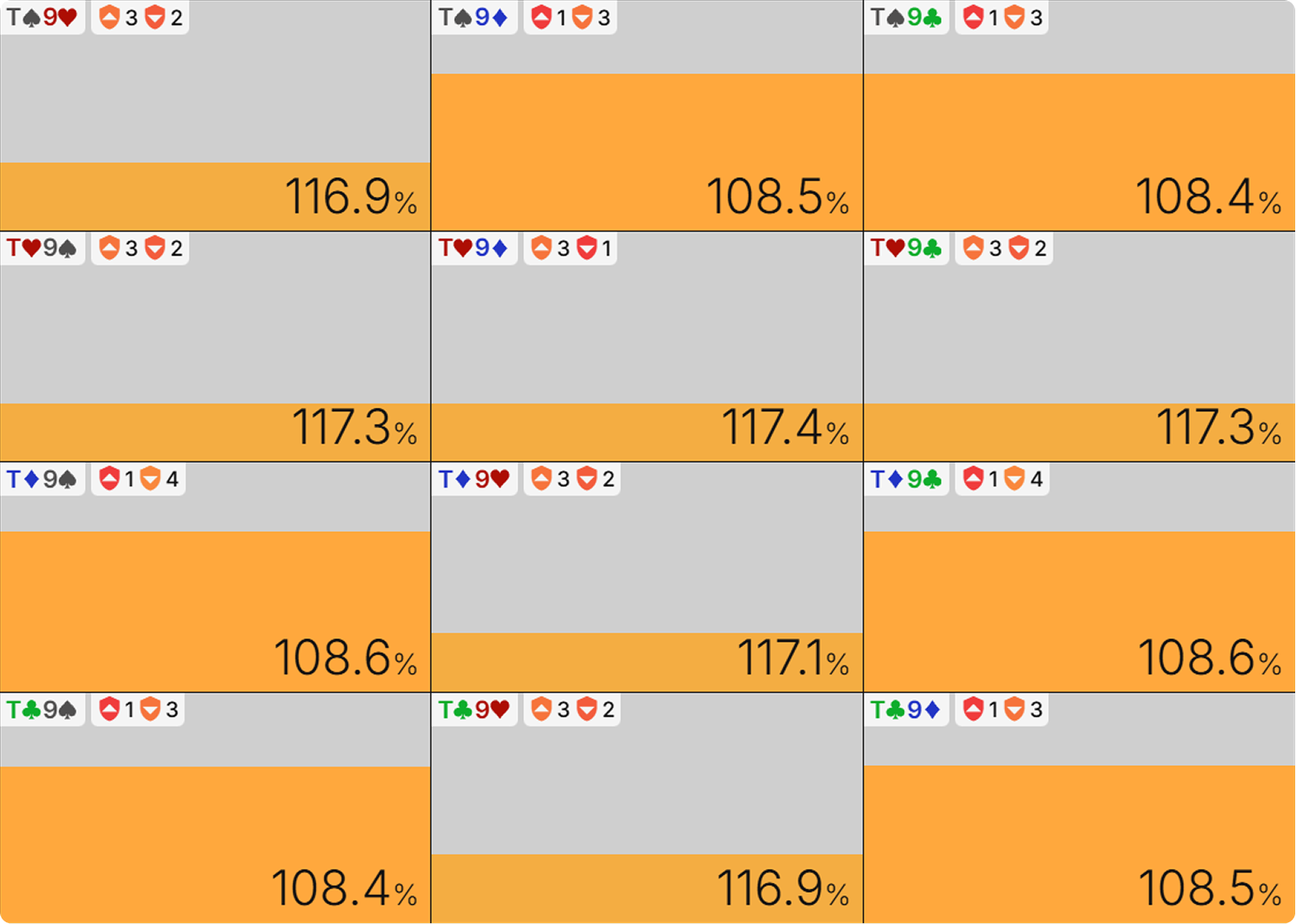
Compare this to the situation after calling a small 33% pot bet, where even combos without a ♥ over-realize on the same turn:
{{width: 67%}}
{{/width}}
The flushes in UTG’s range are only one side of the story. BB turns a flush on this card 21.6% of the time after calling the overbet, compared to 10.6% after calling the small c-bet.
BB will face similar problems on a 9♥ turn, where the greater proportion of flushes in UTG’s overbetting range will make it harder to win with the second pair at showdown than it would be against UTG’s small betting range. This is both because the pair will be good less often and because UTG will be more likely to bluff when they can’t beat a pair of Nines.
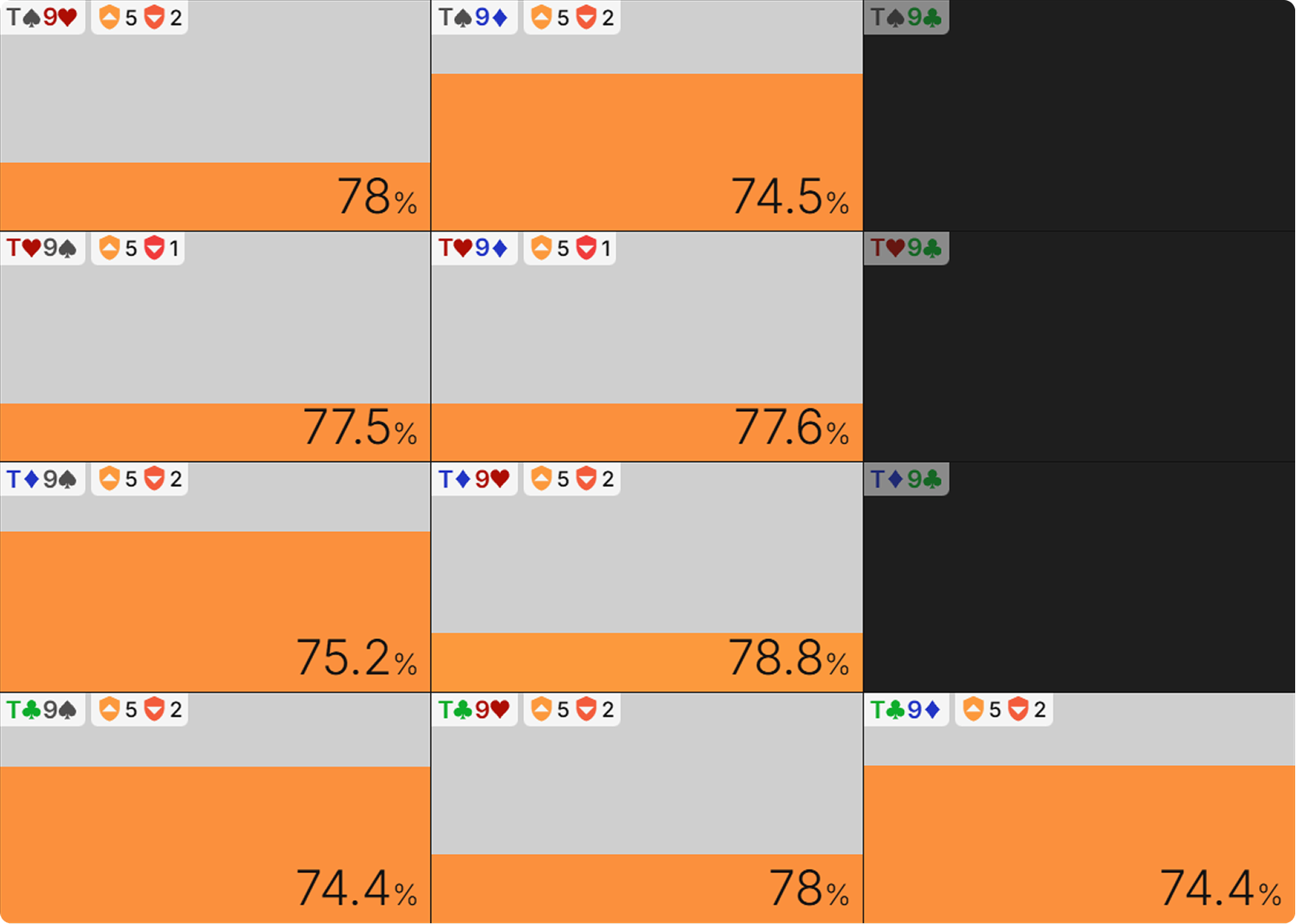
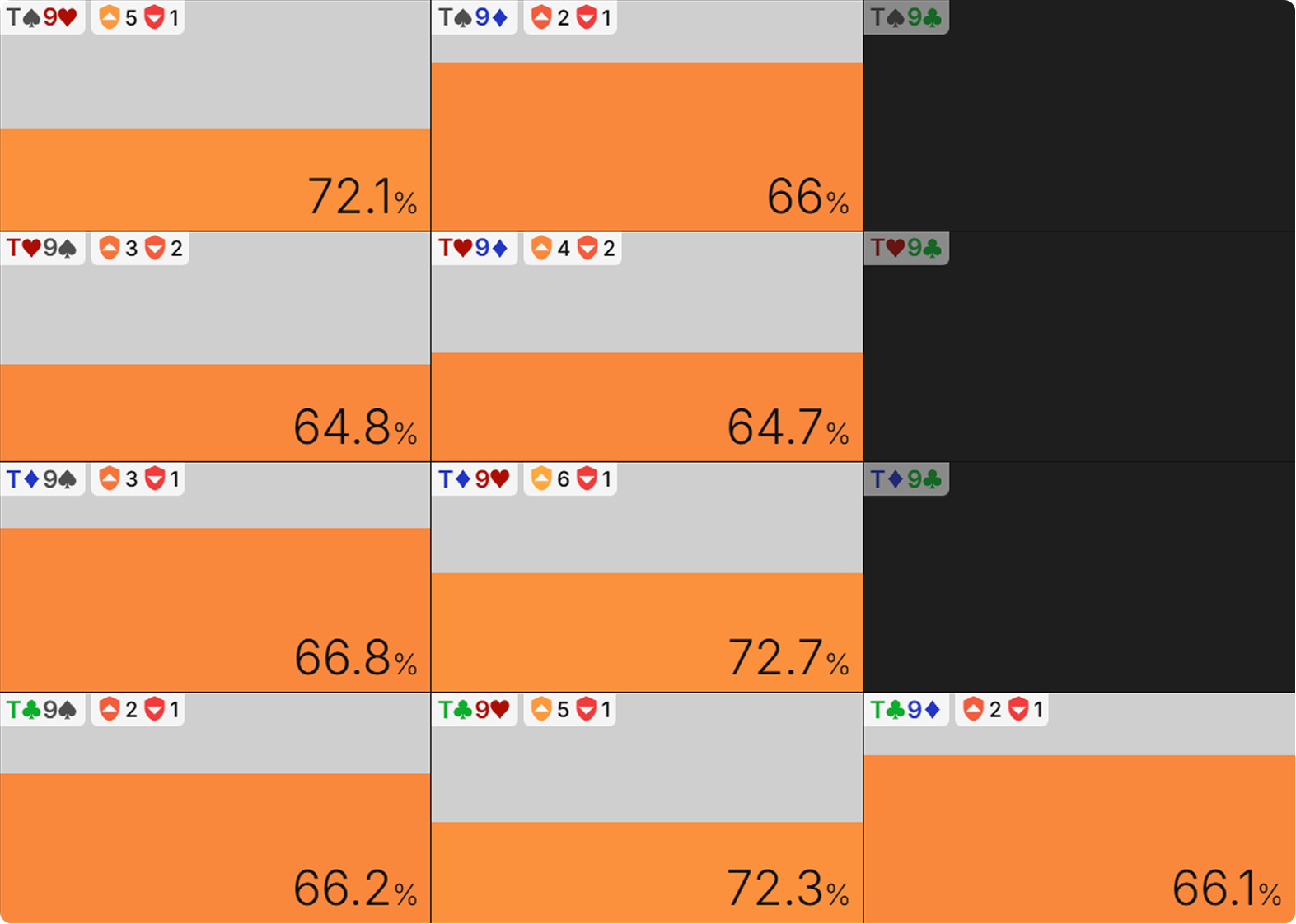
Even when a non-heart 9 turns, BB realizes equity less well against the overbet range than against the 33% pot range:
{{grid: 2}}
{{/grid}}
UTG’s range is more polar when they bet big on the flop. This means they are more likely to have either a strong hand that is beating T9 or a very weak hand that will be incentivized to bluff. While T9o is a good candidate for bluff-catching the turn, thanks to the straight draw, it’s a pure fold to a third barrel on a blank river, which is how UTG ought to play many hands that would lose at showdown.
When UTG bets just 33% pot on the flop, they have more medium hands like A8 and K8 in their range, which they are incentivized to take to showdown. They don’t want to turn those hands into bluffs, which works out nicely for BB, whose modest pairs would likely fold to a bluff.
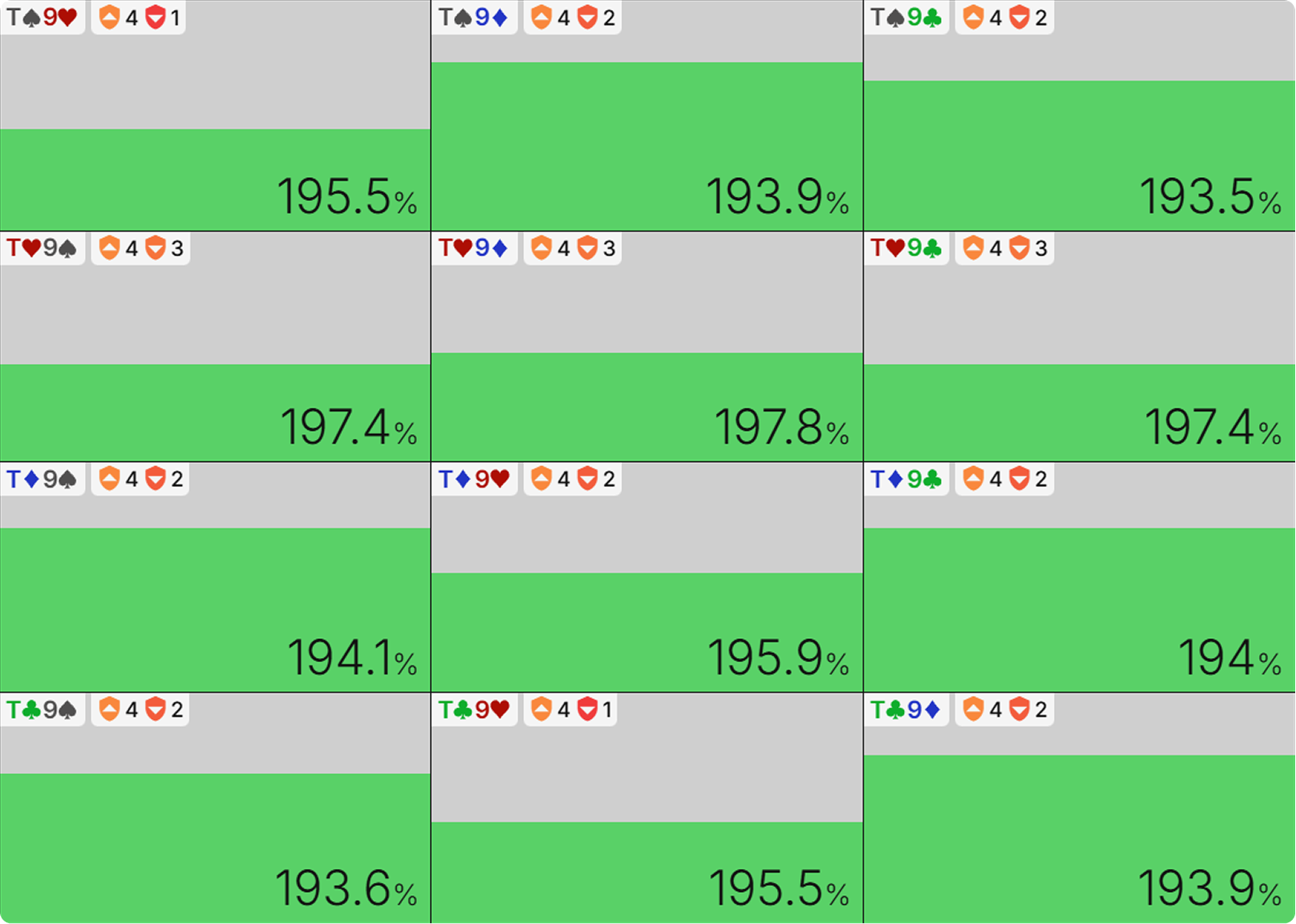
Implied odds, in the most classic sense of the word, still count for something even against the overbet range. If BB does manage to turn the nuts vs. a flop overbet, they can expect to win about another pot-sized bet, on average:
{{width: 67%}}
{{/width}}
That’s good, but not enough to warrant the flop call in its own right. It’s important to recognize that T9o in this scenario is far from an “implied odds call,” even though implied odds do contribute to its EV.
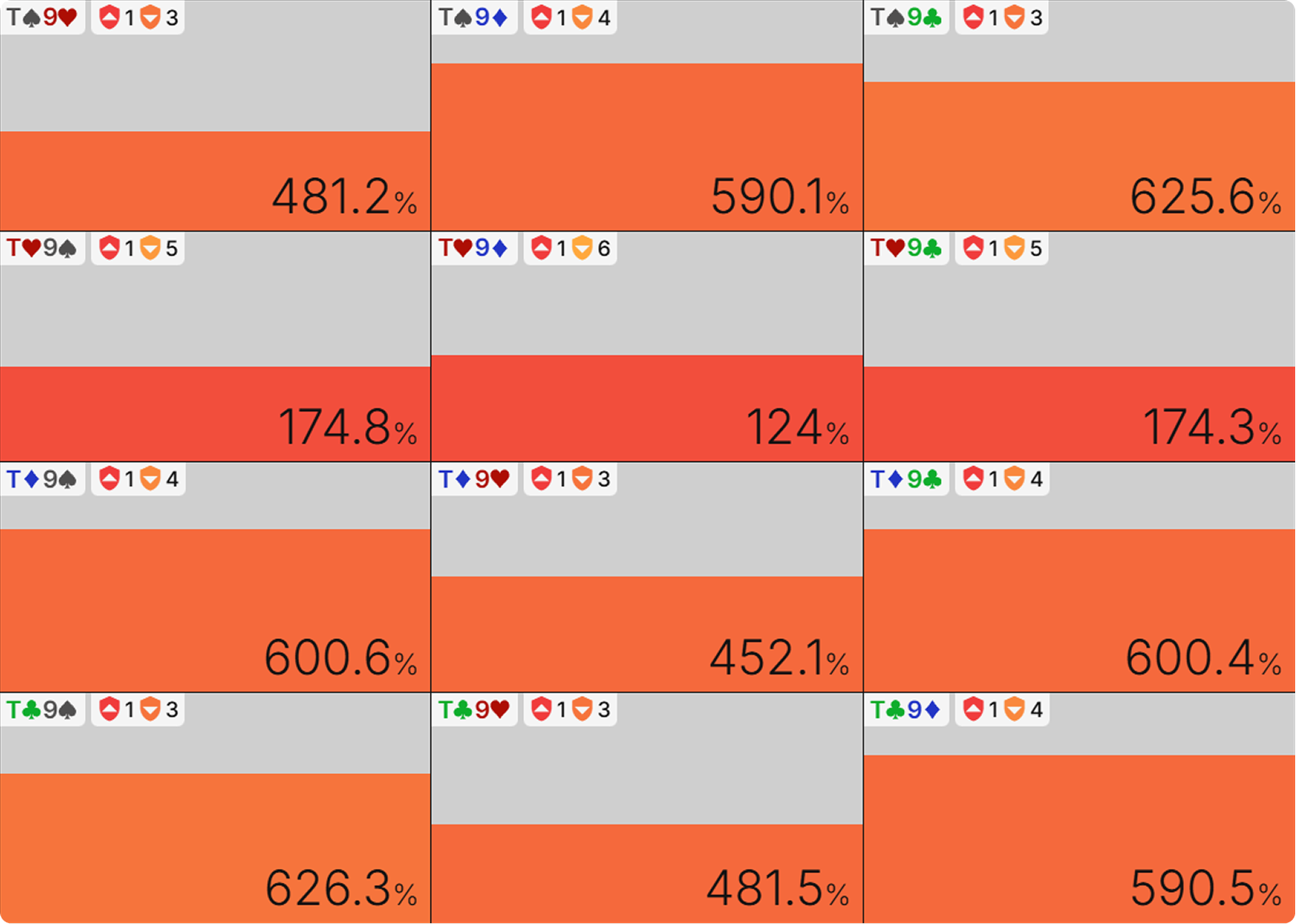
In fact, there’s another scenario where T9o has much better equity realization than when it turns the nuts. Can you guess what action led to this result?
{{width: 67%}}
{{/width}}
This is T9o’s performance on J♥8♦2♥ 2♣ 2♦ after UTG overbets the flop and checks back the turn.
In this scenario, T♣9♦ has just 1.3% equity. It never realizes this equity by checking, because the few worse hands held by UTG always bluff. However, BB can capture nearly 10% of the pot by bluffing with this hand.
{{question-mark}}
Why is bluffing so profitable?
{{/question-mark}}
Because in theory, UTG should defend at a frequency that makes the top of BB’s bluffing range indifferent (King-high hands), and because those hands have some small showdown value, UTG is forced to fold more than MDF to make them indifferent between bluffing and checking. Since T9o has no showdown value, bluffing ends up more profitable than checking for it.
Turn Reports
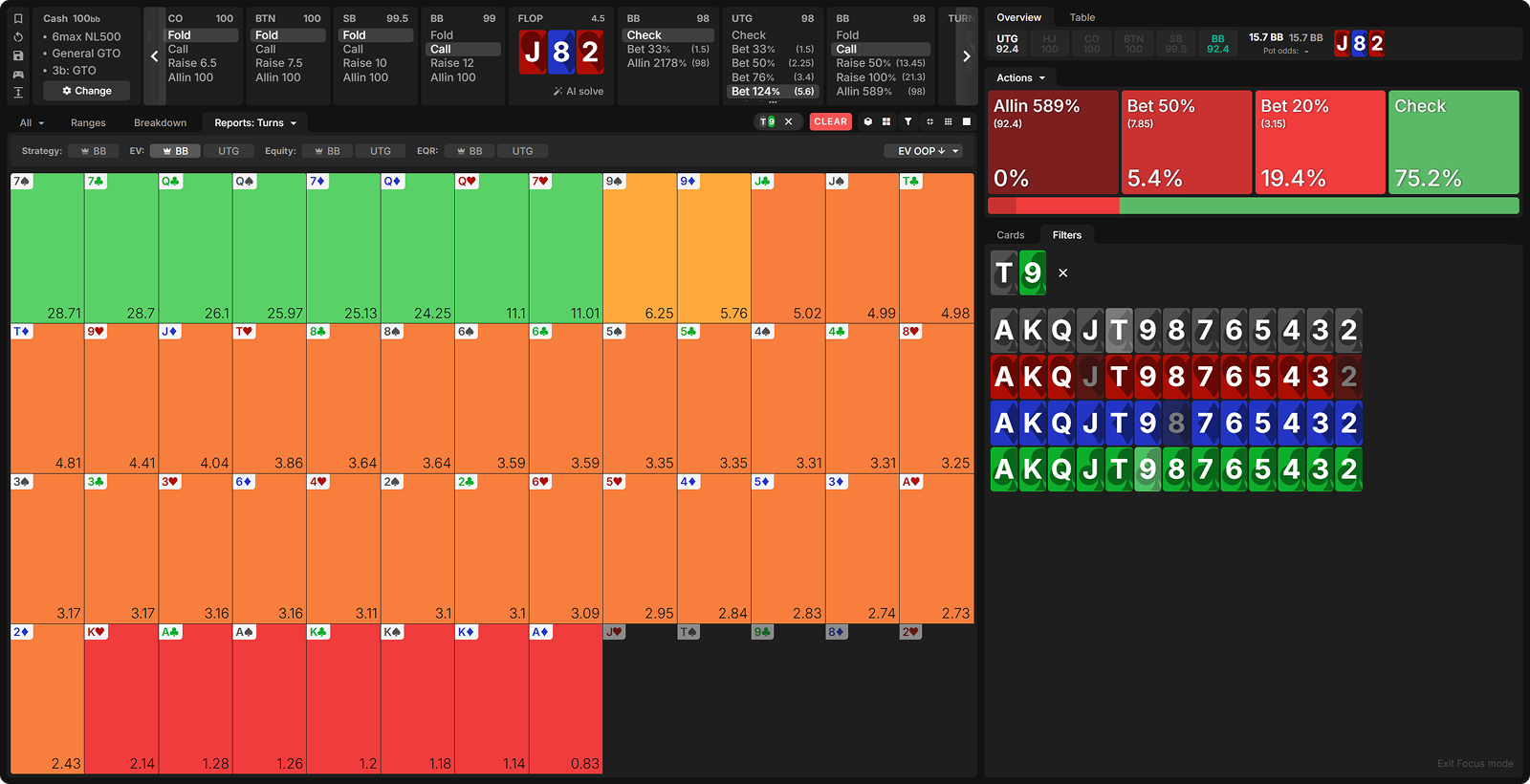
Using turn reports, we can filter for T9o and visualize its EV on all turn cards. Six of our outs make up the bulk of our hand’s expectation, two of our outs complete potential flush draws and are substantially less valuable. Yet, even when we fail to improve immediately, the remaining cards aren’t worthless. Bricks still carry some hidden equity: take the 4♠, for example, where T9o retains roughly 60% of its flop investment—a substantial cushion that highlights the persistent strength of our hand’s potential to bluff or realize equity on the river.
Conclusion
Sure, you can win a big pot when you make a strong hand, but a lot has to go right for that to happen. Actually making the hand is hard enough, but then you also need your opponent to pay you off when you do, which can be tricky when your draw is obvious and/or your range is otherwise strong.
I prefer to think of hands like T9 on a J82 flop as “portfolio hands” rather than “implied odds hands.” That’s because the call derives its profitability from many different sources: value betting on the strongest runouts, bluffing on others, and sometimes even showing down a marginal hand. Excessive focus on implied odds (especially in the narrow sense) obscures these other sources of value and leads to less nuanced thinking overall.
Early in your poker career, it makes sense to focus on big, simple concepts like, “This hand is worth calling because it has eight outs to a straight and you could win a big pot if you hit them.” But improving at poker requires broadening your horizon to see all the possibilities and making the most of the edge cases.
Monkey in the Middle: 3-Way Pot Heuristics
In this article, we will discuss the key strategic differences between this scenario and one where you face a continuation bet in a heads-up pot, how those differences factor into the GTO responses to these bets in 3-way pots, and when those differences are more or less salient.
Poker Concepts You’re Using Wrong (and How They’re Hurting Your Winrate)
Language and poker are two of my great passions in life, so I’ve always been interested in poker’s unique and colorful vocabulary. As a poker coach, podcaster, and writer, I have particularly strong opinions about the language we use to explain poker strategy.

When Checking the Nuts Beats Betting Them
Poker is a complex game that requires a diverse skillset from someone who wants to excel at it. Think of emotional disciplinef, accurate hand reading, and a firm grasp of board texture dynamics. But in the pursuit of advanced strategy, we often neglect the fundamentals, such as extracting maximum va