Crush Calling Stations With These 3 Solver-Approved Strategies

Overview
A "{{tooltip-title: calling station}},” someone who is seemingly willing to consider calling down with any pair, can be a source of frustration for many players.
This article will explore ways how we can exploit those stationey tendencies, transforming any potential frustration into excitement. .
{{tooltip-content: calling station}}
Somebody who does not like to fold certain hands and prefers to call them instead.
{{/tooltip-content}}
Preflop OOP
Whenever we face opponents who have clear out-of-line tendencies, it pays to be extra attentive to how our decisions on the early streets will affect the later streets.
Let’s differentiate between playing in position (IP) and out of position (OOP).
Since OOP is the player that’s first to act, we’ll also pick them as the player first to analyze. Consider the scenario where we have just fired up a 15bb spin and go. We’re in the SB, and the Villain in the BB is a regular who tends to call small opens too often. The BTN folds, and we have the opportunity to play heads up OOP for 15bb effective.
This is the equilibrium solution for SB 3-way 15bb effective no limp. Before we dive into it, a small note on the description “SB 3-way.” In spins, the term indicates playing the SB vs BB when the BTN folded. It’s important to point that out because, unlike in heads up, the SB is out of position.

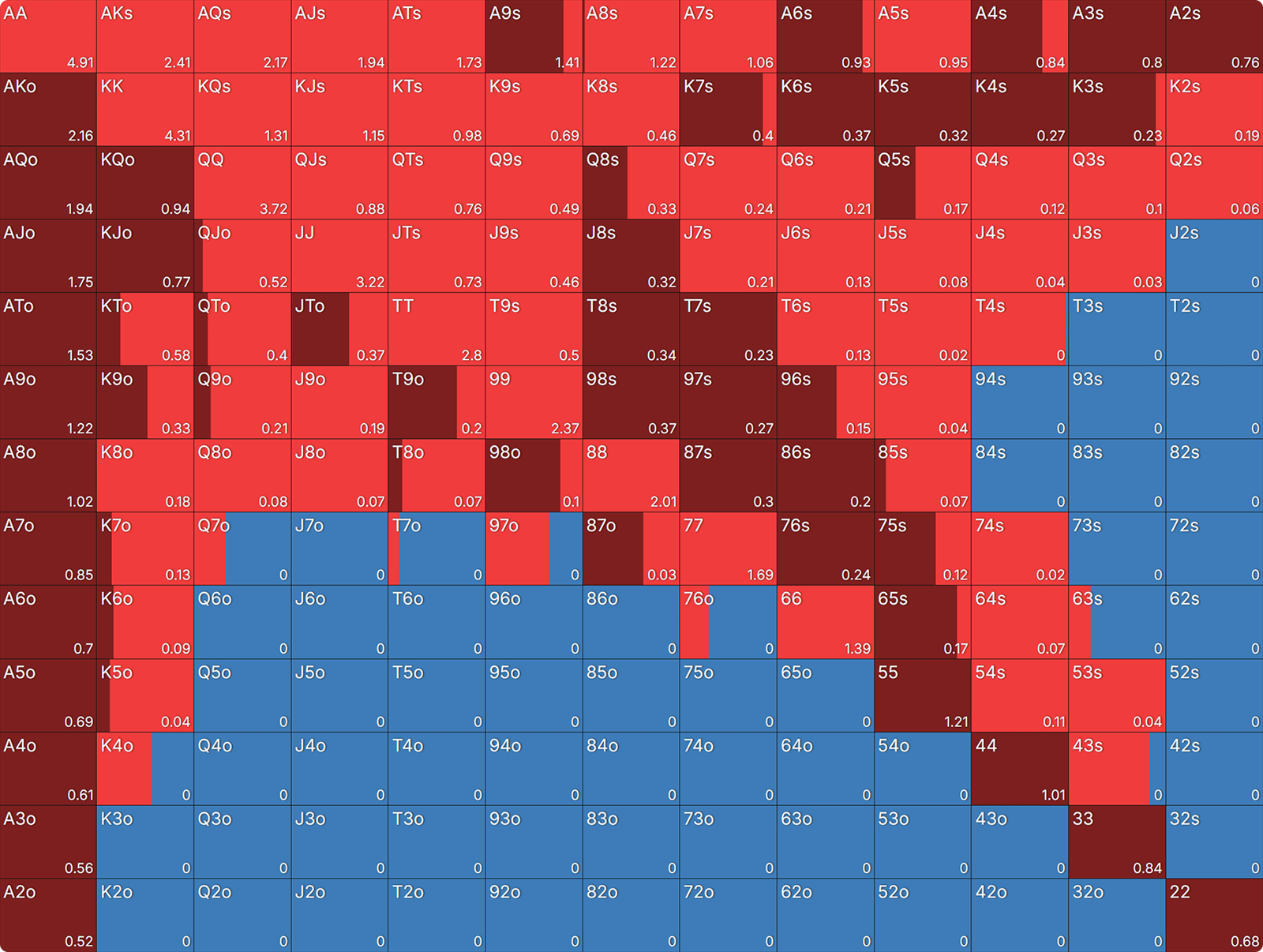
Notice the hands that have a relatively low EV. For example, 97o has 0bb EV. In general, when playing against calling stations, the EV of our strongest preflop hands will increase, but our weaker hands lose EV.
{{question-mark}}
If we know that the BB is a calling station, which of the following ideas would you try in-game?
{{/question-mark}}
- Play the same preflop range but adjust postflop.
- Cut the weakest hands with low EV.
- Move all-in preflop more often.
I recommend points (2) and (3) over point (1). Thinking ahead when preflop will ensure we are already set up to exploit their postflop tendencies.
So, putting ideas 2 and 3 in practice could look something like this: simply fold all the hands with an EV of <0.05bb and move all-in at full frequency with hands that originally mixed between raising min and all-in.

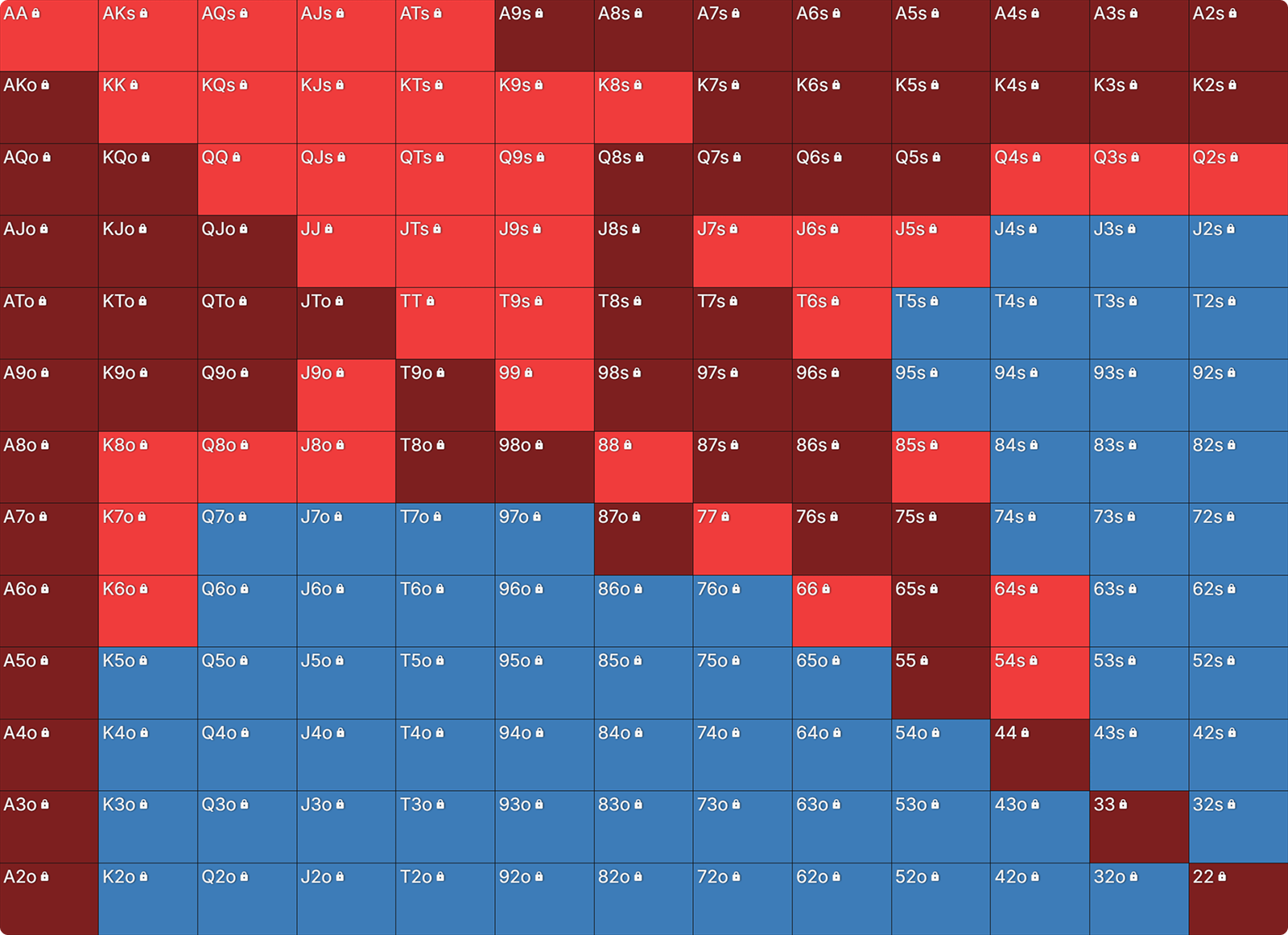
{{interactive-reveal-answer: Quiz time! Which of the following statements do you think is/are correct?}}
{{correct: By cutting our weakest hands and moving all-in with many more middling hands, we arrive postflop with a much stronger range when we do decide to min-raise preflop.}}
{{correct: The all-in range from SB is now weaker. Therefore, BB should call the all-in wider.}}
{{wrong: The all-in range from SB mainly just includes more hands that were already going all-in at some frequency. Therefore, the BB should call the same range as before, not a wider one.}}
{{correct: The SB is at risk of being re-exploited by the BB.}}
{{/interactive-reveal-answer}}
Whenever we intentionally make significant deviations from baseline, it’s important to know what the appropriate adjustments would be in response, so we are aware if/when our opponent is re-exploiting us or not.
Our deviations have weakened our raise all-in preflop range because the combinations of the weaker hands have increased, thereby lowering the average strength.
→ Resulting in the correct adjustment of calling wider vs. all-in.
Our deviations have also strengthened our raise 2bb range.
→ Resulting in the correct adjustment of folding more to the min-raise whilst being more cautious postflop.
Note how the correct adjustments listed here are likely to be difficult for a calling station. These players, in general, do not like to fold, so it’s not very likely that they will be able to correctly adjust to our deviations.
Postflop OOP
I will save postflop OOP play for another article, as this is arguably the most complex Spin and Go scenario and deserves its own dedicated piece.
Playing OOP in Spins is usually centered around aggression with direct equity. We typically use less polarizing hands when bluffing and instead focus on direct draw equity. On many boards, we try to reduce the game to two streets to reduce the positional advantage of the BB.
Preflop IP
It can still be a good idea to make some preflop adjustments. However, I would not recommend cutting as many hands. Instead, we should search for the best ways to play our weak hands postflop.
Being IP is a lot more favorable against a calling station than being OOP. The ability to see the next card/showdown by checking is a big advantage.
Postflop IP
There is a big difference between a flop calling station and a player who is capable of stationing off across multiple streets. To correctly identify calls that could flag a player as a calling station, we first need to have a strong knowledge of GTO thresholds ourselves. Consider the following spot below:
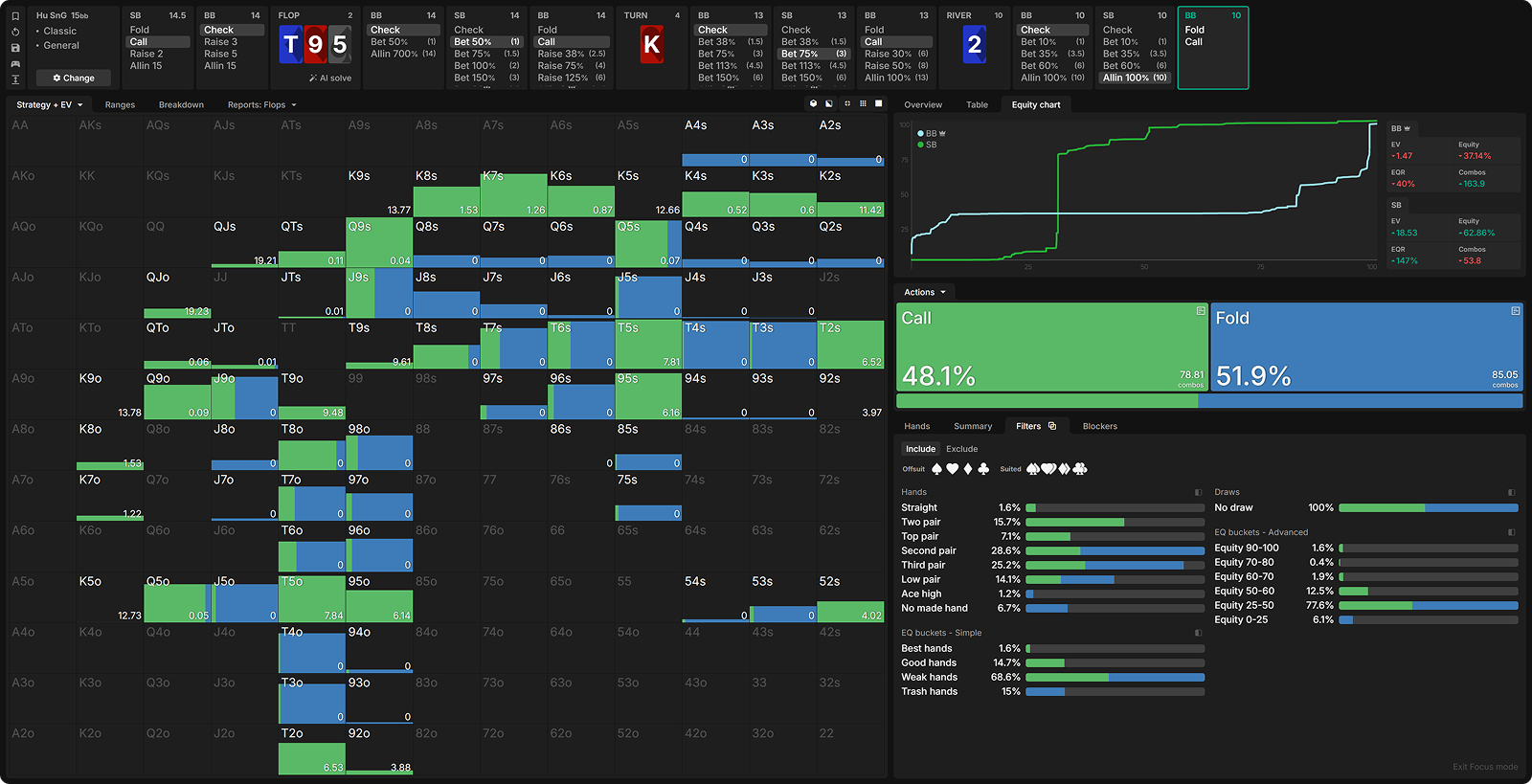
Imagine getting called by the hands below. What information can we gain from each?
We are heads up as the SB with 15bb effective, holding J♦4♣. We c-bet the flop for 1bb on T♦9♥5♠, the BB calls. The turn comes K♥, and we barrel 3bb, BB calls again. The river brings a 2♦, and we move all-in hoping to see a fold. For clarity, the board is T♦9♥5♠ K♥ 2♦.
9♦6♦
{{toggle: Reveal Answer}}
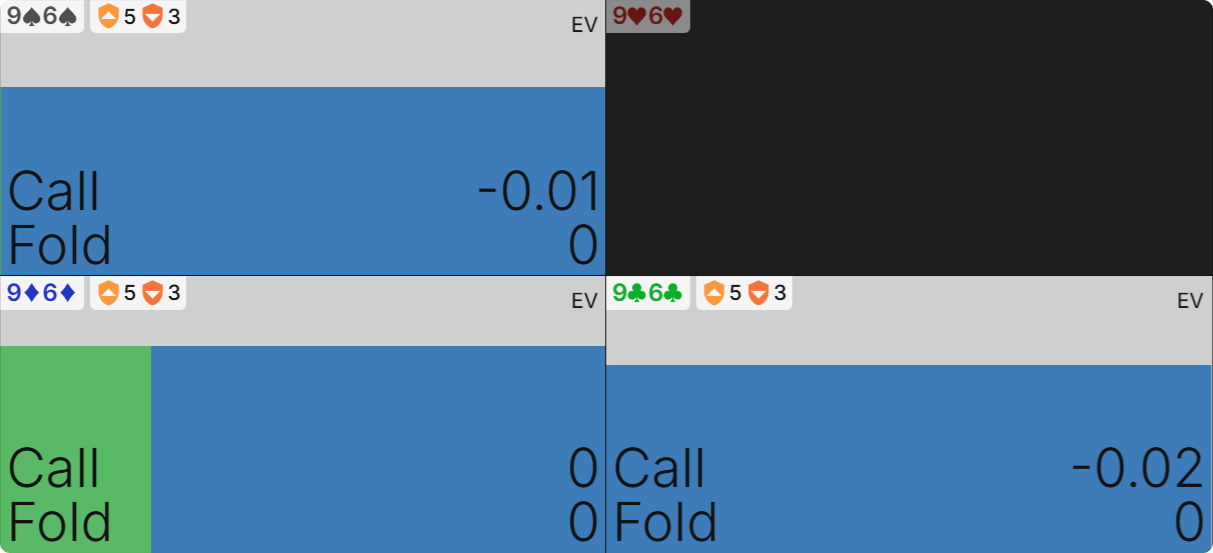
9♦6♦ is a mixed-frequency call. Seeing the opponent make this call gives us the piece of info that they are capable of making uncomfortable calls, but this by itself is not enough to label them as a calling station.
{{/toggle}}
K♣4♣
{{toggle: Reveal Answer}}
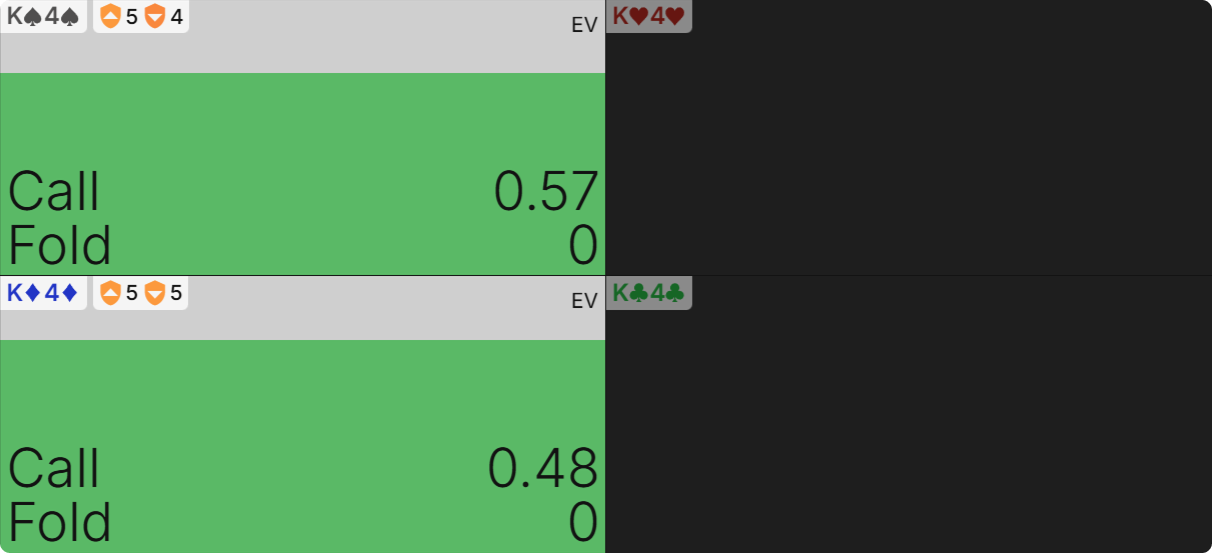
K♣4♣ is not supposed to arrive at the river. However, we can see that the showdown strength of a pair of Kings makes for a clear call on the river with hands that should arrive there. This showdown does not give us insight into their tendency to call triple barrels.
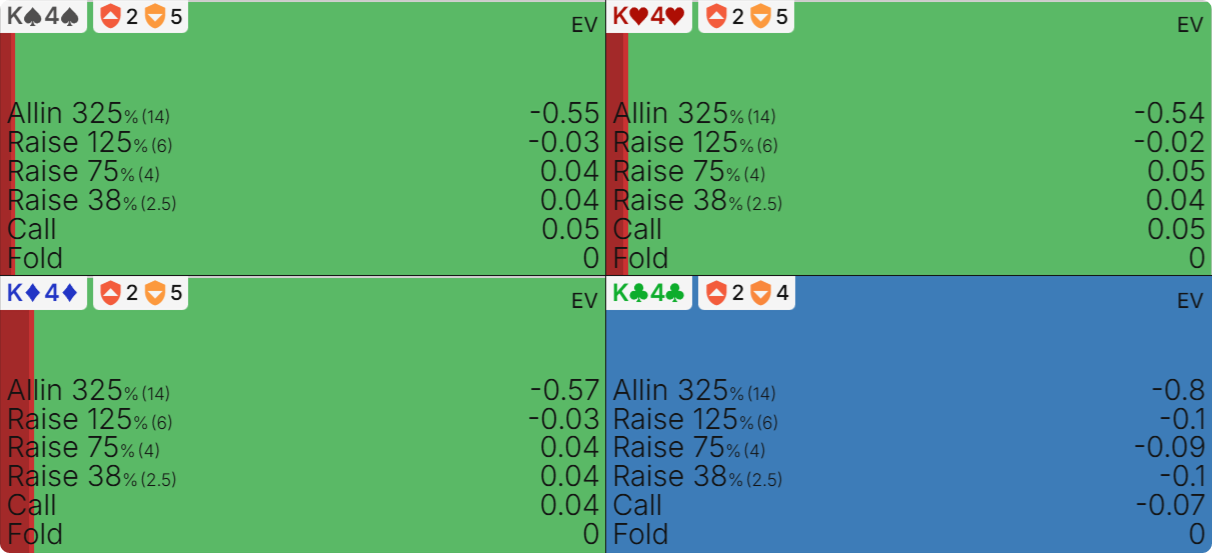
The insight it does provide is that they overvalue high card strength to flop c-bets. This information can be useful when considering how wide we should c-bet vs. them. A showdown like this could also be a hint that turn barreling may yield extra rewards against such an opponent, as they will arrive on the turn (OTT) with a wider range than they should. On the flip side, a c-bet + check turn line will underperform.
{{/toggle}}
5♥3♠
{{toggle: Reveal Answer}}
{{width: 20%}}
{{/width}}
5♥3♠ is not supposed to be in the vs. triple barrel river node, so seeing this hand called to a triple barrel should set off alarm bells; it’s a big indicator the player is calling too wide. This is a very valuable showdown to take note of, as it reveals the many relevant information points that are bundled up in the hand, so let’s cover them.
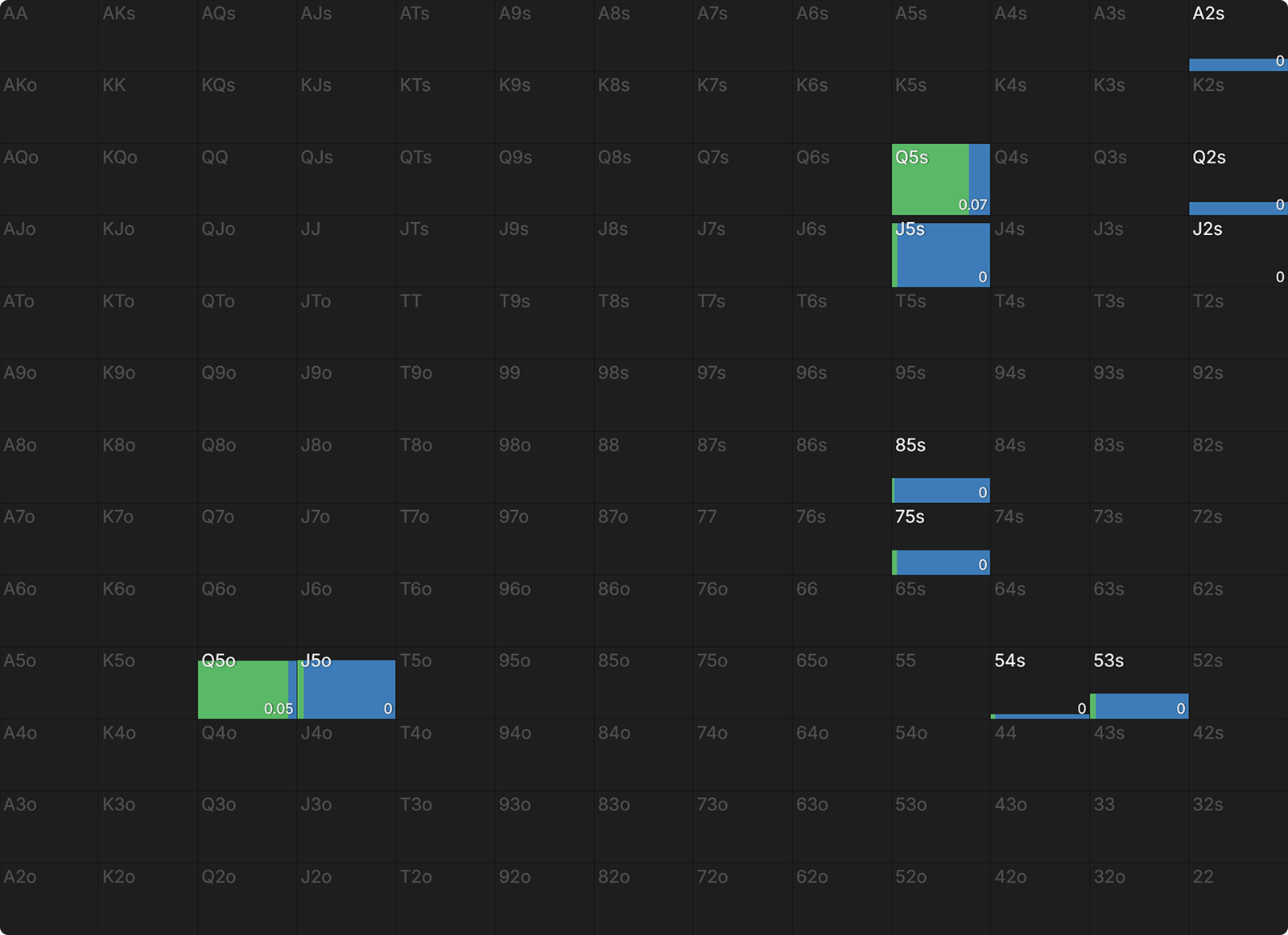
Firstly, we see that ~60% of the 5-x that do (theoretically) arrive on the river are folding to the triple barrel. So calling down 5-x, which shouldn’t even arrive at the river to begin with, is a super strong signal of station tendencies.
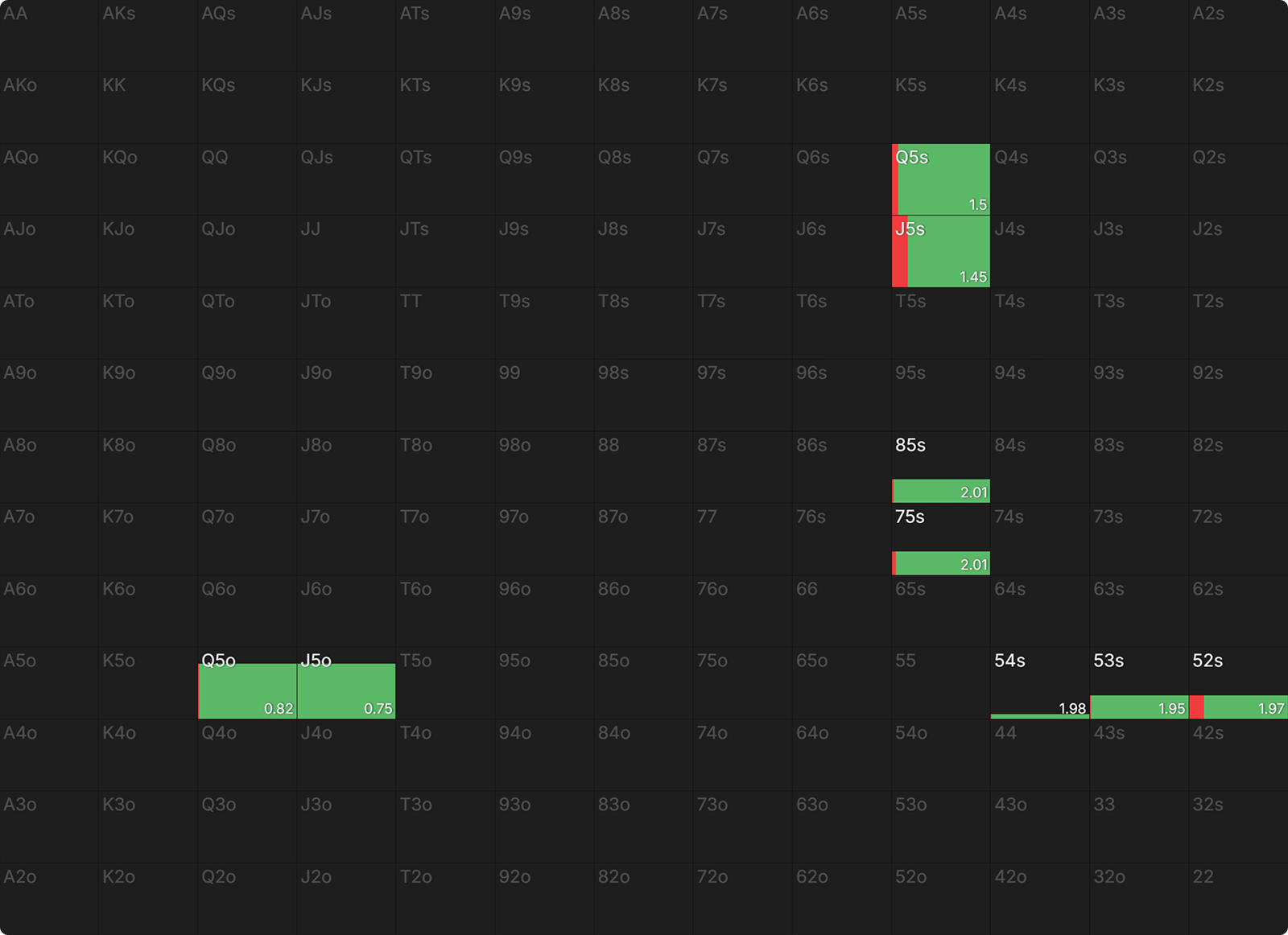
BB GTO turn response with 5-x vs SB’s second barrel (75% pot): with draw
without draw
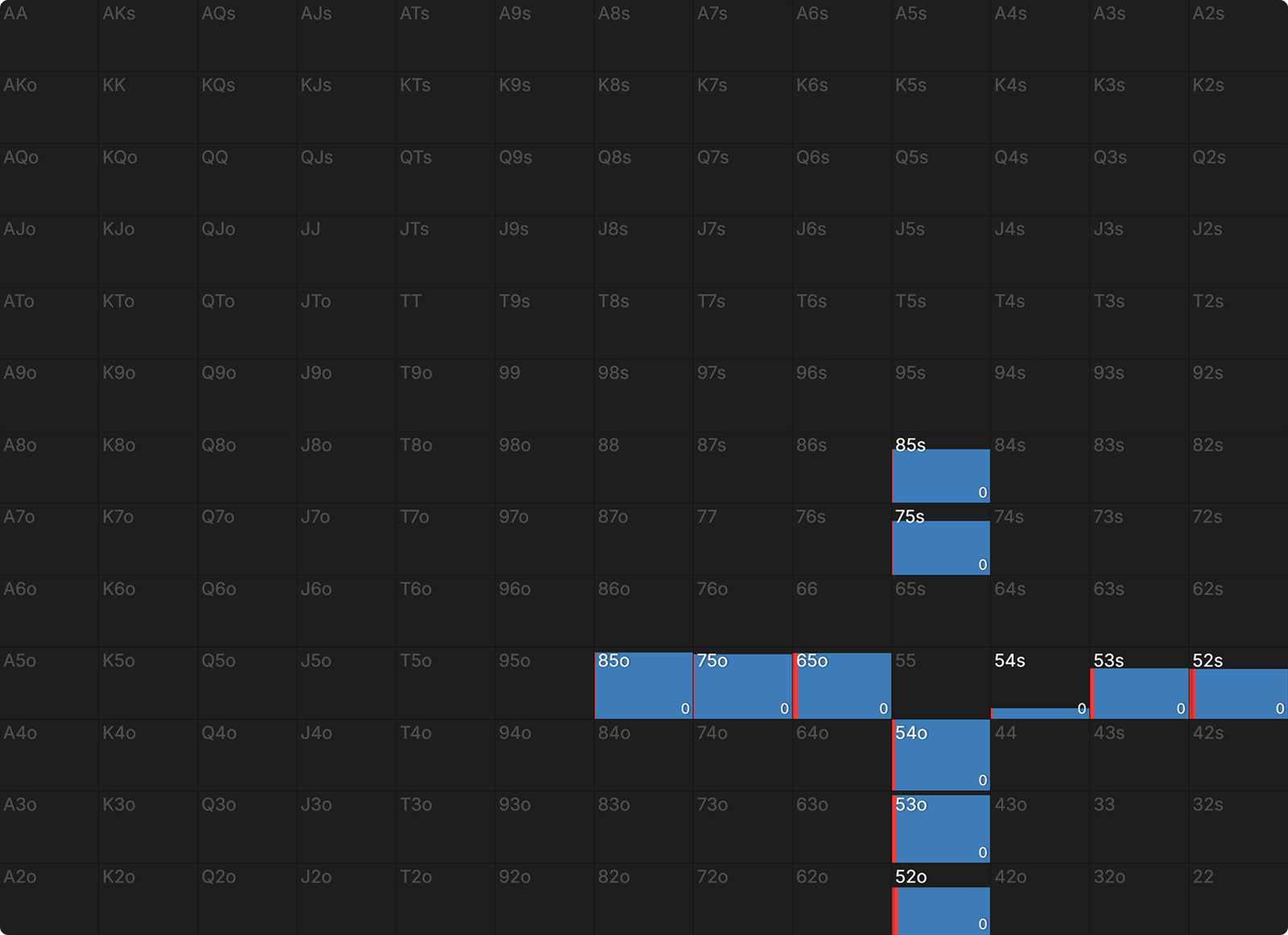
Against the turn barrel, we can see that the only 5-x that should continue are the ones that also have a draw. Therefore, they have made a -EV call on the turn since, in equilibrium, that was a clear threshold mistake. Then they compounded this station tendency on the river by calling again to the third barrel.
All the information points from this showdown imply that our Villain is a calling station across multiple streets, and we can generate more EV by exploiting these tendencies.
{{/toggle}}
Versus Flop Calling Stations
We will define a flop calling station as:
{{interactive-reveal-answer: First, let’s test our intuition. Which of the following statements do you think apply to flop calling stations:}}
{{correct: Calling too wide on the flop will weaken their turn range.}}
{{wrong: Calling too wide on the flop lowers the EV of our bluff c-bets.*}}
{{correct: Calling too wide on the flop will skew river ranges in probe lines. }}
{{/interactive-reveal-answer}}
{{toggle: Show Note on Option (B)}}
*The EV coming from direct flop fold equity will decrease. However, the EV of other lines will also change.
{{/toggle}}
Consider the following heads-up example at 15bb effective.
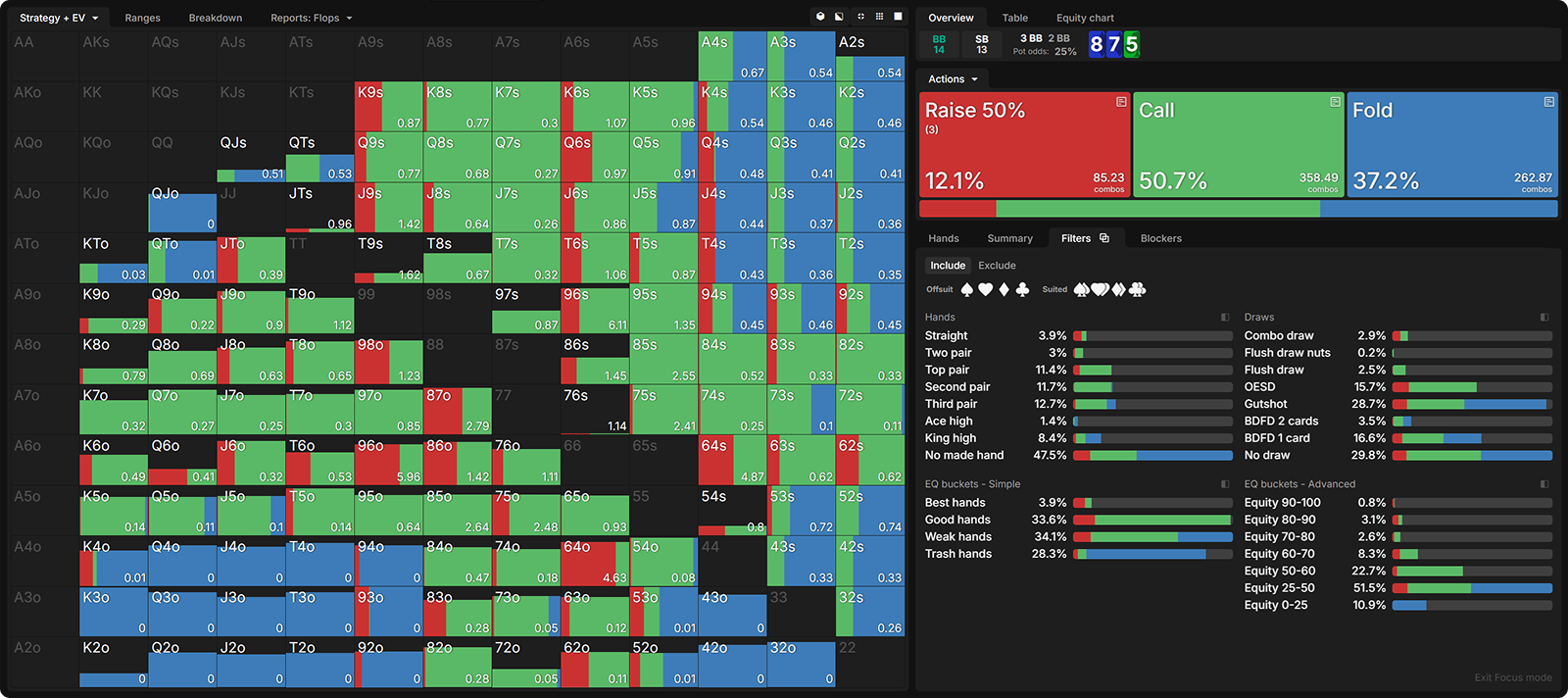
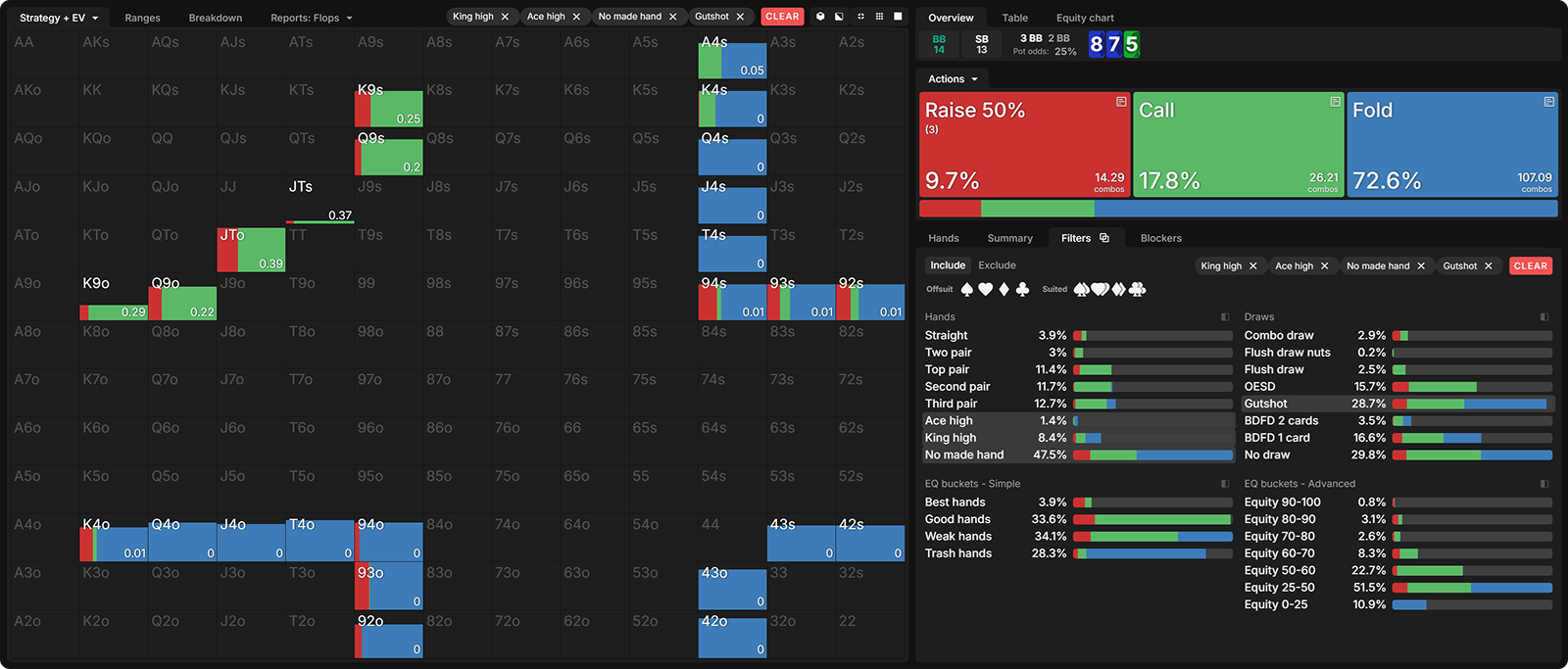
Facing a 1bb (50% pot) c-bet, the equilibrium strategy is to fold ~37% of the time.
Diving deeper, we notice that this min-bet is sufficient to drive the BB toward folding a large portion of its gutshot holdings; in fact, ~73% of its unpaired gutshots are simply folding.
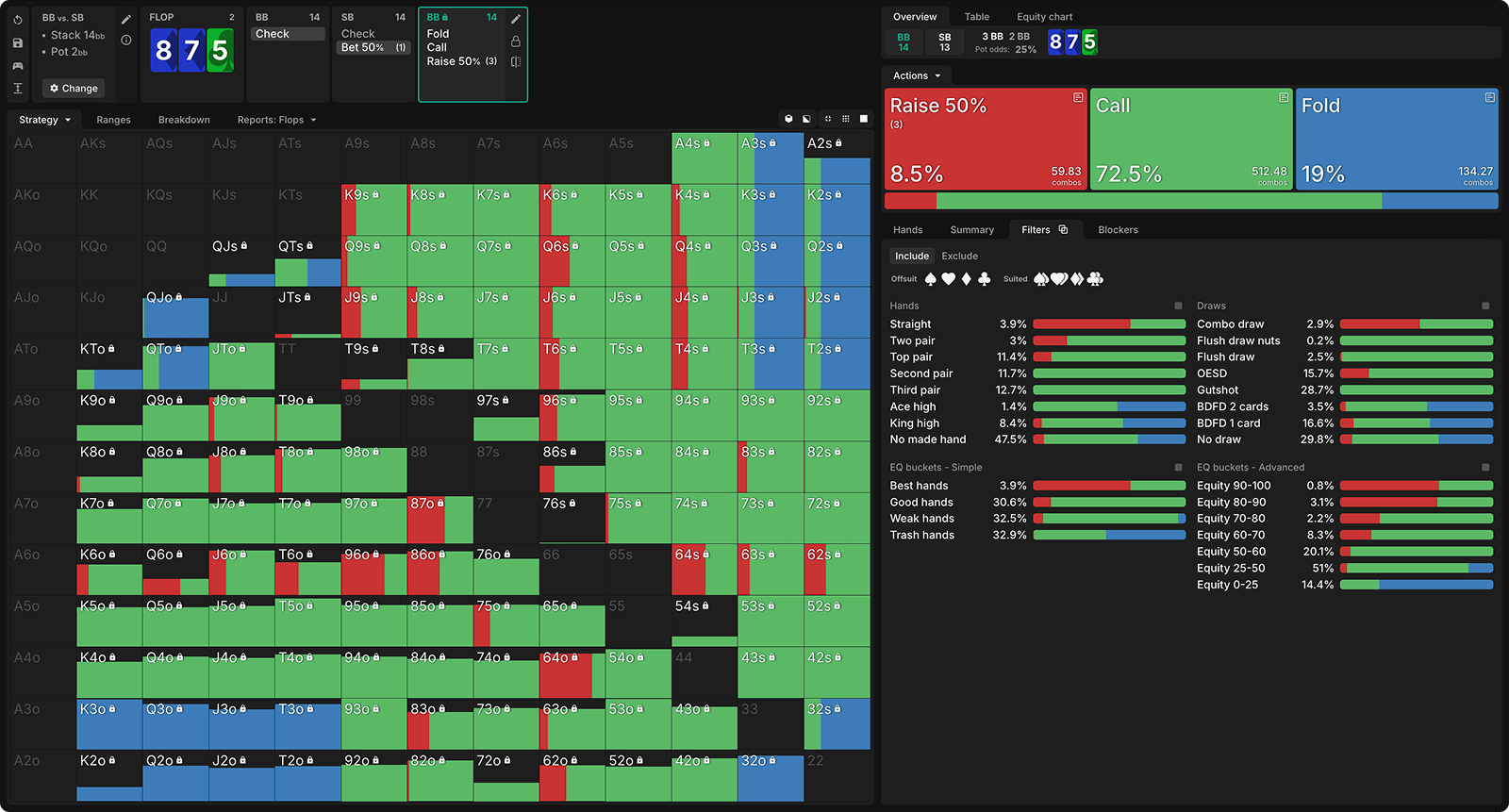
It is a reasonable assumption that a flop calling station will not be willing to let go of a direct draw on the flop, so let’s nodelock the BB to call all gutshots and all pairs.
{{question-mark}}
Given this information that if we c-bet 1bb, the BB is going to continue very wide, how do you expect the SB to adjust?
{{/question-mark}}
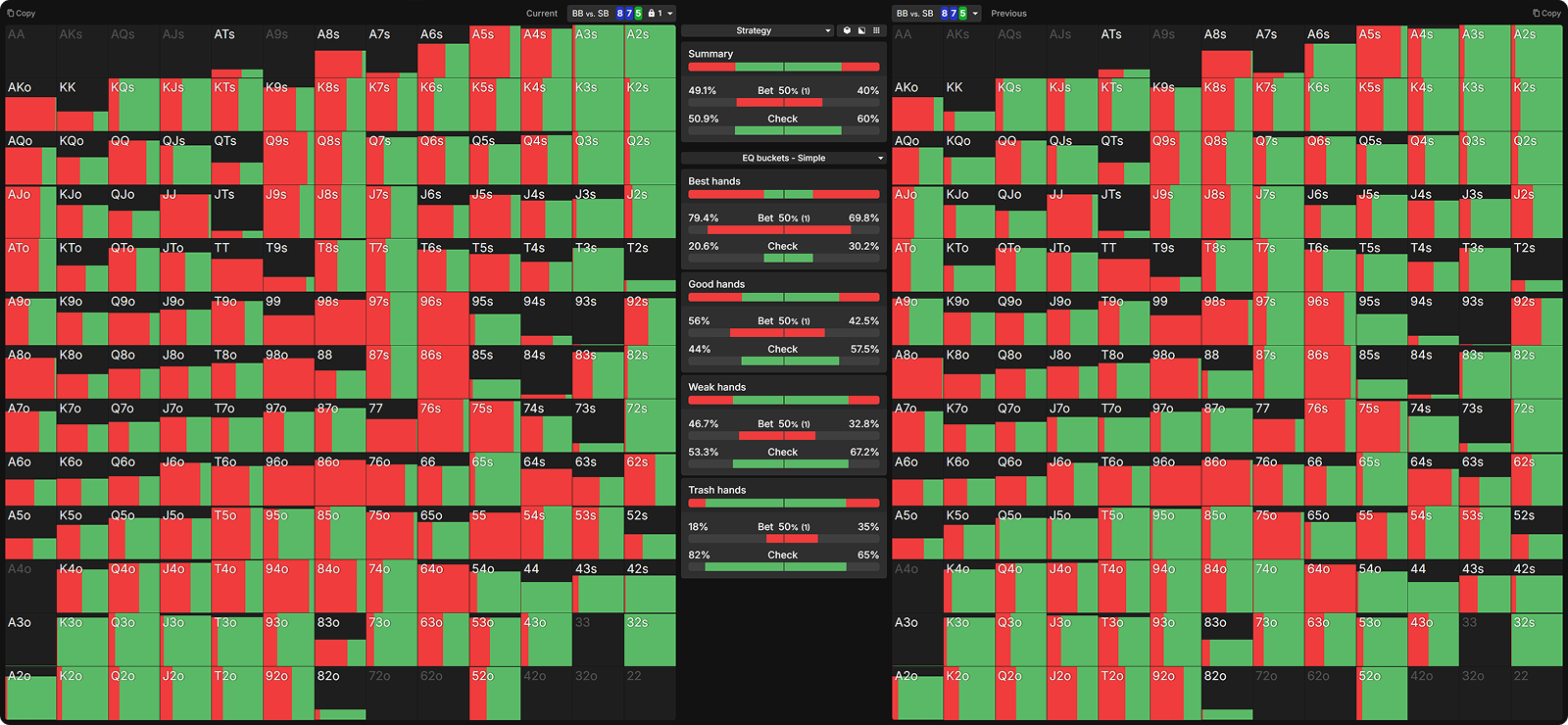
SB increases their c-betting frequency, going from 40% to 49%. In general, we can see that the extra betting frequency is a result of the SB recognizing that there is more value to be extracted from the BB’s new flop defending range. The betting frequency of the “Best” and “Good” equity buckets increases significantly, and the betting frequency of “Trash” reduces, due to the solver defending turns and rivers properly afterwards. In practice, many opponents will struggle playing an overly weak range on subsequent streets and will likely over-fold. When that happens, both the EV and the betting frequency of our bluffs increase rapidly.
The main takeaway here is:
{{question-mark}}
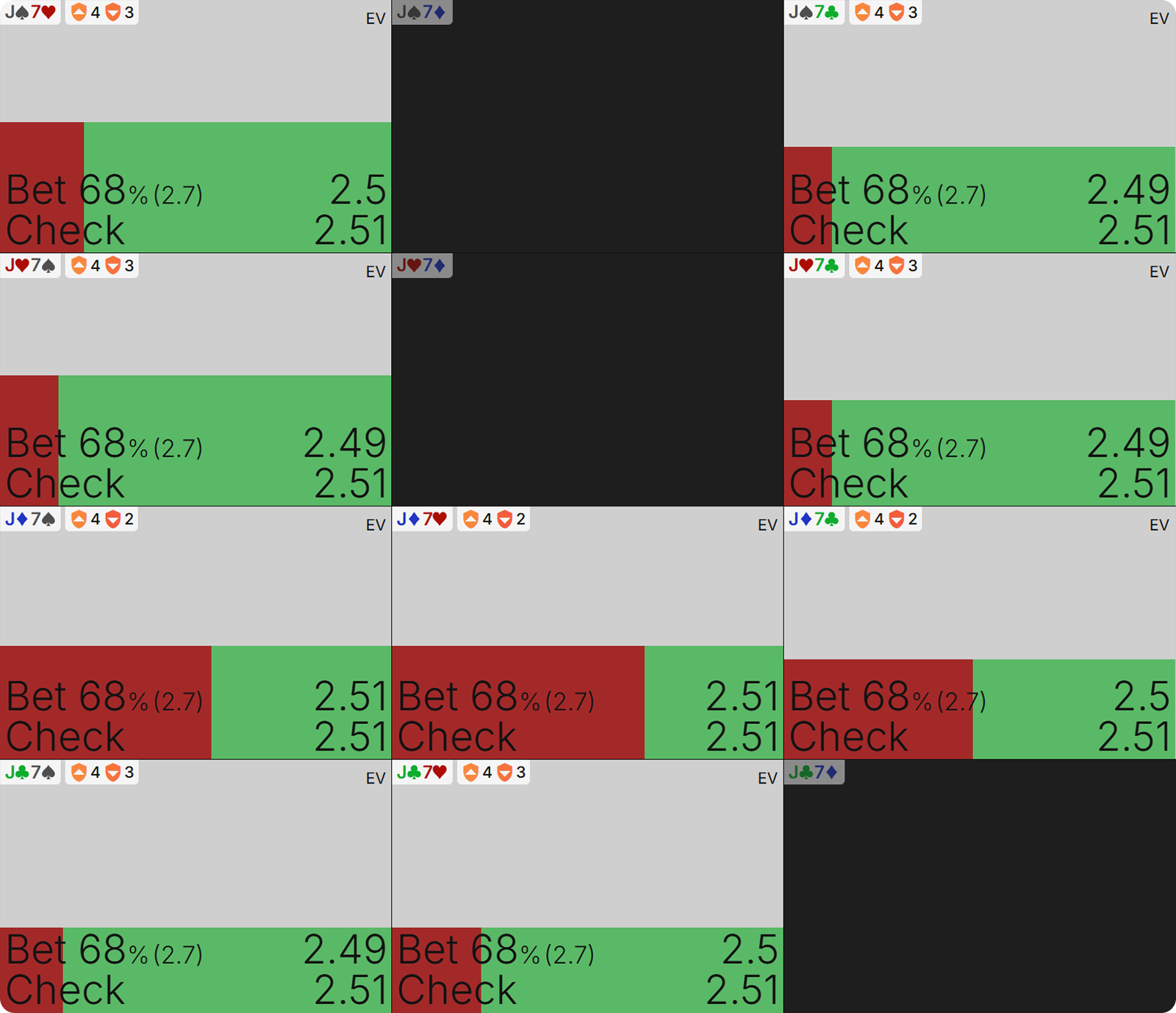
Now, let’s imagine we hold J♣7♠ and we c-bet on the flop vs. a calling station. How do we navigate turns?
{{/question-mark}}
BB’s turn arriving range will contain many extra gutshot combinations and weak pairs from the flop. This will make 4-straight turn cards better for their range, but on every other card, their range will remain weak. We can visualize this by comparing a blank 2♠ turn and a straight-completing 6♠ turn.
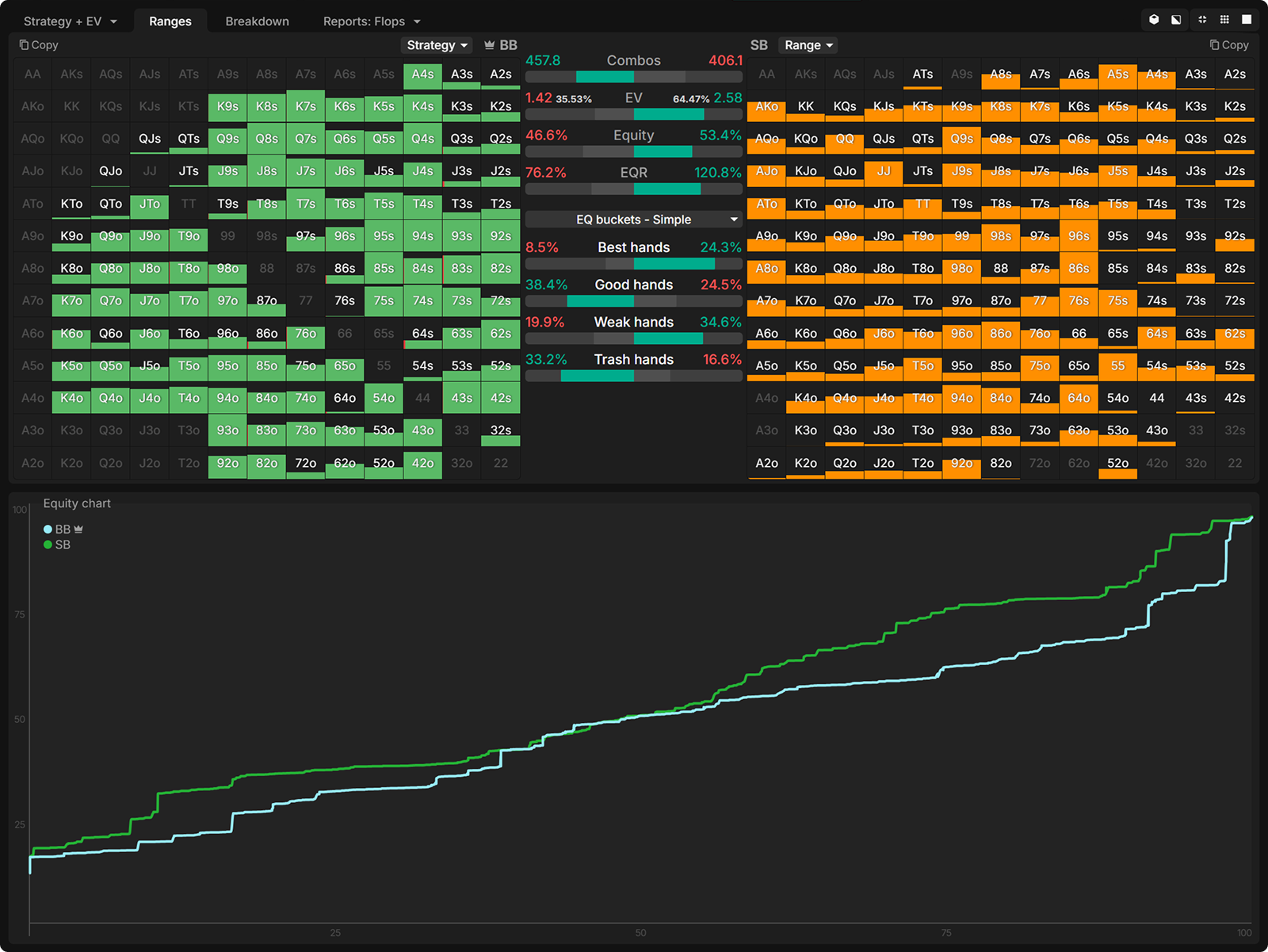
On turns that do not put four-to-a-straight on the board, the SB will maintain a huge advantage. This will allow us to choose between continuing to value bet OTT with our thinner holdings, such as J♣7♠, or to check the turn and get ready to bluff-catch vs. river probes.
{{width: 75%}}
{{/width}}
This is the decision point where extra info on the player helps to decide between these mixed actions. If they are a calling station to barrels, we should continue to barrel our 7-x, but if only a flop calling station, checking and letting them navigate an extremely wide and weak range on the river is the exploit I would make.
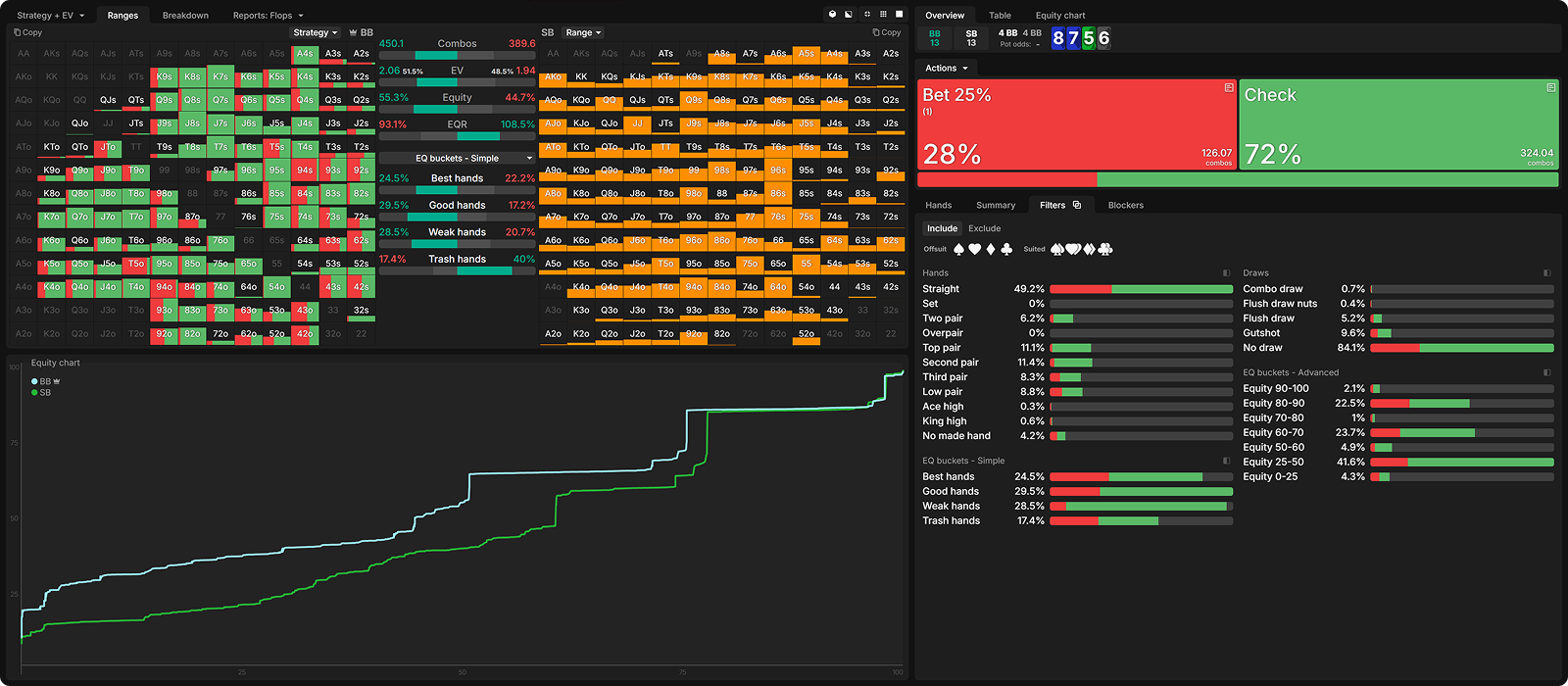
We see on the straight-completing 6♠ turn that the BB now has the range advantage. That is what incentivizes them to start developing a turn donking range. This is something many players may miss. If they don’t start to implement a donking range, then we (in the SB) should simply not re-open the action with a bet OTT often at all.
In summary, flop calling stations will always end up with a weaker turn range by calling too many speculative holdings on the flop. To get the major point of this section across, consider these two broad categories of flops (and the implications for the turn):
- On draw-heavy flops, this will result in non-draw completing turns being very bad for their range.
- On more disconnected flops (e.g., T♠7♦2♥), they will usually defend too many non-backdoor high-card holdings. This makes their turn range weaker on lower-card turns, such as 3–9, as they have too many random high-card holdings. We should exploit this by barrelling more on these lower cards, whilst more frequently skipping the barrel bluff on higher cards, which now connect better with their range.
Versus Multi-Street Calling Stations
The most emotional street for many players is the river. If you 3-barrel in Spin and Gos and get caught bluffing, the majority of the time, your whole stack will have been at risk.
“How can he call me down with that? What is he doing?” may be echoing in your head when your opponent makes a call with a hand you expected to fold.
Let’s simulate a hand that may invoke those emotions: A♥Q♠3♣ 7♠ 2♣
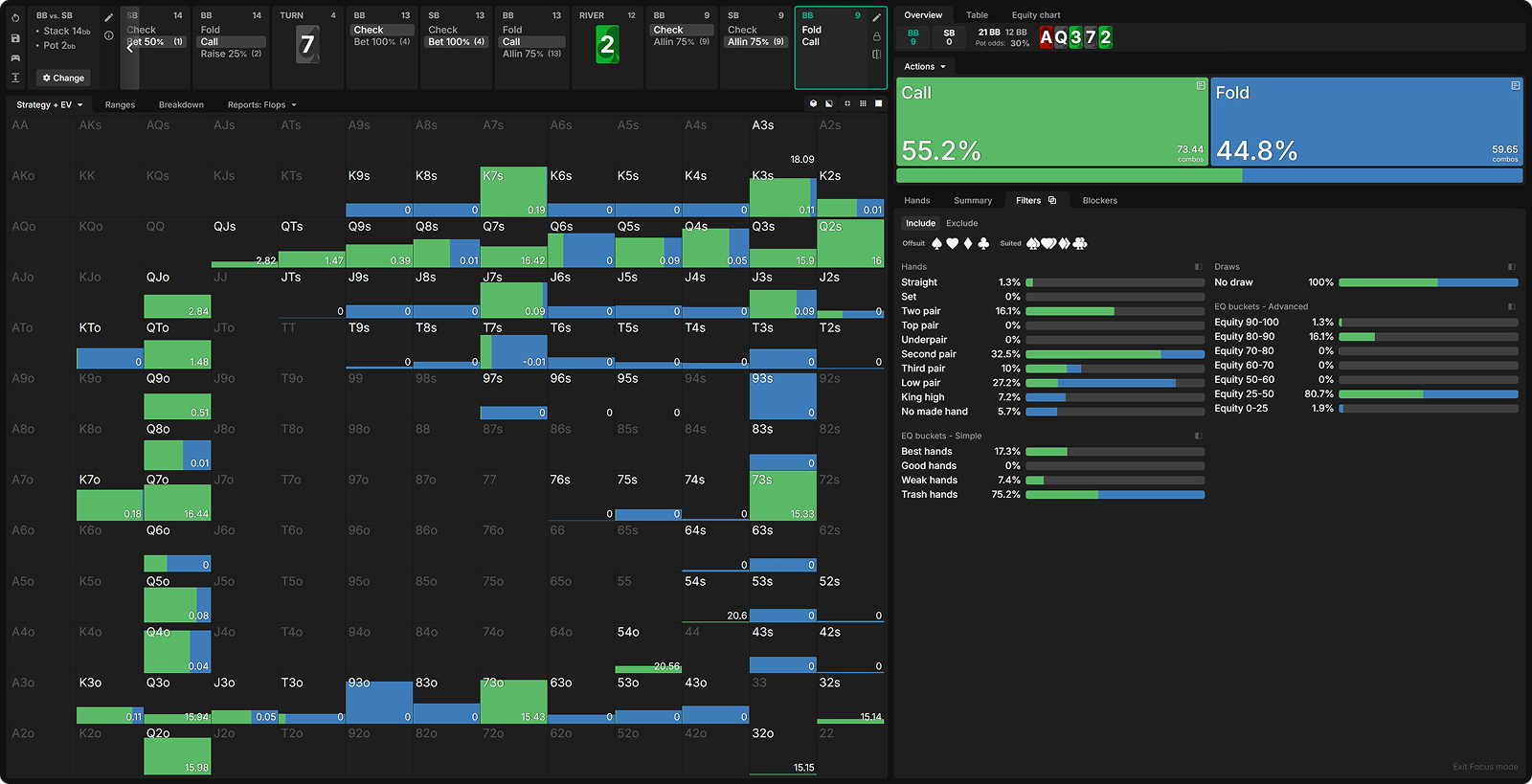
- We are in the SB with 6♥5♣ and open-limp preflop, the BB checks back.
- On a flop of A♥Q♠3♣, we c-bet 1bb and the BB calls.
- The turn brings a 7♠, giving us a gutshot, we opt for a 4bb barrel sizing, and the BB calls.
- The board completes with a 2♣ river, our gutshot missed, and we go all-in, BB snap-calls us with 9♠3♥, a pure fold in theory.
After seeing this showdown, we decide that this player is a calling station who is going to call us down with any pair on this runout.
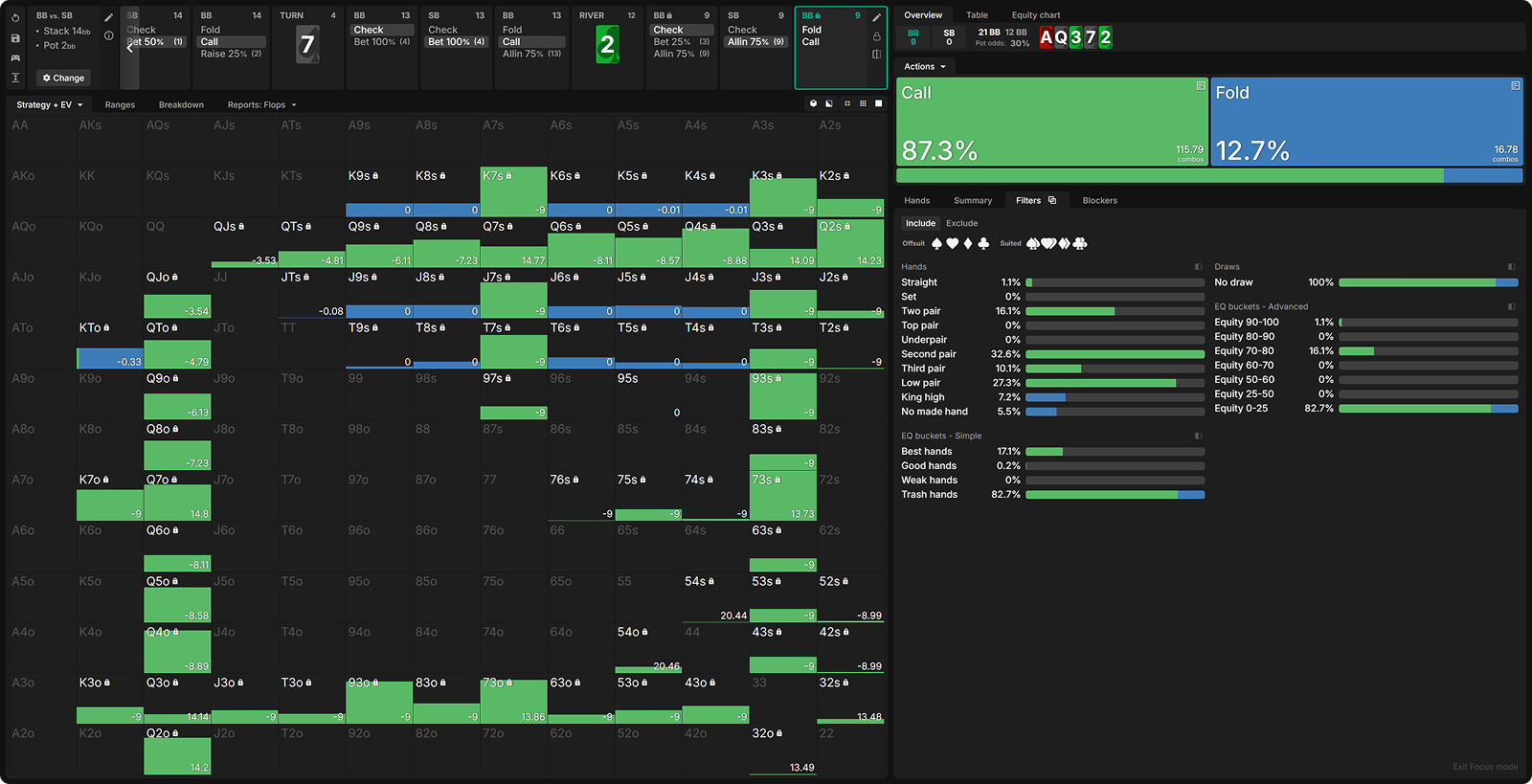
{{question-mark}}
How do you anticipate this will affect the solver’s 3-barrel range on the river, if we nodelock BB to call all pairs to the triple barrel?
{{/question-mark}}
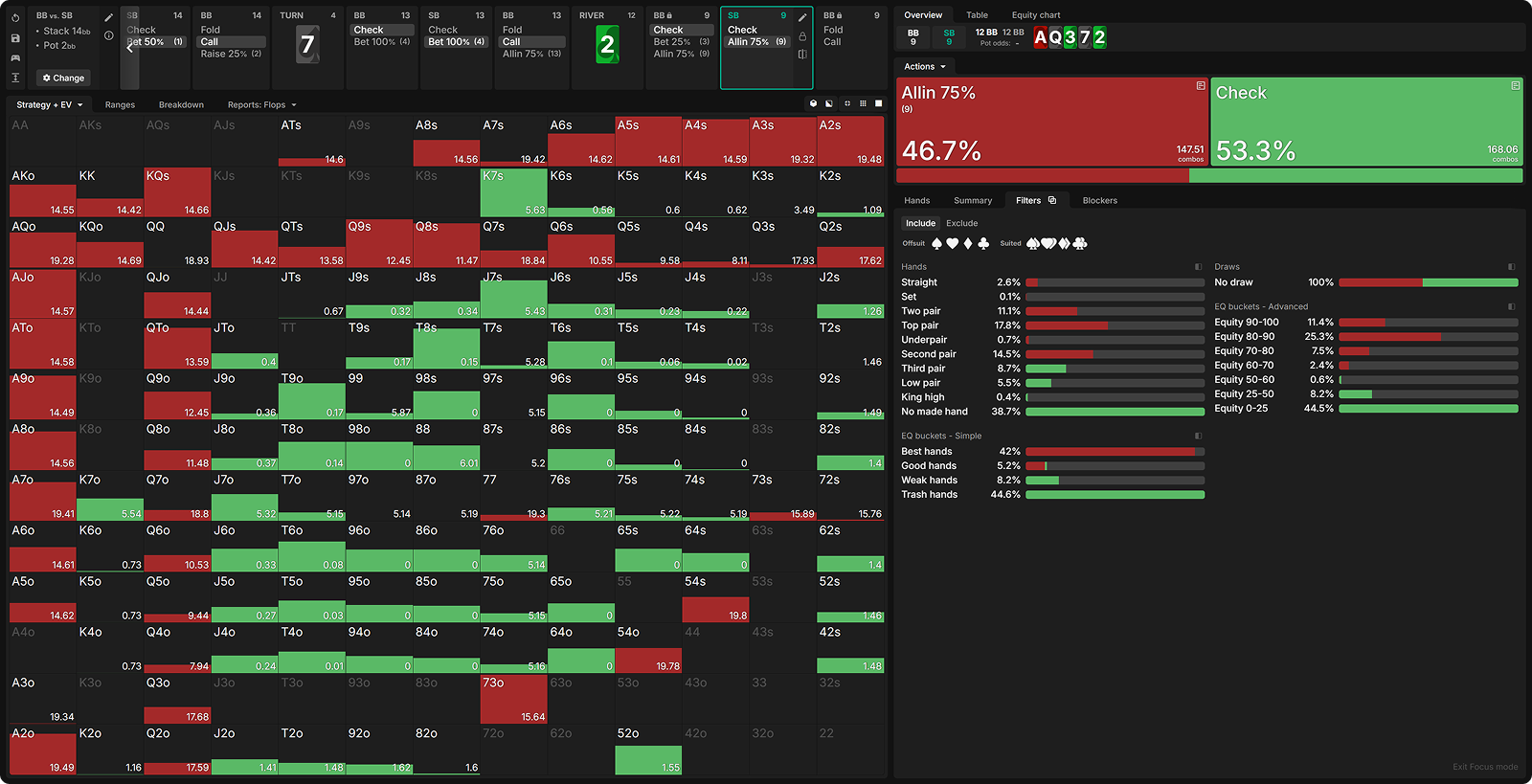
The solver enters what I like to call "maximum greed mode."
Simply put, any hand that wins > 50% of the time when their bet gets called on the river makes that bet (i.e., all-in), and every other hand simply checks.
The reason for this is that bluffs no longer meet the minimum threshold of fold equity to be profitable anymore; here, that would be 9bb/21bb ≈ 43%. Since the BB is already calling every pair regardless of our range construction, SB doesn’t need to bluff to get their value hands paid.
Against players you don’t play very often or those that don’t pay attention to your game, this will be optimal. However, most players are capable of re-adjusting based on how they perceive you to be playing.
{{question-mark}}
How, then, can we exploit real-life players who are capable of re-adjusting?
{{/question-mark}}
The Power of Compounding Adjusts
In the last section, we saw that max exploit strategies are often very extreme in their nature and may become easy to notice. What if we could plan ahead and manipulate our range on previous streets, such that we could still make large exploits on the river, but without them being as obvious to spot?
That’s where ‘compounding adjusts’ comes into the picture.
To visualize this, let’s take our previous HU SB 15bb eff spot.
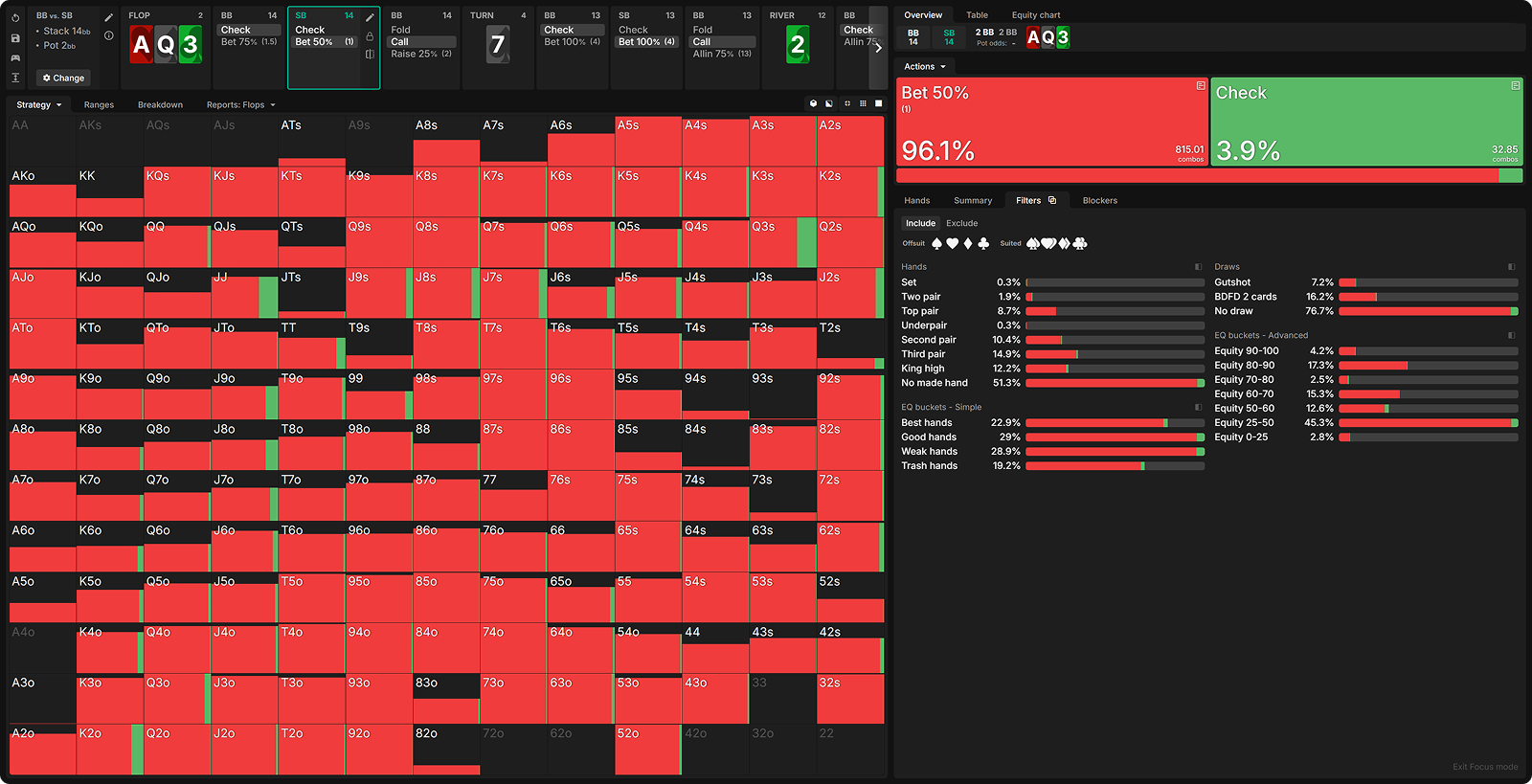
The equilibrium strategy is c-betting 96% of its range. Step 1 of our compounded adjustment, in this case, could be to change this c-bet frequency to 85%.
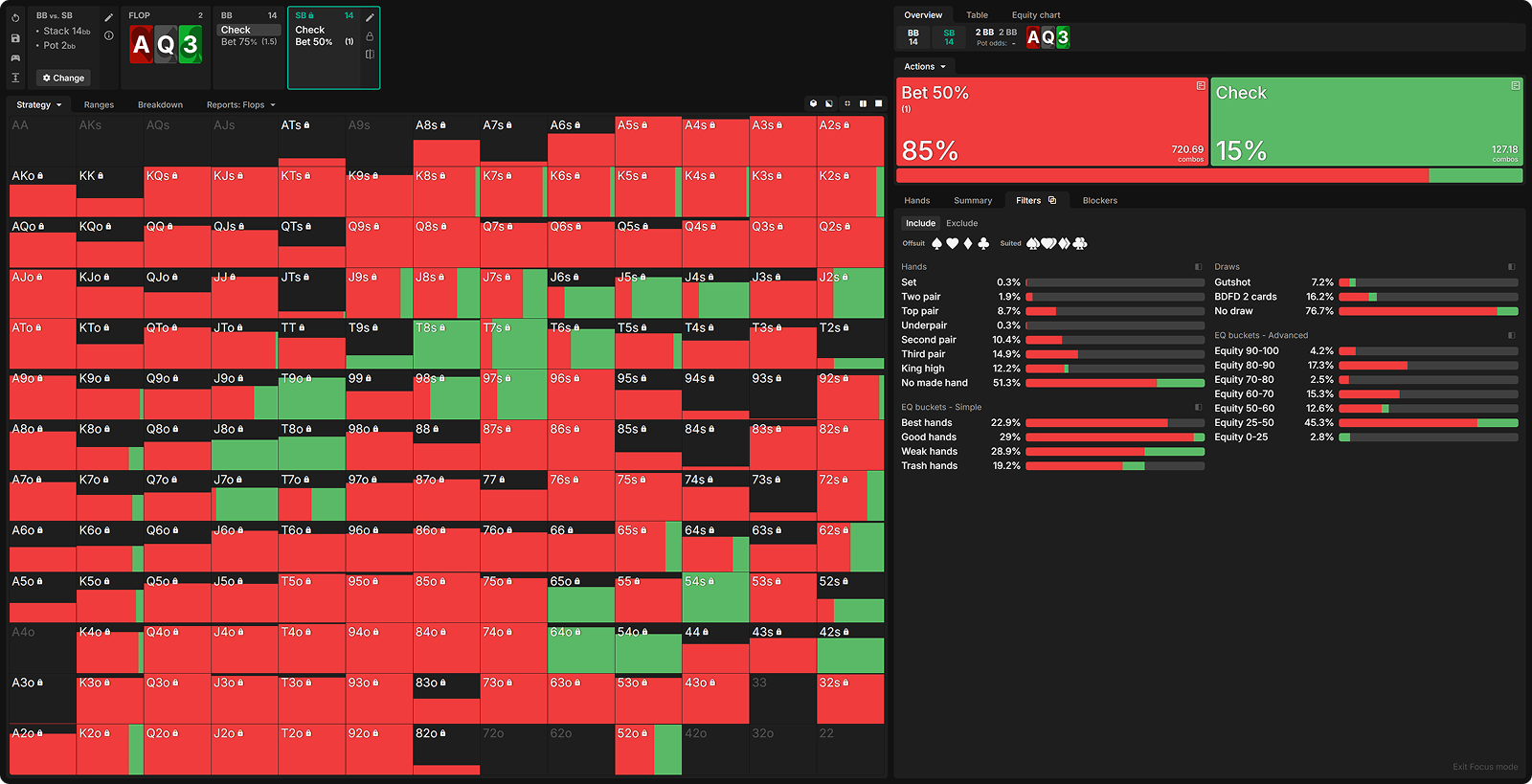
Our new c-betting range of 85% includes more value combinations (every hand with > 60% equity is now betting), whilst containing less trash (our new checks all come from hands with < 50% equity).
Continuing to the next street, the 7♠ turn.
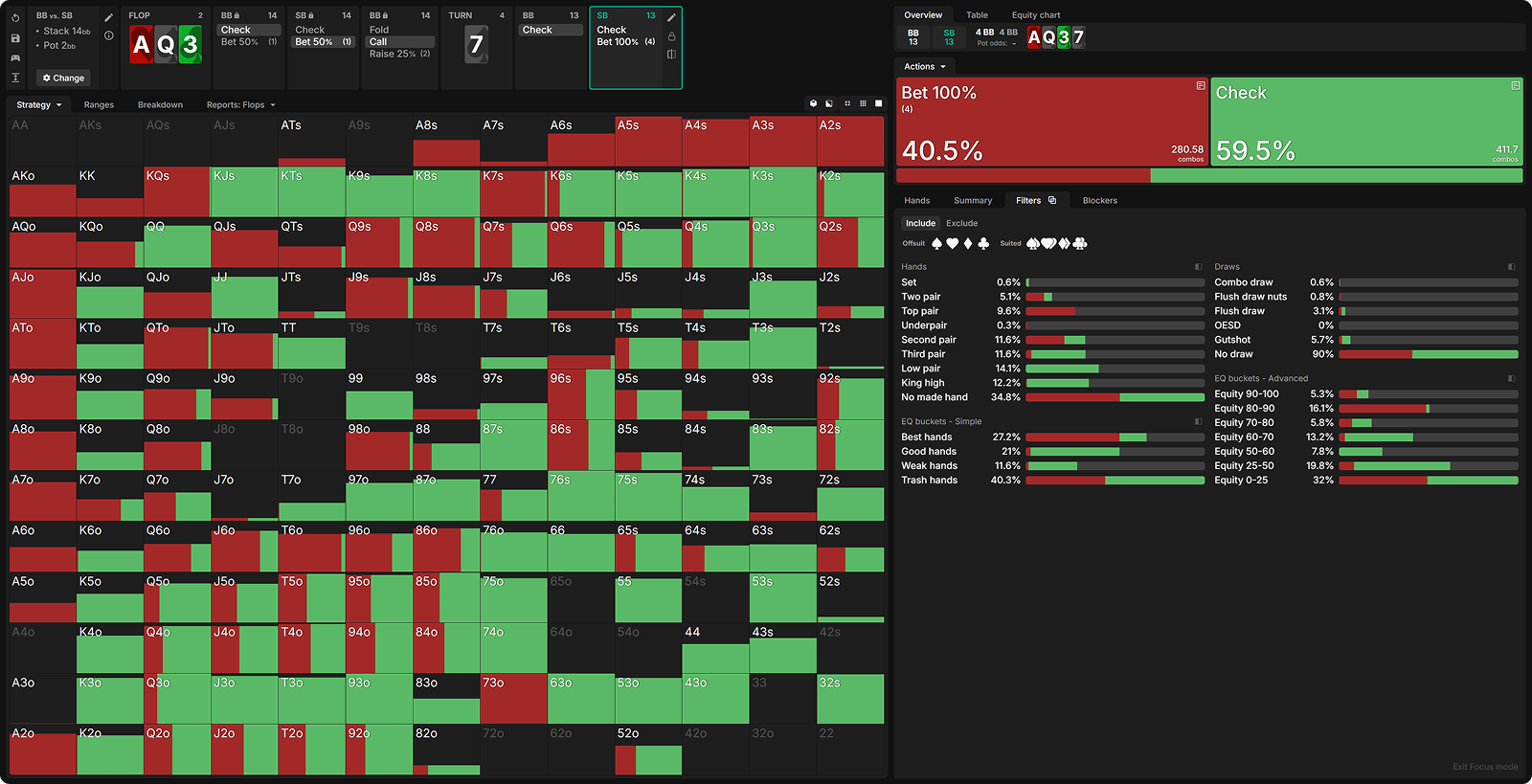
The solver is choosing to barrel ~41% with a 4bb sizing. Let’s apply step 2 of the compounding process.
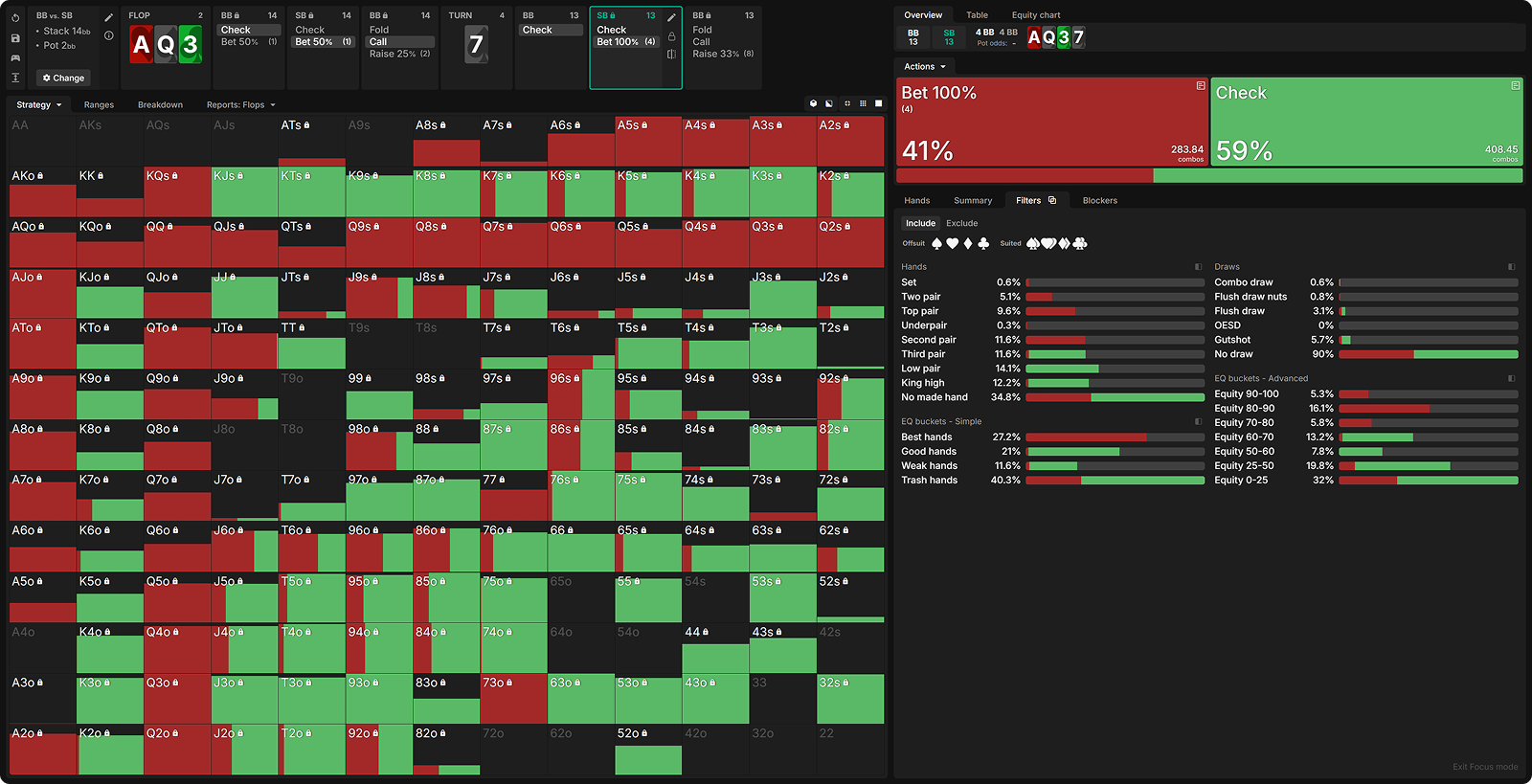
We keep our barrelling frequencies very similar. However, we have modified the range composition. Again, we have decreased the frequency we barrel with our 0–25% equity hands and replaced them exclusively with hands that have 70%+ equity.
So far, we have slightly under-bluffed the flop and changed our range composition on the turn.
{{question-mark}}
Now is a good time to pause and ask yourself, how would you adjust on the turn as the BB if you knew the SB constructed their range like this?
{{/question-mark}}
You are correct if you answered, “I would fold more.” But how much more?
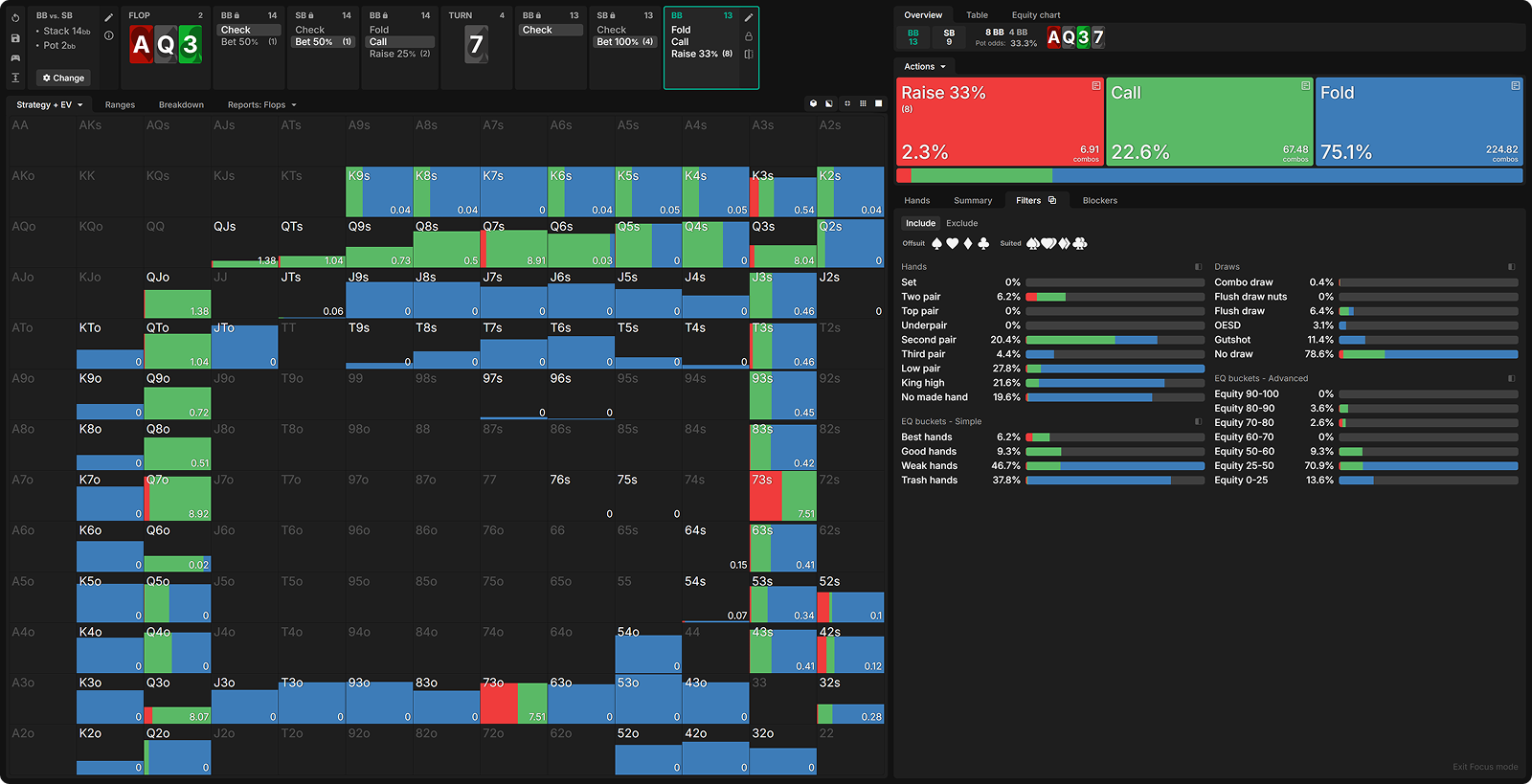
A huge adjustment is required in the BB already. Folding all 3-x that don’t contain a redraw, even starting to find folds with some pairs of Queens!
We already know that calling stations find it hard to fold a pair on the river, let alone folding 75% of their range to a turn barrel.
Finally, let’s complete the compounding process on a rivered 2♣. If you kept track, you know this will be step 3.
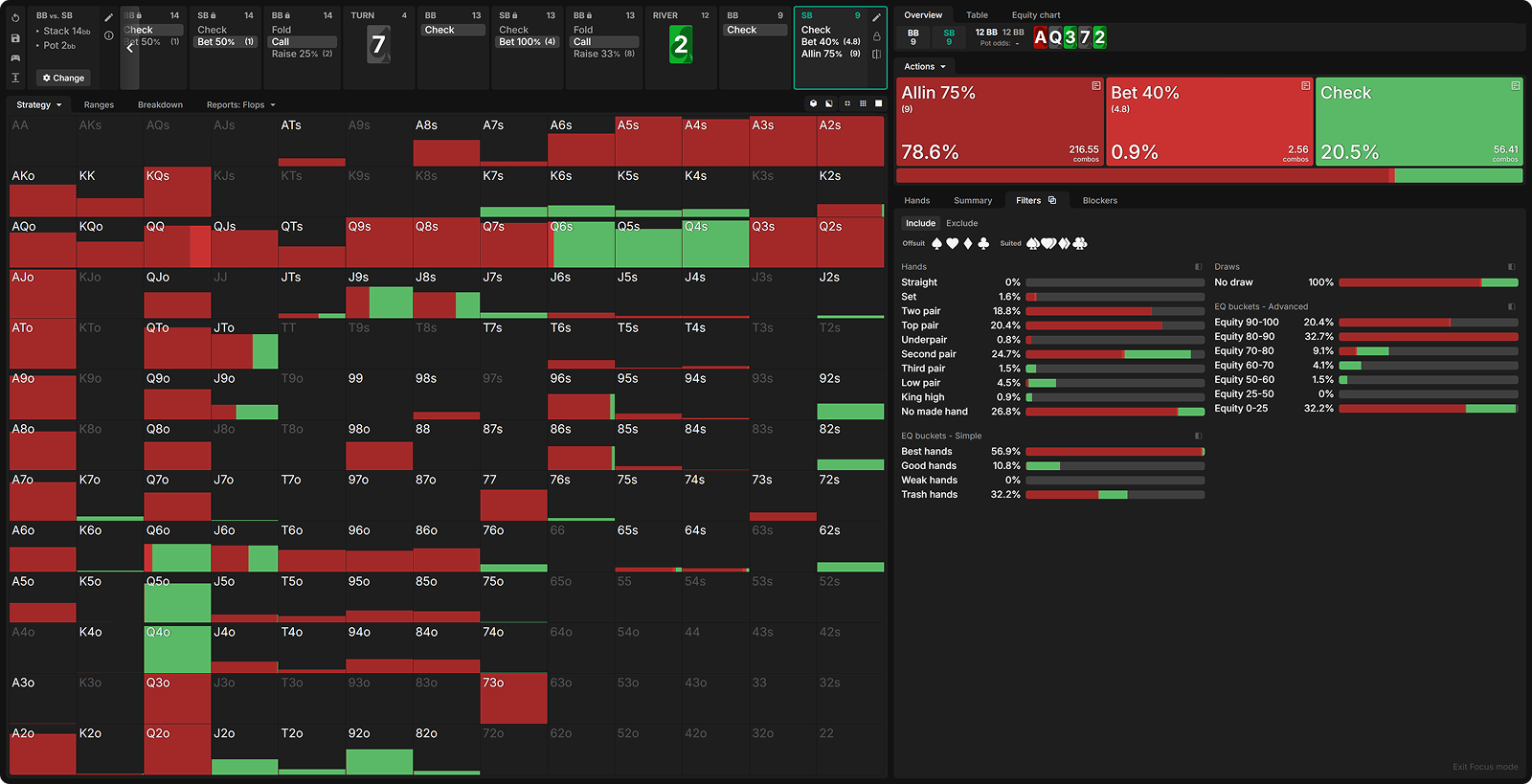
Notice how the solver is now incredibly aggressive on the river. This is due to our turn-barreling range being strong. Even if the BB calls all of its pairs to our river all-in, our strategy doesn’t lose EV. It actually gains a little bit of EV because the extra chips we lose with our bluffs are more than made up for by our value bets that get paid off.
River Performance Comparison
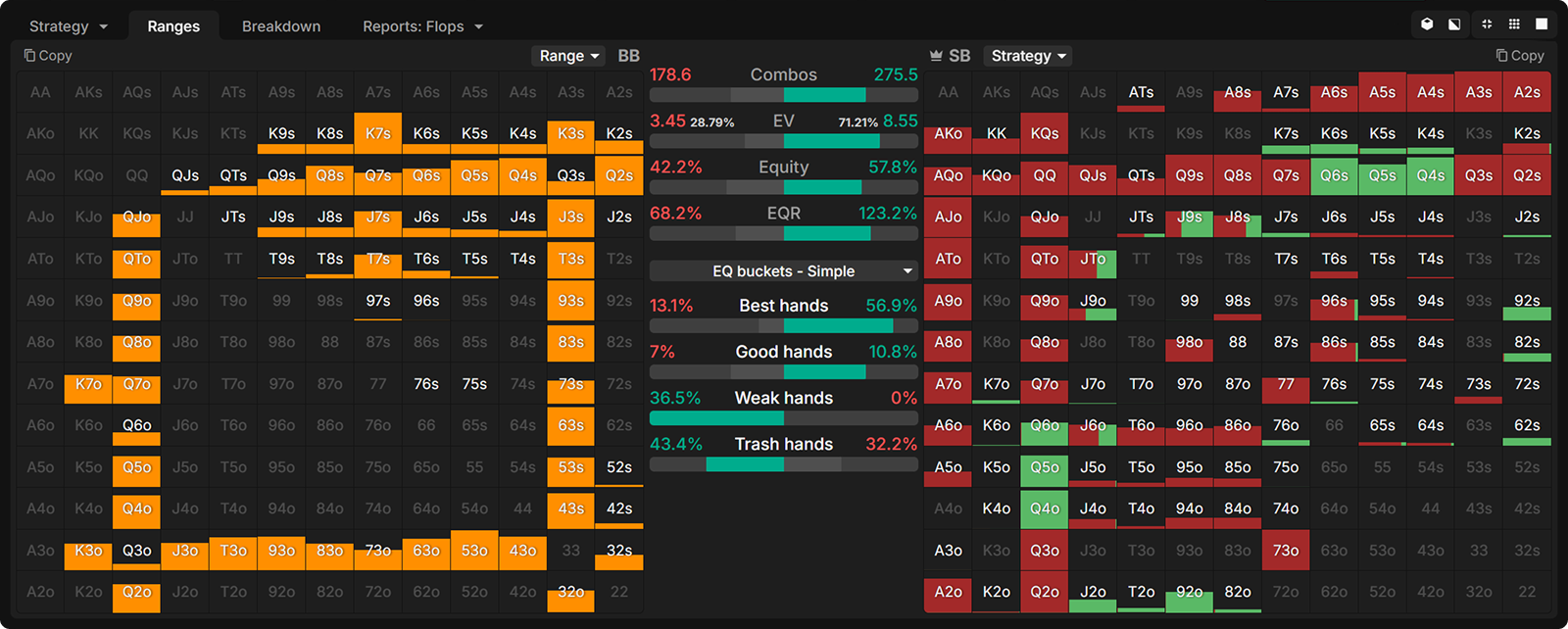
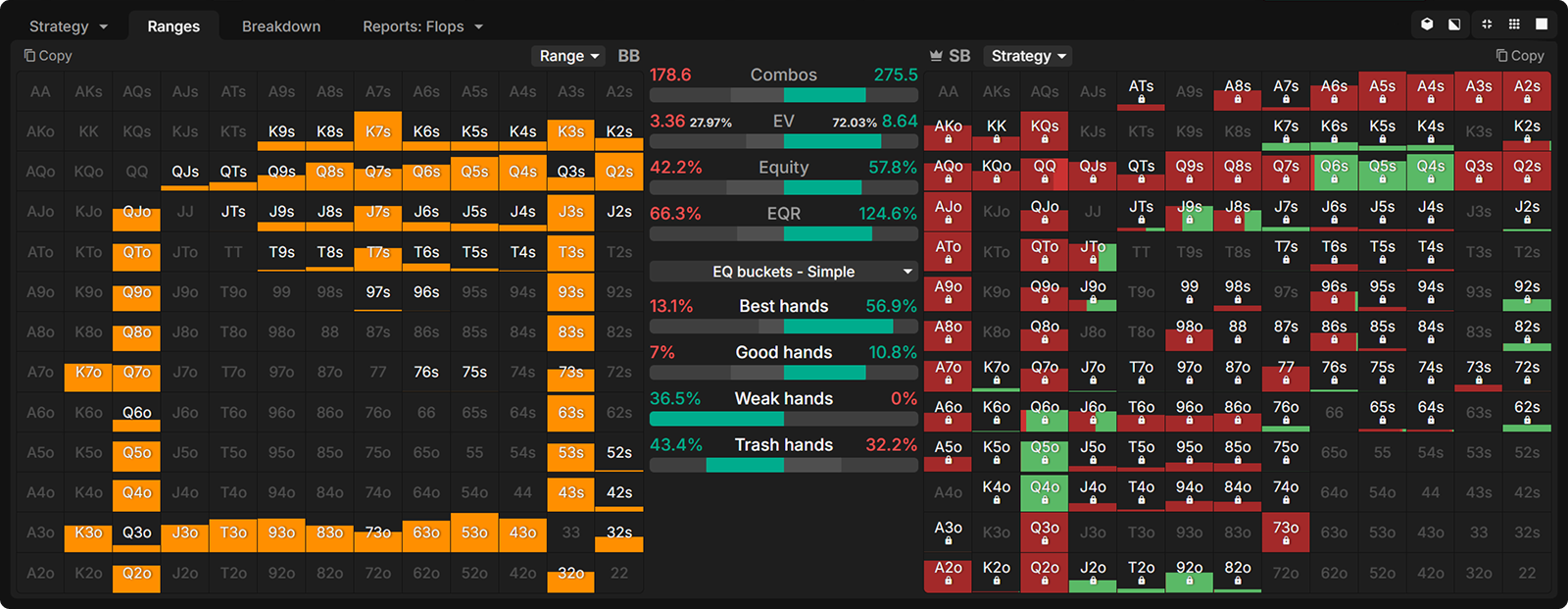
We now have multiple options available to exploit the BB:
1. Compounded exploit – We often play against this player. So we prefer to use an exploit that is more subtle, of the kind that is more likely to be effective over long periods of time, potentially forever. In our example, this means to aim for the solver output strategy OTR, even though we expect this Villain to call down every pair.
2. Maximum greed – We rarely play against this player. We can get away with simply moving all-in with all of our Queen-x and better, whilst checking everything worse. This type of exploitative strategy has the downside of being easier to notice (and counterexploit).
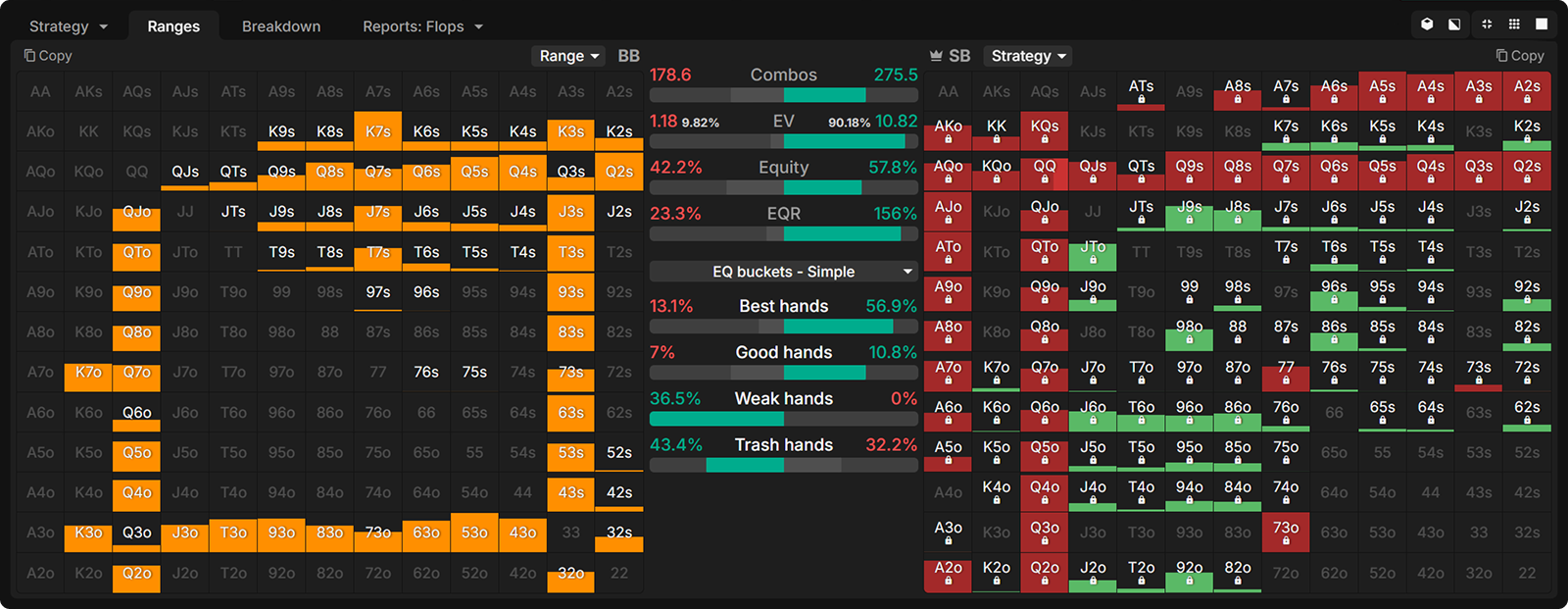
On a one-off hand, option (2) will make far more EV. This is where we need to weigh how much we care about the longevity of our exploit. If we play the Villain very often, we should lean more towards option (1); if we don’t play the Villain very often or the situation is uncommon, we can go full exploit with option (2).
Conclusion
To be the kind of player that has the number of calling stations, dial in these three key points:
- Be prepared preflop – Start every hand dynamically by adjusting your preflop range so that it can already capture the extra EV on the table coming from the opponent’s station tendencies, even before any board cards are dealt.
- Lower your value threshold – When players call too wide, we no longer need super strong hands in order to bet for value. Instead, we can c-bet + barrel a much more linear range, which punishes the BB for calling too many speculative drawing hands & low pair holdings.
- Compounding bluffing deviations – By manipulating our range in every street, we can create the illusion of having plenty of bluffs when in reality our double-barrel range can be stronger than equilibrium, allowing our value to continuously get paid without making it easy for the Villain to adjust.
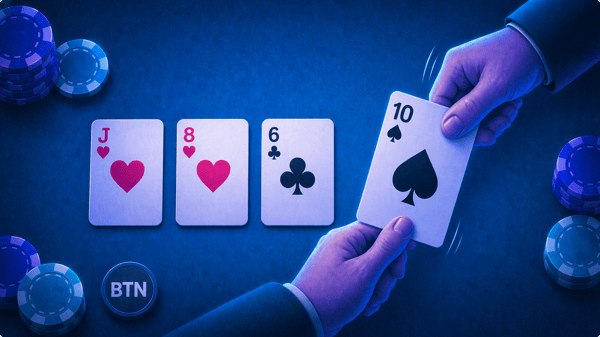
The Four-Point Checklist for Calling Turn Barrels
This article will provide a 4-point checklist of questions to ask yourself when facing a barrel, each one giving you an information point on whether our holding is a threshold hand or a clear decision one way or the other.
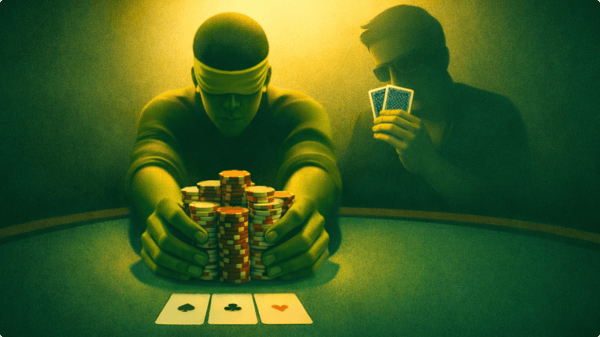
Small Blind, Big Problems: When to Size Up From OOP BvB
This article will give you a plan of action for establishing which types of boards prefer which sizing schemes and which types of hands fit into these schemes (both for value and for bluffs) when OOP BvB in Spin and Gos.

The Art of Value Bluffing From the Button
Playing “OK” from the Button in Spins often comes relatively naturally. Our relatively tight preflop range makes almost all boards favorable for us against the much wider range of the BB.