GTO Wizard AI Custom Multiway Solving

Overview
At GTO Wizard AI, we’re proud to release our state-of-the-art preflop multiway solver! It supports up to 9 players, any cash game spot (chip EV and rake) and all our usual features (tree edits, nodelocking, profiles, etc.) – with the same speed and accuracy that we always aim to deliver.
In other words if you’re a subscriber to the Ultra tier, you can now solve preflop multiway trees in seconds, directly from your mobile or computer, without any hardware requirements!
How It Works
Just like GTO Wizard AI for heads-up and 3-way, preflop multiway solutions are solved on the fly based on the exact parameters you input. These are solved using state-of-the-art technology that combines traditional solving methods with neural networks to solve any spot within seconds! Find out more HERE!
Our AI solver learned to approximate a Nash Equilibrium by playing against itself for essentially billions of hands. Aiming for a solver that can generalize to any preflop spot, we trained it on random combinations of stacks, blinds, rake & ante structures. As such, our preflop multiway solver can accurately handle any spot you can throw at it: BB ante, straddle, double-straddle, Mississippi straddle, etc.
With this release, we also introduce the capability to switch between two engine modes: Classic and Fast, which allows you to control the accuracy-speed tradeoff that is inherent to solvers. Classic is the standard street-by-street solving that has been available in GTO Wizard AI since the initial release, where we solve one street at a time. Due to the size of preflop trees, it’s not efficient to solve the entire street at once, so Fast is a new mode that solves by only looking a few moves ahead and resolving multiple times within the same street. This allows us to solve very large trees in just a few seconds while still maintaining very high accuracy. However, it does have some implications on nodelocking and tree editing; read the Dynamic-Depth-Limited Solving (DDLS) section below to learn more.
How Does It Compare to Other Solvers?
Unfortunately, it’s intractable to compute the Nash distance in preflop multiway spots because the game is too large. As such, we verified the accuracy of our solutions using internal benchmarks that compare our fast AI solutions against both third-party solvers and solutions generated with extended runtimes and deeper search depths. You can also verify for yourself the accuracy of our solver for free HERE by solving any preflop spot with stacks less than 10bb.
Furthermore, we will also release in the near future a public API explicitly designed for researchers and hobbyists. This API will enable the community to directly interact with GTO Wizard AI to benchmark their own poker engine against ours. We believe in transparency and are excited to provide the tools necessary for you to verify the accuracy of our solutions and push the boundaries of poker research alongside us.
Most existing multiway solvers rely on abstractions that lose information by deliberately treating distinct hands as strategically equivalent, or on blueprint strategies that assume static play deeper in the game tree. These methods can dramatically reduce the size of the game tree, but they do so by removing important information for making decisions.
Abstractions that lose information don’t just limit flexibility for solving custom spots precisely. They can also cause solvers to behave in surprising ways. For instance, solving a finer-grained abstraction doesn’t necessarily lead to a better approximation of the Nash equilibrium than solving a coarser-grained one if both lose information (source).
A blueprint strategy is a simplified strategy pre-computed by solving smaller, abstracted versions of poker. They help the solver avoid expensive real-time solving in parts of the game tree, but also lock the solver into predefined behavior that may not be optimal, and suffer from the same drawbacks as abstraction (using them requires mapping real positions to the blueprint’s abstract game). Because blueprints are fixed at solving-time, the solvers that work with blueprints have a limited ability to correct mistakes and solve custom spots with high accuracy.
In Practice
In practice, abstractions often manifest themselves with odd combo selections. Let’s take the example of one of our pre-solved solutions, a 6-max 100bb sim with NL50 rake. We see that the traditional (abstracted) solver heavily prefers 3-betting K3s. vs K5s, when there is no real reason to believe it’s a better candidate for bluffing (both combos should have similar blockers and equity realization). This is often indicative of artifacts created by abstractions.
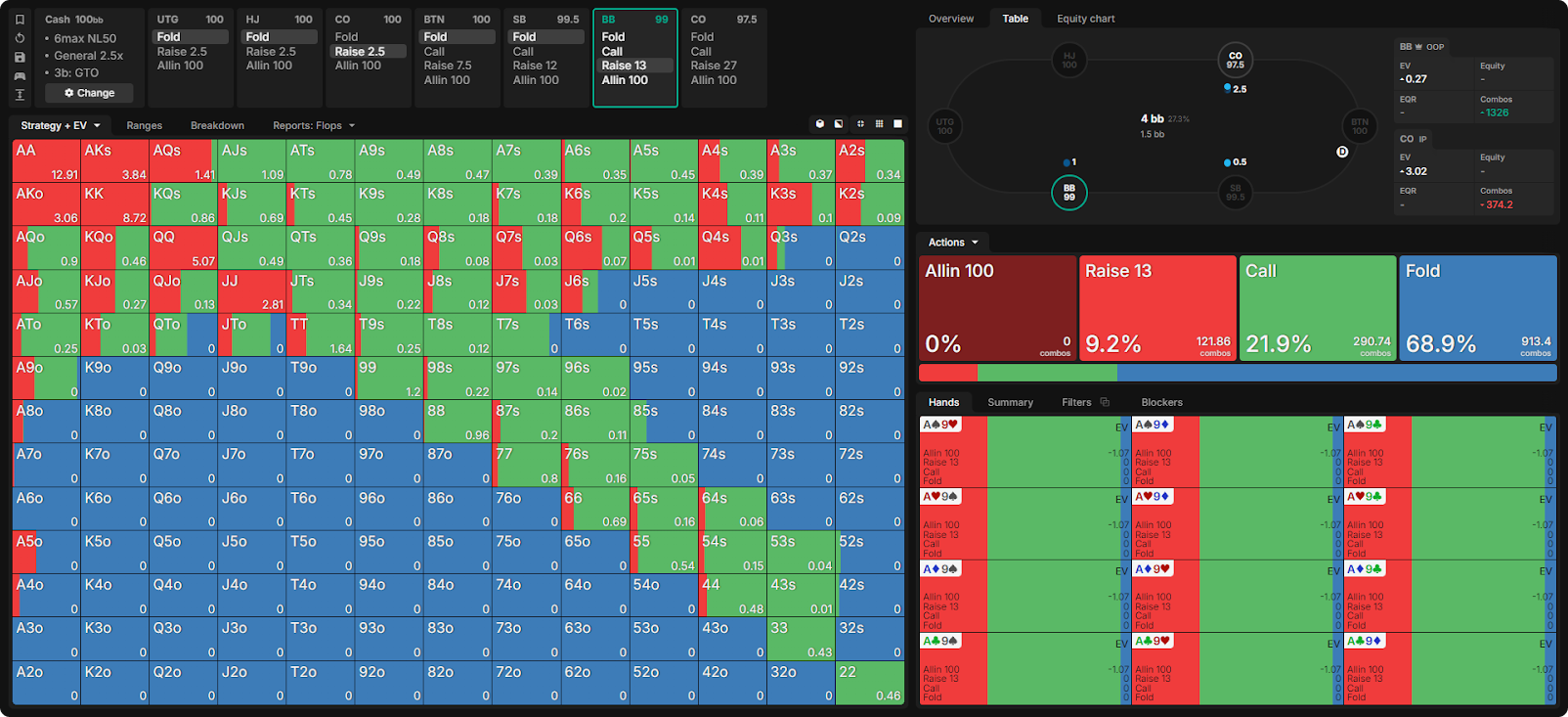
If we compare to the exact same spot solved by GTO Wizard AI, we see that while we reach similar global frequencies (~9.2% 3-bet and ~22% call), the AI solver does so in a much more balanced way by mixing 3-bets bluffs with a lot more hands (e.g., all suited King-x with some frequency). Since GTO Wizard AI solves without abstractions, it has to ensure that it can’t be exploited easily postflop and thus doesn’t concentrate its bluffs in only a few combos.
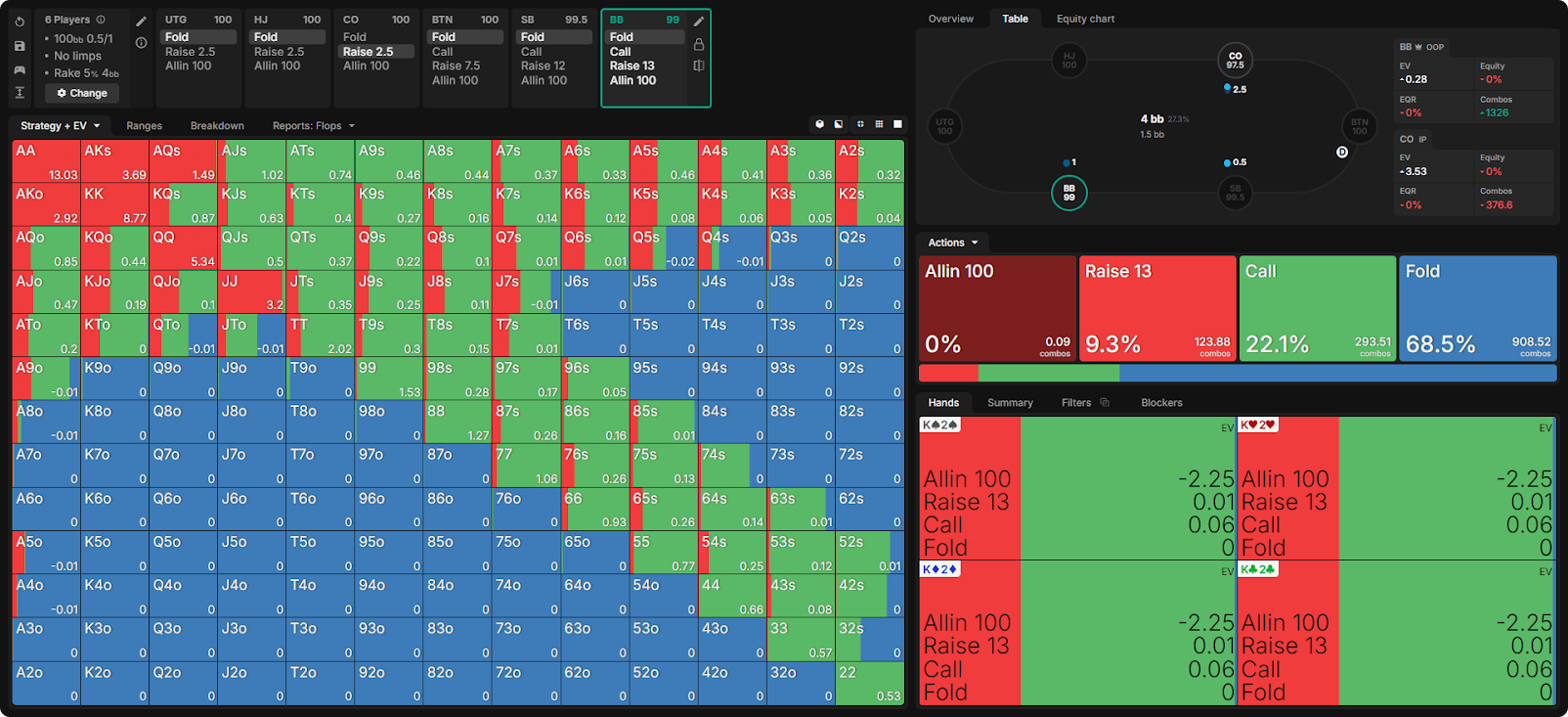
While our AI solutions might look a bit harder to learn due to more mixing, they give you a more reliable model of what GTO actually looks like, providing strong insights into how to balance your range properly. You also won’t have to worry about technical details that are, in fact, solver inaccuracies (e.g., why does K3s 3-bet here and K5s doesn’t).
Limitations
Solving multiway preflop trees in a few seconds is a major technical challenge; preflop trees grow exponentially with the number of players. As such, solvers traditionally impose heavy restrictions on players’ actions to significantly reduce the tree size. The common approach is to restrict the number of players who make it to the flop by removing the option to call at some nodes.
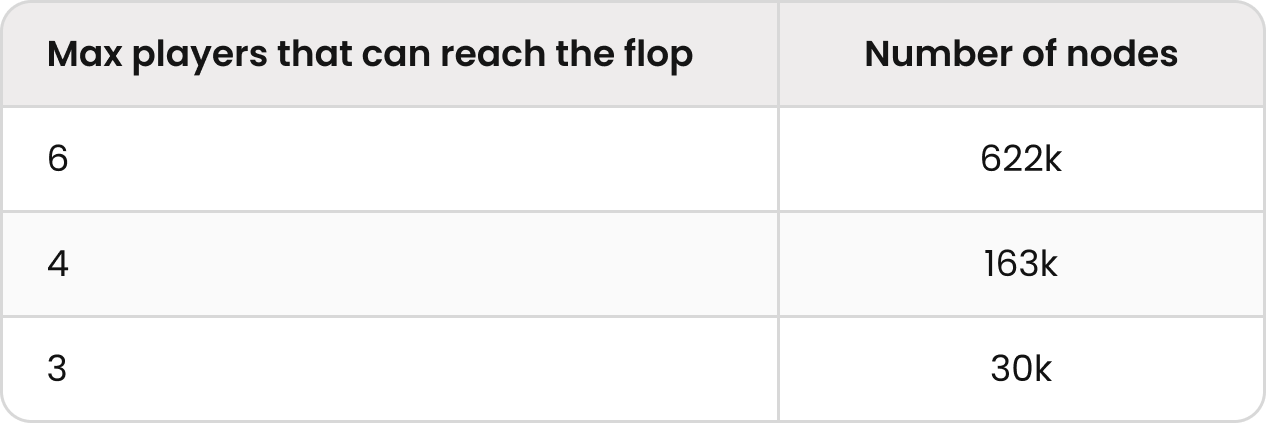
For example, let’s take a 6-max 100bb preflop tree where players only have a single bet/raise size of ‘3x’ at every node.
{{width: 67%}}
{{/width}}
Without any restrictions, this 6-max tree is massive: 622,000 preflop nodes! However, by allowing a maximum of 3 players to get to the flop, we can reduce the tree size and thus the solving time by ~20x in this spot.
For these reasons, GTO Wizard AI is currently always limited to 3 players making it to the flop to allow fast solving time and accurate results. As for deciding who can make it to the flop, we use internal rules that prioritize players who are closing the action or who have invested the most in the pot. For example, if UTG opens and BTN calls, the BB will have the priority to call over the SB, so the SB will only be allowed to squeeze or fold. Note that this is a common limitation of our preflop presolved solutions as well. These restrictions usually have a limited impact on the strategy and EVs of the player, but nevertheless, we aim to remove these limitations in the future and allow you to customize this parameter when setting up your preflop solve.
Dynamic-Depth-Limited Solving (Fast Mode)
As mentioned above, GTO Wizard AI solves poker games on a street-by-street basis. This approach is now referred to as Classic solving in GTO Wizard AI. The fundamental reason for this design choice is computational feasibility: solving a full poker game from preflop to river is intractable due to the immense size of the game tree, making full-game equilibrium computation impractical with current hardware and time constraints. To address this challenge, we rely on a technique known as depth-limited solving. Instead of expanding the game tree all the way to the end, the solver imposes a cutoff, typically at the end of a street. When this depth limit is reached, the value of the remainder of the game is approximated using a neural network. This neural network estimates the expected value of future play under equilibrium assumptions. GTO Wizard AI employs this depth-limited approach as a core component of its architecture.
Beyond computational complexity, poker introduces another fundamental difficulty that distinguishes it from perfect-information games such as chess: the strategic relevance of game history. In poker, past actions convey information and influence future actions, meaning one cannot arbitrarily fix earlier decisions and safely solve the remainder of the game in isolation. To better illustrate this issue, consider a player who is playing a Nash equilibrium strategy. If we fix this player’s past actions and allow the opponent to respond freely, the opponent may become indifferent among multiple actions due to the defining properties of Nash equilibria. In such cases, vastly different strategies (for example, always going all-in versus always folding) can yield the same expected value. As a result, the player loses the ability to punish suboptimal future behavior of their opponents. This phenomenon is known as unsafe solving and is closely related to the non-uniqueness of best responses to a Nash equilibrium. Unlike in chess, where fixing a position preserves strategic integrity, fixing the history in poker can fundamentally alter strategies.
This observation implies that one cannot simply select an arbitrary point in the game (such as the middle of the turn) and solve forward without regard to how that state was reached. Some notion of history is required to maintain safety. Empirically, however, people have observed that starting from the beginning of a street is nearly safe in practice. Due to chance events (card dealing) at the end of the previous street, the impact of prior strategic commitments is significantly diluted. This empirical insight is the reason behind street-by-street solving in GTO Wizard AI.
Despite its success, classic street-by-street solving has an important limitation: the size of the game tree still grows exponentially with the number of players, making it difficult to maintain high solution quality while meeting practical latency constraints.
To overcome these limitations, we introduce Fast mode. Rather than expanding until the end of the street, this approach constructs a smaller lookahead that includes only the strategically relevant portions of the game tree. As an action is selected, the solver creates another game tree starting from the selected action with a small lookahead, while applying neural network value approximations at the end of this lookahead. As play progresses and specific actions are chosen, the solver repeatedly resolves the game from the newly reached spot. Unlike Classic solving, which always starts from the beginning of a street, fast solving begins from the currently selected action. Because it operates on significantly smaller game trees, Fast mode can compute solutions much more quickly than Classic mode while preserving accuracy.
A natural question arises: Does Fast mode and dynamic subgame resolving reintroduce the unsafe solving issues discussed earlier? After months of effort and experimentation, we developed a new method for safe subgame solving in No-limit Hold’em, and we’re confident that Fast mode and dynamic subgame re-solving produce strategies close to Nash.
{{question-mark}}
Why is Fast mode the future of solving?
{{/question-mark}}
Street-by-street solving imposes additional practical constraints on action abstraction. Because the game tree grows rapidly, especially in multiplayer settings, solvers often restrict the action space by enforcing hard limits on the number of bets, raises, and available sizes. These manual constraints are necessary to keep computation manageable, but can reduce strategic expressiveness.
Fast mode substantially alleviates this issue. Since it relies on short lookaheads, the overall tree size remains small. This allows for significantly richer action spaces, including more bet sizes and deeper raising sequences. In this regard, Fast mode represents a meaningful step forward: it removes many of the structural limitations inherent in Classic solving while delivering comparable solution quality within practical time constraints. For these reasons, Fast mode is not merely an optimization. It represents the future direction of large-scale poker equilibrium computation, with direct applications to larger games like Pot-Limit Omaha.
Limitations of Fast Mode
Despite its many advantages, this approach has inherent limitations. In Fast mode, the game tree is smaller than in Classic mode because we do not solve the entire street. Instead, we rely on a limited lookahead. As a result, Fast mode depends more on neural network approximations, whereas Classic mode relies more on search. Since all approximations introduce some degree of error, Fast mode necessarily involves a higher level of approximation than Classic mode. However, our empirical evaluation shows that the impact on solution quality is minimal. In practice, Fast mode solutions are consistently close to those produced by Classic mode. We validated this not only through direct comparisons with Classic mode, but also by benchmarking against other solvers, where Fast mode demonstrated competitive and reliable performance.
Another important distinction between Fast mode and Classic mode arises in the handling of nodelocking, frequency locking, and profiles. In Classic mode, applying a lock or profile implicitly assumes that the constraint holds for the entire street. Players adapt their strategies throughout the street to satisfy the imposed locking, and once the street ends, all players revert to playing according to a GTO strategy.
In contrast, Fast mode applies these constraints only within the limited lookahead subgame. Locks and profiles, therefore, affect only a small number of future actions rather than the entire street. Beyond this lookahead, players are again assumed to follow a GTO strategy. While this difference is subtle, it can lead to observable behavioral differences between Fast mode and Classic mode when working with nodelocking, frequency locking, or profiles, and should be taken into account when interpreting results.
What’s Next
While today’s release of custom multiway preflop solving is a massive leap forward, our vision for the ultimate solver is even bigger. Here is a glimpse of some of the features our team is working on.
Custom Preflop Tournaments
With this new release, our engine handles Chip EV and raked games at blazing speeds and with incredible accuracy. Our next major target is to extend our technology to ICM and bounty tournaments. Soon, you’ll be able to input payout structures, remaining players, and bounties for preflop spots. This will allow you to generate custom preflop solutions that account for risk premiums, bubble pressure, and bounty dynamics in multiway pots. Calculations that used to take hours and expensive hardware will now be accessible instantly at your fingertips.
Expanding Multiway Postflop
A few months ago, we released 3-way postflop custom solving, changing the way players study the game. We are actively working on pushing those boundaries even further. We are currently developing the architecture to handle 4-way, 5-way, and beyond for postflop scenarios. Our new advancements, such as Fast mode, are paving the way to make this a reality.
Custom Hand Analysis
Currently, our Hand History Analyzer relies on our vast library of static solutions to review your play. This new release opens up the possibility of directly grading your play against the perfect solution for your specific hand. Instead of mapping your hand to the closest available library solution, the Analyzer will eventually be able to trigger a custom solve in the background for that exact spot, with the same sizes that happened in game. This will ensure that your performance is graded against the true optimal solution of the game you played, rather than the nearest approximation. For you, this means more accurate analysis and no more “No spots available” when using the Analyzer.
Extending to Larger Games
With the rise in popularity of larger variants of poker, such as Pot-Limit Omaha, we want to extend our best-in-class solver to other game types. This comes with significant technical challenges for both the solver and the seamless user experience we aim to provide. Large trees and the sheer number of hands in these larger variants mean that existing methods from commercial solvers or academic research won’t work. Our team is already working on delivering cutting-edge poker AI research and developing the algorithmic advances needed to solve these big games accurately.
We thank all members of the engine team who have worked diligently over the past months to solve these complex problems, which have enabled the release of custom multiway preflop solving.
A special thanks goes to the authors of this article: Christopher Solinas, Mahdi Alikhasi, Marc-Antoine Provost, Philippe Beardsell

How GTO Wizard Solved PLO
Just like GTO Wizard AI for No-Limit Hold’em, GTO Wizard AI PLO solutions are solved on the fly according to the parameters you input. These are solved using state-of-the-art technology that combines traditional solving methods with predictive neural networks to solve any spot within seconds!
GTO Wizard Themes Competition Winners
Hello Wizards, in August, we announced a themes competition, where we gave you a chance to win a 1-month Premium membership on GTO Wizard.
6 Reasons Why You Should Use GTO Wizard
6 Reasons Why You Should Use GTO Wizard. The primary problem with running your own solves is that it takes a massive amount of time, energy, and computation to run your own sims.