Isolating Limpers in Short Stack HU


Overview
Heads-up (HU) poker at shallow stack depths is unforgiving. Did you know that small differences in stack size can drastically change optimal isolation (iso) strategies? Learning how your iso frequency and sizing change as stacks decrease is vital if you want to keep your edge sharp! This article provides a platform to identify and exploit opponents who deviate from optimal play, giving you the confidence to dominate short-stacked heads-up play.
Establishing a Theory Baseline
What Is an “Iso” Anyway?
An isolation raise (iso-raise) occurs when your opponent limps, and you raise preflop. In heads-up poker, iso frequency and sizing are crucial, especially when stacks dip below 20bb. Optimal strategies are sensitive to stack depth because risk and reward shift dramatically.
Let’s visualize this clearly:
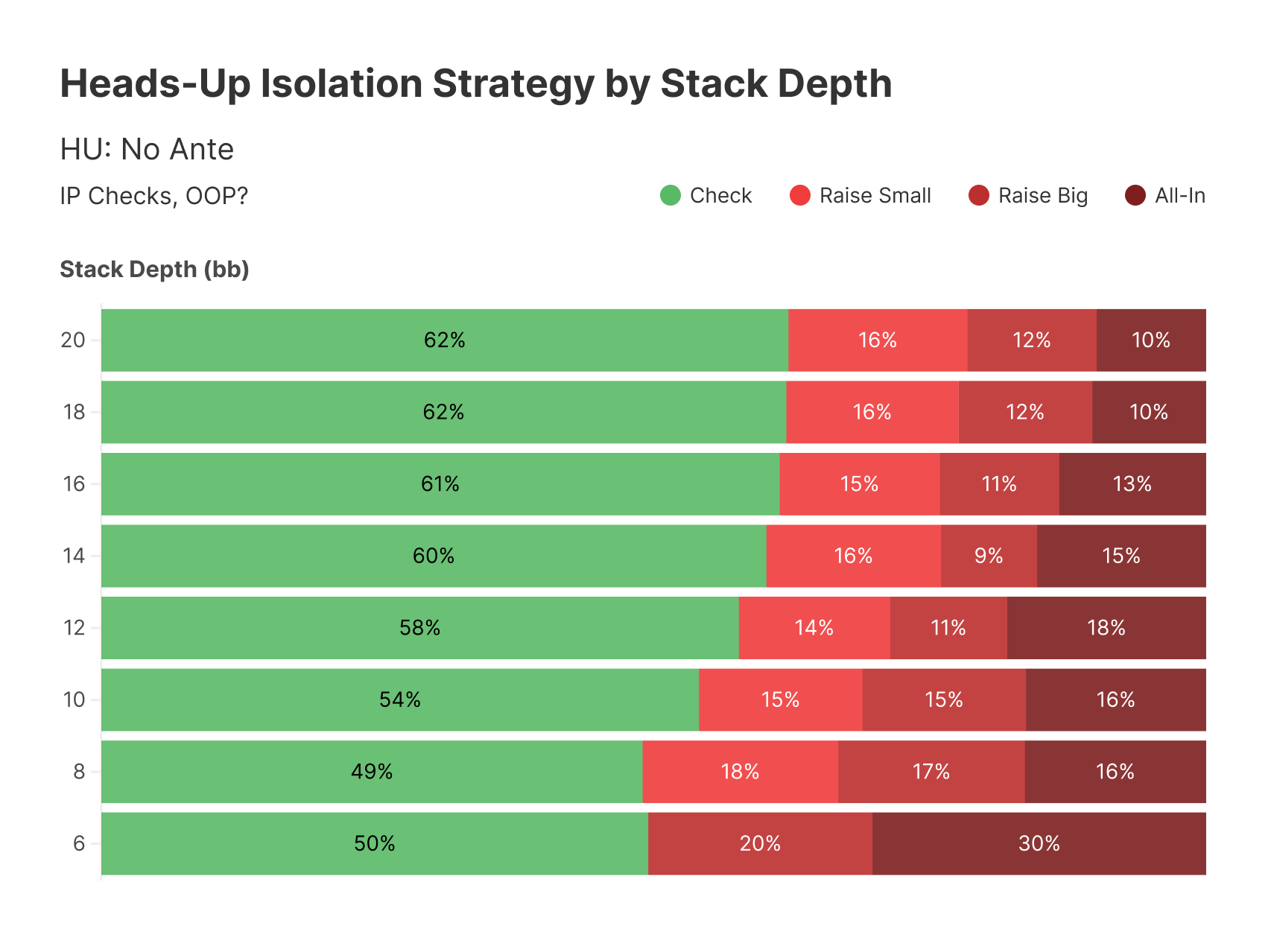
Key Observations
- The overall iso frequency increases as the effective stack size decreases.
- With shallower stack depths, the risk associated with moving all-in lessens, resulting in an increase in the frequency of large and all-in iso-raises.
Getting to Grips With Iso Sizings (at 20bb)
Baseline Strategies: 20bb
First, using the AI heads-up preflop solver, let’s study the unexploitable range at 20bb HU for the SB, to set the SB baseline.


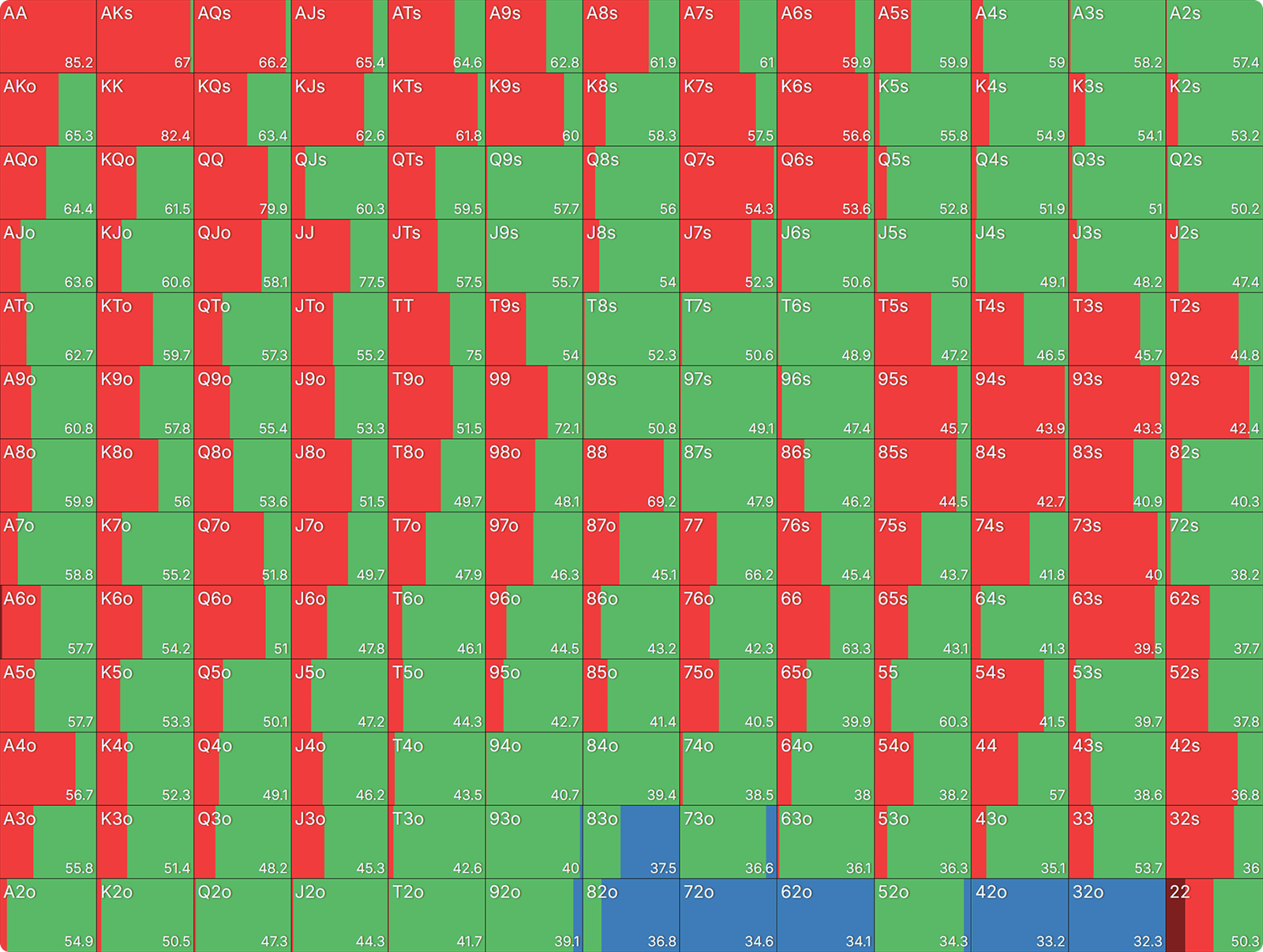
Breaking the SB range down into equity buckets can help to conceptualize the overall strategy better:
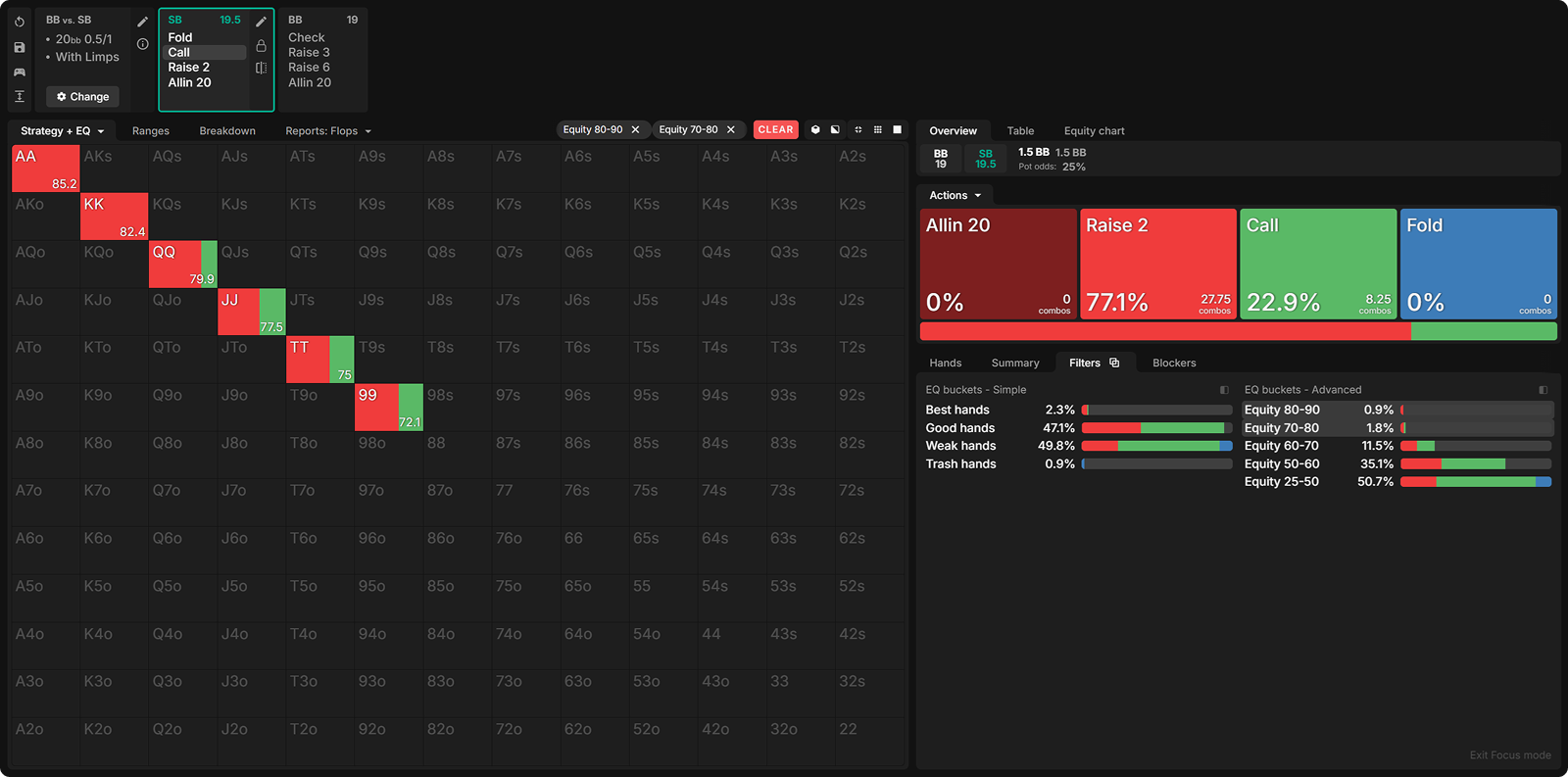
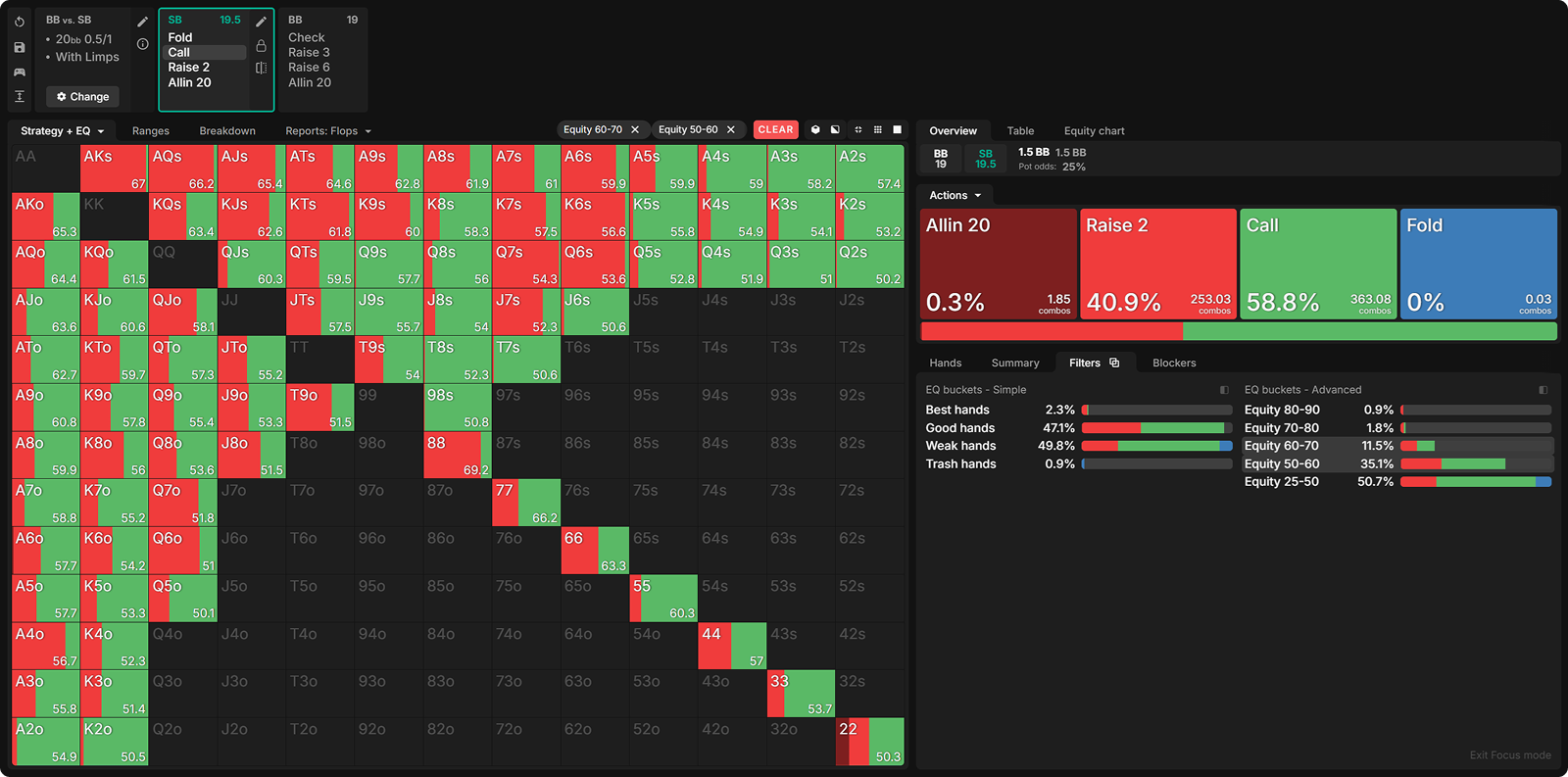
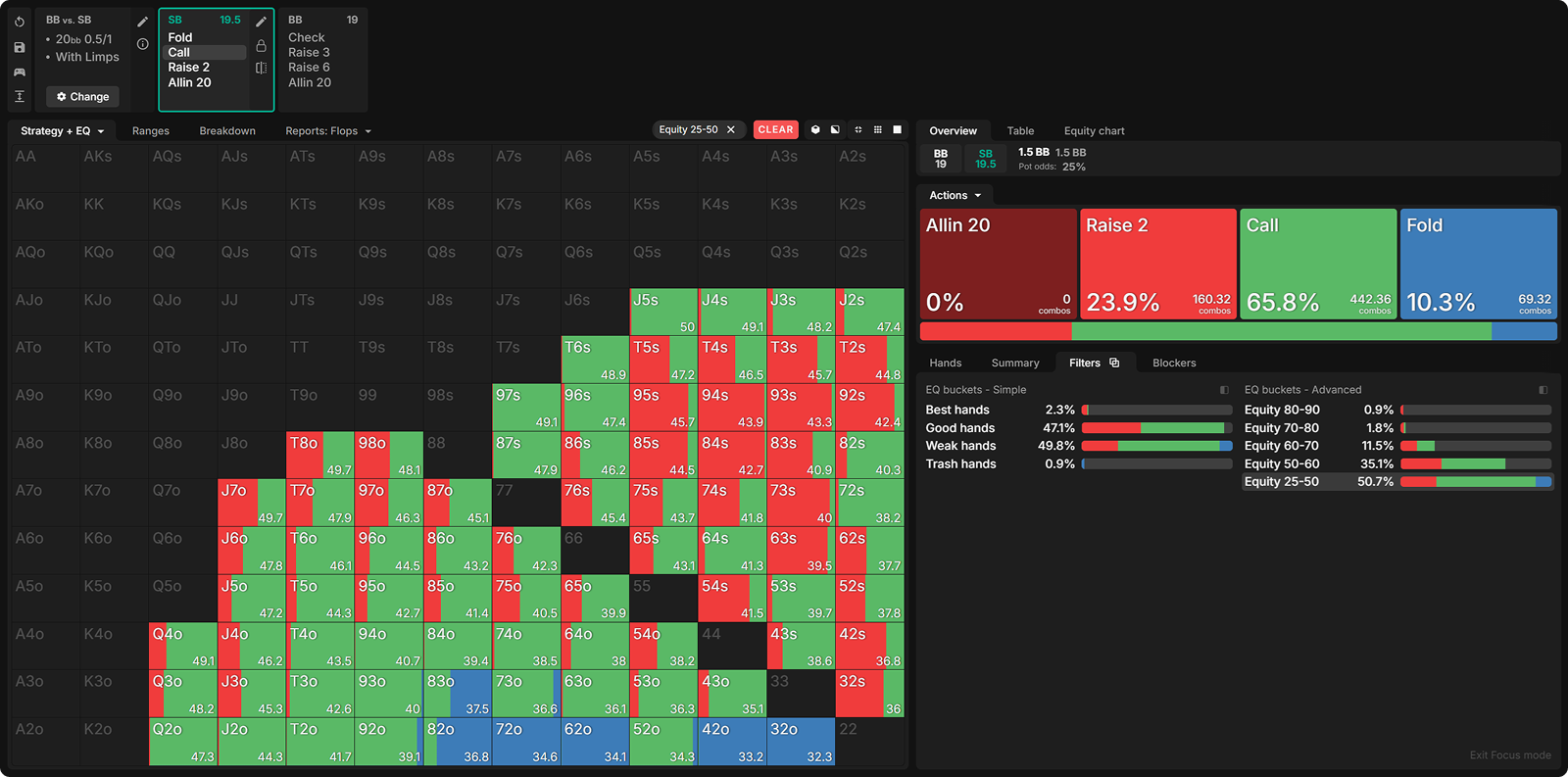
Now that we have established the SB’s baseline strategy, let’s move on to the BB, whose response is even more mixed.
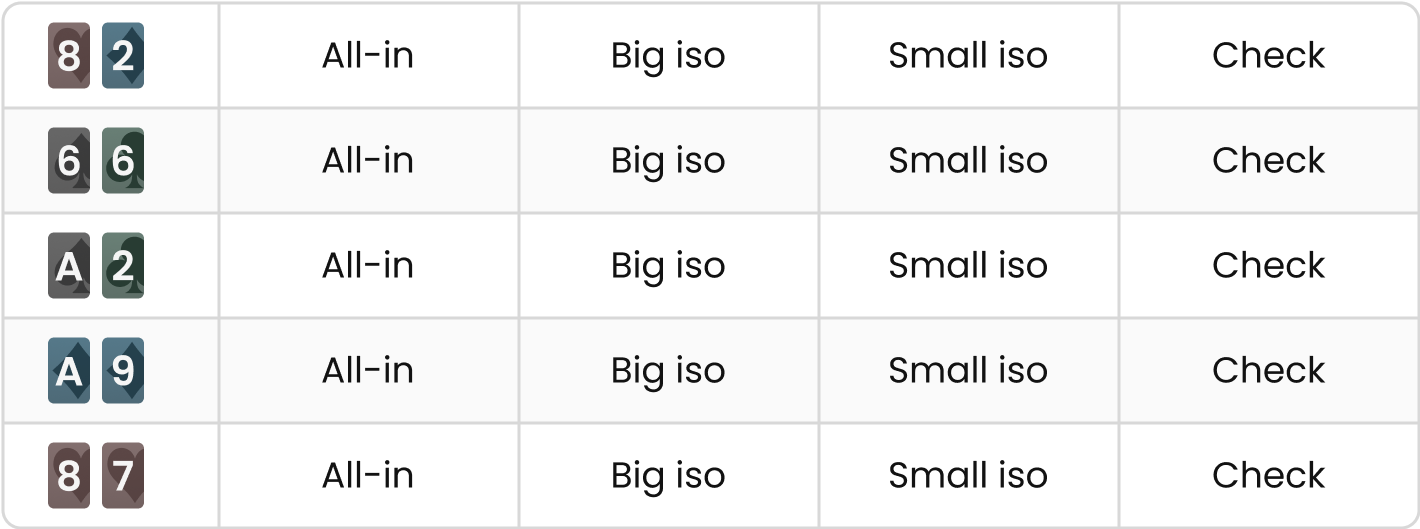
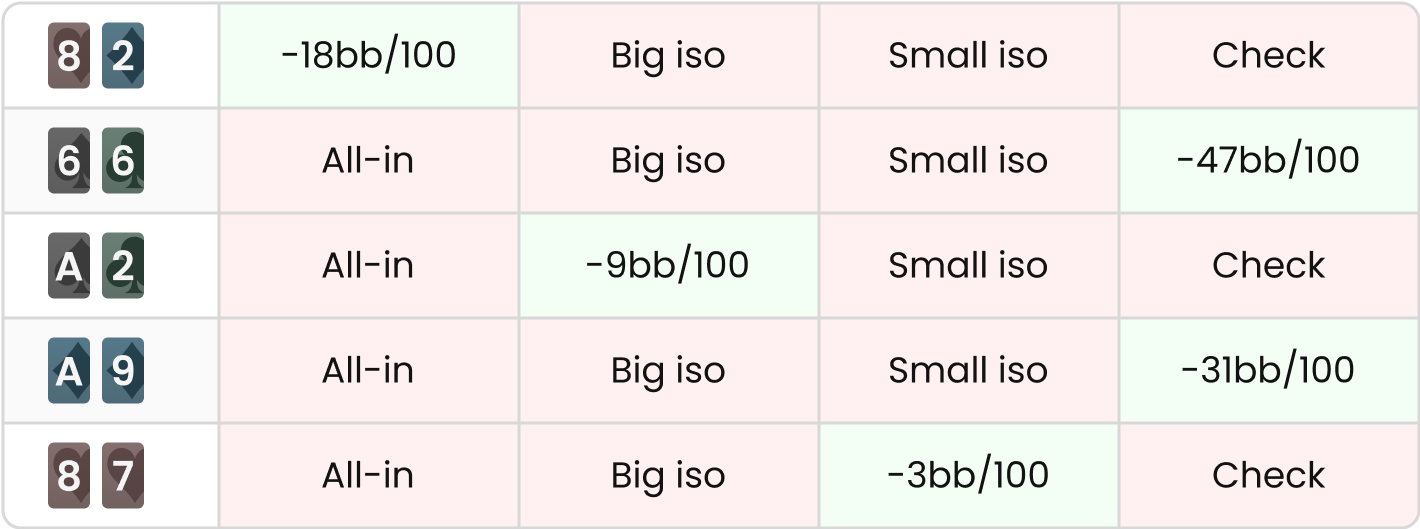
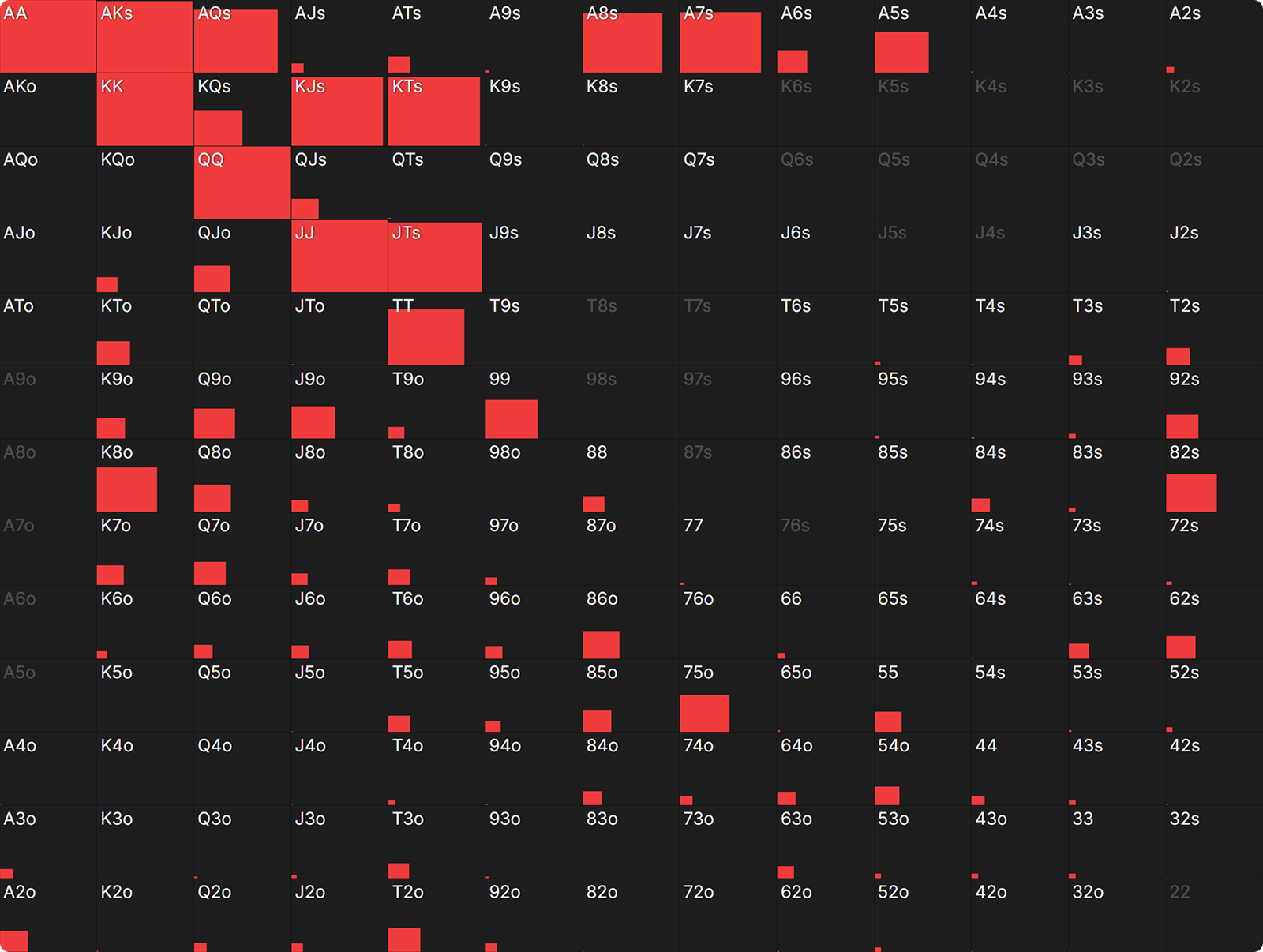
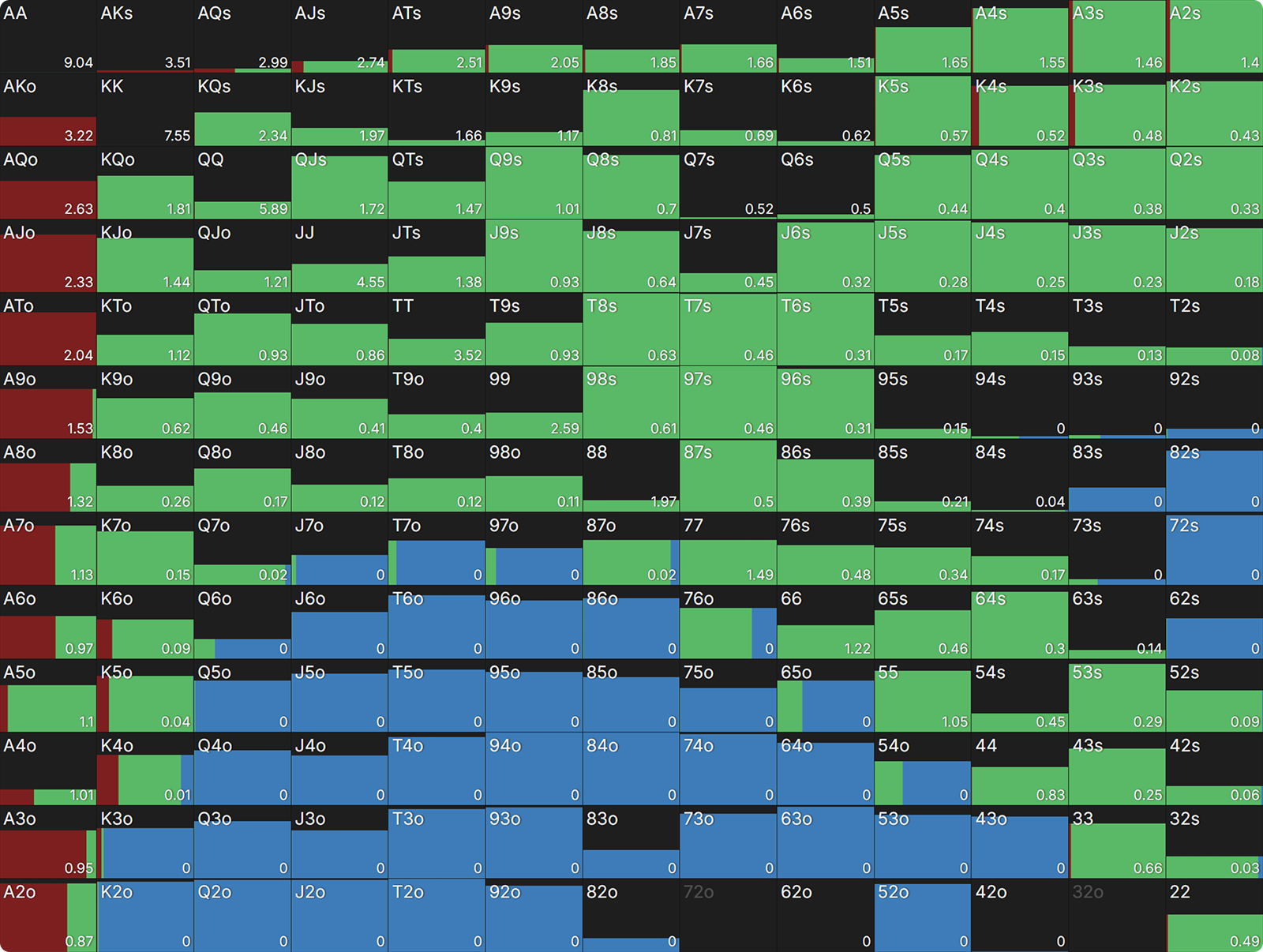
In the image below, you can see a selection of hands with which BB will mix between three of the options when facing a limp 20bb deep, while specifically disliking the fourth option. For each hand, which action do you think is the one “burning EV”?🔥
(To reveal the answers, hover over the left side of the image and start moving your mouse cursor to the right.)
{{compare}}
{{/compare}}
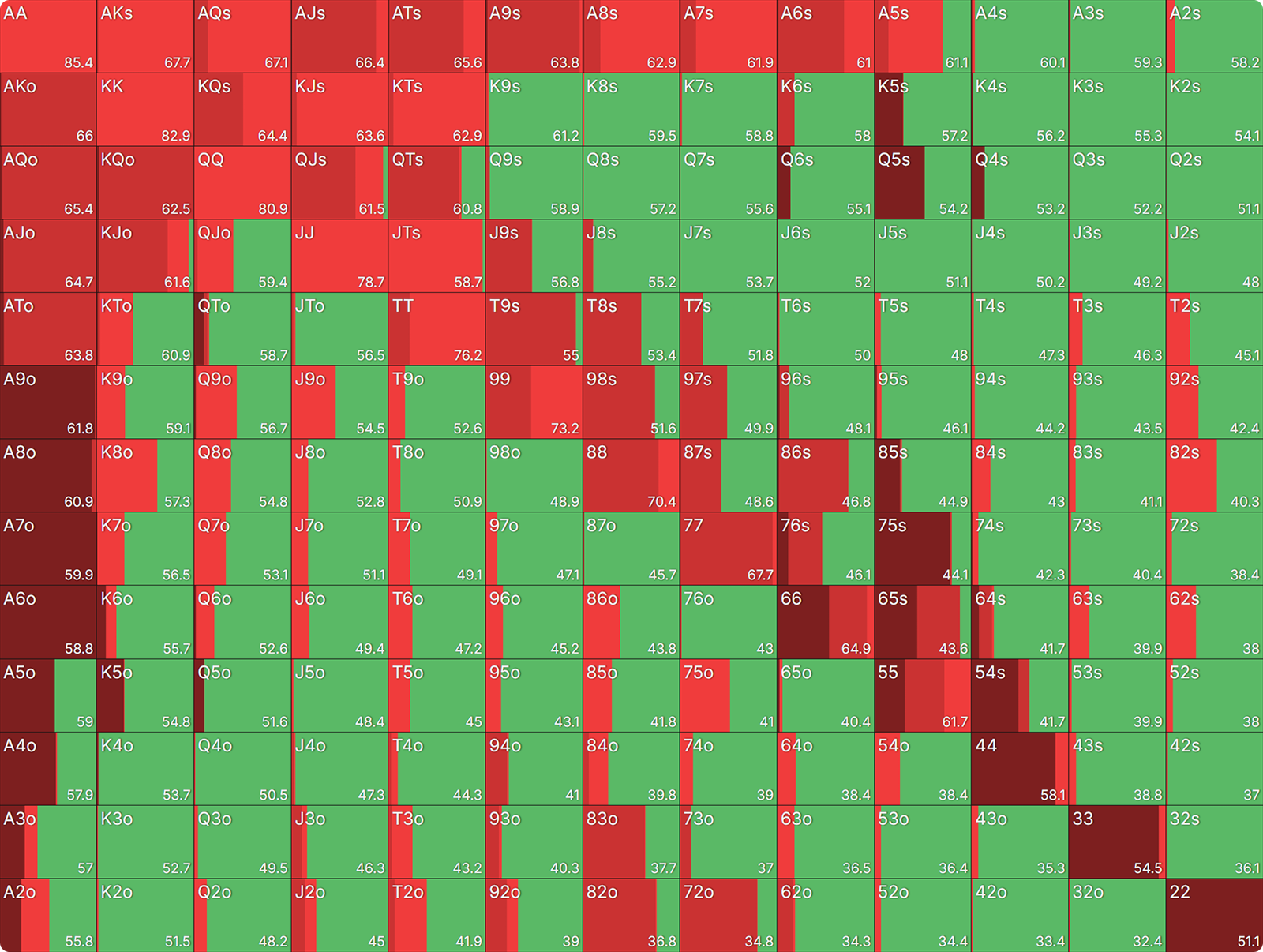
We can see the unexploitable HU BB 20bb vs limp strategy below:


Why Different Hands Use Different Iso Sizes
At 20bb, let’s explore which hands each iso size is built around.
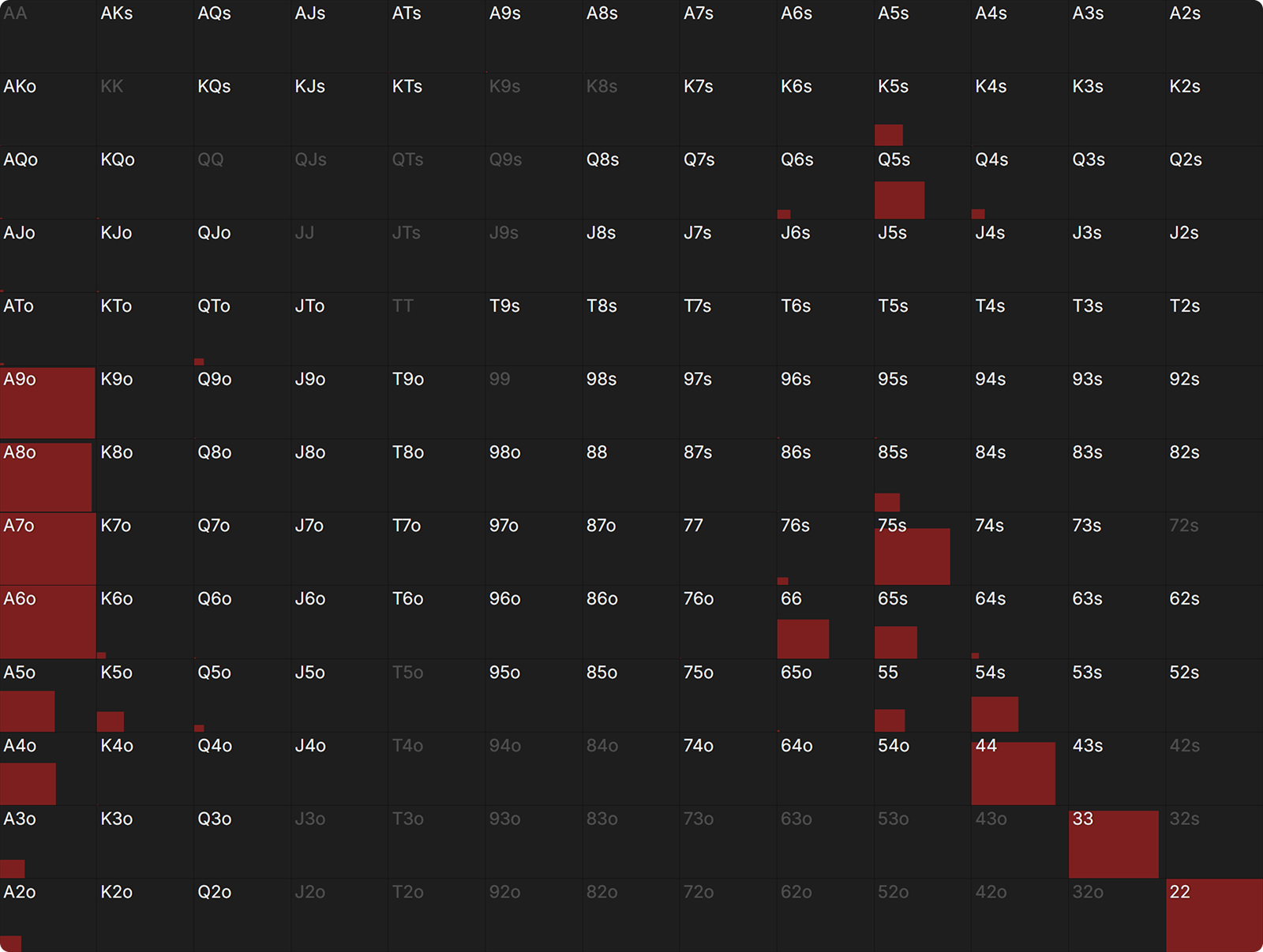
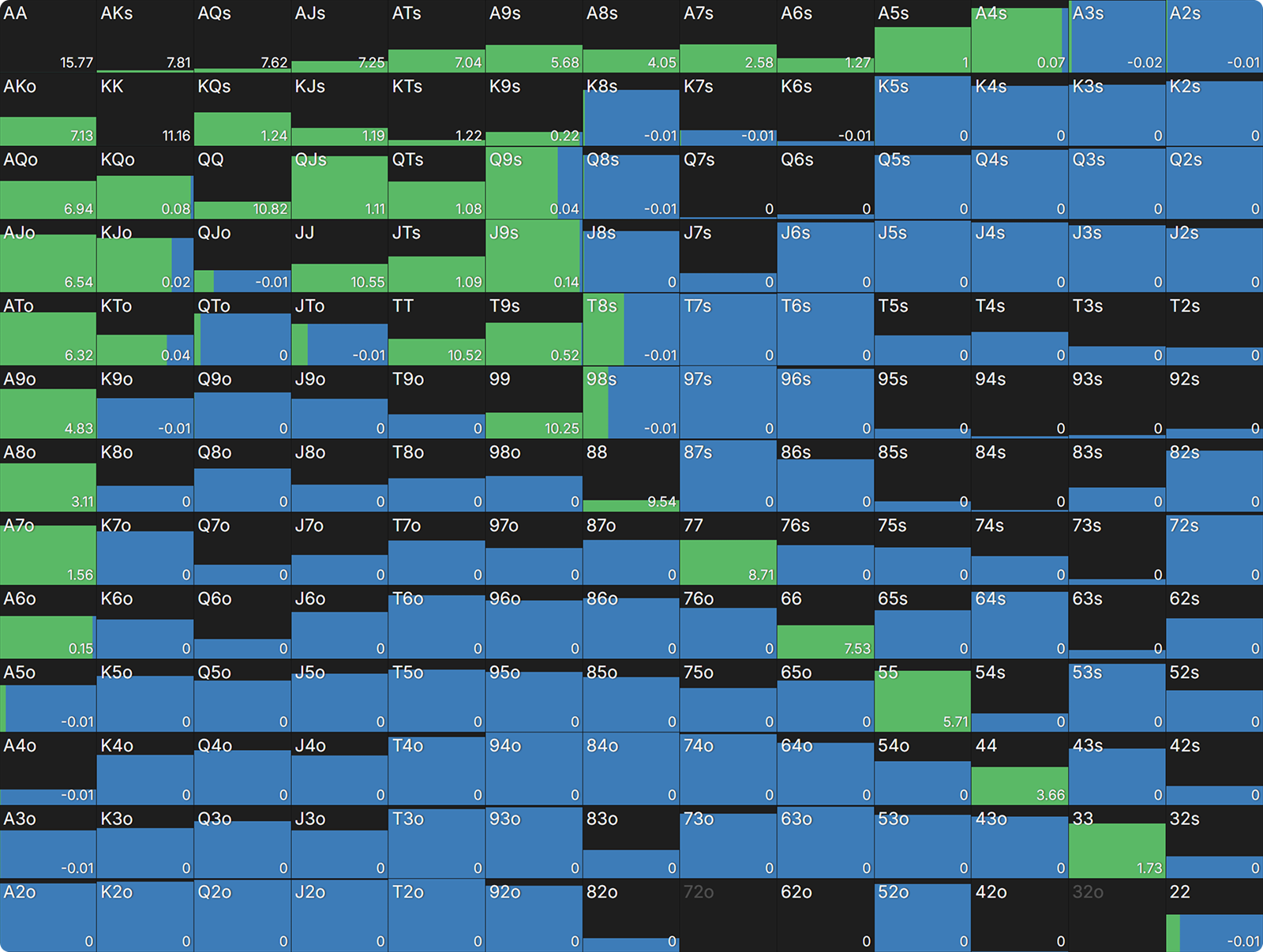
All-In Iso
Hands like medium to low offsuit Ace-x and low pocket pairs. These hands are often ahead of a limping range but lack postflop playability. Moving all-in preflop avoids getting into these tricky postflop spots and forces the SB to fold ~82% of the time, preventing them from realizing their equity. Bluff candidates are mainly low suited connectors. Hands like 82o in the above quiz have far too little equity for a shove to be optimal.
{{grid: 2}}
{{/grid}}
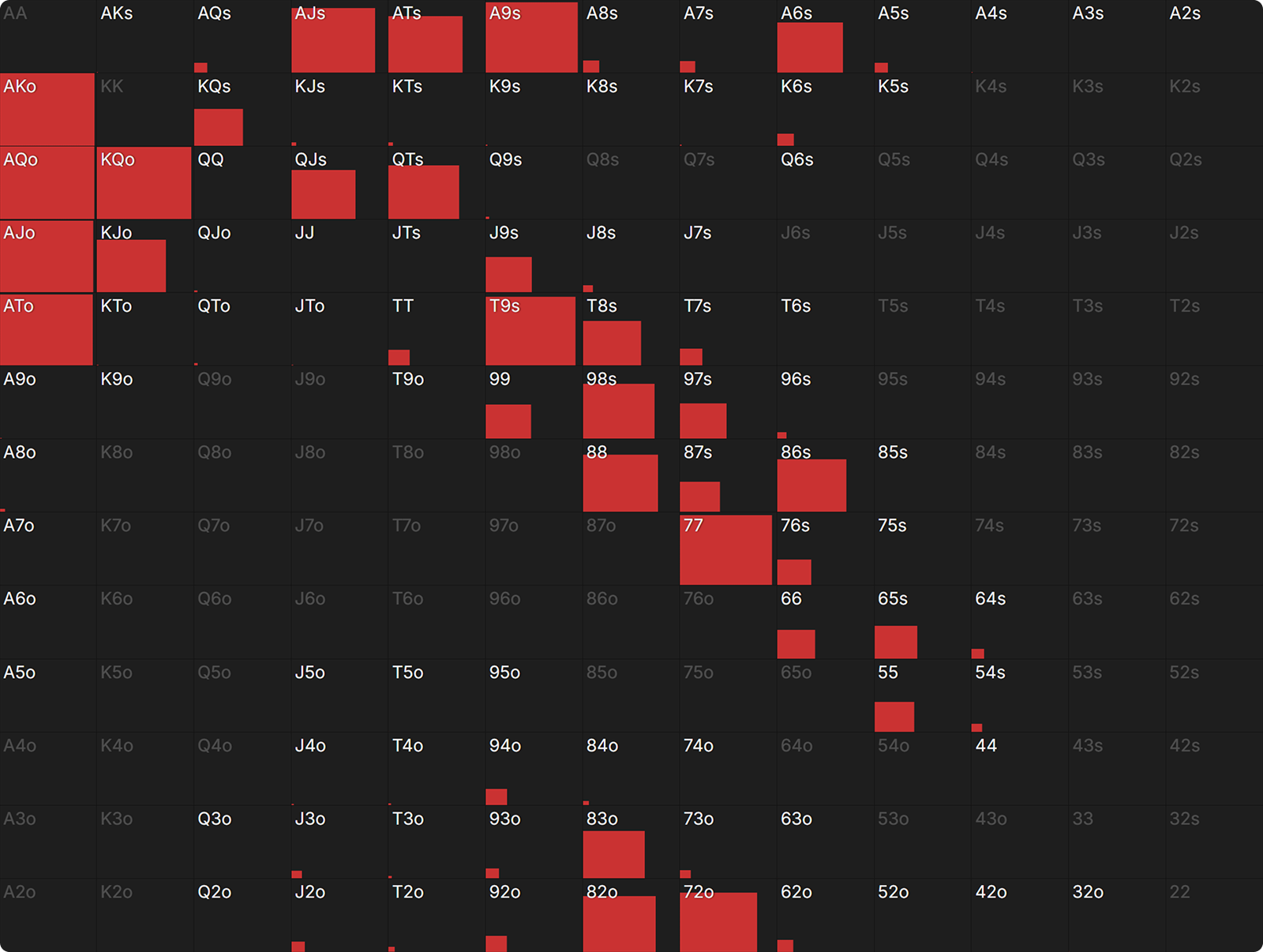
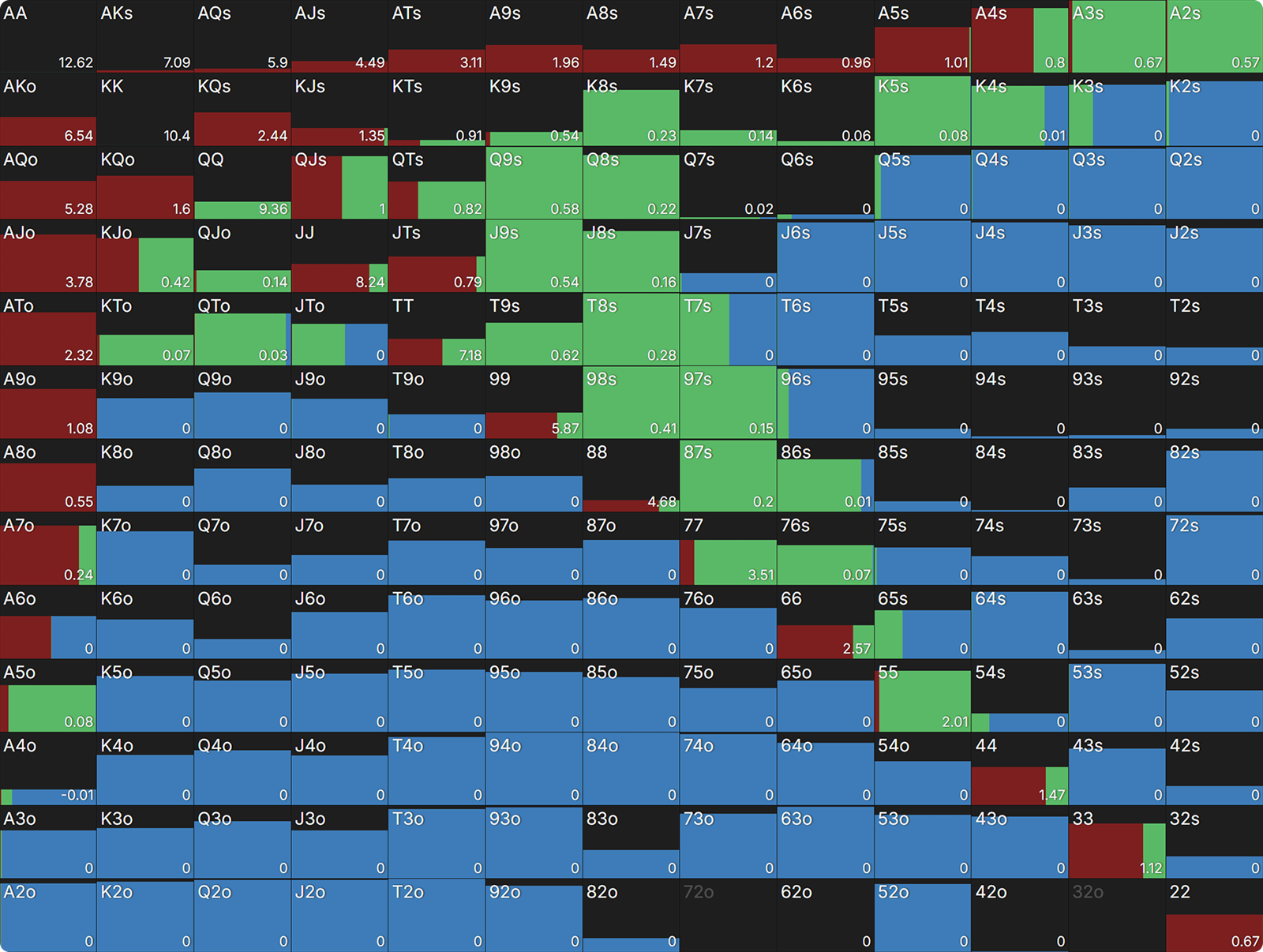
Big Iso (Non-All-In)
The strongest offsuit hands, middling pockets, and medium suited connectors. Besides being fine with getting immediate preflop folds, they also benefit from reducing the stack-to-pot ratio (SPR) if the hand were to go postflop. Bluff candidates are absolute trash hands like 72o. These hands don’t benefit much from seeing flops, so they use the sizing that will cause them to see flops the least often. In the quiz, A2o was the hand least happy to use a large iso-raise: it plays fine seeing flops but struggles facing a shove.
{{grid: 2}}
{{/grid}}
Small Iso
Premium value hands (best pocket pairs & suited Broadways), merged hands (offsuit hands with two cards ranking 8+), and a vast mix of trash hands to achieve decent board coverage. The smaller iso size keeps many of SB’s weak hands in play, which is why it’s mainly used with hands that have good playability postflop. Hands like 87s dislike the play because, when called, they’re frequently dominated by hands such as T8o or Q7s.
{{grid: 2}}
{{/grid}}
Key Observations
- All-in iso and large non-all-in iso – Prevents many hands that limp from realizing their equity and forces SB to protect its limping range with many good hands (>50% equity).
- Small iso – Punishes the weak hands in the SB’s limping range (<50% equity hands) whilst extracting value with our premium hands in the BB.
Practical Simplifications
It is possible to create a strategy that removes all of the mixed-frequency isolations with minimal EV loss. To do this, we can look at the total number of combinations of hands in each isolation sizing and recreate the same frequencies without mixing specific holdings.
Exploiting Common Deviations
20bb → Deviation 1) SB Raises Too Linear
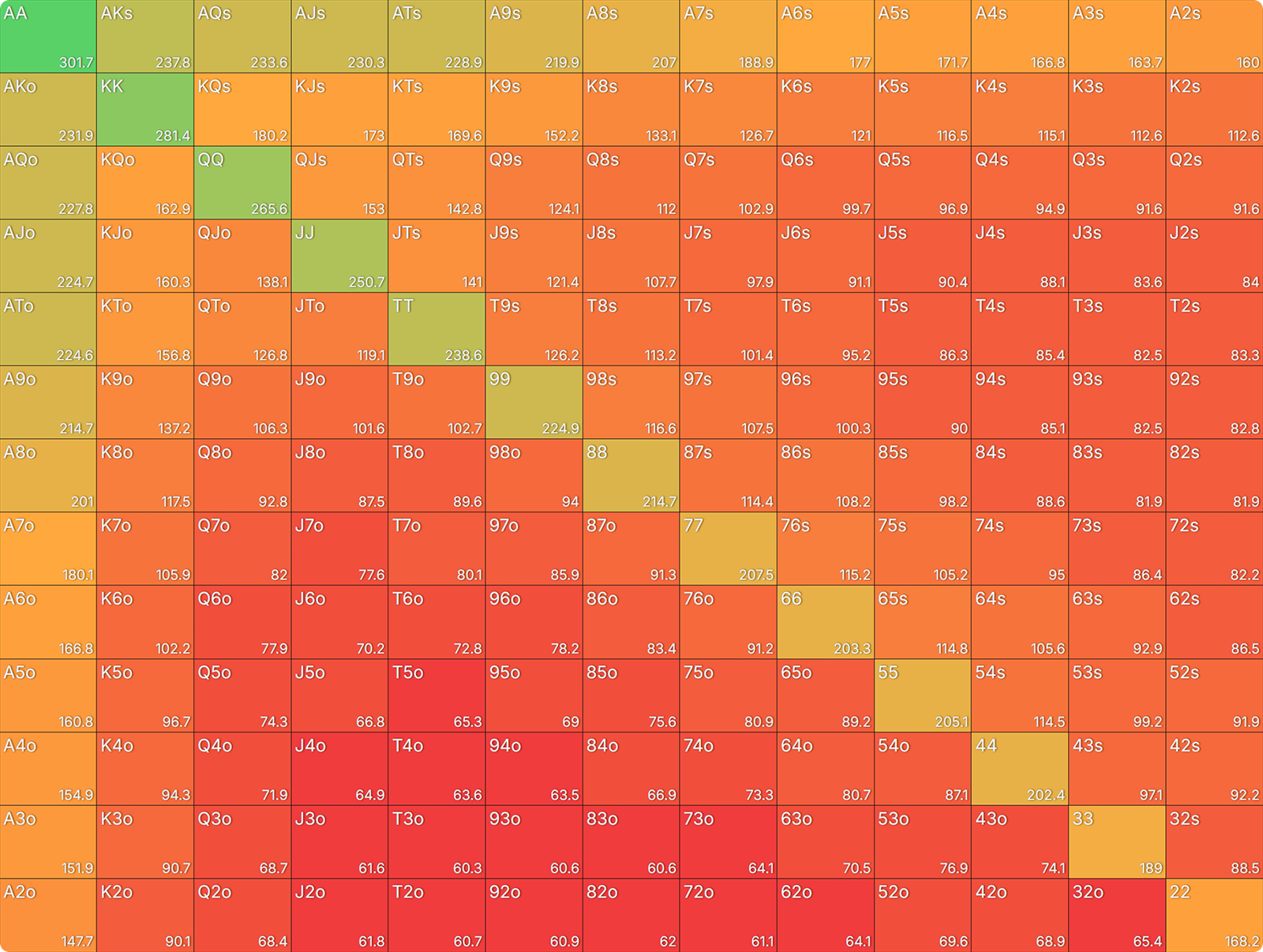
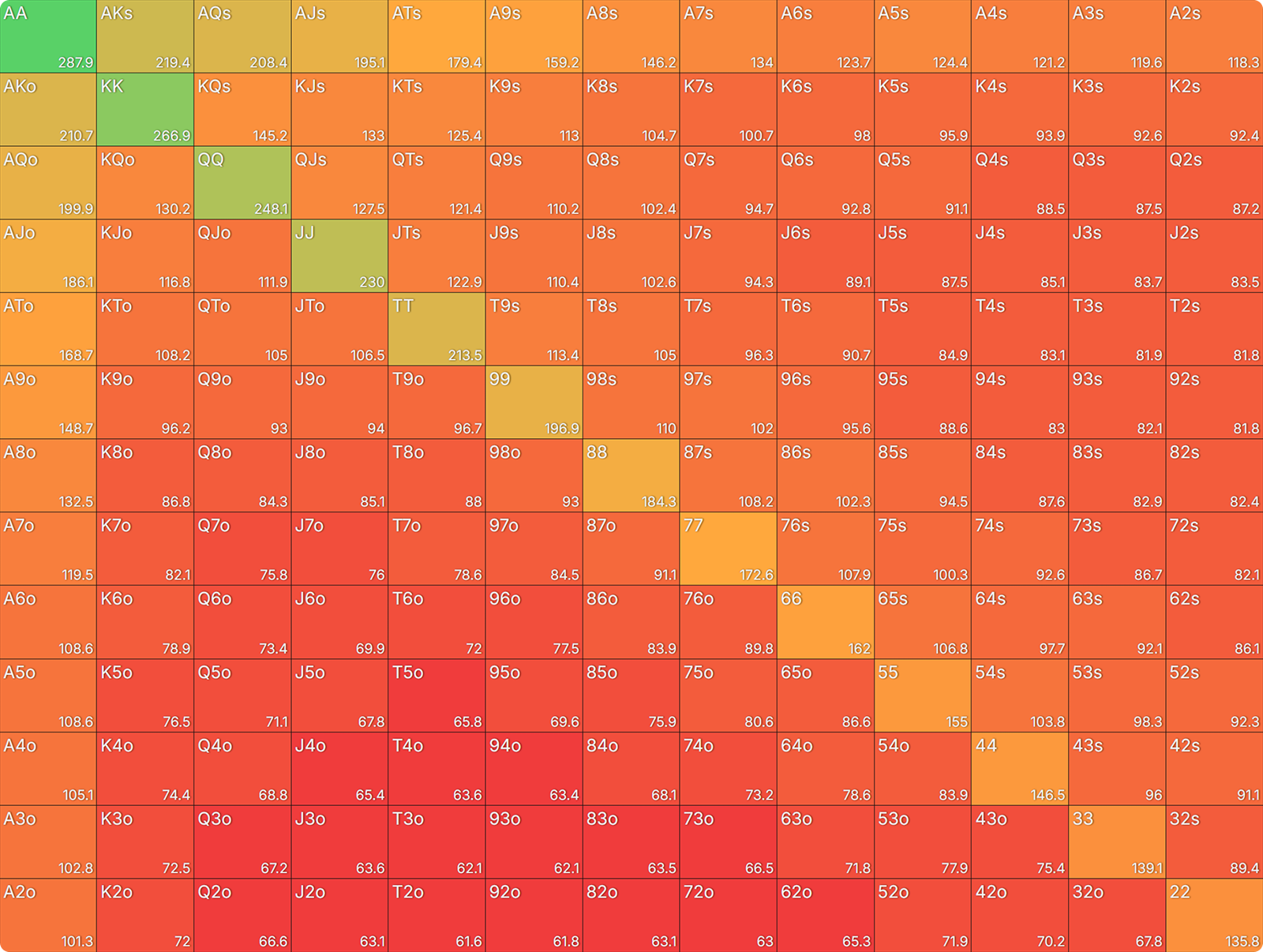
Many opponents mistakenly raise too many of their strong hands preflop. Below, I have nodelocked the SB to raise all hands with 60%+ equity.
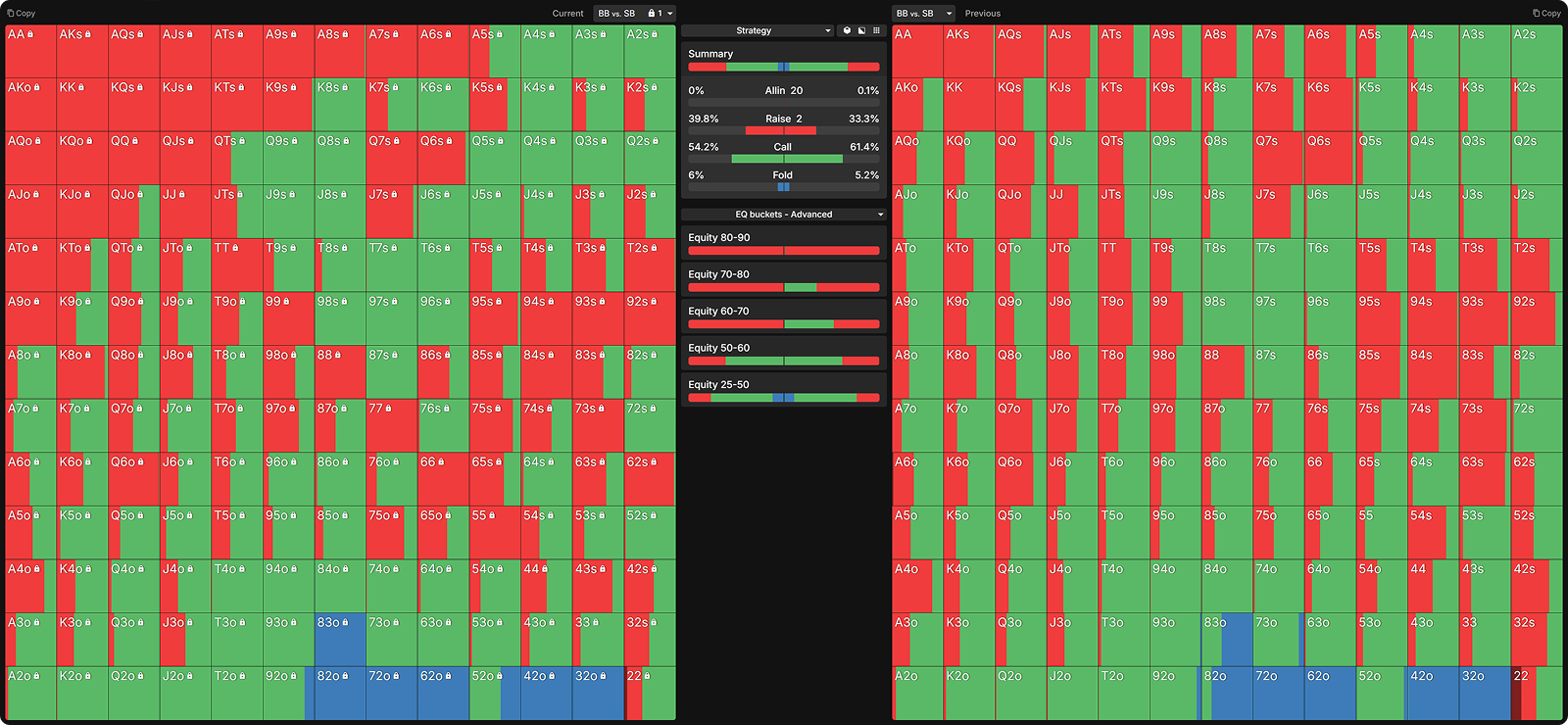
By raising all hands with 60%+ equity, the SB has significantly weakened its limping range. Let’s look at how the BB exploits this deviation.
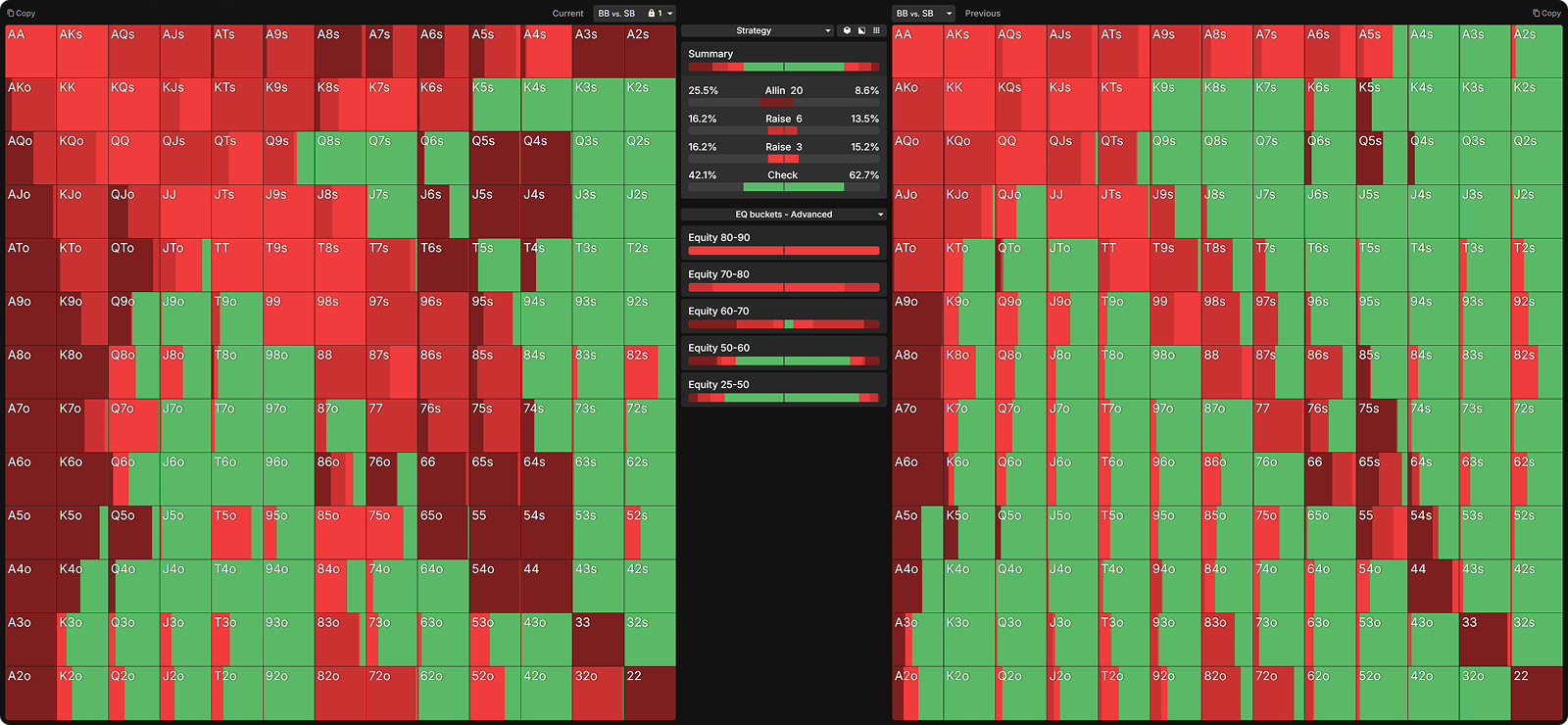
The overall iso-raise frequency from the BB increases significantly. The hands that benefit the most in the HU BB range are the offsuit Ace-x and King-x. Due to the lack of “traps” in the new SB limping range that was nodelocked, these hands have much higher equity realization (EQR).
{{grid: 2}}
{{/grid}}
20bb → Deviation 2) Reduced VPIP
Many players are unaware of or uncomfortable with how wide they need to play heads up in the SB. They try to wait for better hands, causing them to fold too many small blinds. When they do get in there (i.e., VPIP), they start with a stronger range.
Baseline Strategy Minus Worst Hands
Let’s first consider the deviation where the SB plays the same strategy as the baseline but cuts the worst hands.
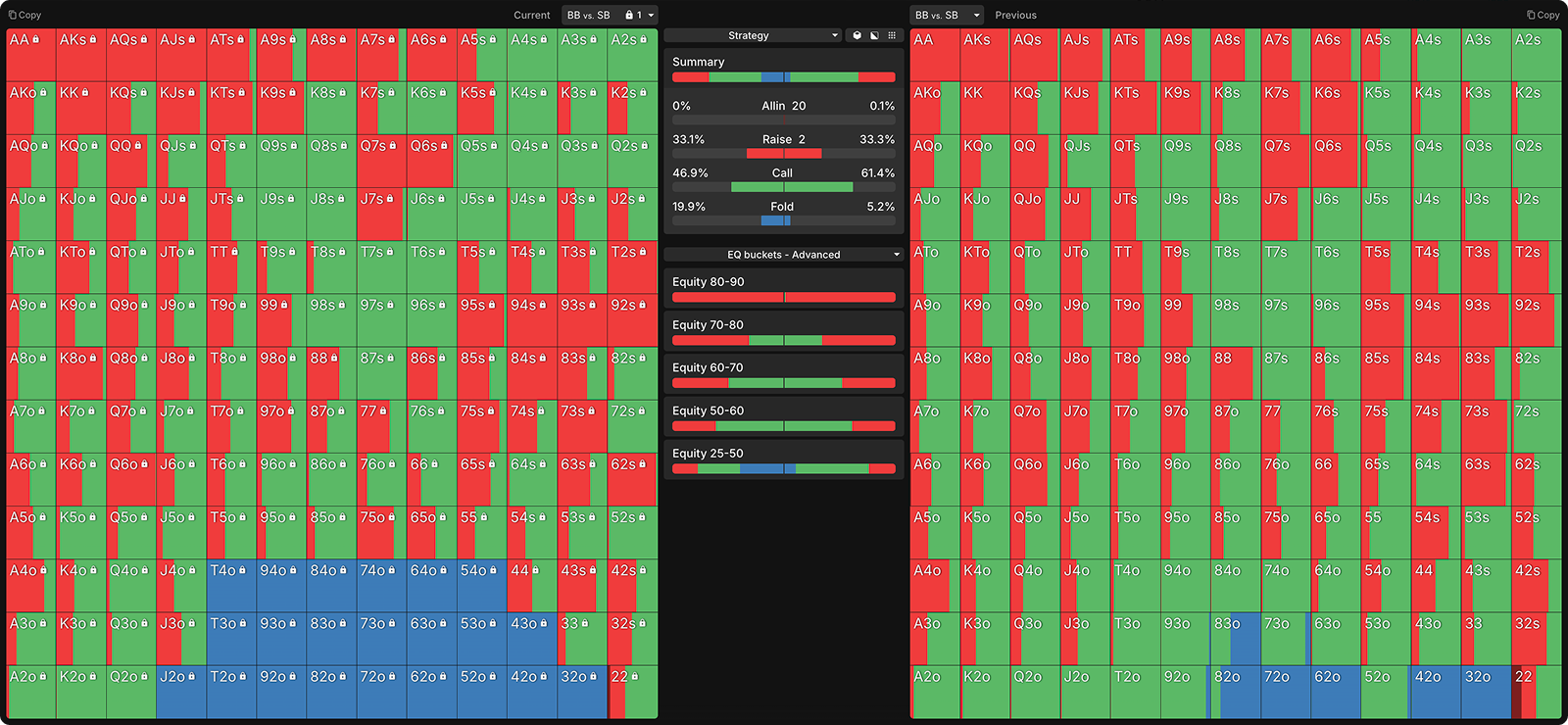
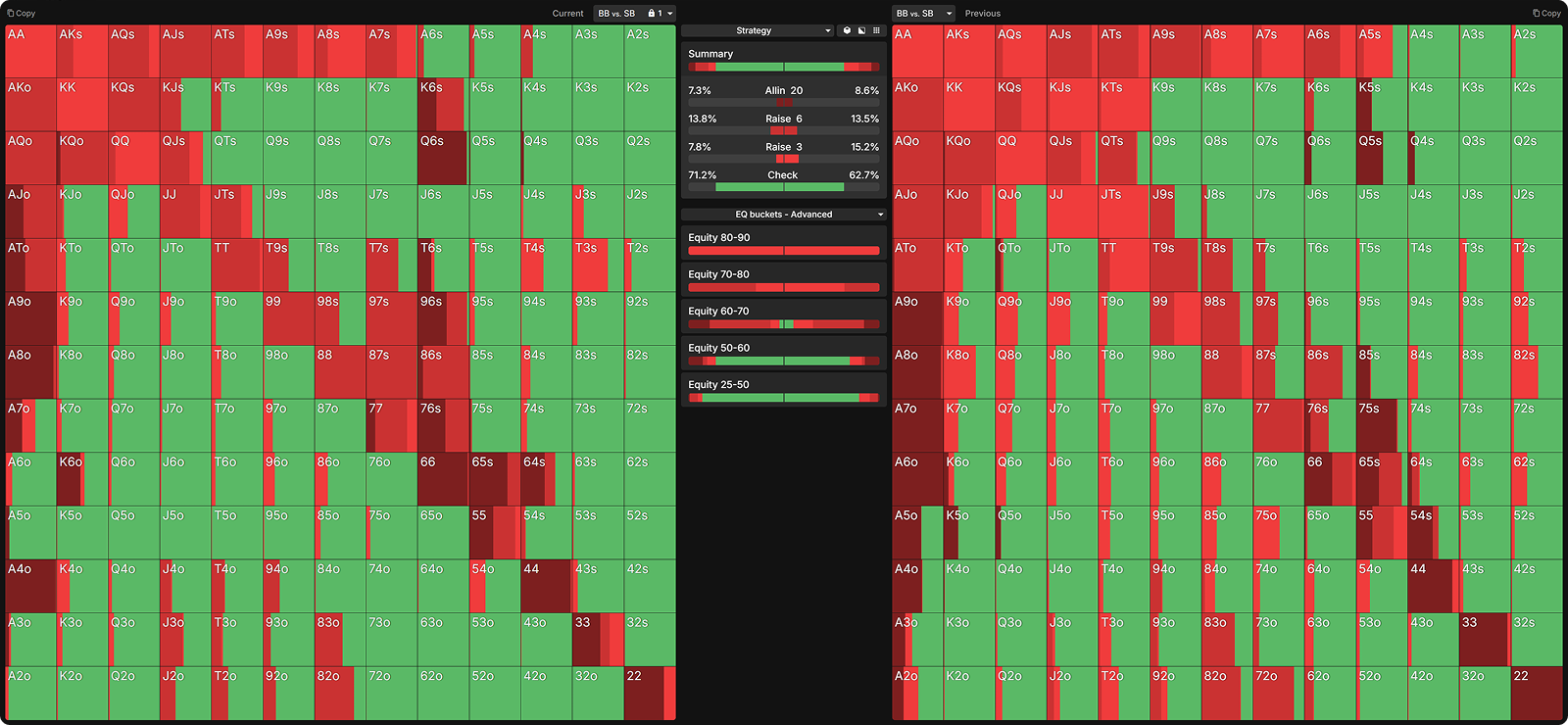
The BB exploit to the SB deviation is to reduce their overall iso frequency, which reflects the recognition that the SB strengthened its limping range by removing its weakest hands. Now, if you pay close attention, you’ll notice that it’s the small iso sizing frequency that decreases the most. This is a logical consequence since the small size targets the weaker parts of the SB range (which has significantly diminished, resulting in the reduction of VPIP).
One thing to note is that we assumed the SB retained all of their strong hands in the limping range from the baseline strategy. In real-life games, players who cut VPIP short will often also deviate by raising too linearly from the SB—remember the first deviation discussed.
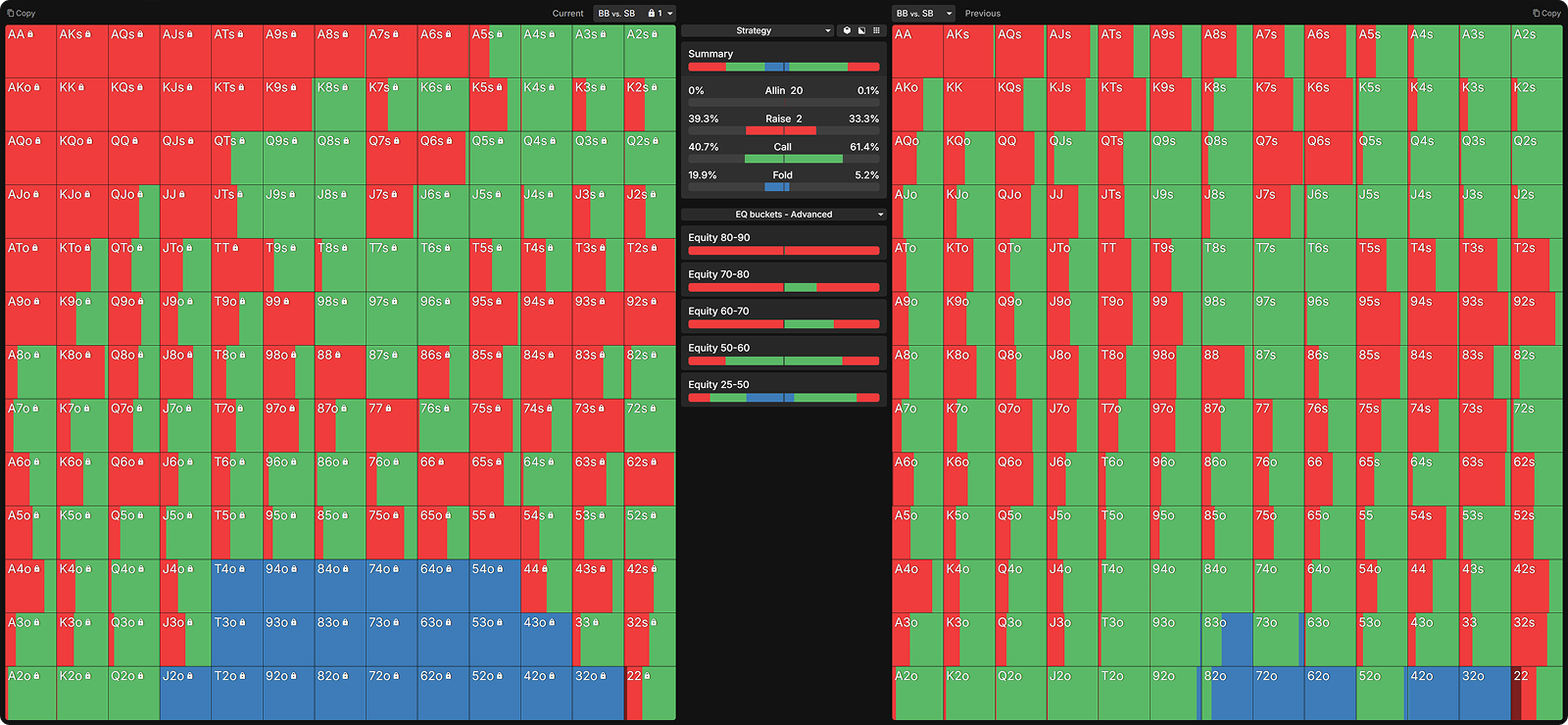
So let’s see how the BB exploits an SB player who makes the combined deviation (1+2).
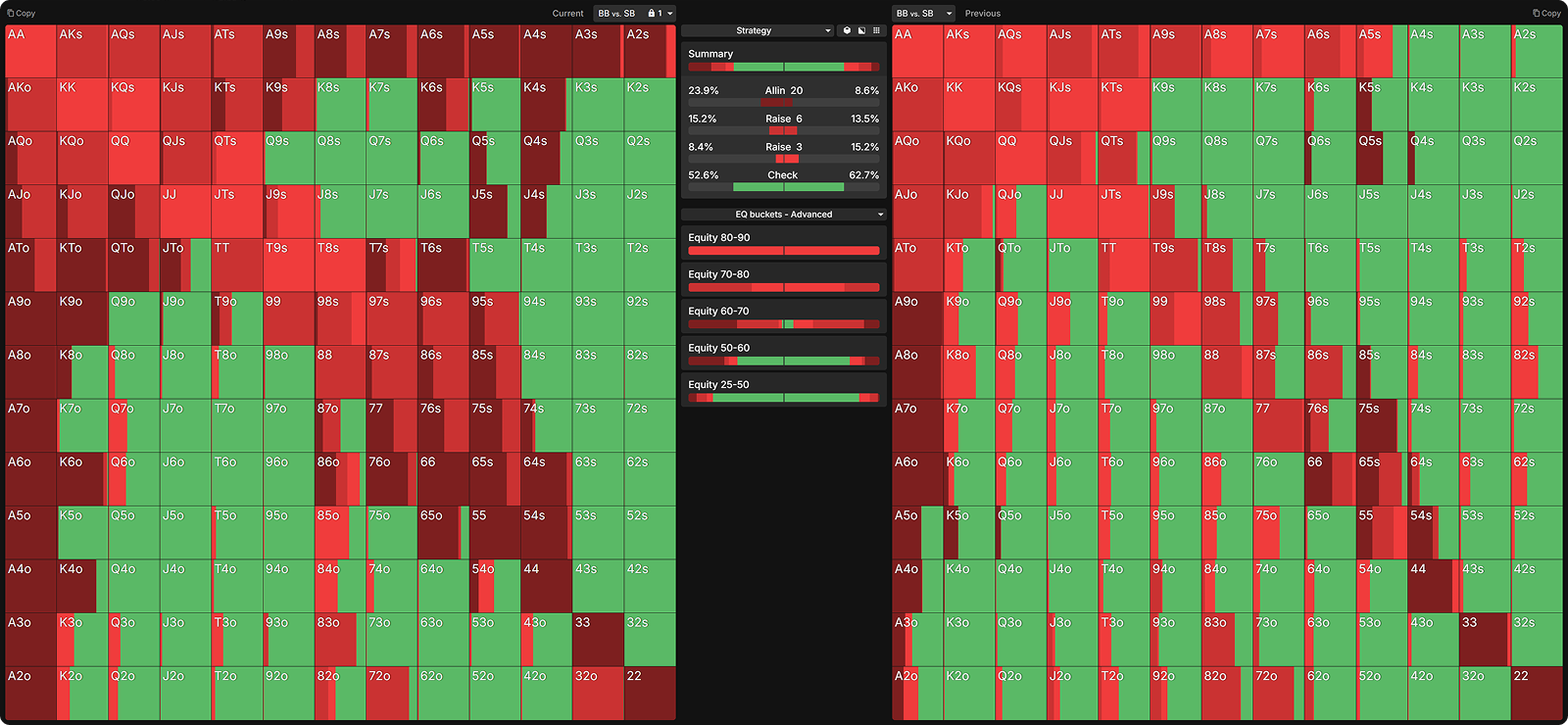
Even though the SB has a reduced VPIP, the lack of strong hands in the limping range still allows BB to isolate more aggressively with a large sizing.
Iso Strategy Changes As Stack Depth Decreases
Baseline Strategies: 16bb
Let’s consult the AI HU preflop solver once again to set our HU baseline strategies at 16bb.First, we have the HU SB 16bb baseline strategy.


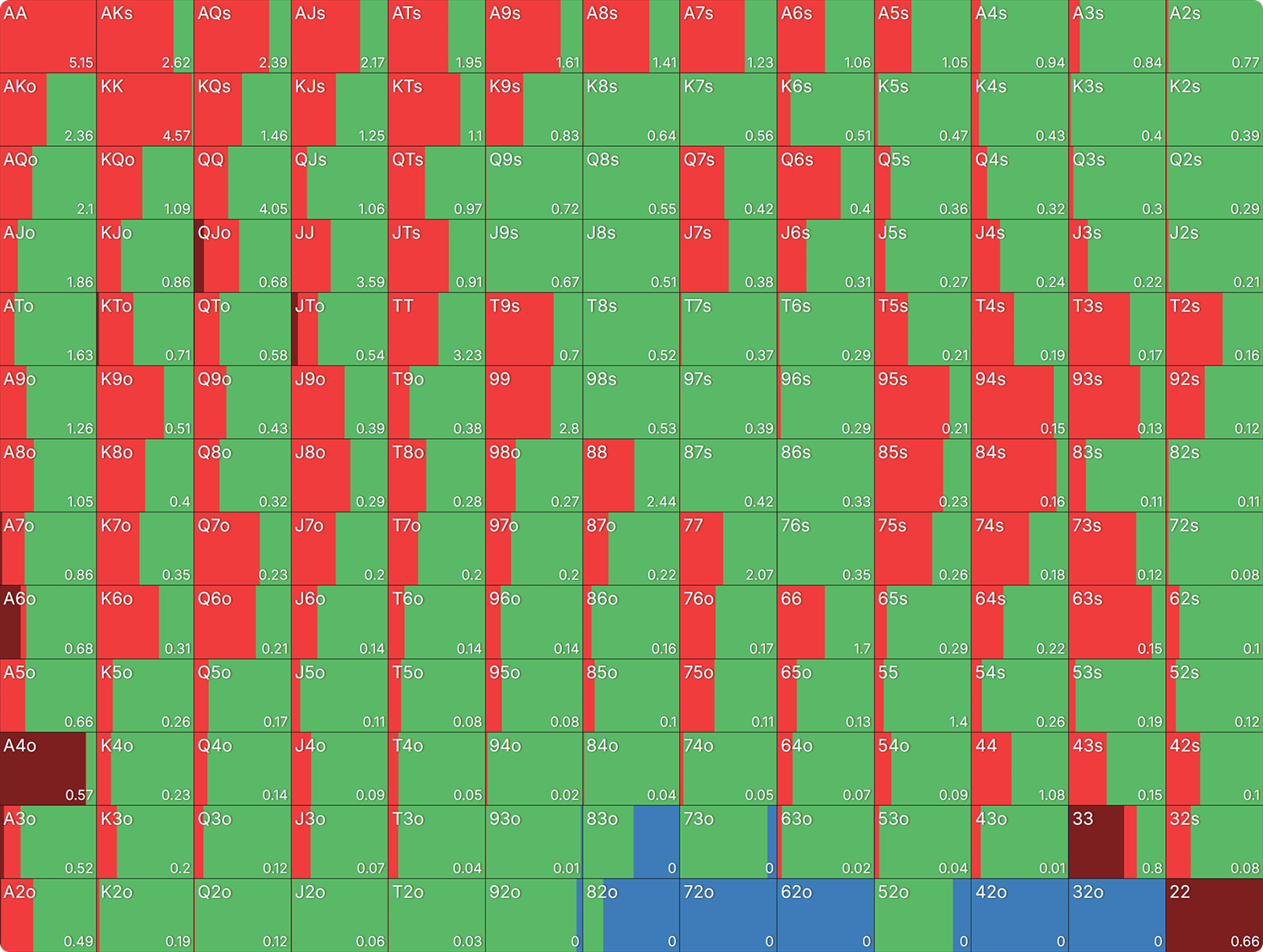
The strategy is similar to the 20bb strategy. The main difference is that our min-raising frequency decreases, which is due to the lower SPR.
Now, let’s take a look at the BB’s response.


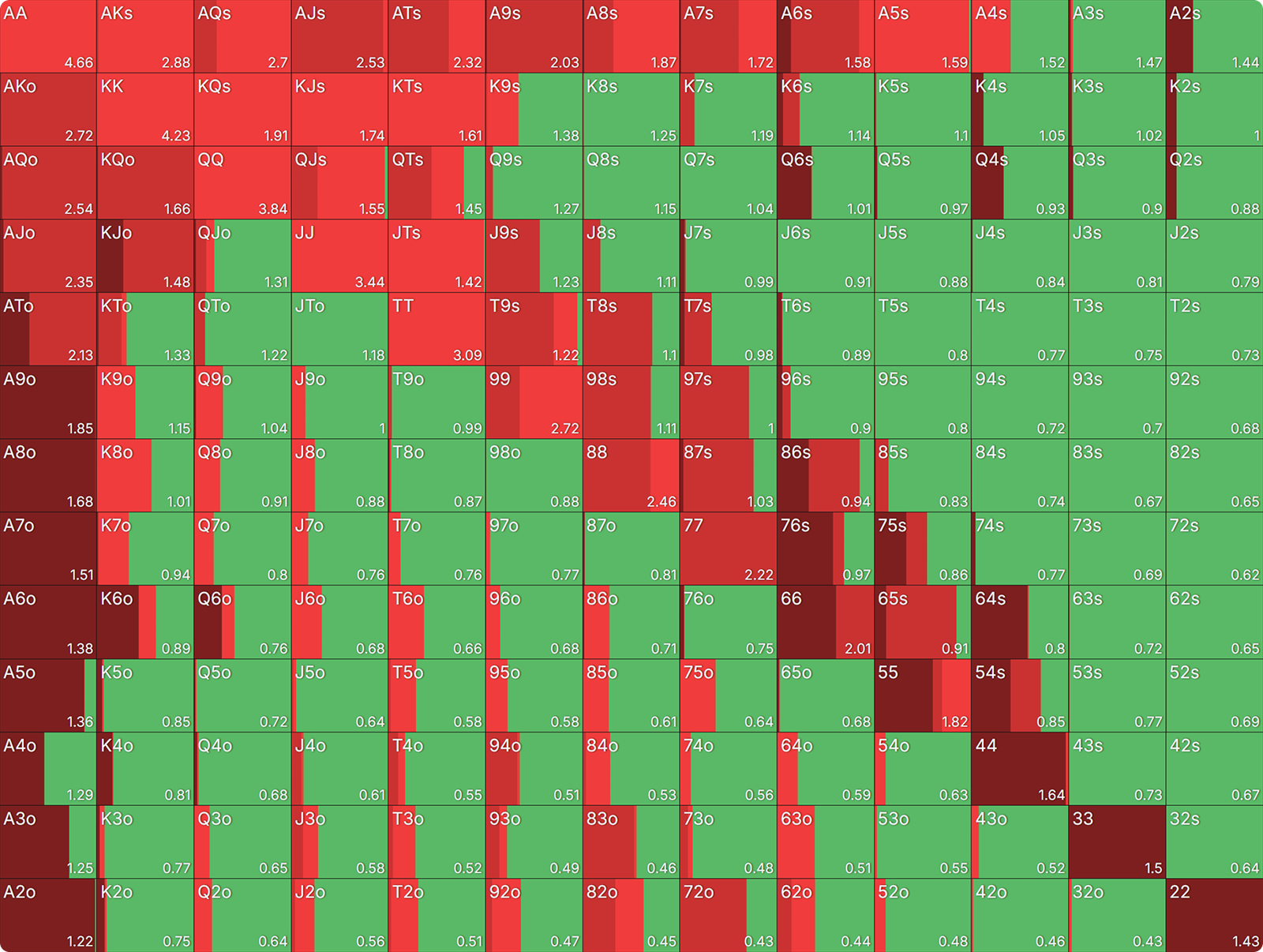
Once again, the baseline strategy is similar to the baseline at 20bb. The frequency of larger iso’s increases, but the change is not drastic.
16bb → No Min-Raise Deviation
A common thing to see from regular spin players is a no-min-raise strategy from the SB at an effective stack depth of 16bb or less. In the graphic below, you can view how the AI solver models the SB’s strategy when min-raising is not an option.
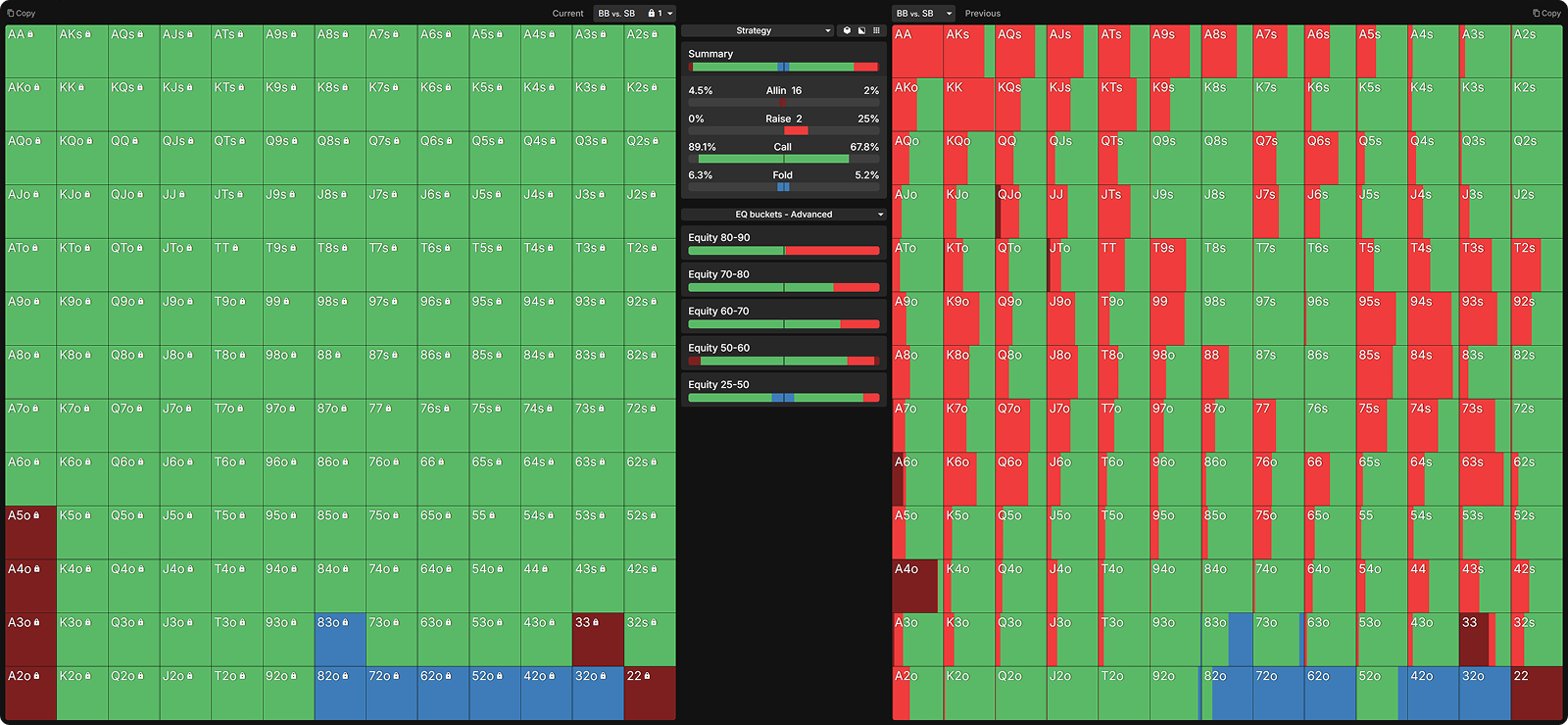
{{interactive-reveal-answer: Which of the following statements do you think is/are true?}}
{{wrong: Our iso strategy does not change much.}}
{{correct: The BB prefers to iso smaller on average.}}
{{wrong: The BB iso-raises all-in more because the SB is limping more hands.}}
{{correct: The SB limping range is stronger than the baseline limping range.}}
{{/interactive-reveal-answer}}
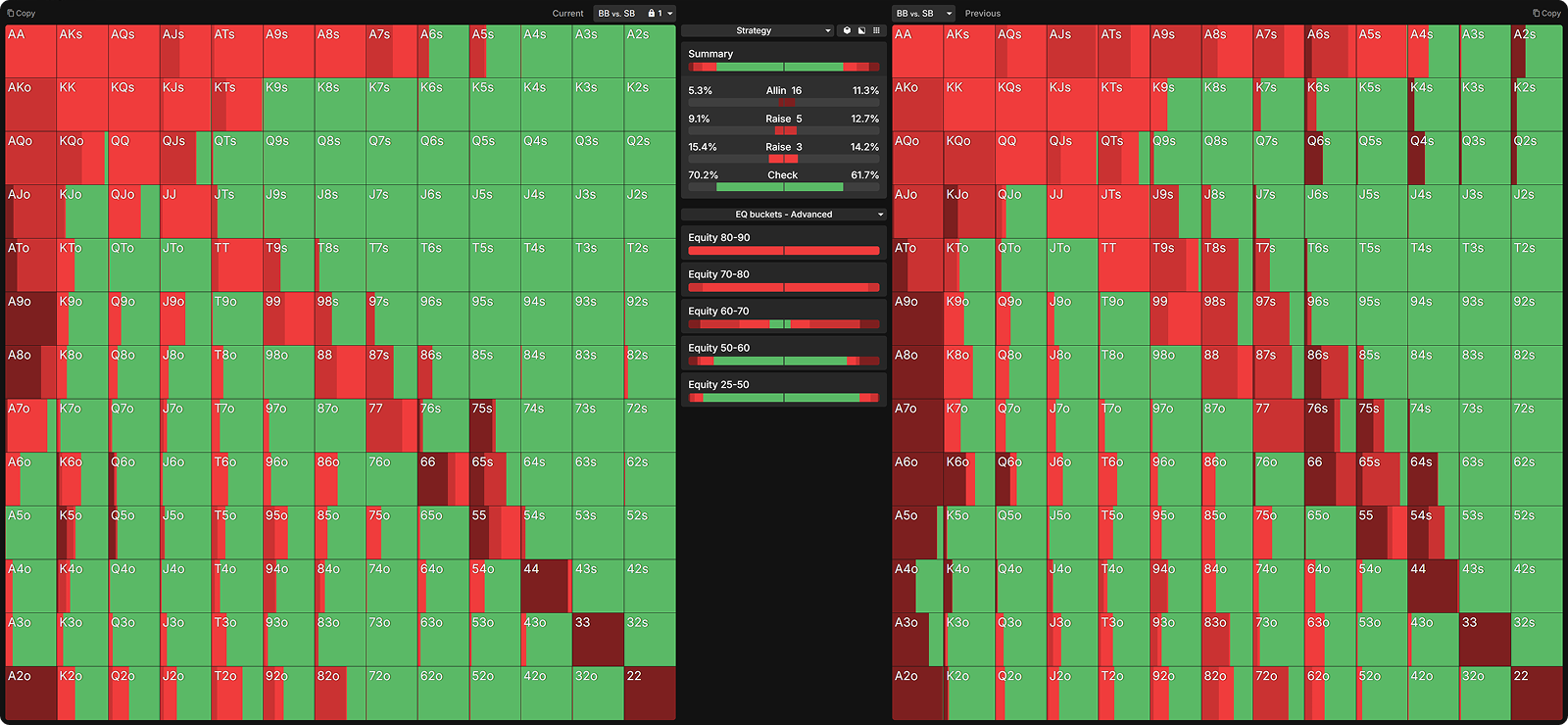
The exploit the BB makes is to iso less often with a smaller average size. Since the SB is limping all of its best hands, reopening the action becomes riskier, and we have less incentive to grow the pot against a stronger limping range.
In general, in balanced strategies that mix raise and limp, the raising range is stronger than the limping range. So if a player removes the raising range, that strength is naturally transmitted to the limping range.
10bb and Below: All-In Becomes the Standard
When we reach single-digit stack depths, going all-in is often the baseline play. Failure to master these all-in ranges can subsequently leave limping ranges heavily exposed to exploitation. Underestimating the importance of shallow-stacked preflop play can be detrimental to your HU win rates.
Let’s examine the HU baseline strategies at 10bb that the AI HU preflop solver identified.
First up, the HU SB 10bb baseline strategy.


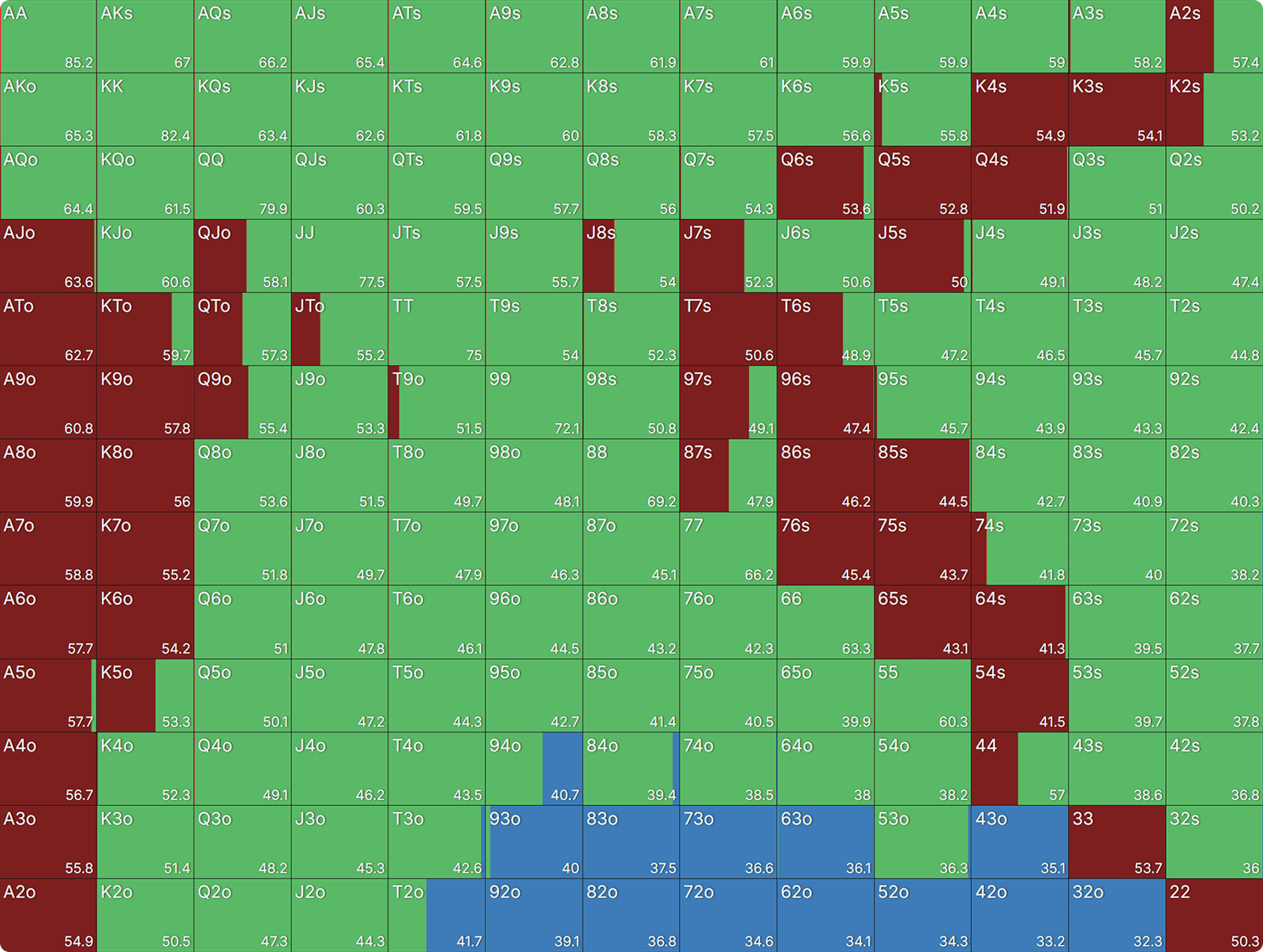
Again, by inspecting the equity buckets for the SB strategy, we can gain a deeper understanding of the role each hand category fulfills.
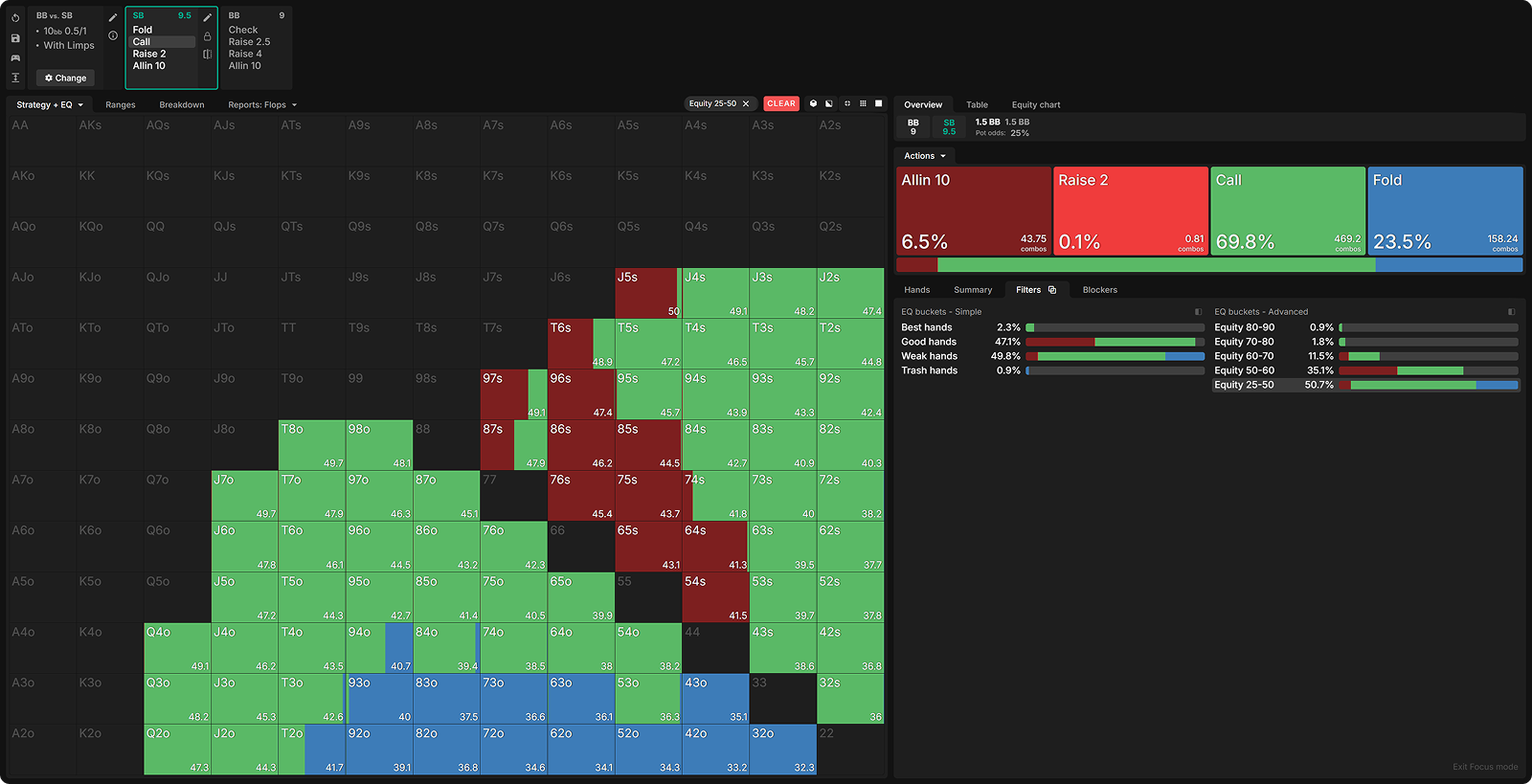
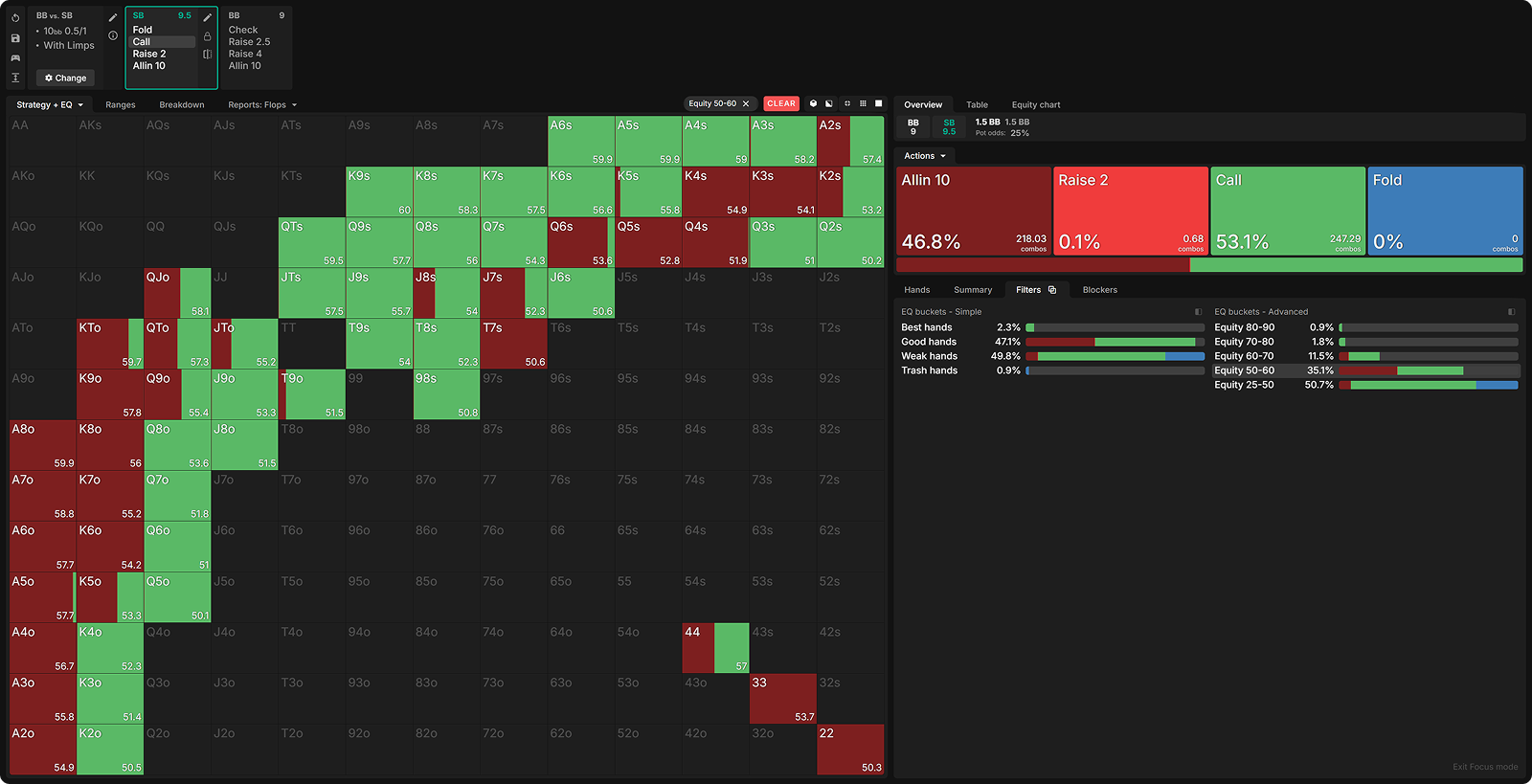
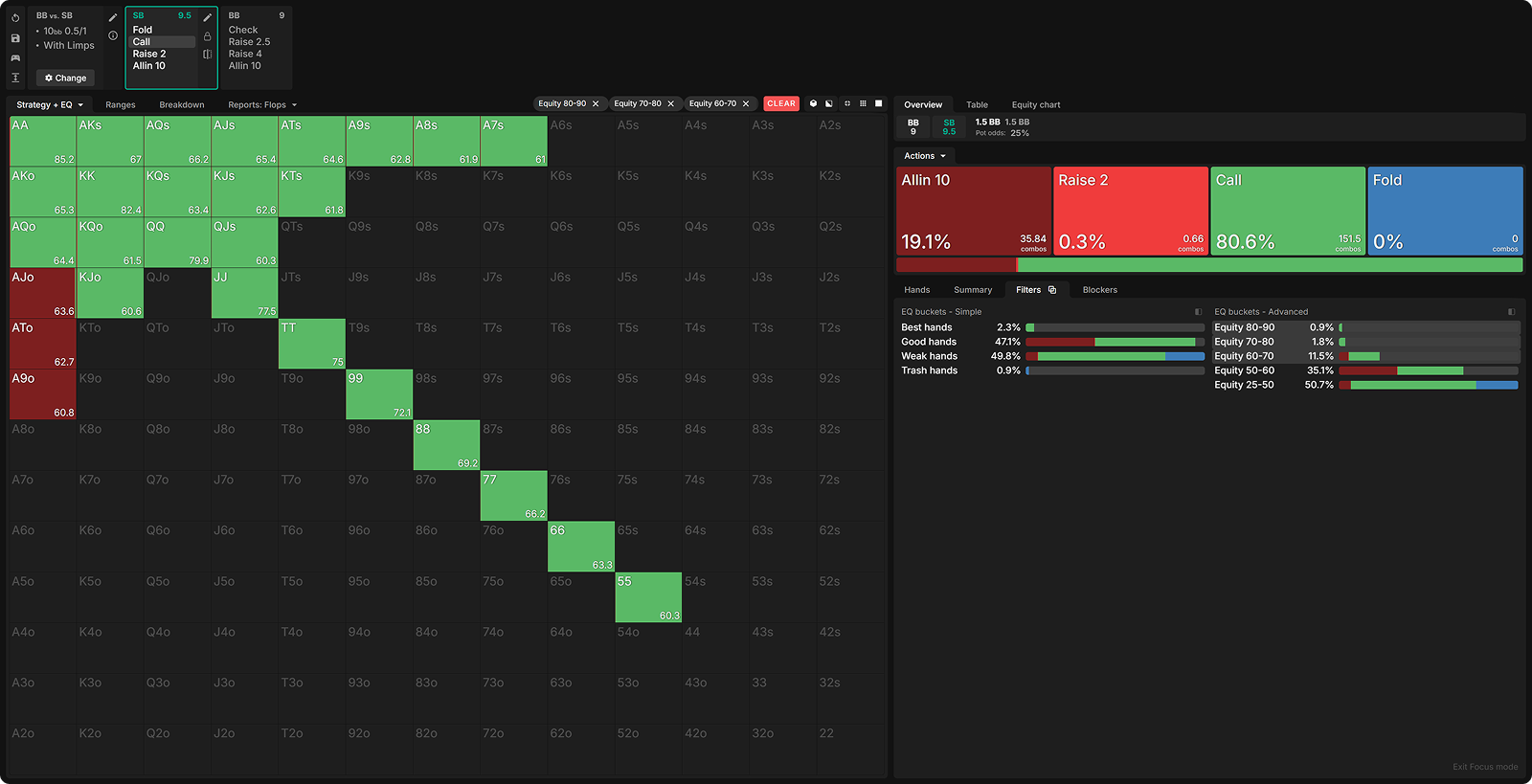
Key Observations
- SB’s VPIP is still high at ~88%.
- All-in has become a significant part of the strategy; clocking in at a frequency of ~22%.
- The weak part of SB’s limping range (0–50% equity) needs to be supported by the strong part (50%+ EQ).
Now onto the 10bb HU BB baseline strategy.


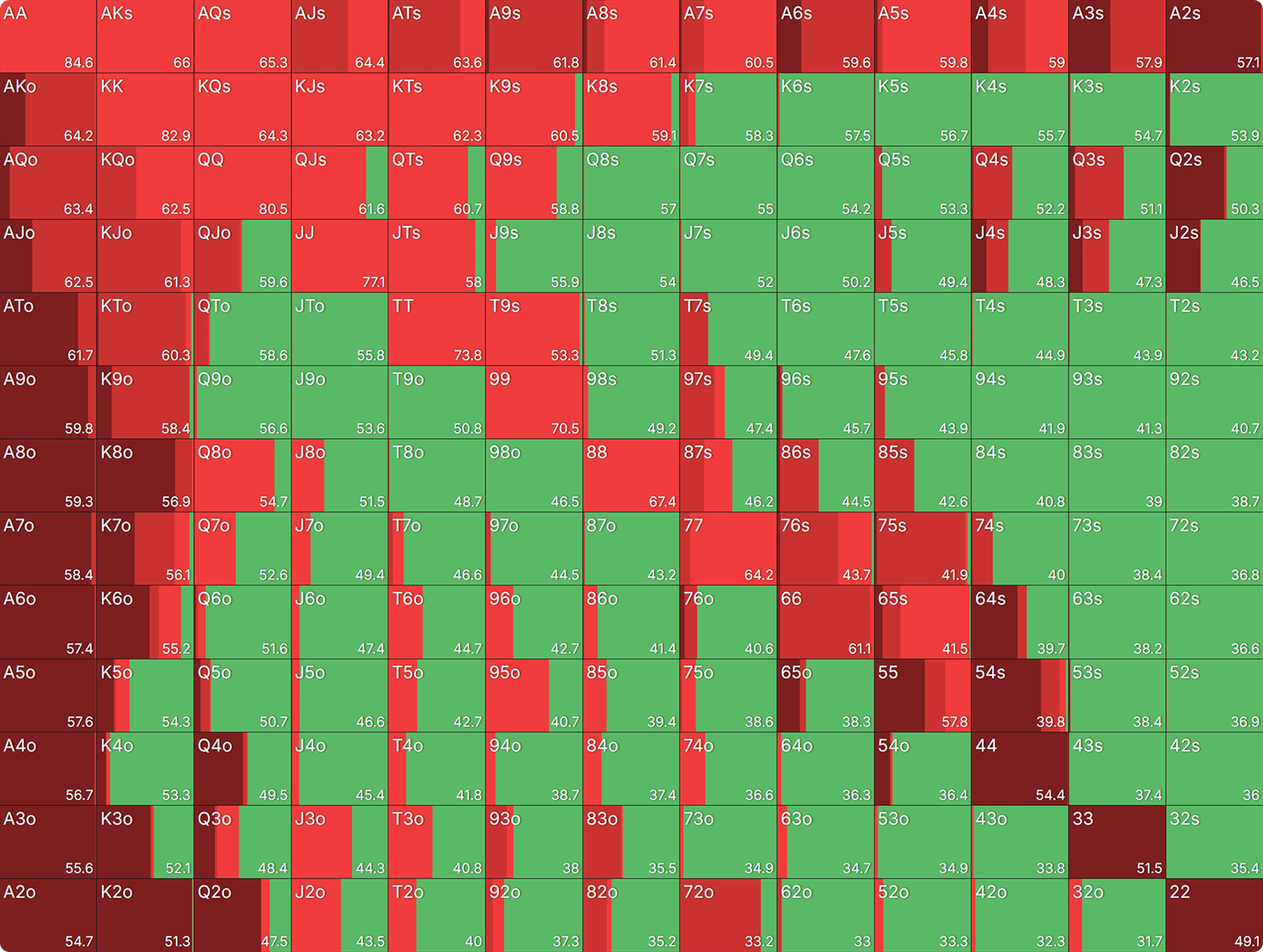
Due to the better risk-reward ratio, we can now use large isolation raises and all-in isolation raises at a higher frequency. The range composition of all-in raises starts to shift towards high-card hands and away from suited connectors.
Let’s look at how the SB responds to the different isolations:
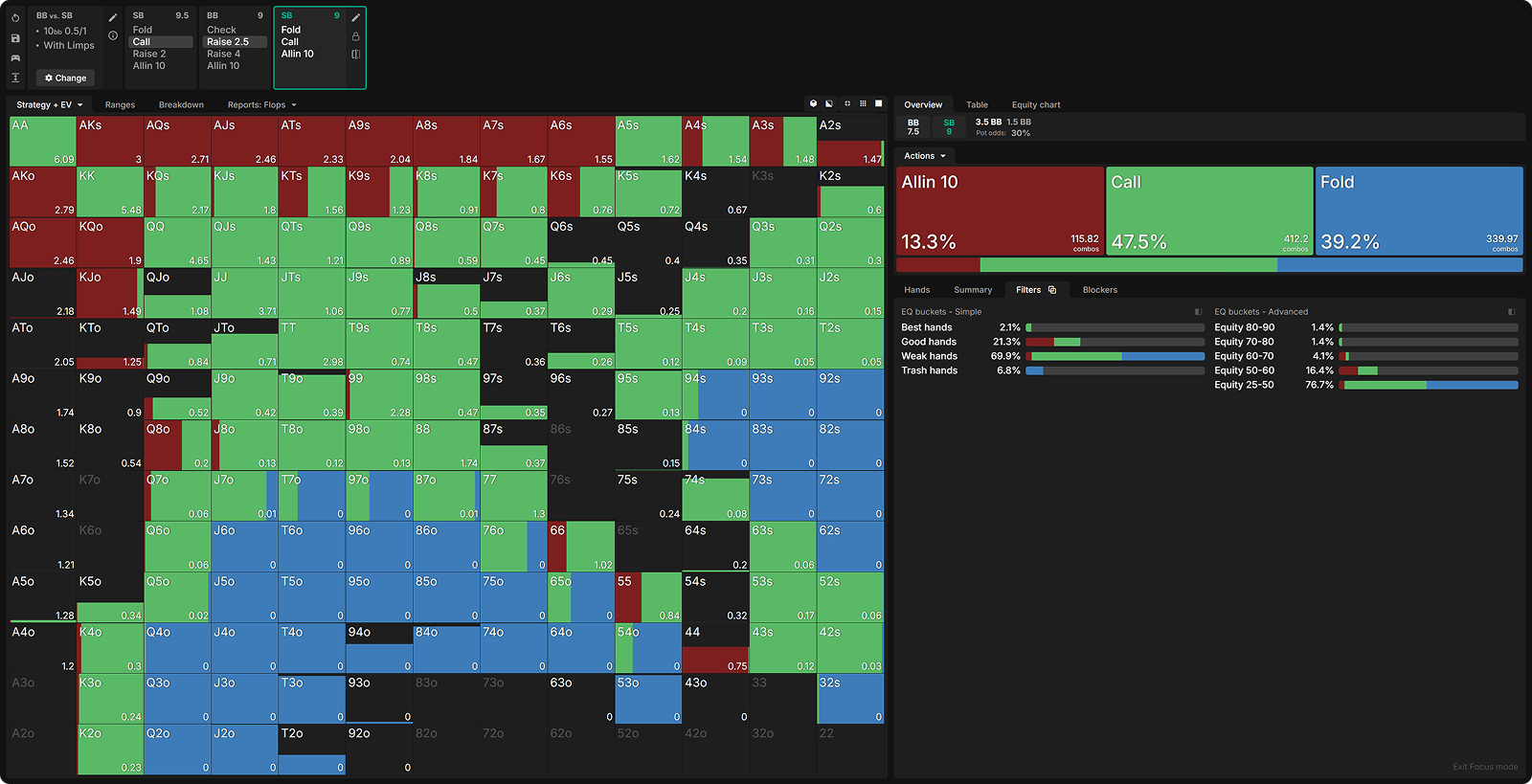
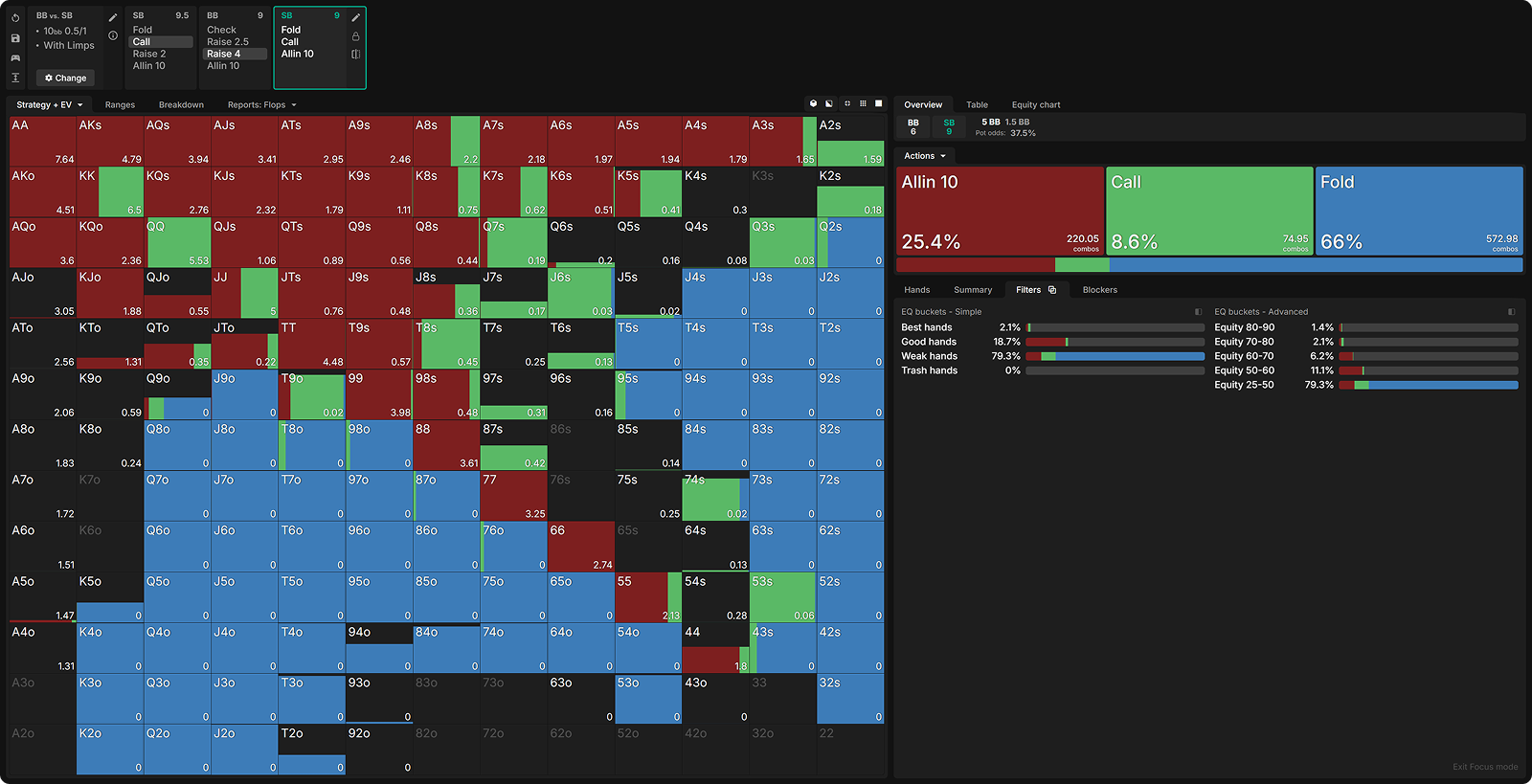
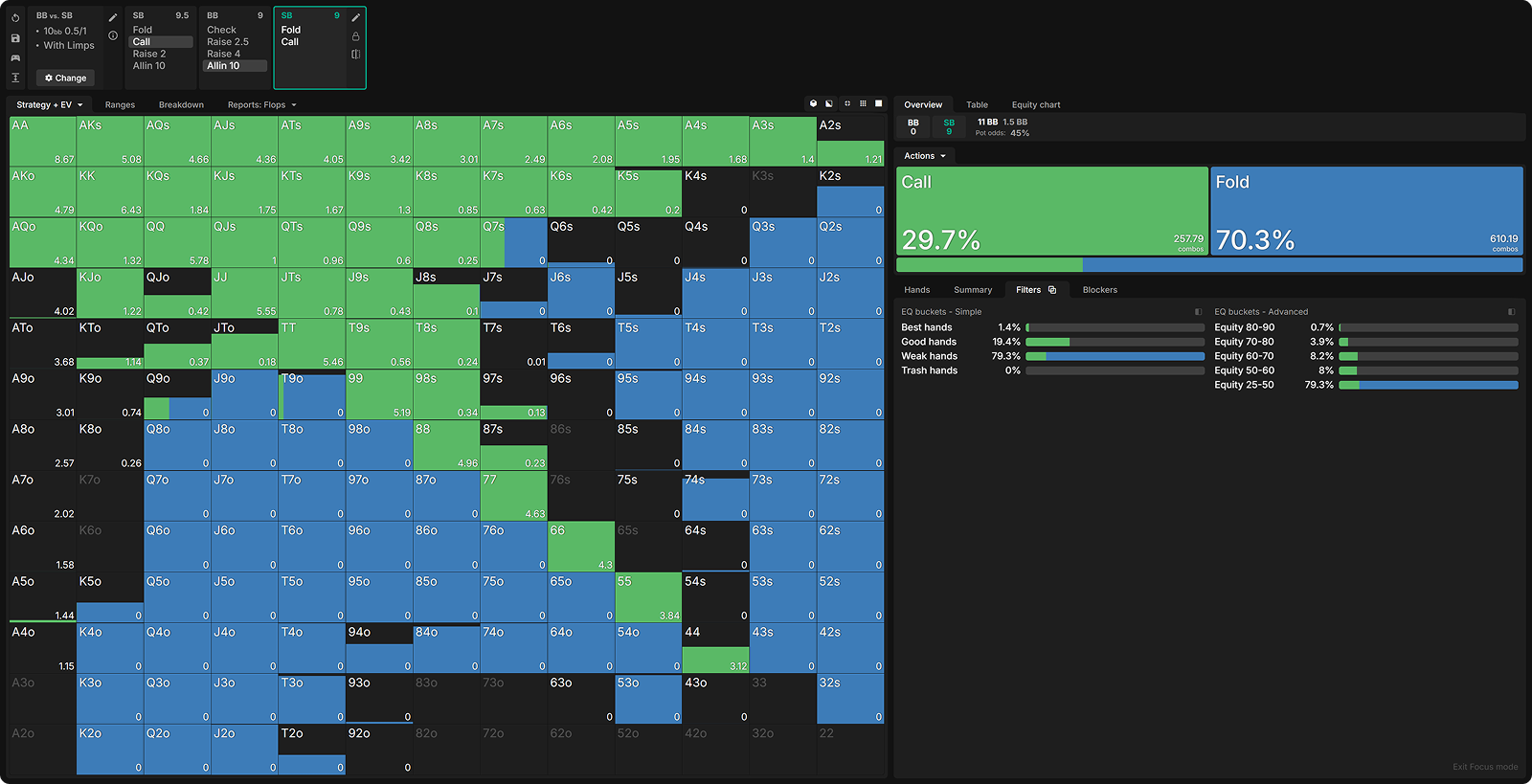
Key Observations
- The SB’s bottom 50% equity buckets struggle with any isolation sizing.
- The 50–60% equity bucket can easily continue vs. a small iso-raise size. It also offers some protection vs. the large/all-in iso sizes.
- The 60%+ equity buckets from earlier can handle any isolation sizing.
Let’s explore some deviations you may encounter from the SB due to the addition of a significant all-in range in the SB baseline strategy.
10bb → Deviation 1) Open-Shove Too Many 50–60% Equity Hands
A common deviation from game theory optimal play is to move all-in with too many middling hands. The range on the left side of the graphic below presents an example of what this could look like.
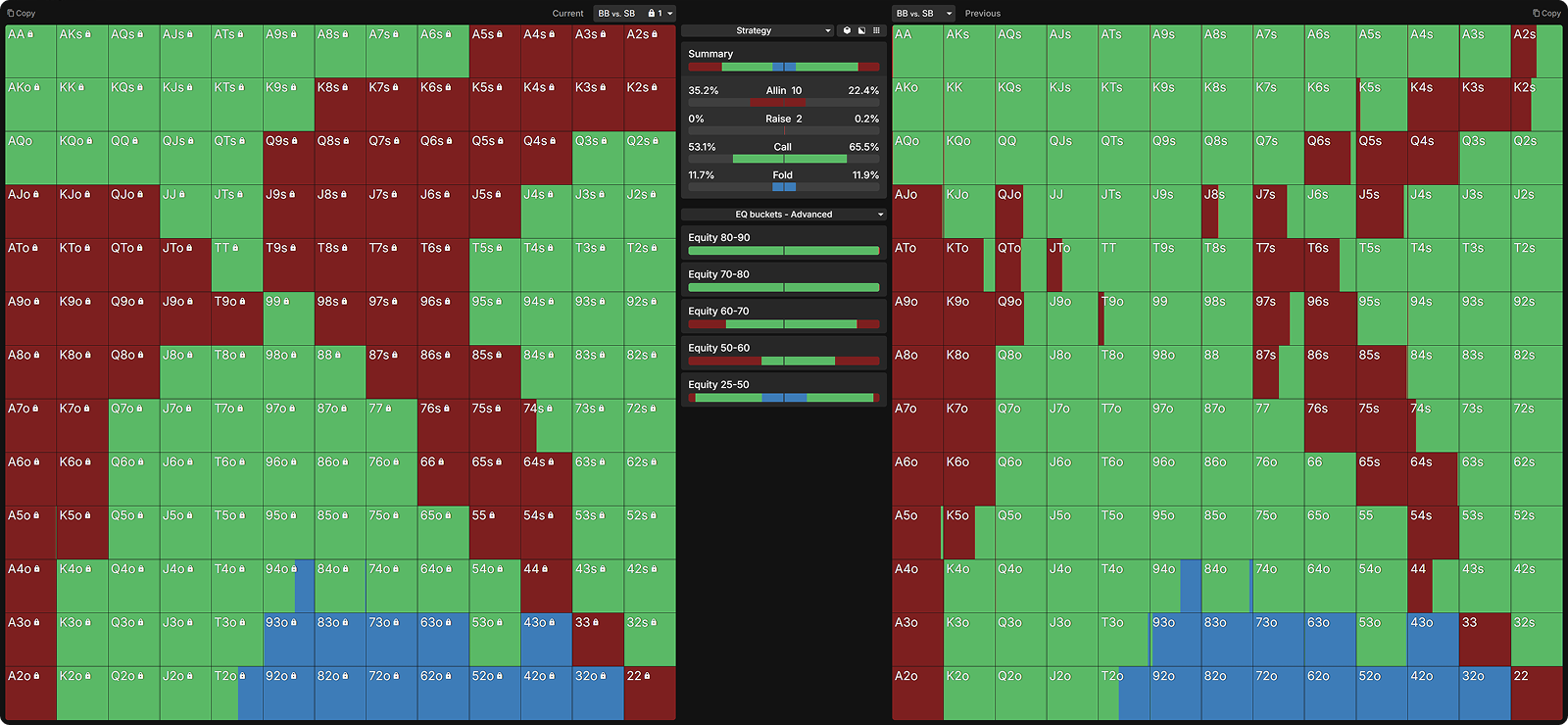
We already saw previously that SB’s hands with 50–60% equity provide cover when facing small isolation raises. If a Villain starts to move all-in with these holdings more than the baseline, these hands can no longer be present (to the same extent) in the limping range, which means there’s less protection against isolations.
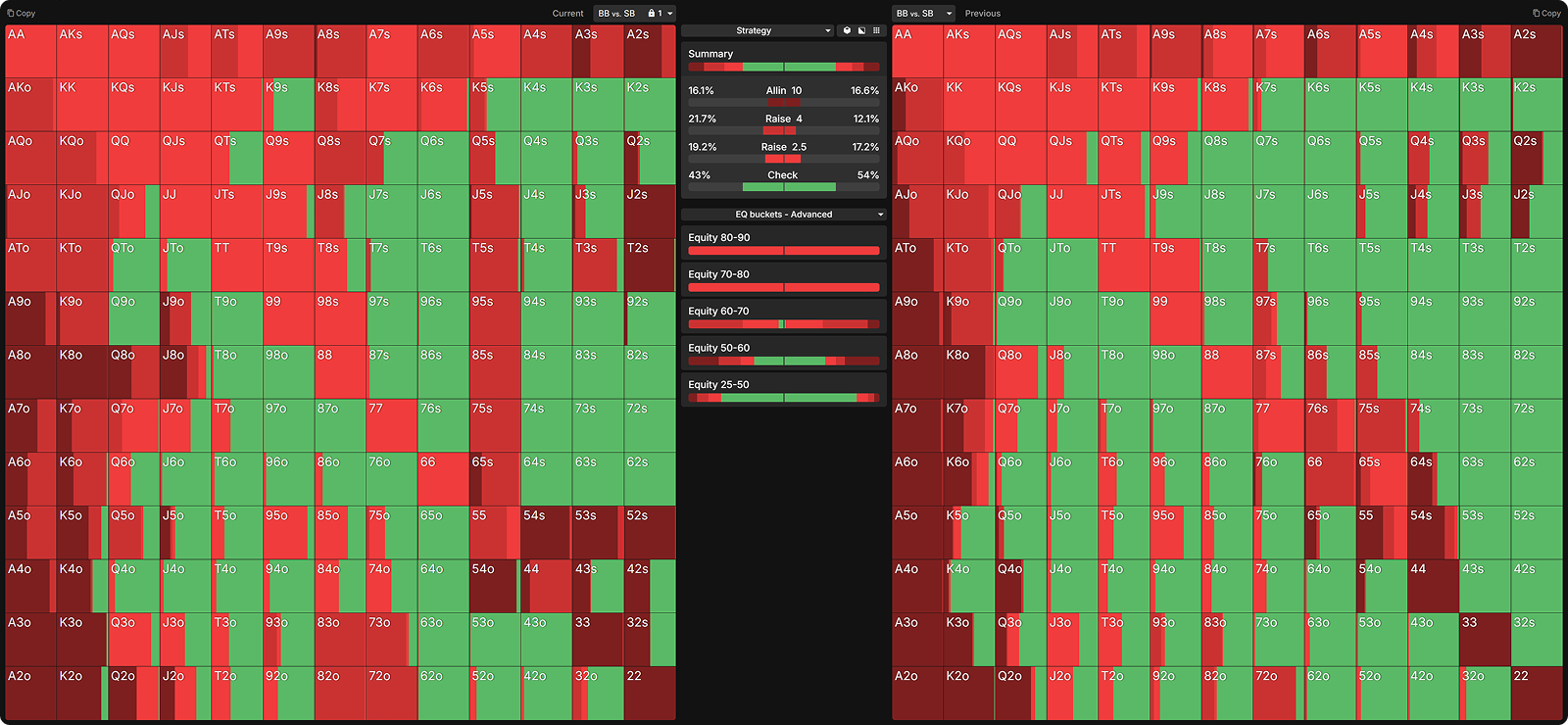
The BB can capitalize on this by increasing its isolation frequency, in particular with the non-all-in iso-raise size. An increase in overall iso frequency of ~11%, as shown above, is already very significant but this assumes the SB player can optimally respond against any deviation the solver makes. This is not in the cards for many human players, however. So the potential exploits we can consider in-game can be even more out of line.
To visualize this, let’s take a look at how the SB responds to the BB’s new small isolation strategy:
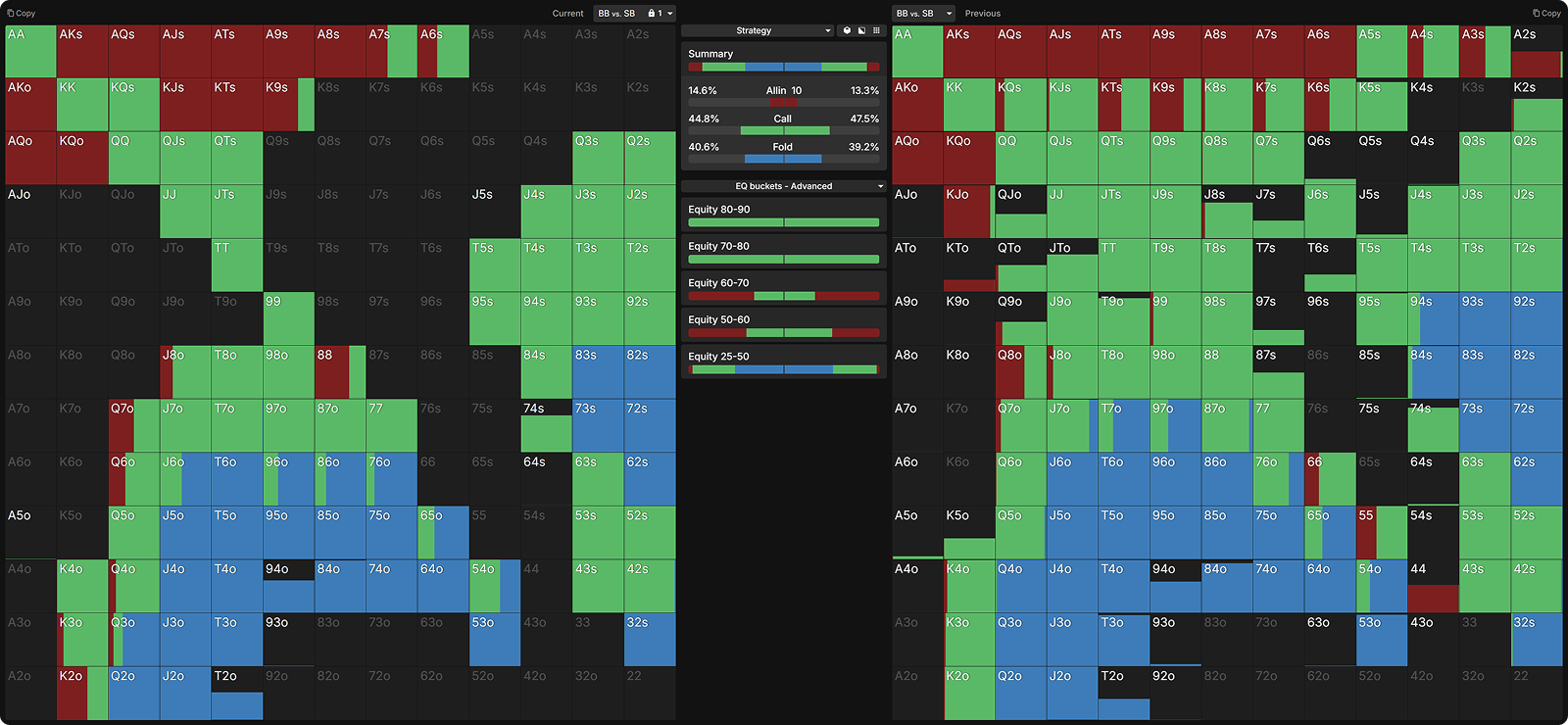
The SB solver calls preflop with weaker hands more often vs. the small isolation. In reality, it’s much more likely that a real-life regular player in the SB will fold a higher percentage of the time to the isolation, not realizing how open-shoving too many middling hands is leaving their limping range exposed.
To exploit players who employ such a strategy, we can shift the range composition of our small isolation to be very trash-heavy, ensuring we punish them for over-folding preflop.
10bb → Deviation 2) Recreational With Raising Range
The only preflop raise size the SB baseline strategy used was all-in. This is not the reality we will face when playing recreational players. In fact, data suggests that at 10bb we can expect, on average, to see: ~33% limp, 20% all-in, 17% raise non-all-in.
Usually, the non-all-in raise contains many of the best holdings. I will try to simulate such a range to see how we can exploit it.
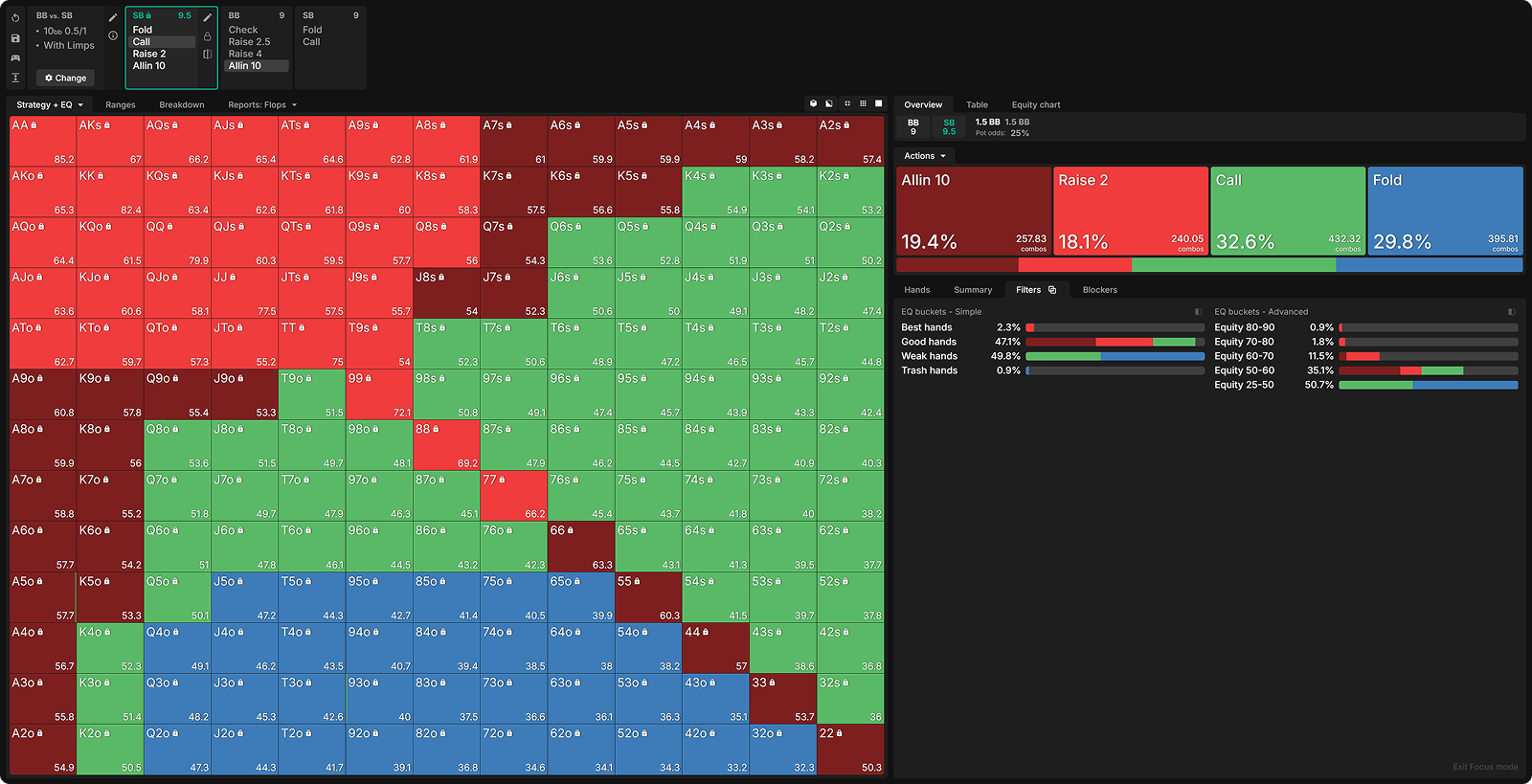
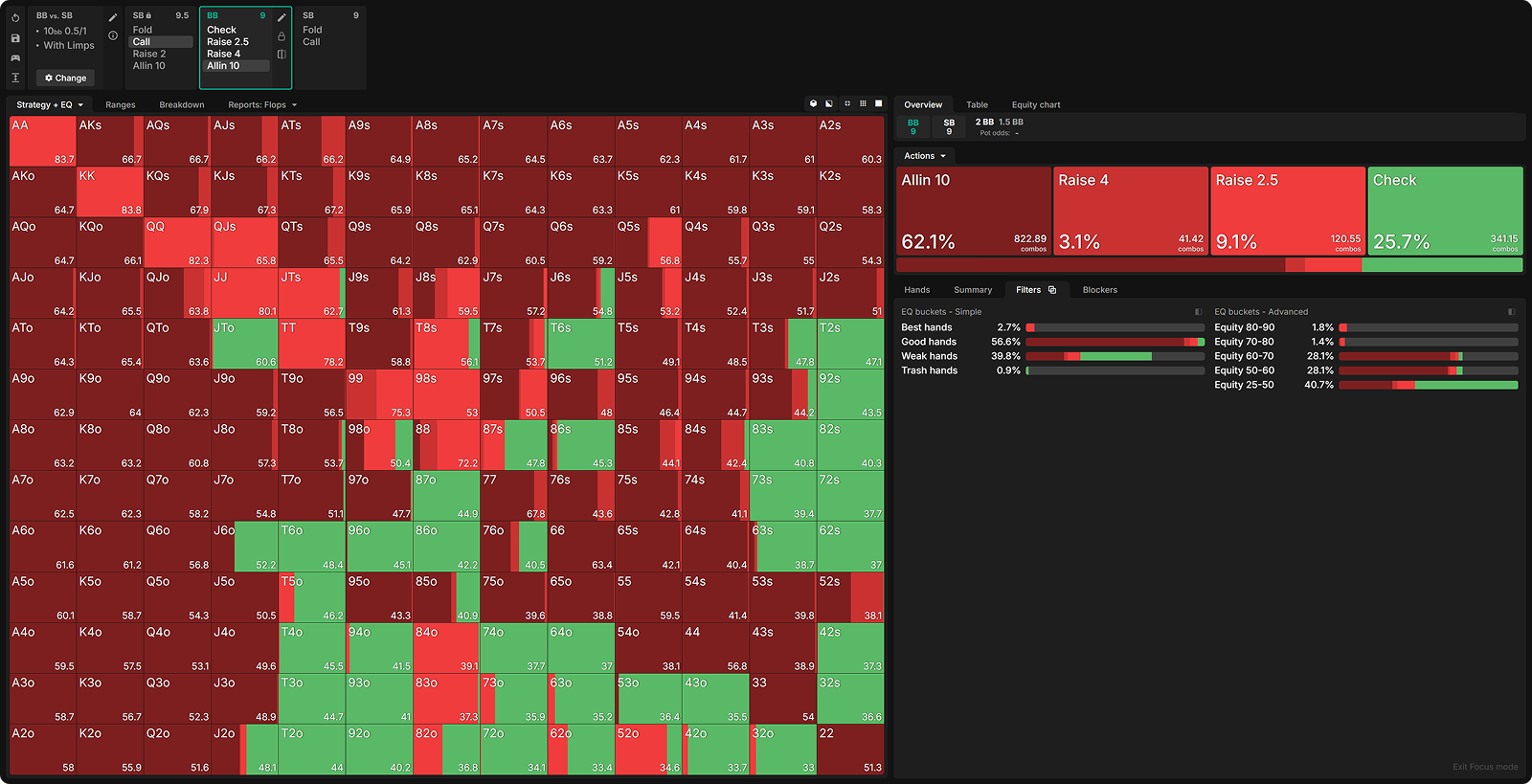
Even though the overall VPIP has decreased from the SB baseline, the composition of the limping range is significantly weaker.
{{interactive-reveal-answer: Which of these exploits is correct for BB?}}
{{correct: Isolation frequency increases and mainly uses all-in.}}
{{wrong: Isolation frequency increases mainly with a small size.}}
{{wrong: Isolation frequency doesn’t increase.}}
{{/interactive-reveal-answer}}
The lack of strong hands in the limping range leaves the SB powerless to defend against an all-in isolation.
Conclusion
The theoretical baselines for preflop play are constantly shifting as the stack depth changes. In theory, the shallower the stack depth, the more aggressive the isolator can be, getting a better risk-to-reward ratio. However, to fully utilize isolation raises as the lethal weapon they can be in practice, we need to work toward an understanding of which isolation strategies deal max pain to which practical deviations in the SB limping range.
The limping VPIP is always an important consideration when assessing what kind of isolation strategy feels most fit. But the most important factor is always the range composition.
When a limping strategy lacks many low-equity (0–50%) hands, the BB has little incentive to isolate, resulting in lower isolation frequencies and a stronger range.
However, almost all limping strategies that you can encounter in the wild will contain lots of low-equity hands. The way to attack these strategies with isolation raises will depend on how many medium-equity (50–60%) and high-equity (60%+) hands also limp to protect their weaker hands.
- A lack of 50–60% equity hands limping will allow the BB to be aggressive with high-frequency small sizing isolations.
- A lack of 60%+ equity hands limping will allow the BB to be aggressive with high-frequency large/all-in isolation sizings.
The Four-Point Checklist for Calling Turn Barrels
This article will provide a 4-point checklist of questions to ask yourself when facing a barrel, each one giving you an information point on whether our holding is a threshold hand or a clear decision one way or the other.

Small Blind, Big Problems: When to Size Up From OOP BvB
This article will give you a plan of action for establishing which types of boards prefer which sizing schemes and which types of hands fit into these schemes (both for value and for bluffs) when OOP BvB in Spin and Gos.

The Art of Value Bluffing From the Button
Playing “OK” from the Button in Spins often comes relatively naturally. Our relatively tight preflop range makes almost all boards favorable for us against the much wider range of the BB.