Playing Under 10bb – Part 2: ICM


Overview
In the first part of this series on shallow stack play, we looked at ChipEV examples to highlight how to play when you find yourself very short stacked in an early stage of a tournament.
You are much more likely to find yourself very short, however, during the end game stages of poker tournaments on bubbles and final tables. This is obviously due to the escalating nature of the blinds.
Studying shallow stack play when ICM is a factor is even more important than studying it in ChipEV Scenarios. This is because we are at the business end of the tournament, where every decision has significant real money implications. A short stack mistake at a final table could literally cost you multiple buy-ins in equity.
Today, we are going to look at some common shallow stack scenarios on both bubbles and final tables. You will see that not only is the strategy different from ChipEV, but there is also a big divergence in strategy between bubble and final table.
Bubble Opens
We will start by looking at when we are the first player to act. First of all, on a bubble.
In the previous article, we looked at how ranges differ as the effective stacks decrease. That's not as easy to do in endgame scenarios, because there are so many more variables at play. The size of the other stacks at the table, for example, greatly influences the action.
Instead, I'm going to compare endgame ranges with ChipEV ranges, which is by no means perfect, but will give you a better understanding of the divergence in the strategy.
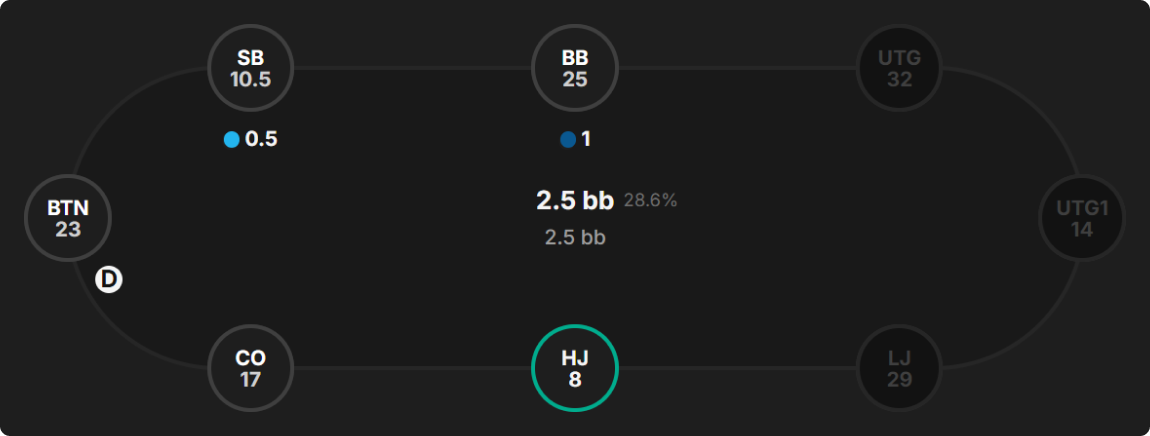
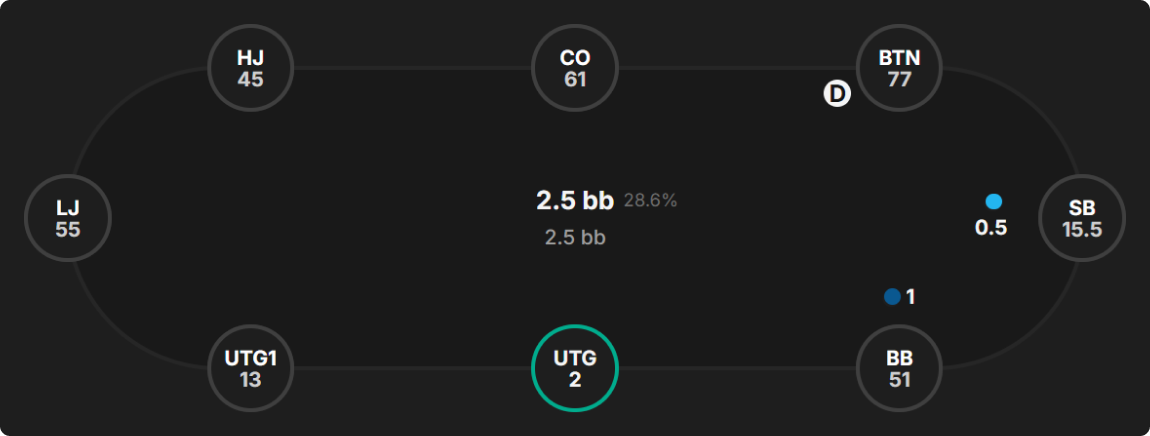
In this first example, we are on the bubble, and the HJ is the shallow stack with 8bbs. This is the table set up:
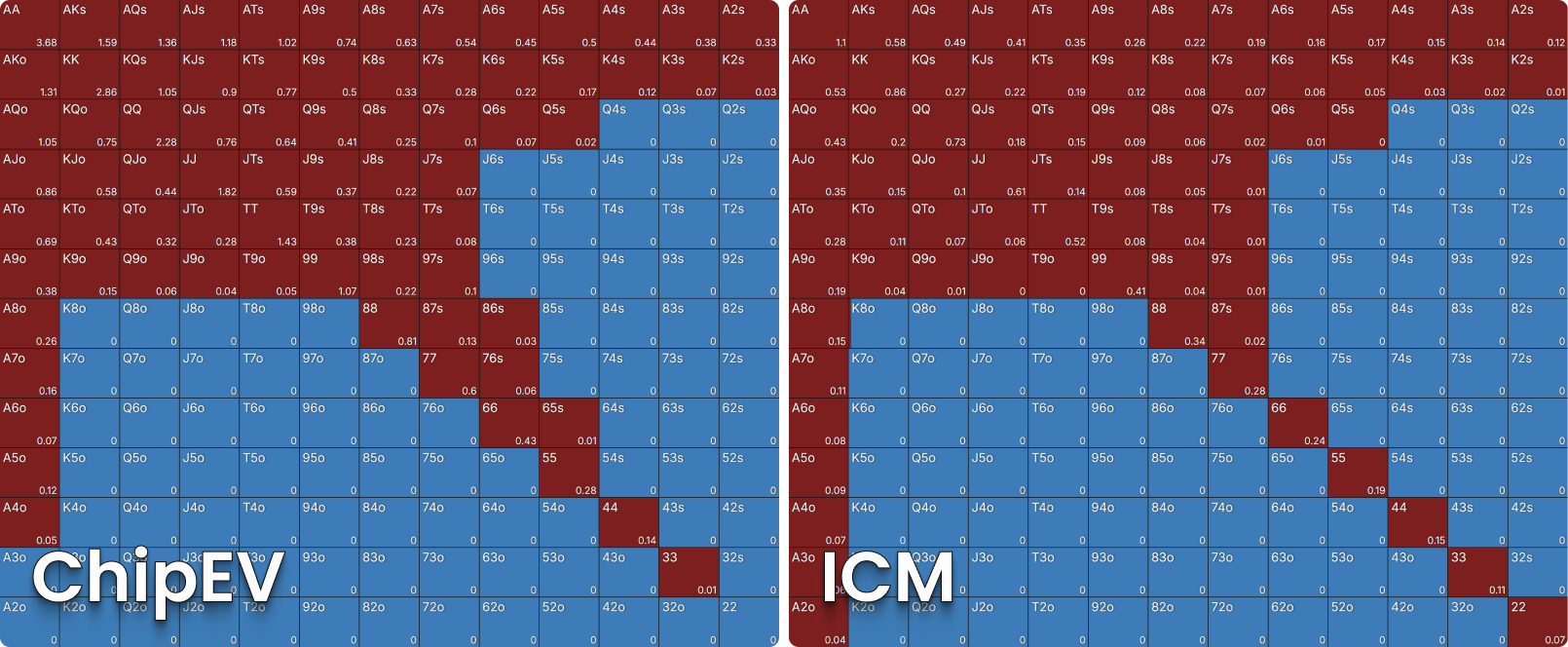
On the left, we have the ChipEV shove range, and on the right, we have the bubble range:
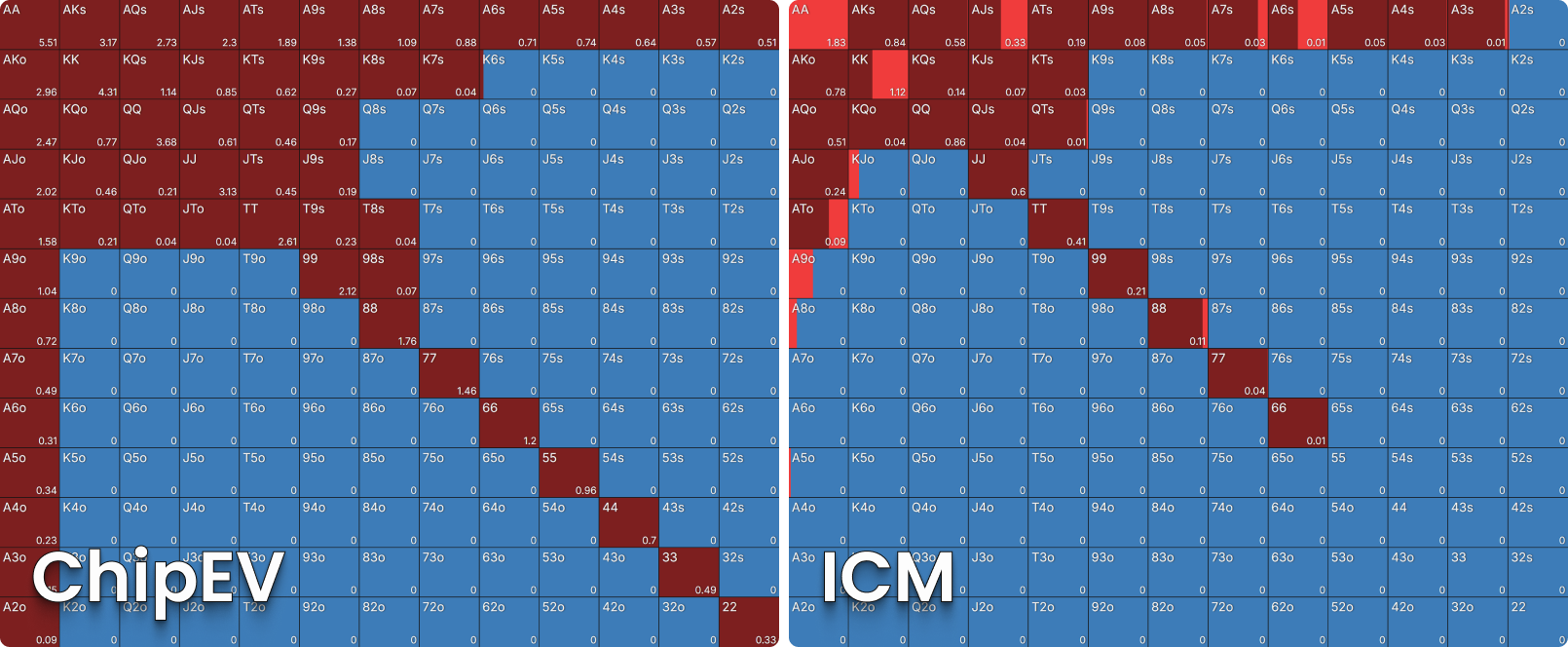
The first thing to note is that the bubble range is significantly tighter, which should come as no surprise. In ChipEV world we shove 30% of the time, in ICM world we shove 12% of the time.
The bubble range is much more weighted towards suited Ace-X type hands. These hands perform very well in endgame situations because, first of all, they have a significant blocker in the Ace, and their suitedness is a useful back-up if they get called by a strong hand.
There is also a small opening range within the shove range. AA Understandably, wants to induce action, and the bluffs mostly have an Ace in them again because of their blocker power. Survival is key on bubbles when you're a short stack, and by having an opening range, it means the bluffs in this range are able to fold when raised. This is obviously not favourable, but nor is shoving with them and being called.
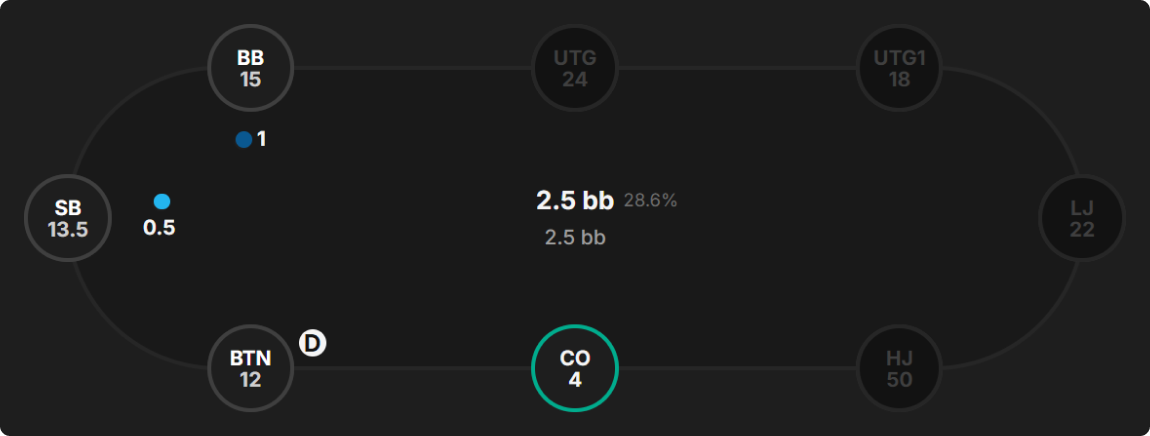
Now let's look at a very shallow stack situation. This is also a bubble, but this time the CO only has 4bbs.
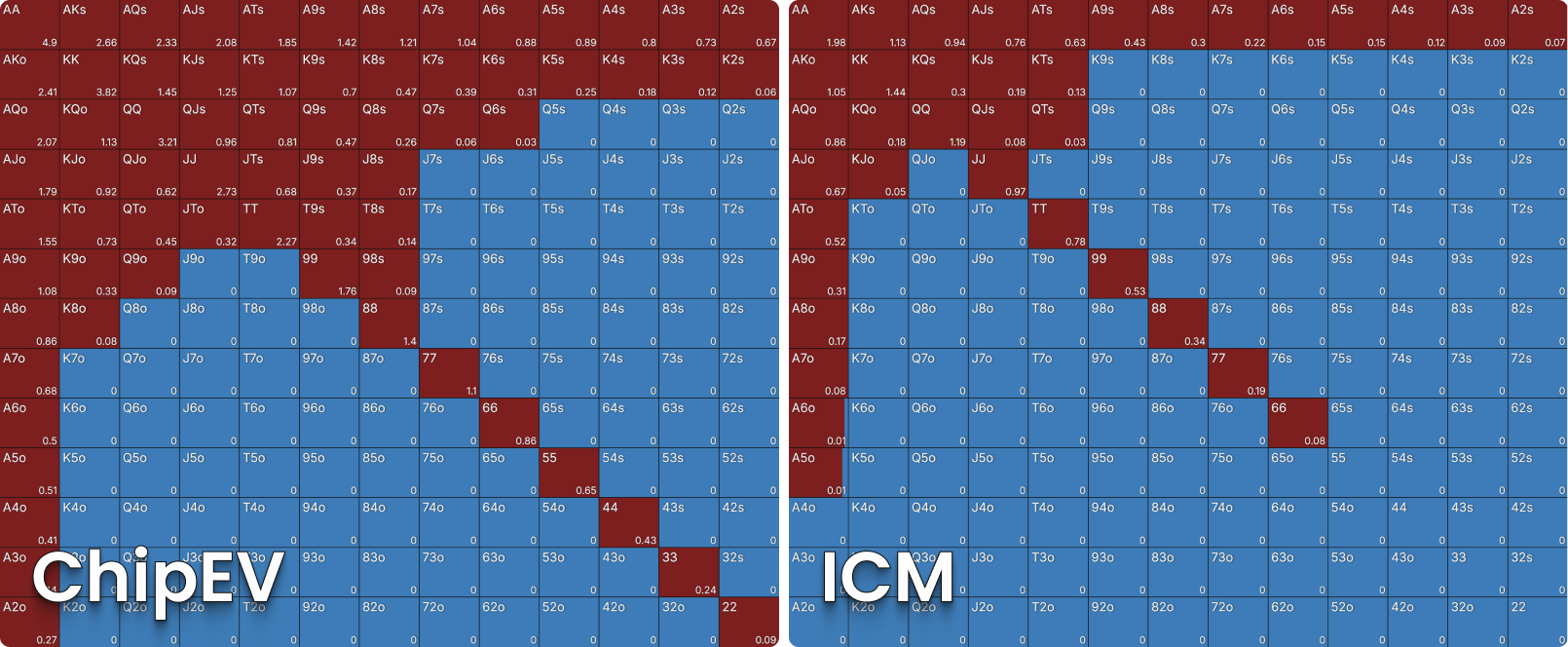
Again, much tighter in the ICM world, but this time around, we are showing wider than if we had 8bbs.
In the previous example, the 8bb stack had a risk premium of 18.9%. In this example, the 4bb stack has a risk premium of 19.2%.
They push wider, despite that higher Risk Premium, for a number of reasons. First of all, they are in a later position, so they have fewer players to worry about. Secondly, there is more upside to their shove. If the 8bb stack shoves and gets it through, they increase their stack by 31.25%. If the 4bb stack gets their shove through, they increase their stack by 62.5%. The shorter stack also stands to increase their stack relatively more if they get called, because the dead money (The blinds) is worth more to them.
It is true that the shallower you are, the more ICM pressure there is on you, and we will see examples of that shortly. However, there is a practical future game consideration here too, which the solvers don't always pick up on perfectly. The fact of the matter is, the CO is likely to be eliminated next if they don't take action, especially if the other players are aware he is essentially about to blind out. In that respect, there may even be a case for pushing wider than the solver advocates.
Final table opens
As mentioned at the outset, short stack strategy at a final table is very different to short stack strategy on a bubble. Let's dive into an example to see exactly why.
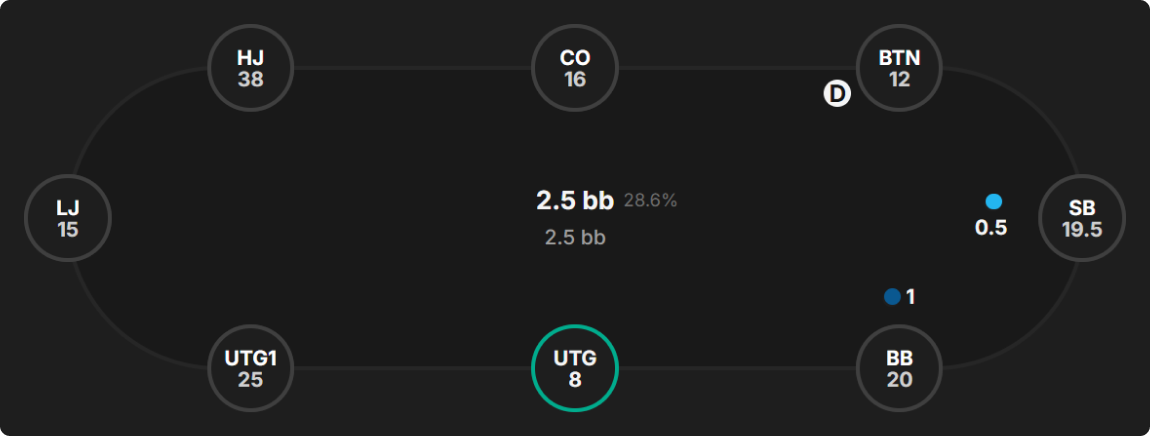
In this example, the shallow stack is UTG, and they have 8bbs.
Once again, on the left is a ChipEV Range, and on the right is a final table range:
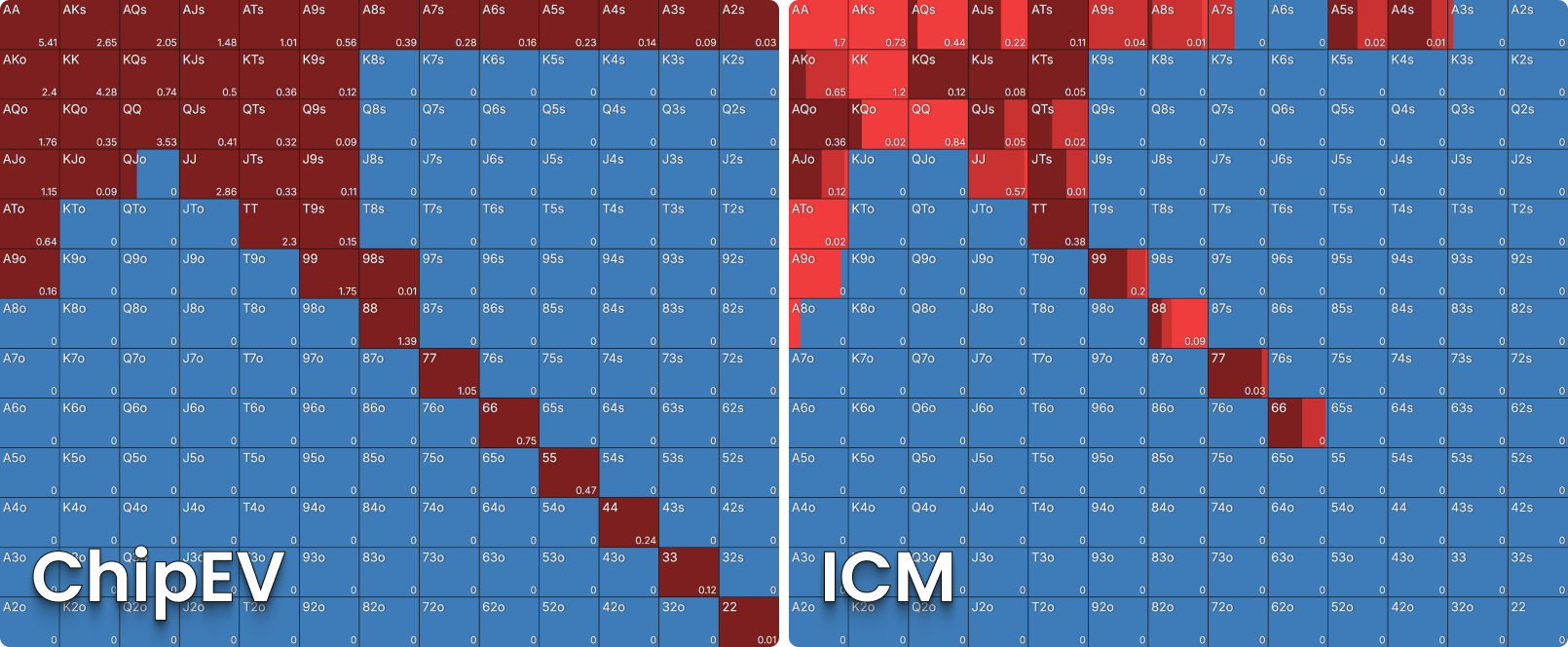
Again, the range is clearly tighter when ICM pressure is a factor. However, it is much wider than the bubble ranges we saw. And in this example, we are the first player to act, rather than a middle position player in the previous examples.
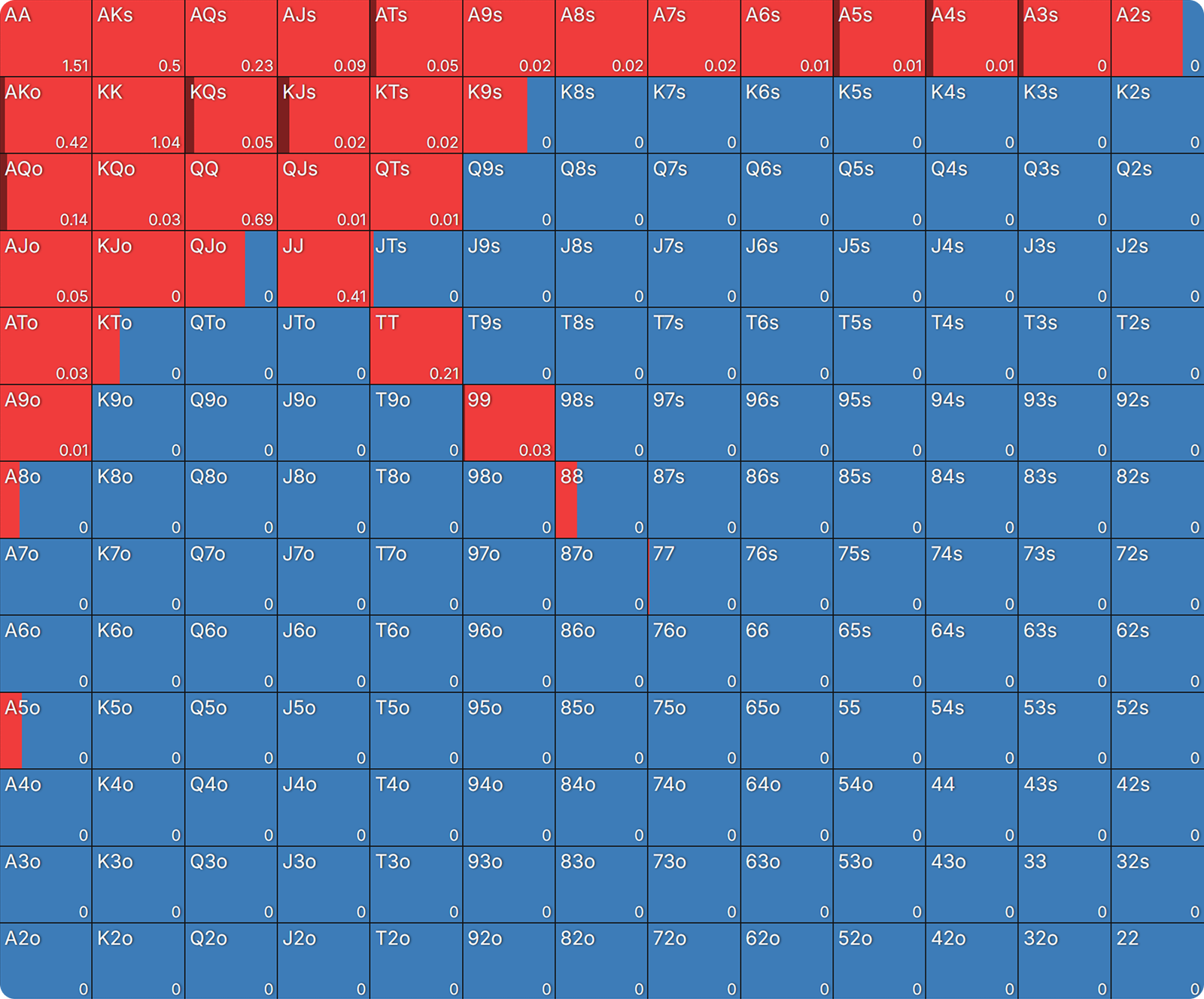
All things considered, this is actually quite a wide range for a UTG player with ICM pressure. To highlight this, let's look at the range for the LJ, who is two positions later and has almost twice as many chips as UTG.
{{width: 75%}}
{{/width}}
The LJ range is almost the same in terms of shape and frequency, they just don’t shove.
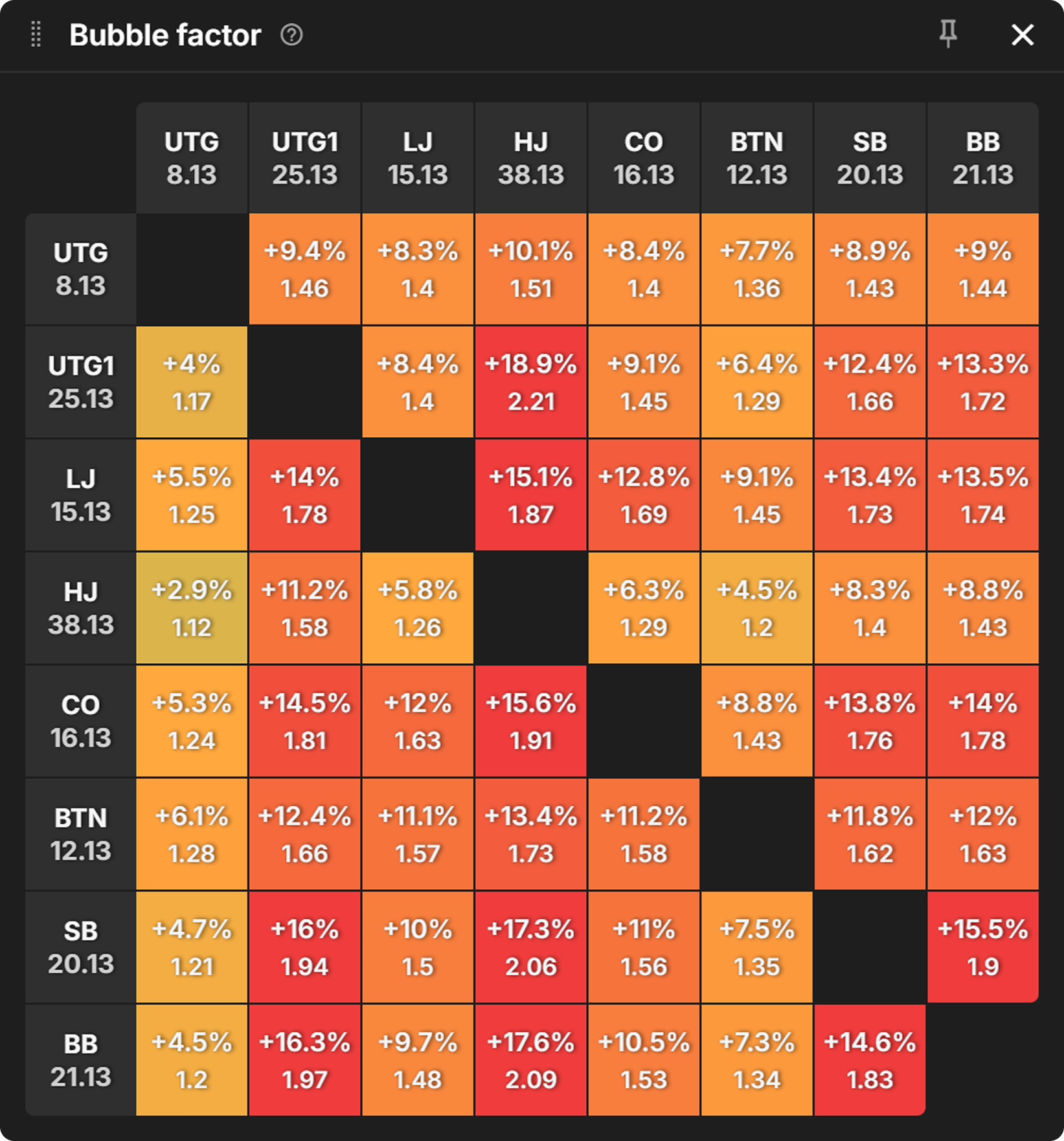
Let's look at the Risk Premiums to see what is happening here.
{{width: 75%}}
{{/width}}
UTG does not have the highest Risk Premium at this table. On the bubble examples, we looked at the short stack player, who had Risk Premiums as high as 19.2%. Here, UTG, the shortest player, has Risk Premiums as low as 8.3%.
We have explored this before in our previous articles on ICM pressure.
On bubbles, ICM pressure is highest on short stack players. As you can see here on final tables, ICM pressure is highest on medium stacked players.
An ICM calculation is essentially an estimate of how often each player will win the tournament, or come second, or come third and so on, and it's based on their percentage of all the chips in play. When a player is short on the bubble, doubling up does not dramatically help their chances of reaching the big final table payouts. Their chances of winning the tournament might increase from 0.5% to 0.8%. Therefore, it's much more important for them to lock up the min cash than it is to accumulate chips.
However, at a final table, those big payouts, or at least the next ladder, are within sight. Doubling up at a final table significantly increases a player's chances of moving up the pay ranks. A short stack player has much less to lose (they have already locked up a prize) when they go all in and a lot more to gain. Therefore, they can be looser than they should be on bubbles. In contrast, a medium stacked player has everything to lose by risking their tournament life when they would otherwise be guaranteed several pay jumps.
Let's highlight this with an extreme example where the UTG player at a final table has 2bbs.
In this example, at the final table, the player can shove wider than ChipEV would dictate.
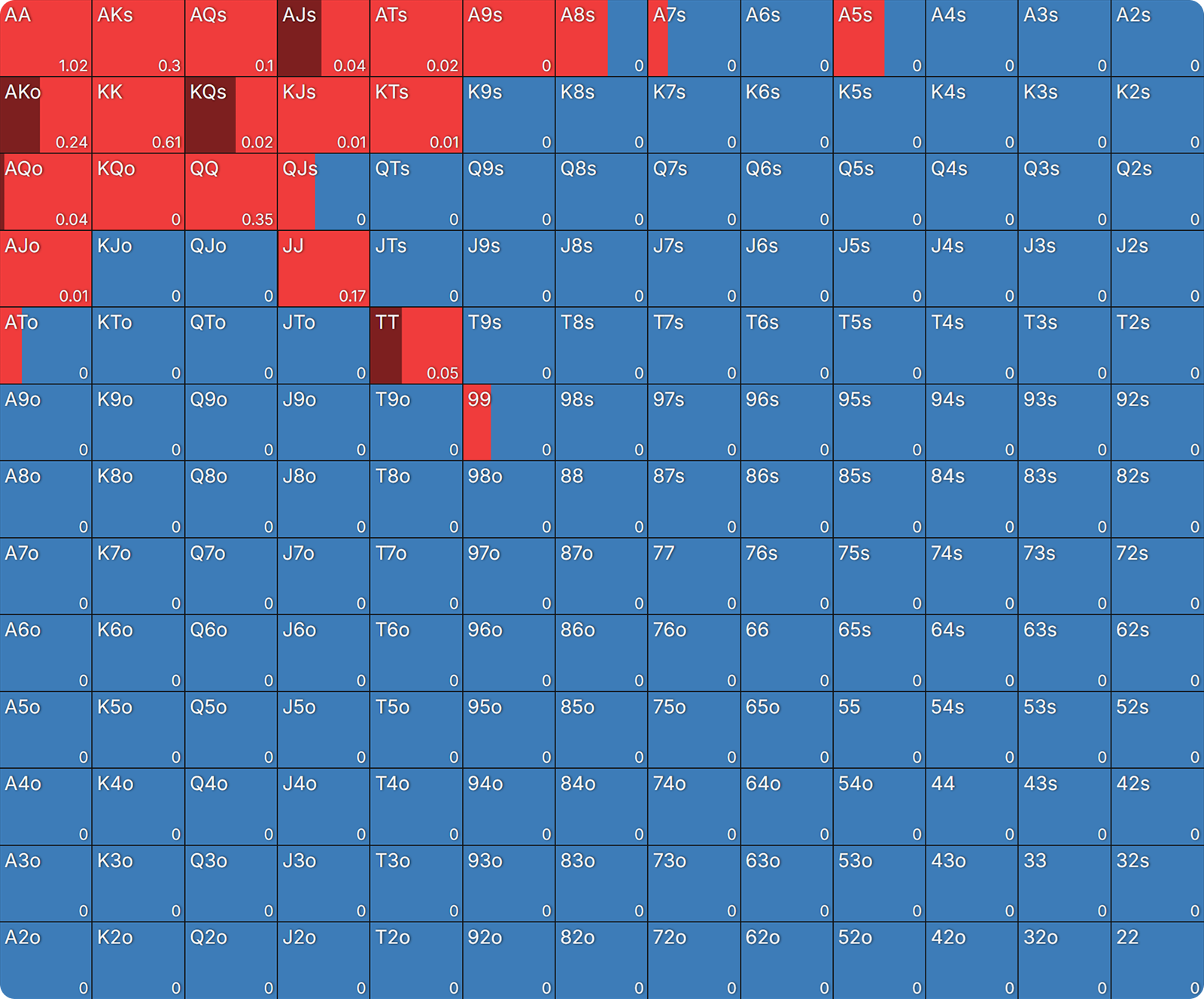
Let's contrast this with the opening range UTG1, who has 13bbs:
{{width: 75%}}
{{/width}}
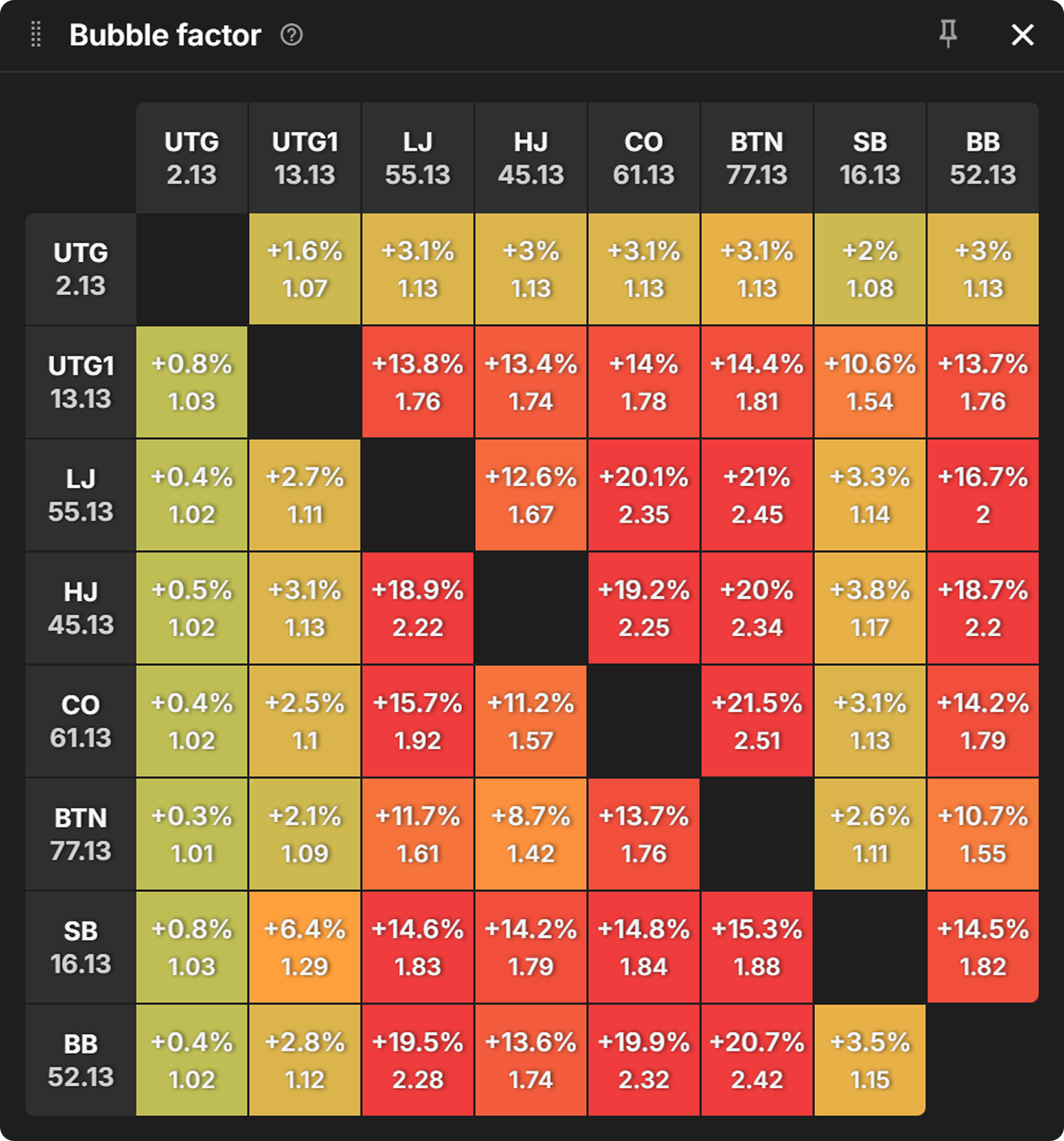
They have more than six times as many chips, but have to be much, much tighter because they have much more to lose by going broke. Again, let's look at the risk premiums to see this put into numbers:
{{width: 75%}}
{{/width}}
UTG has a risk premium as low as 1.6%. This is practically ChipEV. Another reason that they can shove wider than ChipEV is for future game reasons. They are essentially going to be forced all-in on the next hand when they are the Big Blind. If this were live poker, depending on the rules about “ante first” or “big blind first” with the big blind ante, it might actually be correct to shove almost everything here.
Facing Shoves
Now, let's look at our strategy when we are facing a call for our life as a short stack in the endgame. This time we are going to compare the bubble to a final table.
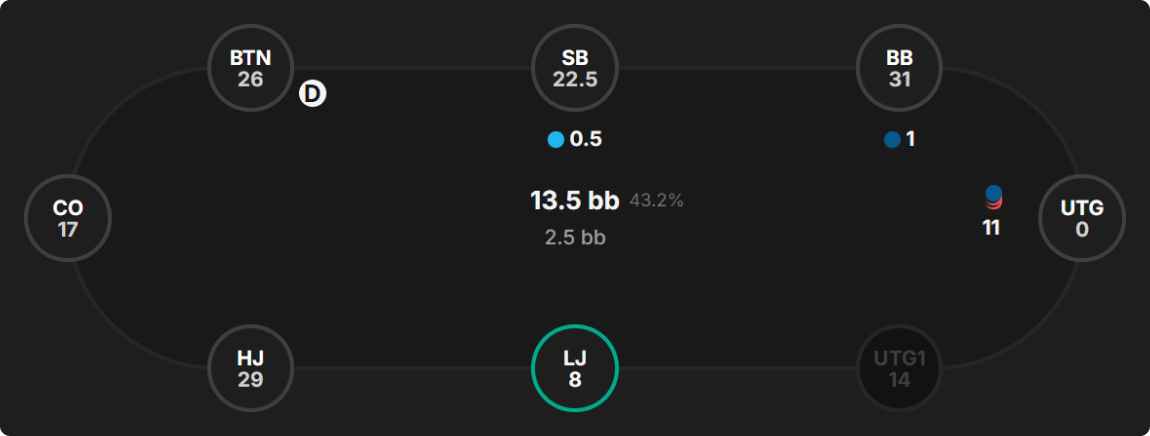
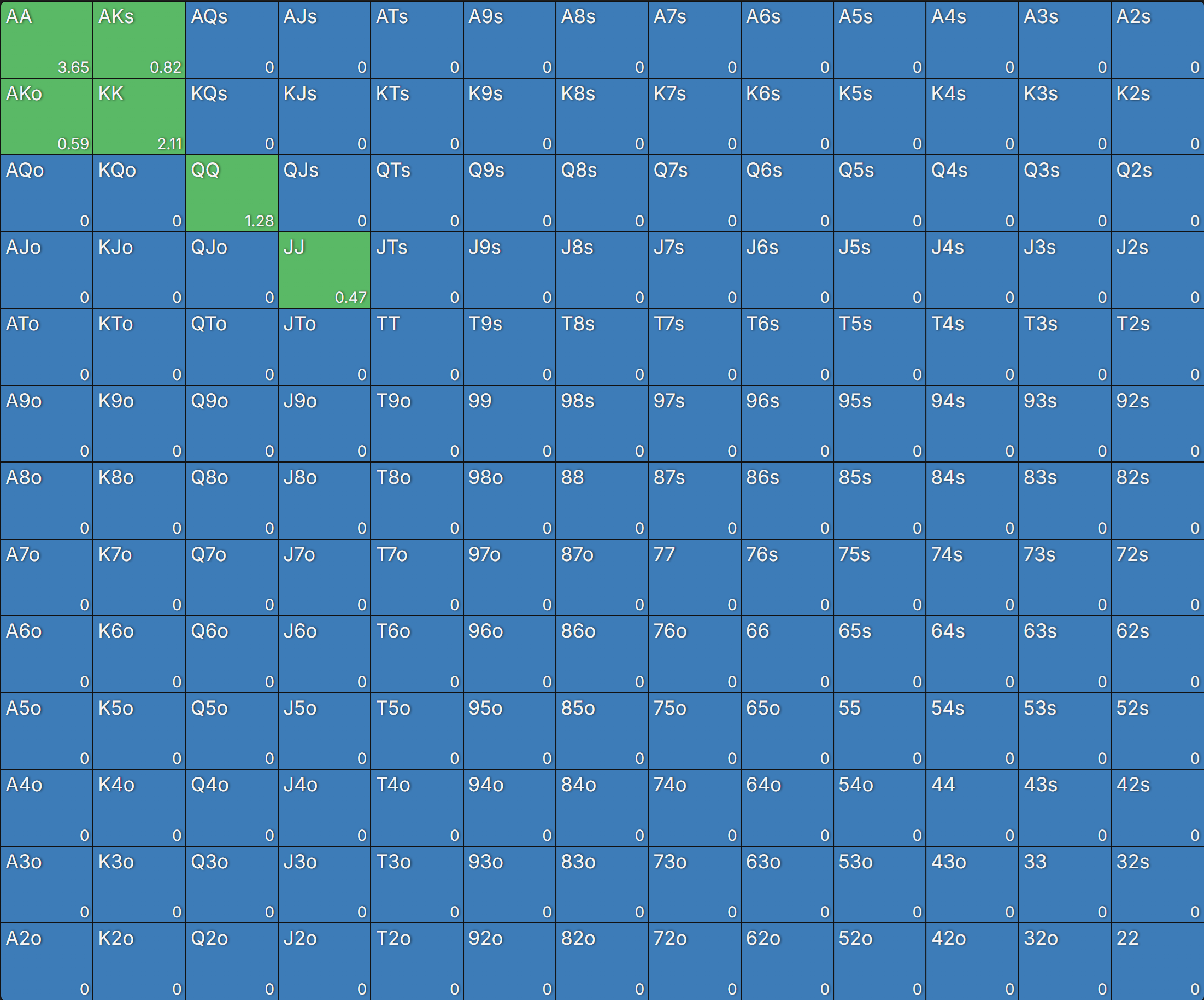
First of all, let's look at this scenario where we are the short stack with 8bbs on the bubble. UTG1 shoves, and the LJ is facing the call.
{{width: 75%}}
{{/width}}
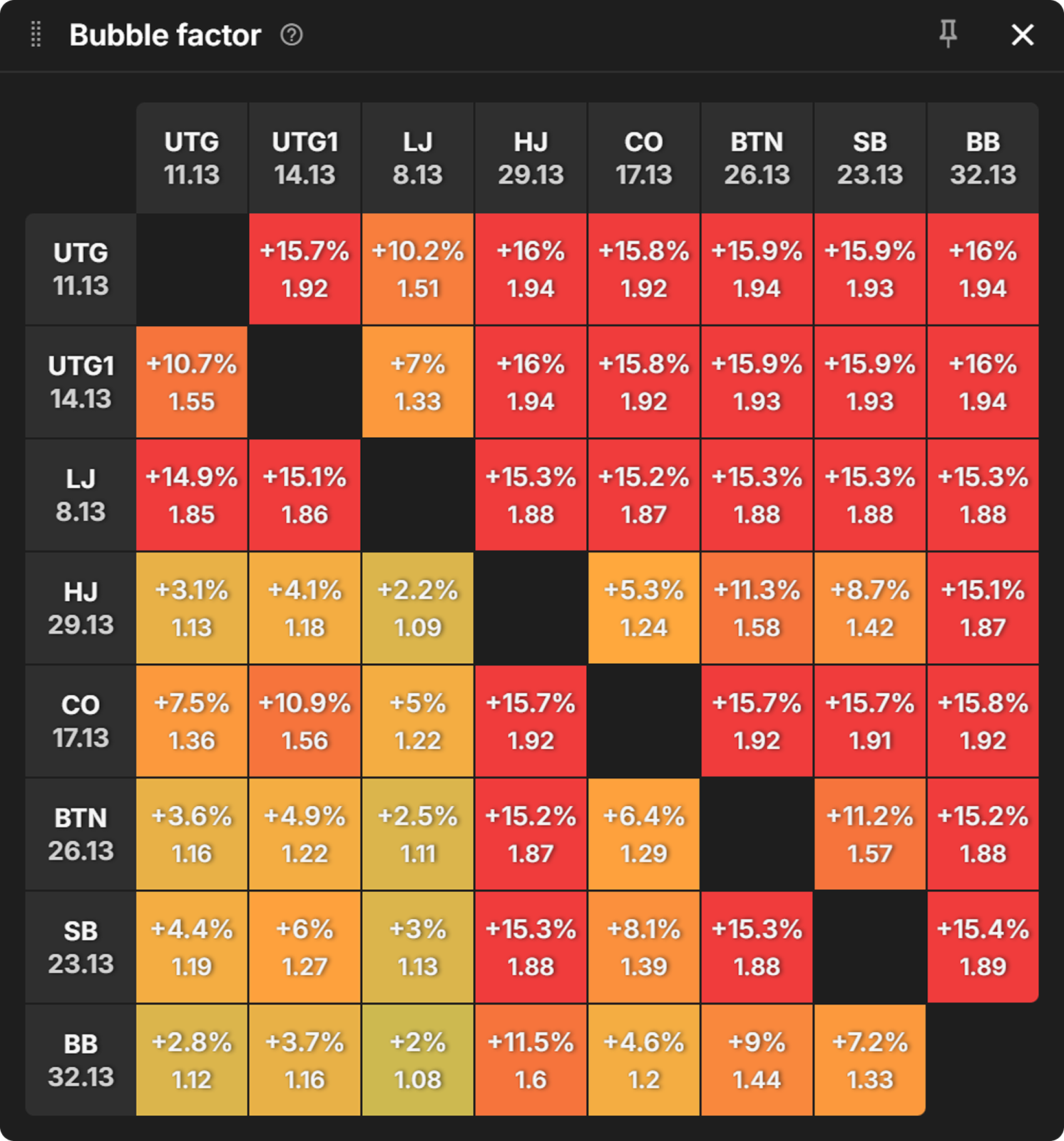
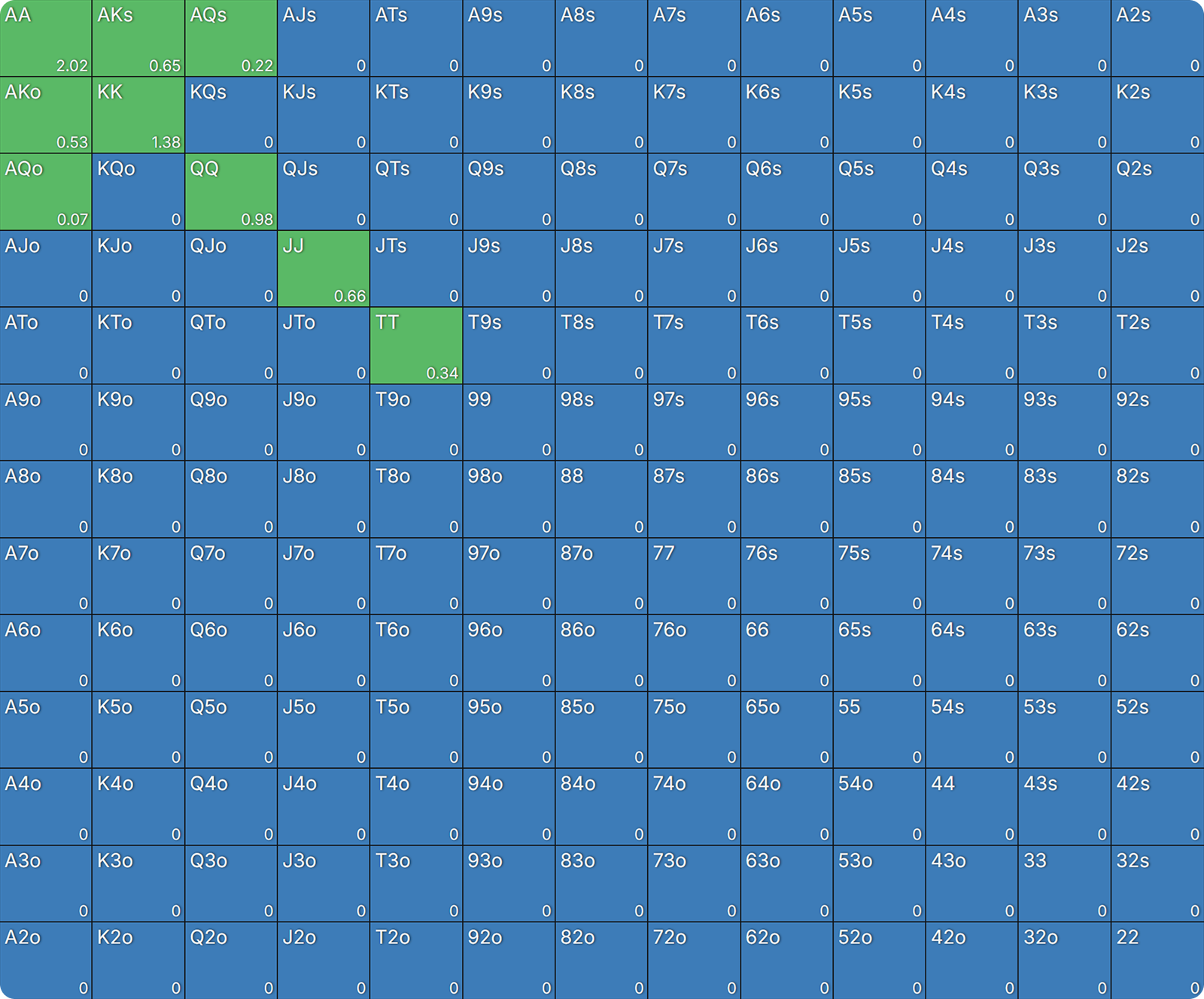
This is an extremely tight range. We fold TT and AQs here. This is an example where a lot of players would call much wider here with hands like 99 and AJs. However, they shouldn't when you look at the Risk Premiums:
{{width: 75%}}
{{/width}}
The LJ has a risk premium of around 15% against every player at this table. Meaning they would need 65% equity to call before you factor in the money already in the pot. Very few hands will have this equity, especially if we assume the player shoving has a tight range.
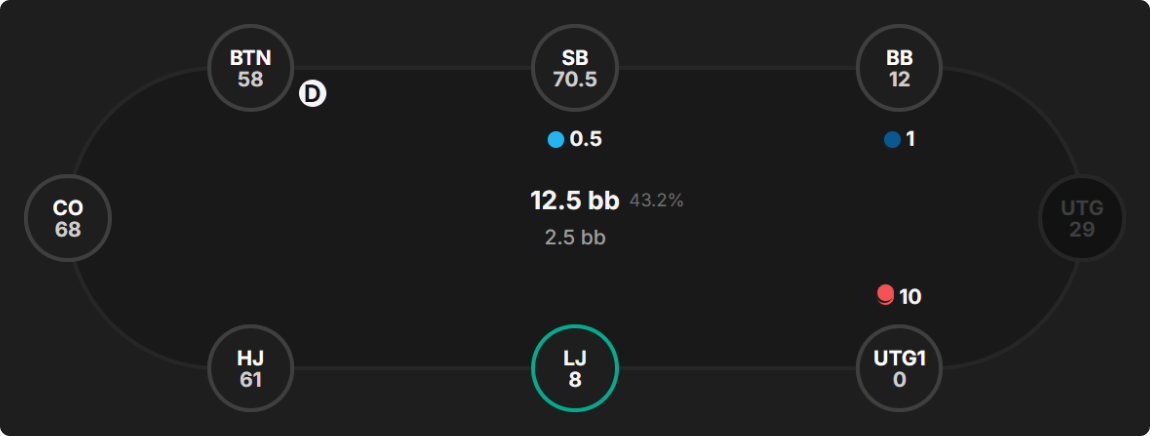
Let's compare this to a player with 8bbs facing a shove at a final table.
{{width: 75%}}
{{/width}}
We call wider, not much wider, there is still significant ICM pressure on us. But the upside of doubling is greater, especially in this particular example, because we would turn UTG1 into the short stack, and we would become a medium stack if we won.
Facing Opens
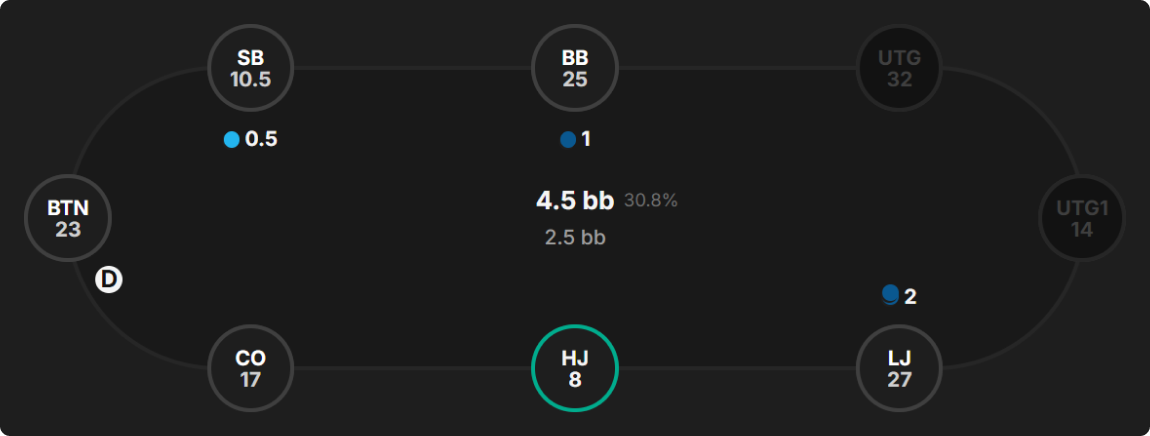
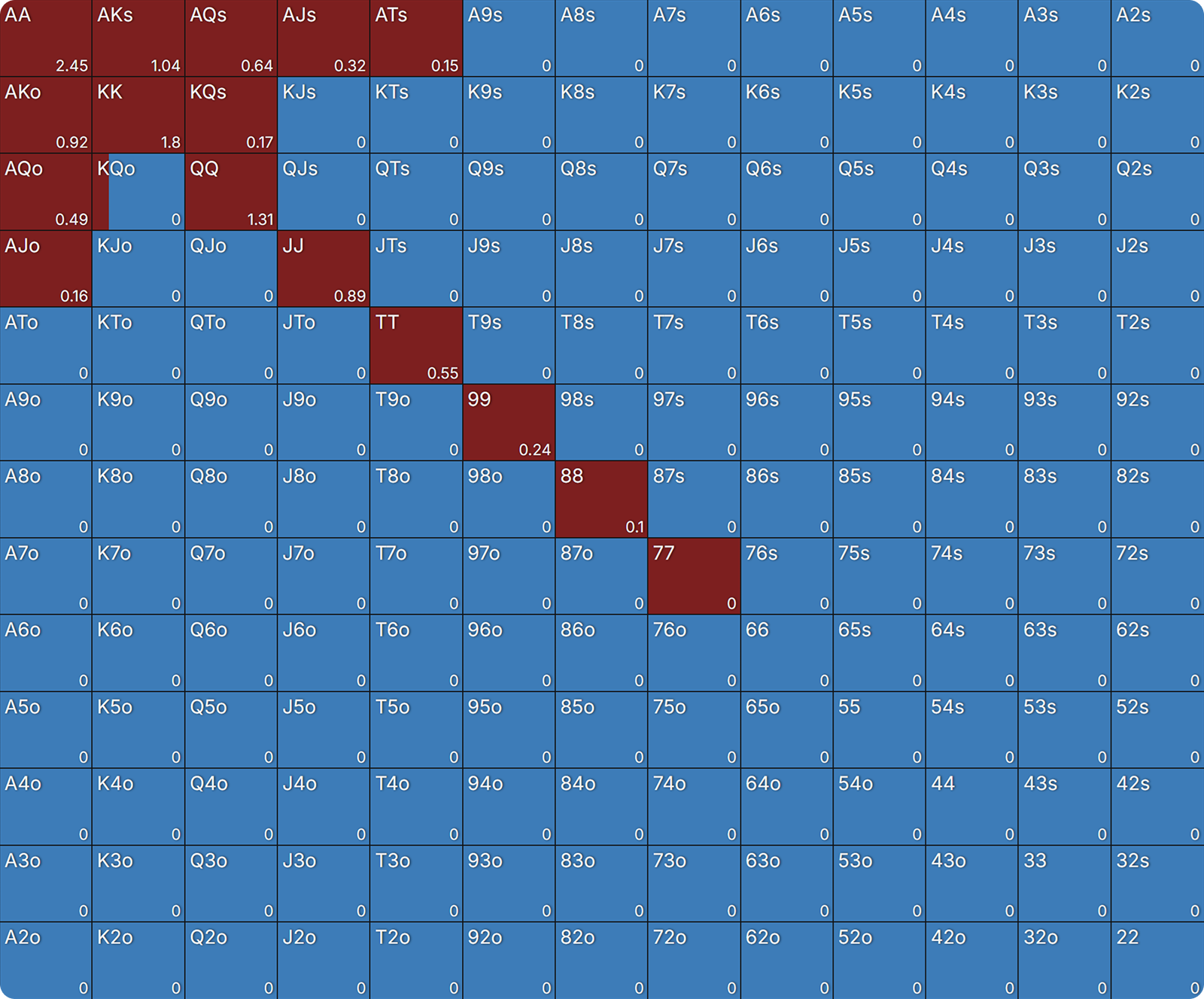
Now let's look at how we respond to opens as the shortest player at the table. First, let's look at our response to an open with 8bbs on a bubble.
{{width: 75%}}
{{/width}}
We always shove because we want to maximise fold equity. This is a strong linear range of all the best hands, but we are usually happy to just take the pot down now.
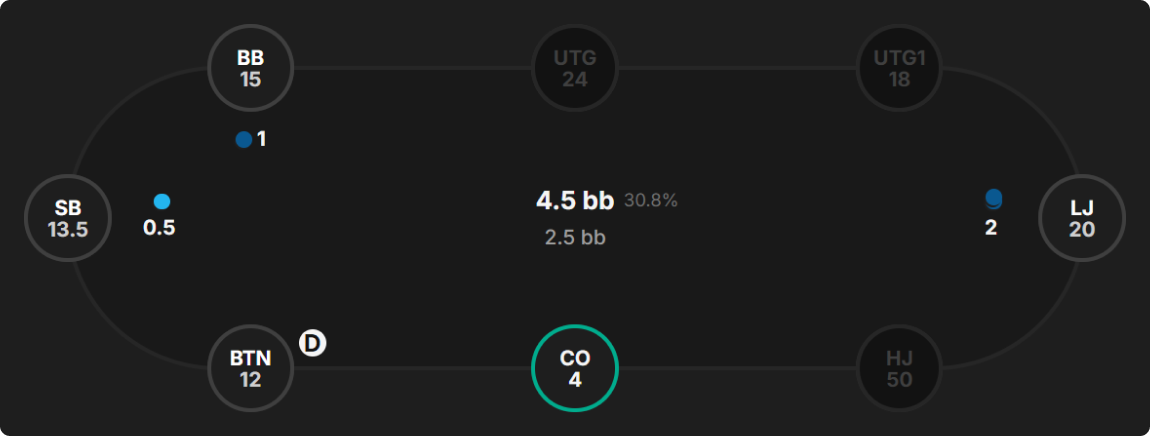
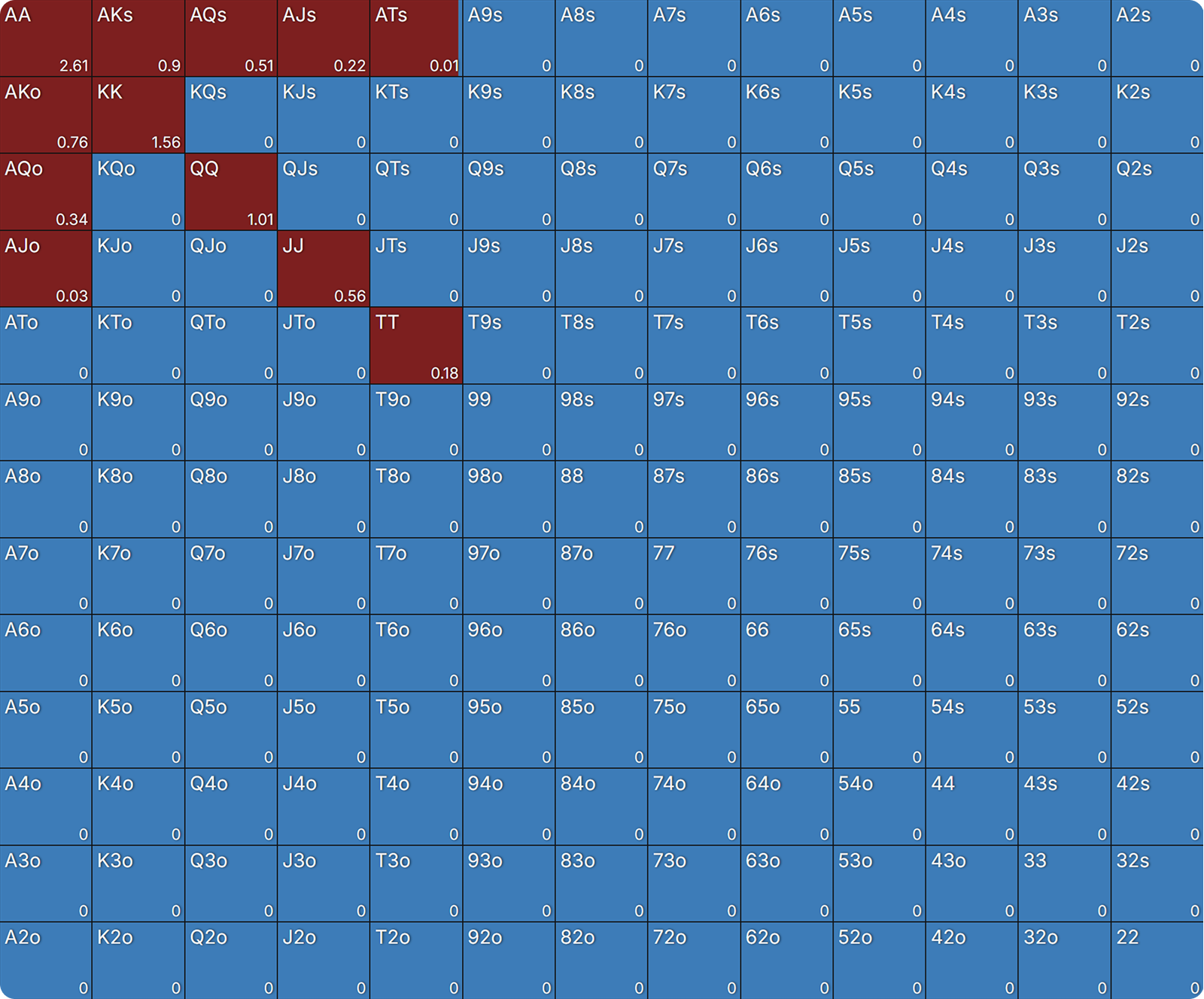
Let's compare this to a similar scenario, but when we only have 4bbs on the bubble.
{{width: 75%}}
{{/width}}
We are much tighter, and this goes against a lot of conventional wisdom. The shorter we are on the bubble, the more ICM pressure there is on us. Locking up that min cash is much more important to the shallow stack on the bubble.
Crucially, perhaps, we have practically no fold equity in this spot, whereas we did when we had 8bbs. As a result, we stick with what is essentially a calling range.
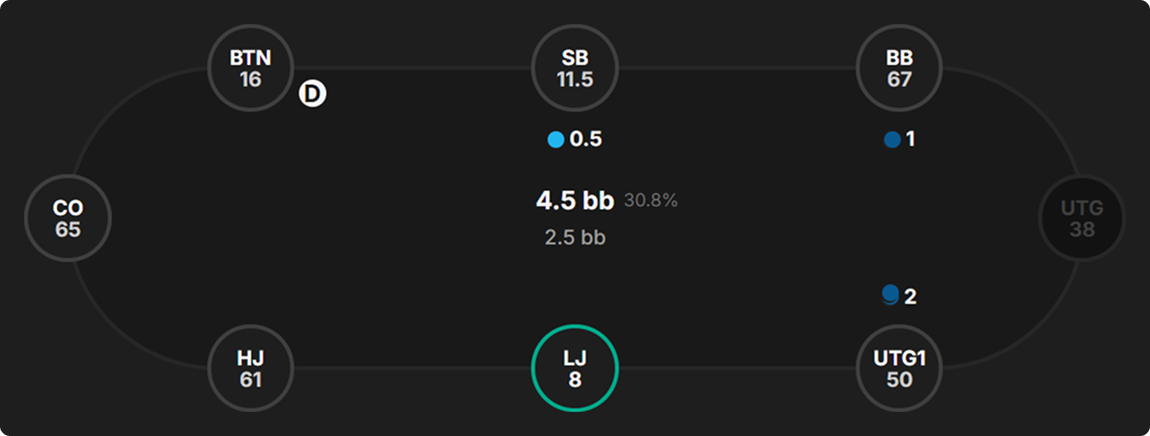
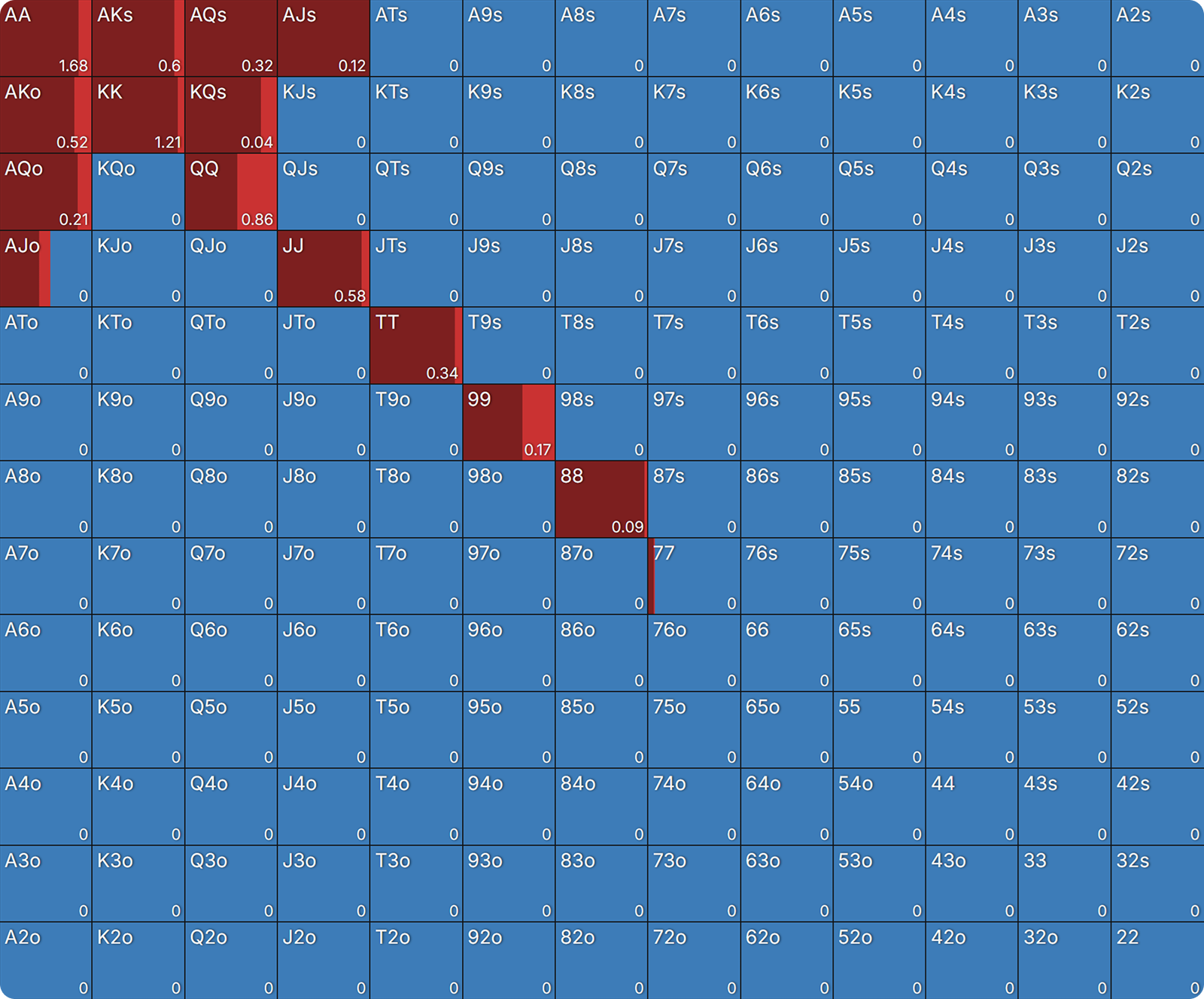
Now let's make a similar comparison but on a final table. First of all, let's look at an 8bb stack facing an open on a final table.
{{width: 75%}}
{{/width}}
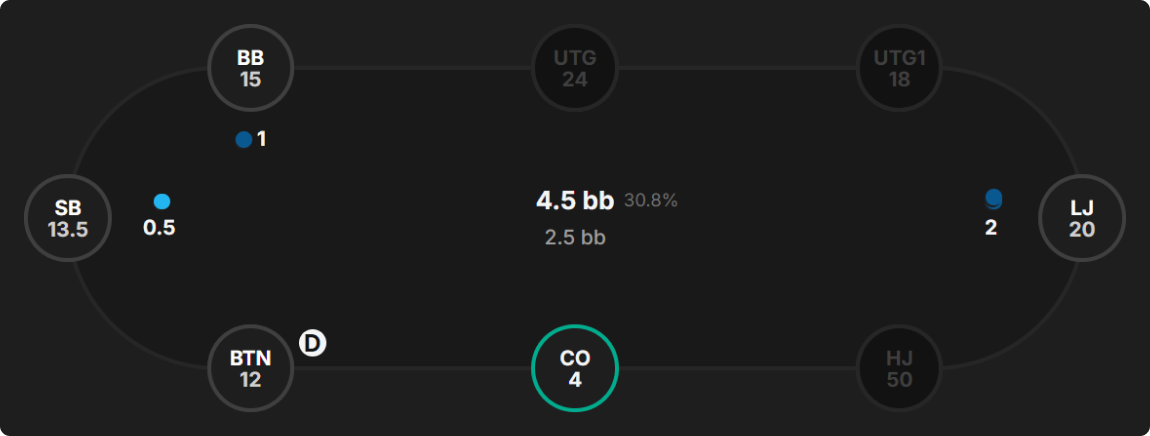
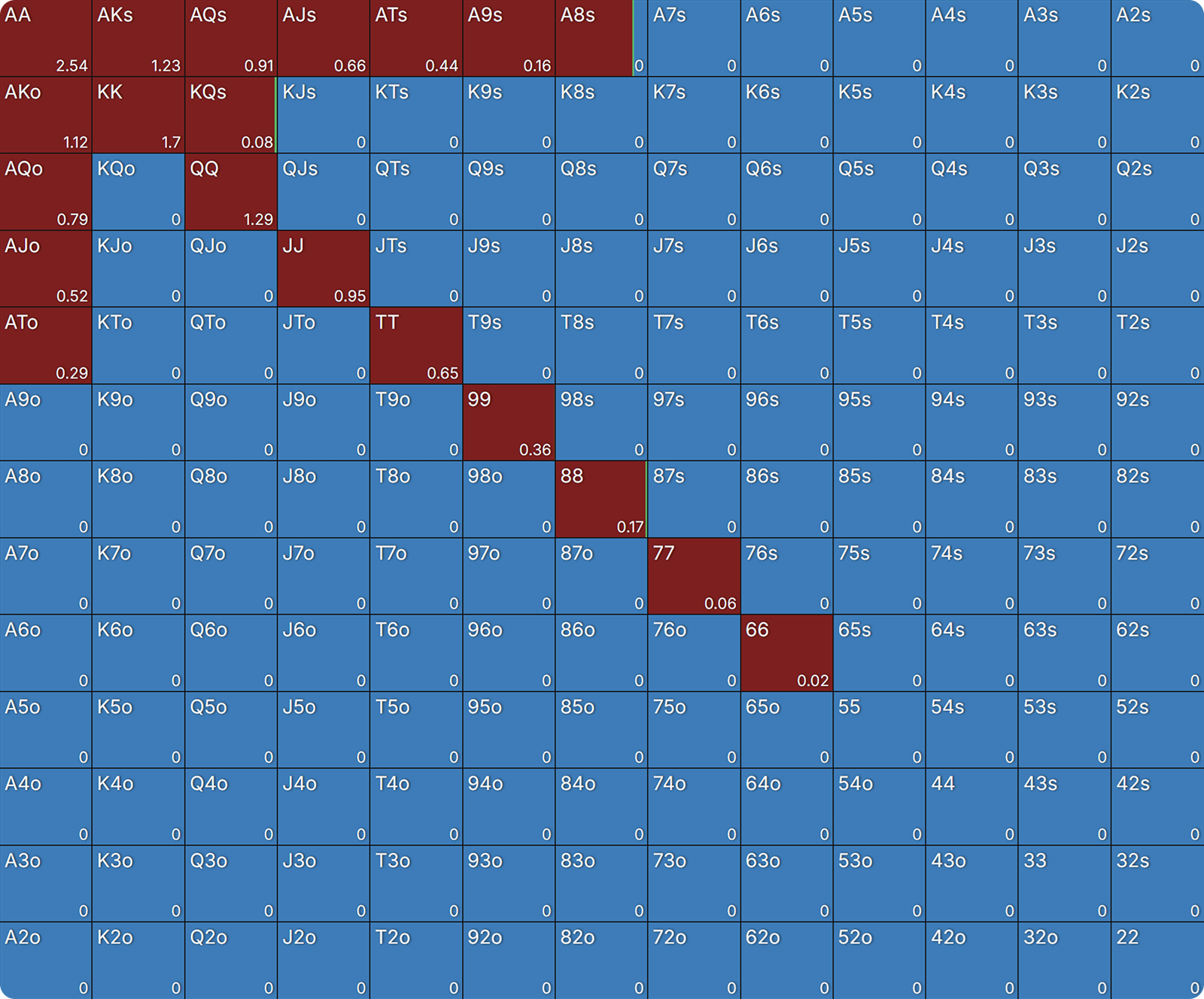
A very similar range to the bubble, to be fair, of strong hands, where we are also happy to get folds. Let's now look at a similar scenario where we only have 4bbs on a final table:
{{width: 75%}}
{{/width}}
This is a much wider range. On the bubble, our range contracted as we got shorter, but here it has expanded. We are not expecting calls here, we are looking for a double up. Because, as we have already stated, the upside of doubling is much greater for short stacks on a final table than it is on a bubble.
Defends
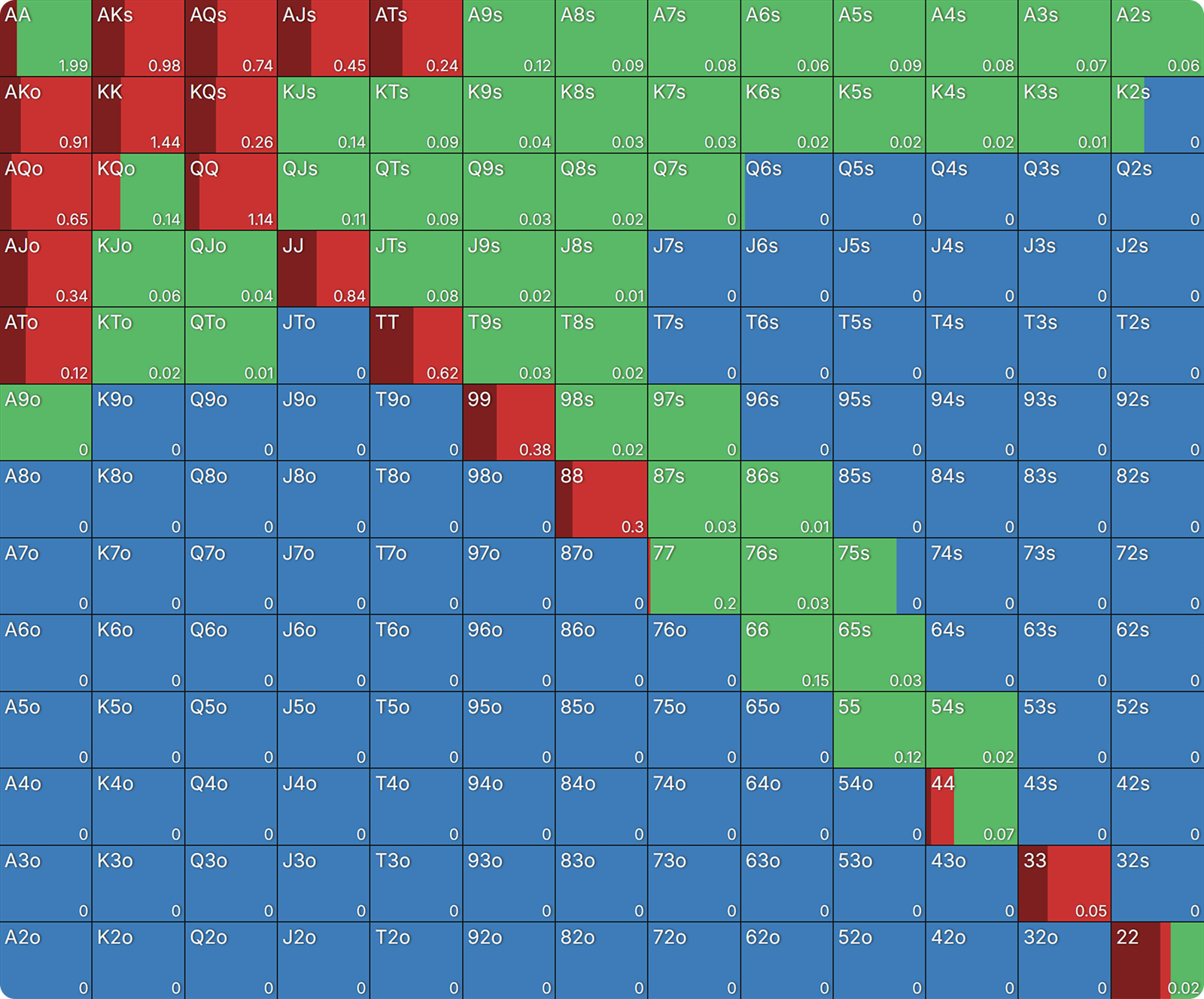
Let's conclude preflop by looking at Big Blind Defence. Here, a Big Blind with 8bbs is facing an open on a final table:
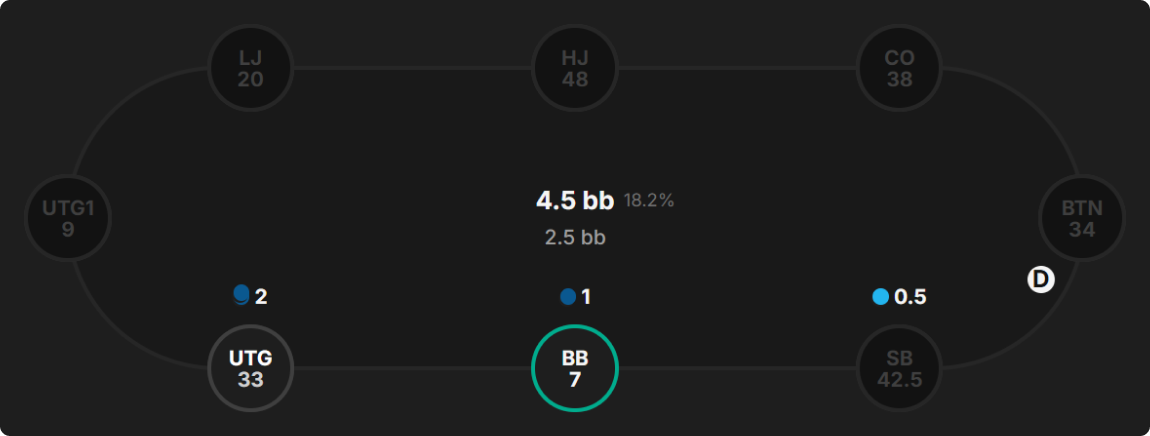
{{width: 75%}}
{{/width}}
This defending range is much tighter than we would see in ChipEV. It is missing all the weak suited hands that would typically call.
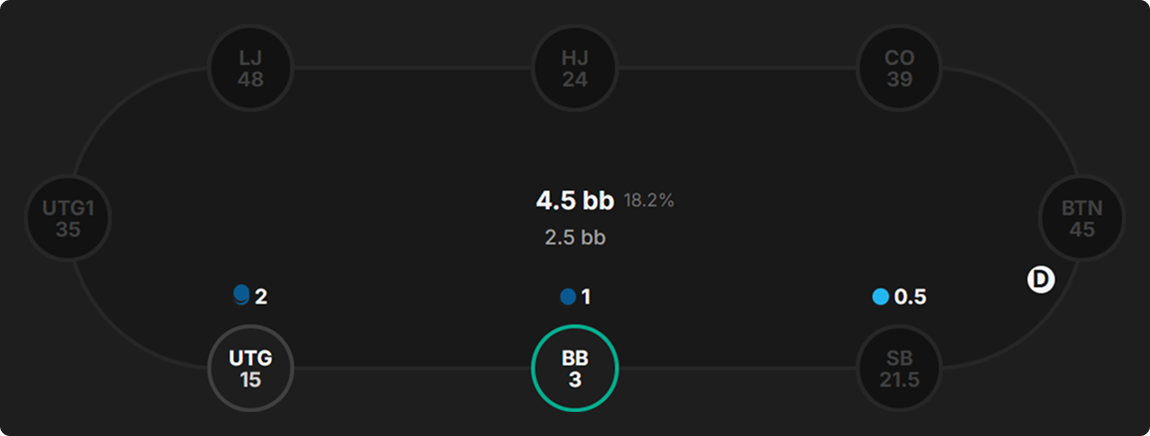
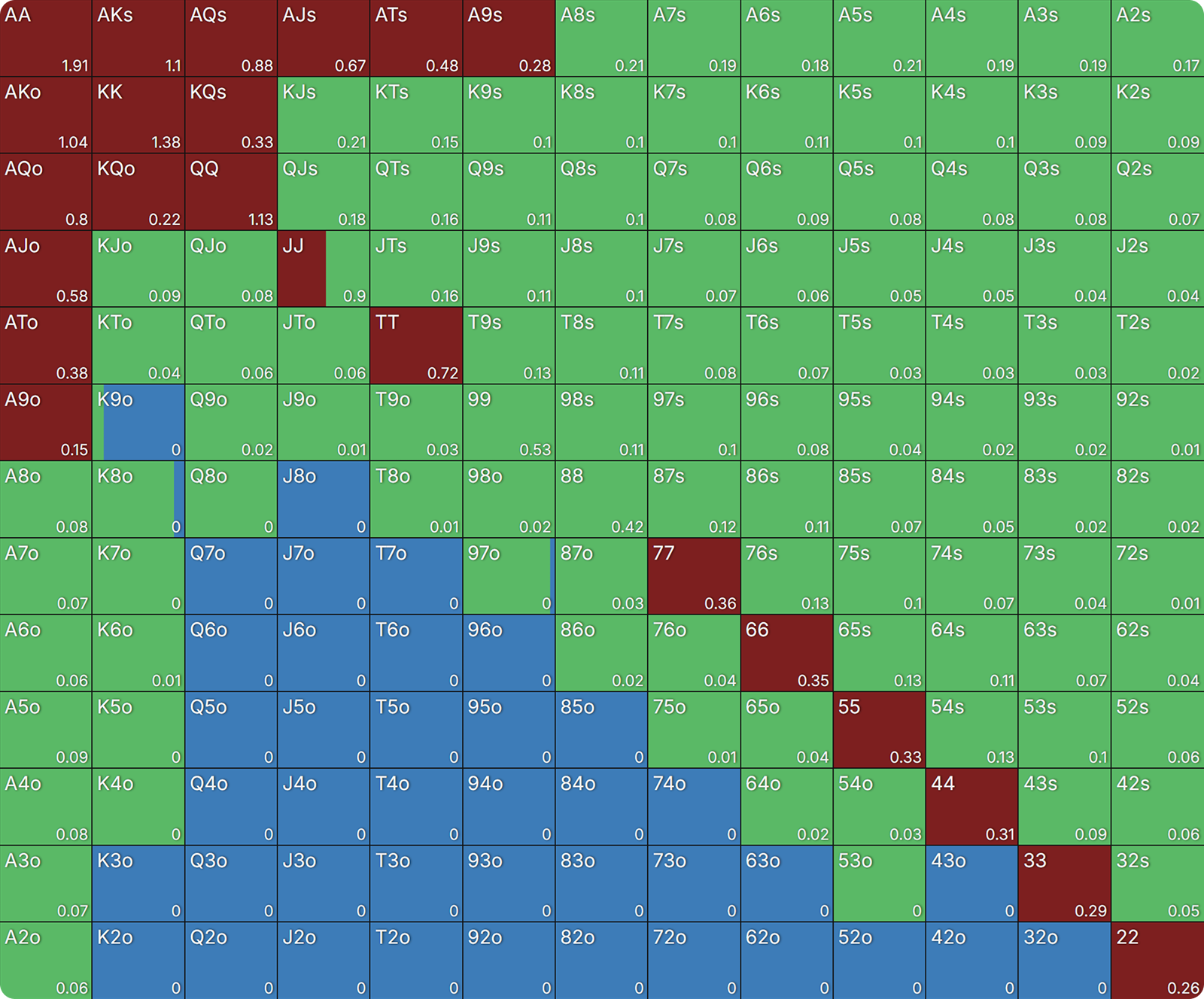
Let's now look at a similar scenario when we are 4bb stack in the Big Blind on a final table:
{{width: 75%}}
{{/width}}
This is a very wide defending range. We are essentially looking to hit a flop in any way and put the rest of the money in with this range. Again, we are looking for a double rather than looking to maintain our position.
Post flop
Let's end with a brief look at post flop strategy, which is too vast a terrain to explore in any particular depth here.
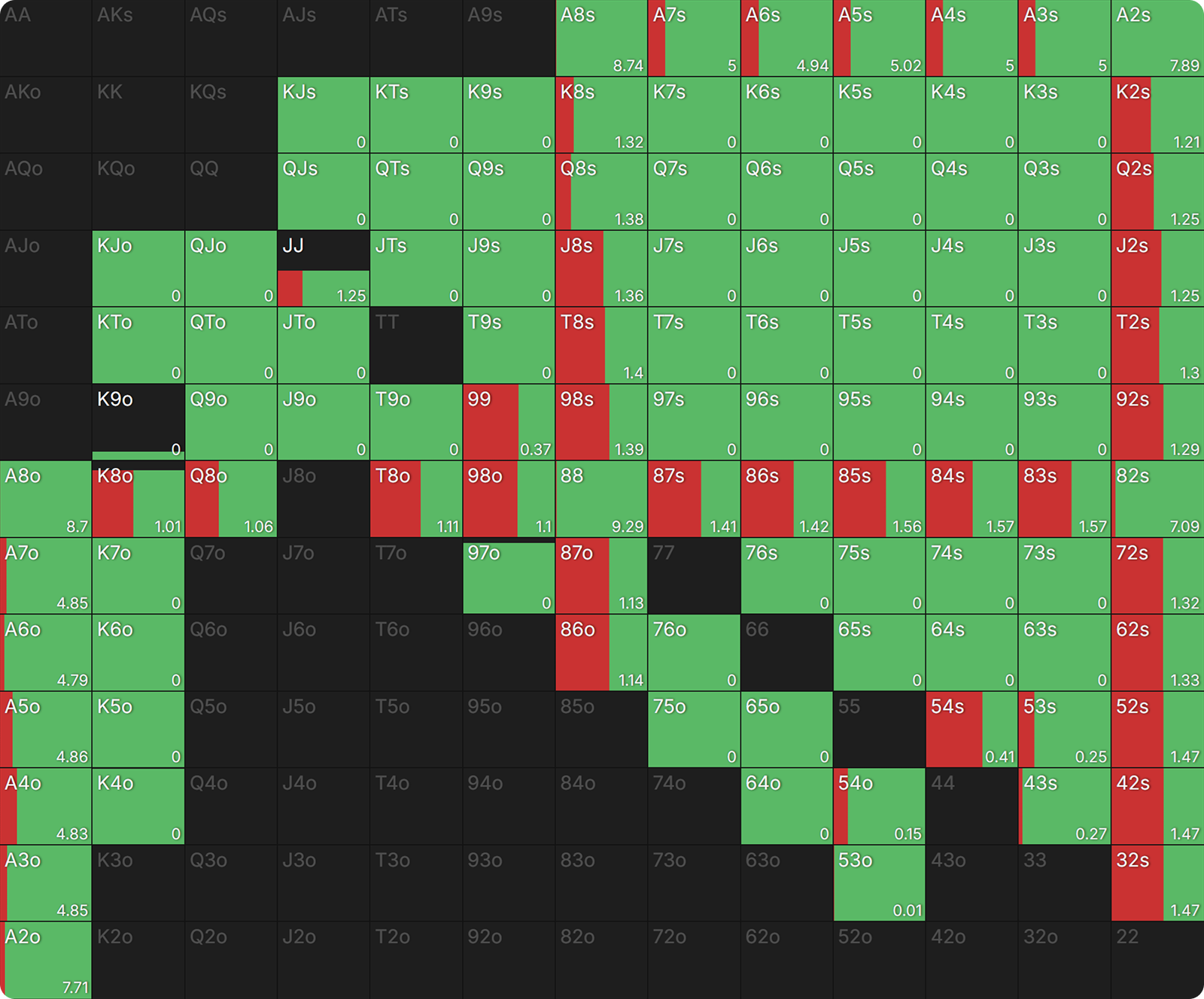
Let's continue the last hand we looked at, where we defended off a 4bb stack. We call, and the flop is A82 rainbow.
This is the Big Blind's first action:
{{width: 75%}}
{{/width}}
The really interesting thing here is, despite both the ICM pressure and the significant range advantage from UTG, we actually lead into our opponent a lot of the time here with a shove. This is the classic "Stop and Go" strategy. It is normally employed to deny equity on low boards and to avoid having to see all five cards. In this instance, UTG calls 100% of the time, so it's really just a value bet.
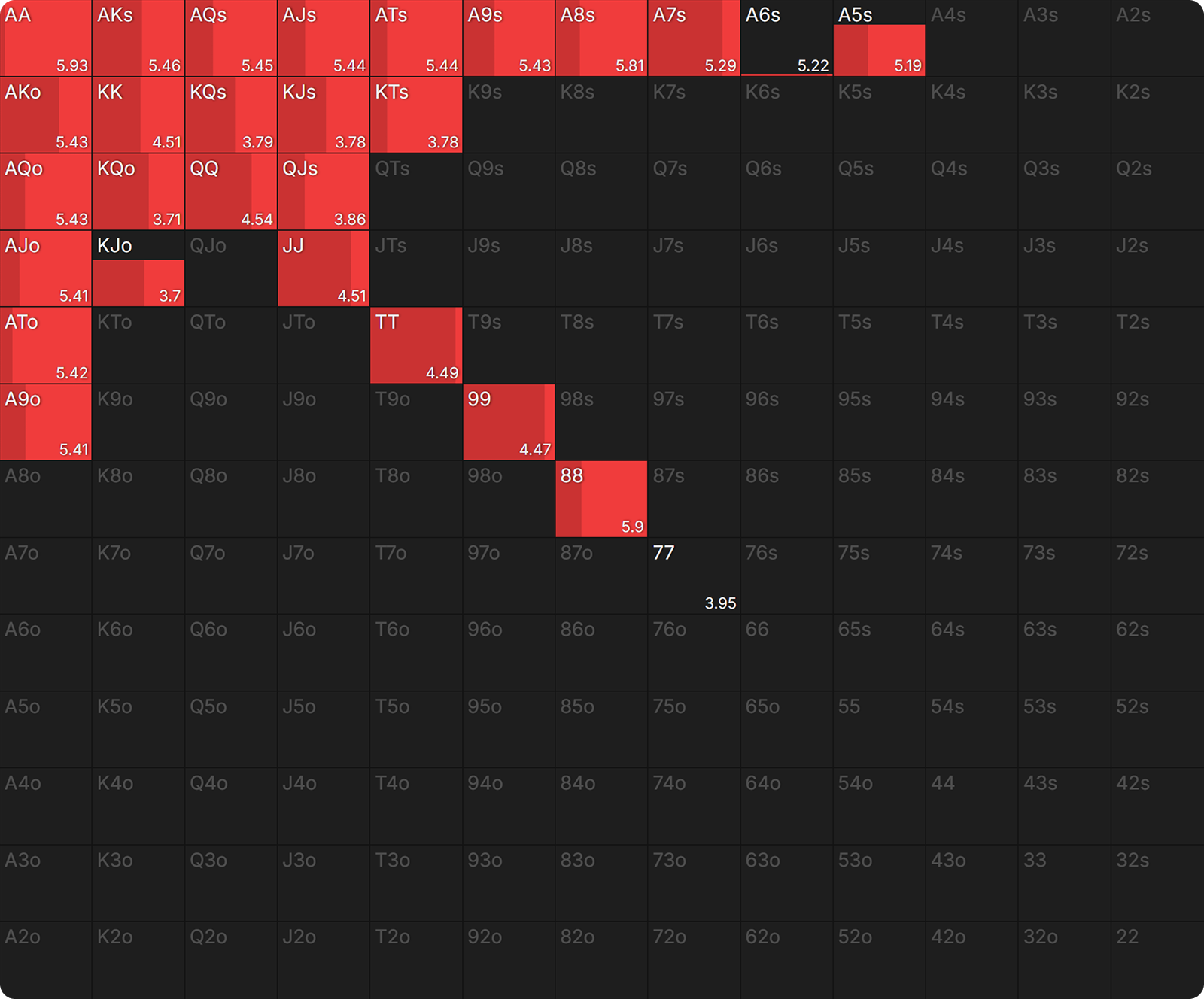
When we check, UTG bets 100% of the time:
{{width: 75%}}
{{/width}}
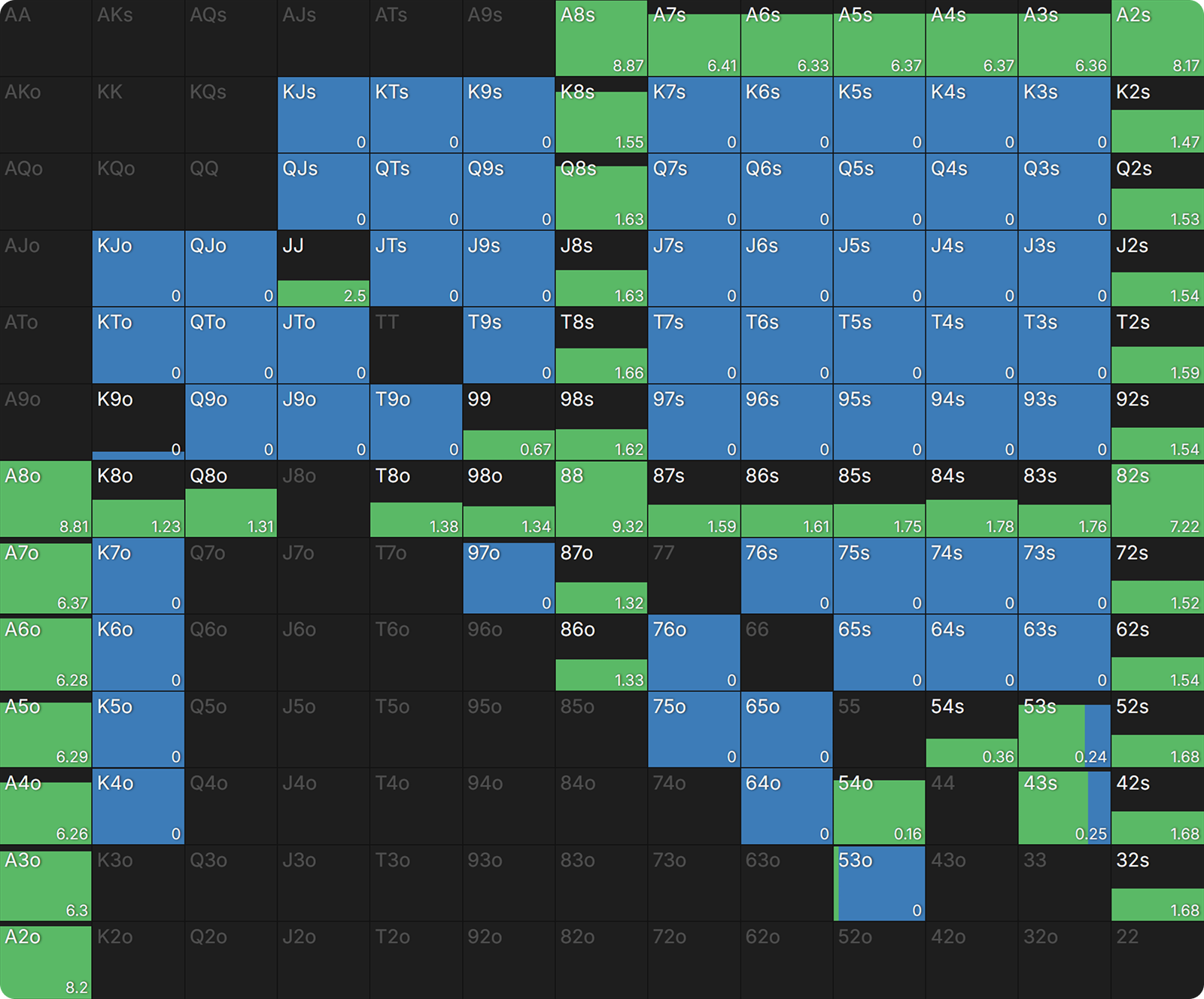
When they do shove 36% pot, this is the big blind's response:
{{width: 75%}}
{{/width}}
They call if they have made a pair, and they fold otherwise. I've highlighted this example to show that, despite being extremely short stacked, we do still have folds at this depth. This includes hands like KJs, which I think a lot of people would throw caution to the wind and call with here just because it has a smidgen of equity (even more so if it has a backdoor flush draw).
Conclusion
In the endgame, shallow stack strategy is typically tight. The upside of doubling is never as much as the downside of being eliminated. So we have to proceed with caution.
Having said that, there is a seismic difference between how a short stack should approach bubbles versus final tables.
On a bubble, the short stacks' equity is tied up in the min cash. Doubling up does not dramatically improve their position and certainly doesn't significantly help their chances of making the final table or winning the event. Therefore, they should be extremely tight because this is when the most ICM pressure is on them.
However, at a final table, those big money prizes are within reach, even to the short stack. Doubling up significantly increases their chances of winning the whole tournament or at least laddering for another pay jump. There is relatively much less ICM pressure on a short stack at a final table, and the upside of them doubling is much greater.

Playing Under 10bb – Part 1: cEV
The solvers have shown us that short stack strategy can still be very nuanced, and as you will see today, most players are probably punting too much when they find themselves with a micro stack.

Register Late, Win More: The Math Behind Smarter Tournament Entry
The immediate positive impact on ROI of late registration can be quite significant. This article analyzes real-world tournament examples to study two variables related to late registration, with a focus on maximizing profitability:
Tournament Poker’s Hidden Stakes
In this era of game theory and solvers and poker games running at a huge variety of stakes at venues all around the world, as well as on dozens of apps and online poker sites, it’s easy to forget that, for the majority of its existence, poker has been a game of hustlers.