The 3 Biggest Leaks Killing Your Winrate


Overview
You are studying and working hard, but your results still aren’t where you want them to be. Does this sound familiar?
Most players tend to focus on implementing new strategies or trying out fancy lines, but often forget where most of their EV comes from. In what follows, we will examine three critical leaks that will kill your win rate in low- and mid-stakes environments. By the end of the article, you will be able to exploit your opponents on a deeper level, and you will have discovered one of the most overlooked reasons why most players will never make it to elite ROI. Without beating around the bush, let’s examine the first mistake!
1) Bluffing Into Strong Ranges
When we think about common misconceptions in low- and mid-stakes poker, there’s one that often comes to mind: “Bluffing doesn’t work; no one is folding.” Statements like this are very simplistic. The answer to the question of whether bluffing a spot works is similar to other poker questions: “It depends.”
The average low- to mid-stakes player makes numerous errors. This includes situations where their range becomes too weak, allowing us to put a lot of pressure on them. There are also spots where our opponents do not realize how much they are meant to defend because of how wide both ranges are, leading to lots of over-folding.
But there is also the other side, where we face a player with a range that’s stronger than it should be. Large amounts of big blinds can be burnt by sticking to our default strategy without exploitative adjustments. We’ll explore two examples that explain the mistake of bluffing into strong ranges and how to figure out what to look for to never do it again!
1.1) Responding to an Under 3-Betting BB (Preflop)
Let’s imagine the following scenario: We are opening from UTG with A4s in a 6-max cash game, and the BB 3-bets us. We know we want to 4-bet this hand occasionally, so we proceed aggressively, in line with the commonly given advice of aggression wins. Shortly after, we get jammed on and have to fold.
Mindlessly following a default game plan is never a good idea. To achieve a high-winning strategy, we must understand our approach and what our opponent is supposed to do in the first place! Let’s look at what the BB is supposed to 3-bet and our 4-betting strategy in response.
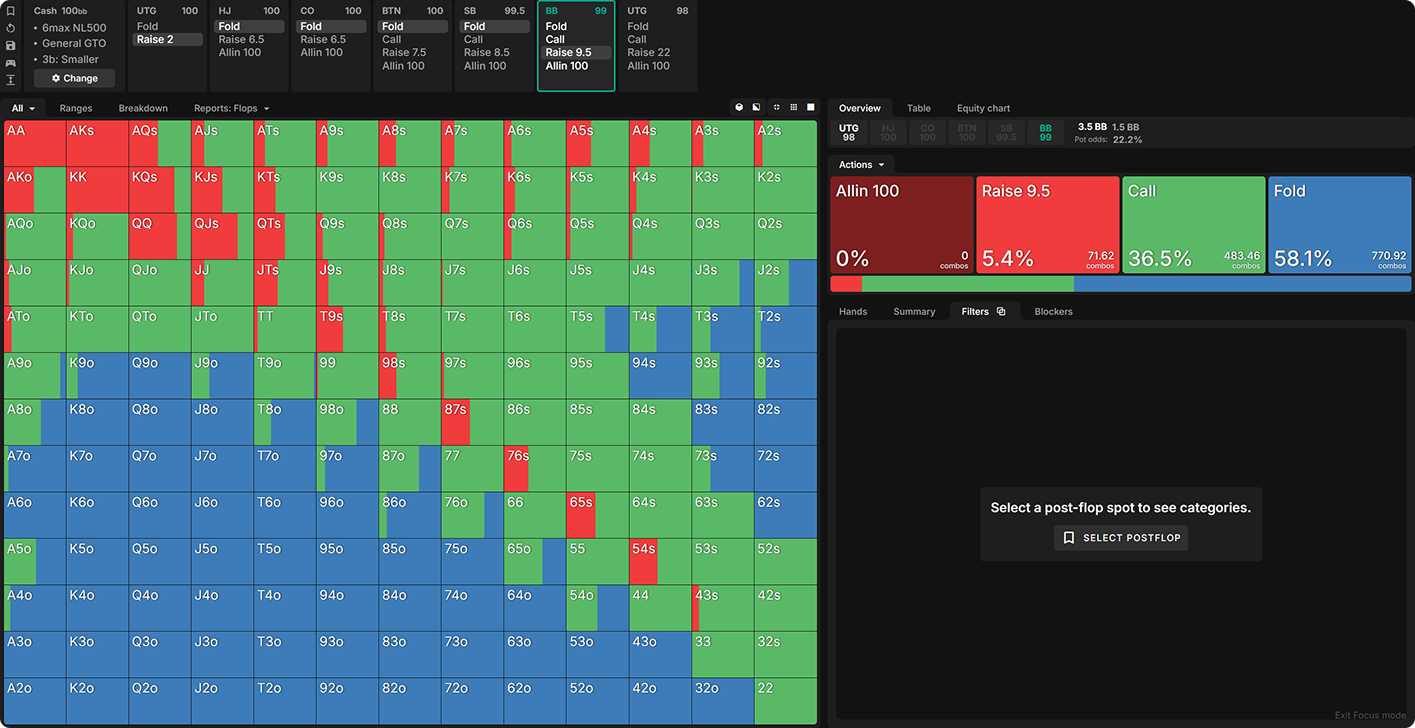
In this simulation, where the BB has the option to 3-bet to 9.5bb, they are supposed to do that with 5.4% of their entire range against UTG’s min-open. All the best pocket pairs, high Ace-x, and strong broadways feel very natural. However, the weaker suited Ace, King, and Queen-x hands, as well as the lower suited connectors, can bring up question marks. The explanation of this strange-looking range is that the BB wants to polarize when 3-betting.
The BB is a unique seat; it’s the only position that has already invested money into the pot without having anyone behind them. This means they get a reasonable price to complete and don’t need to worry about a squeeze from players left to act. Hands that usually 3-bet are becoming frequent calls. The reason is that 3-betting loses appeal when there are fewer and fewer players behind to deny, whilst we still could get denied ourselves when the original raiser gets the option to 4-bet. There are specific hand classes that would greatly regret having allowed that to happen. Coincidentally, calling becomes more attractive due to the already invested big blind. This hollows out the BB’s 3-bet range, only consisting of “nutted” hands in the value region. For the purposes of balance, board coverage, and EQ denial, the BB mixes in some of their weaker-looking holdings that still perform relatively well when they get called.
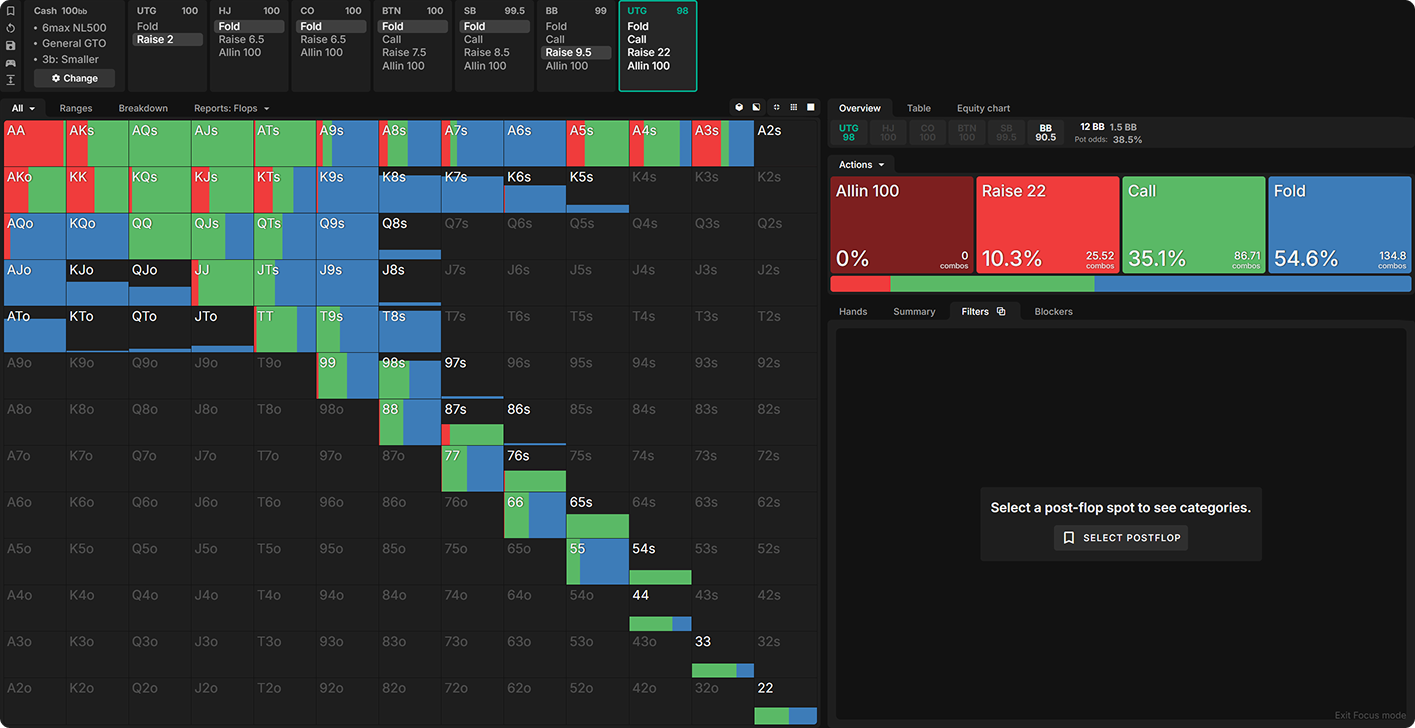
The response of UTG’s range versus BB’s polarized 3-betting strategy already looks quite tight. Our best pairs and AK feel very natural as 4-bets, since they are strong enough to stack off. Like the BB, the UTG player uses certain hand classes, usually located at the bottom of the calling range, as 4-bet bluffs. Hands such as AQo, A4s, and KJs block a large part of BB’s value 3-bet range, don’t care much about getting jammed on, and perform relatively well vs. call. However, note that most of our 4-bet bluffs are indifferent to folding, meaning they gain 0EV by continuing.
The reality is that the population lacks 3-bets with “creative” hand classes. Mass data analysis shows that the BB is heavily under 3-bet. Even slight deviations by the BB (resulting in a stronger range) cause problems for our close hands, as all our 4-bet bluffs and indifferent calling hands now start to bleed money.
The natural question then is: What will help me to identify if someone is being too tight from the BB (and how can we take advantage of that)?
- If you are playing online, you can use a heads-up display (HUD) to track how often the BB is 3-betting versus different positions. Studying the BB’s GTO 3-bet frequencies will give you a good idea if your opponent is too aggressive or too passive. If you have neither a read nor HUD data, sticking to mass data analysis and over-folding is usually a good approach, especially if you face weaker opponents.
- Keeping a record of showdowns becomes even more critical when playing live. If you spot deviations from your opponents, remember them for future decisions. The more present you are for what is happening on the table, the greater the harvest.
- When facing overly passive opponents, skip the 4-bet bluffs and over-fold.
- When facing overly aggressive opponents, depending on how they respond to 4-bets, we usually want to increase our 4-bet bluffs with hands that don’t perform very well postflop (typically offsuit combos), and increase calls with hands that dominate our opponent’s bluffing range. But as soon as they call too much of their aggressive 3-betting range, we start to 4-bet with a wider, more linear range and skip 4-bet bluffs.
1.2) Responding to Tight River Ranges
To illustrate the mistake of bluffing into strong ranges even further, let’s examine a postflop situation. We find ourselves in the following spot: We open the SB, and a very tight-passive BB defends. We check-call a flop bet of the BB on 8♠5♠2♥. The T♦ turn gets checked through. On a flush-completing K♠, we go for a small (20%) block bet but get raised.
Let us take a closer look at how thin the BB is supposed to raise. We can do that by filtering for the top and second pairs.
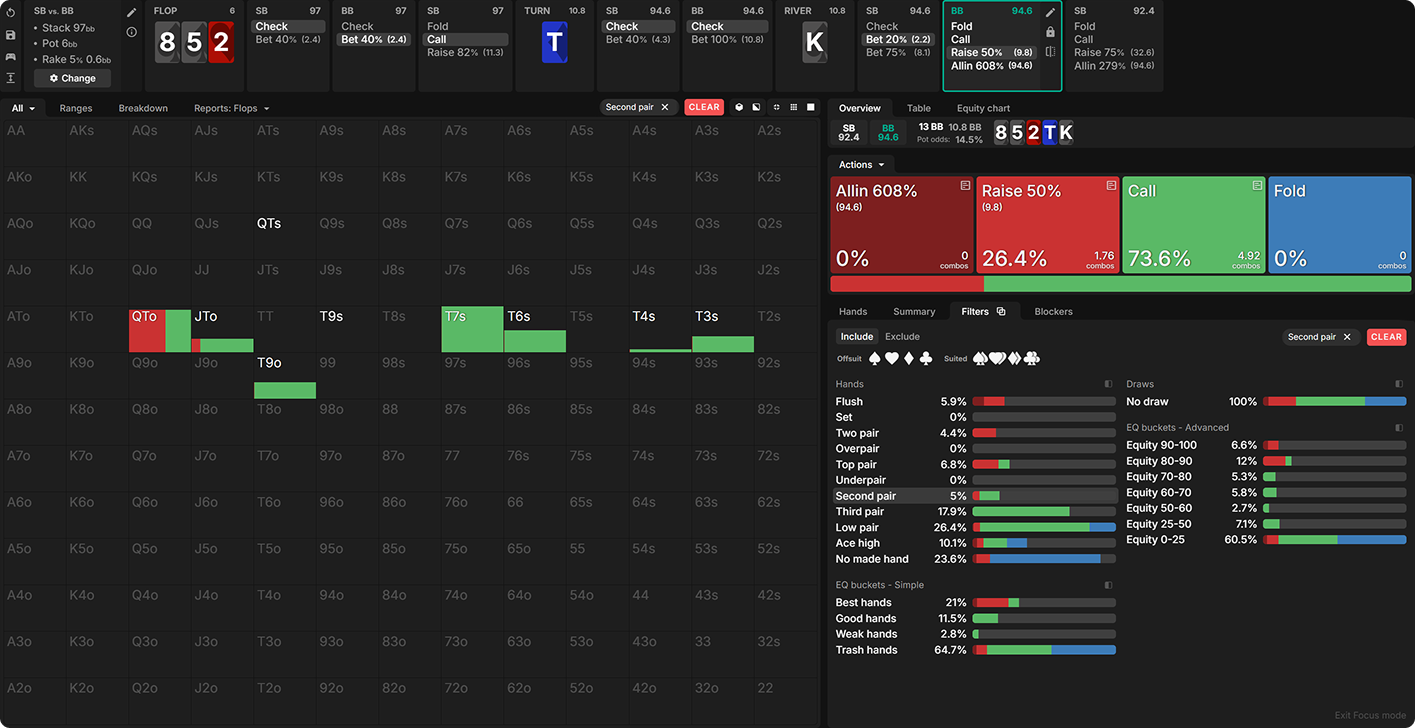
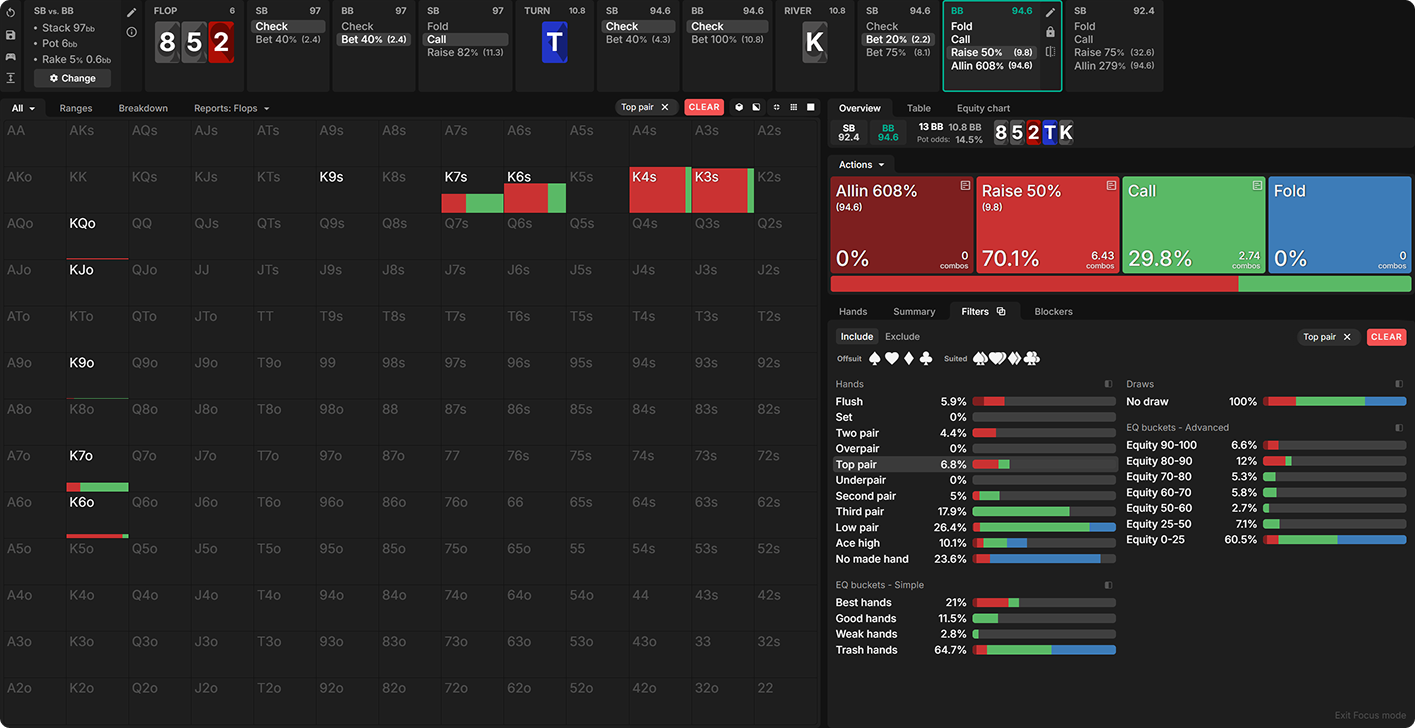
The BB is supposed to raise roughly 35% of second pairs and ~80% of top pairs on the river. As we know, the BB is a very tight, passive player. The chance that they will find enough thin value-raises of this kind is very small. Raising second pairs on an overcard and flush-completing river feels unnatural for many players. A nitty, passive player will also likely not find enough bluffs. To illustrate the extreme amount of money that can be leaked when bluffing into nutted ranges, I’ll run a fun little experiment.
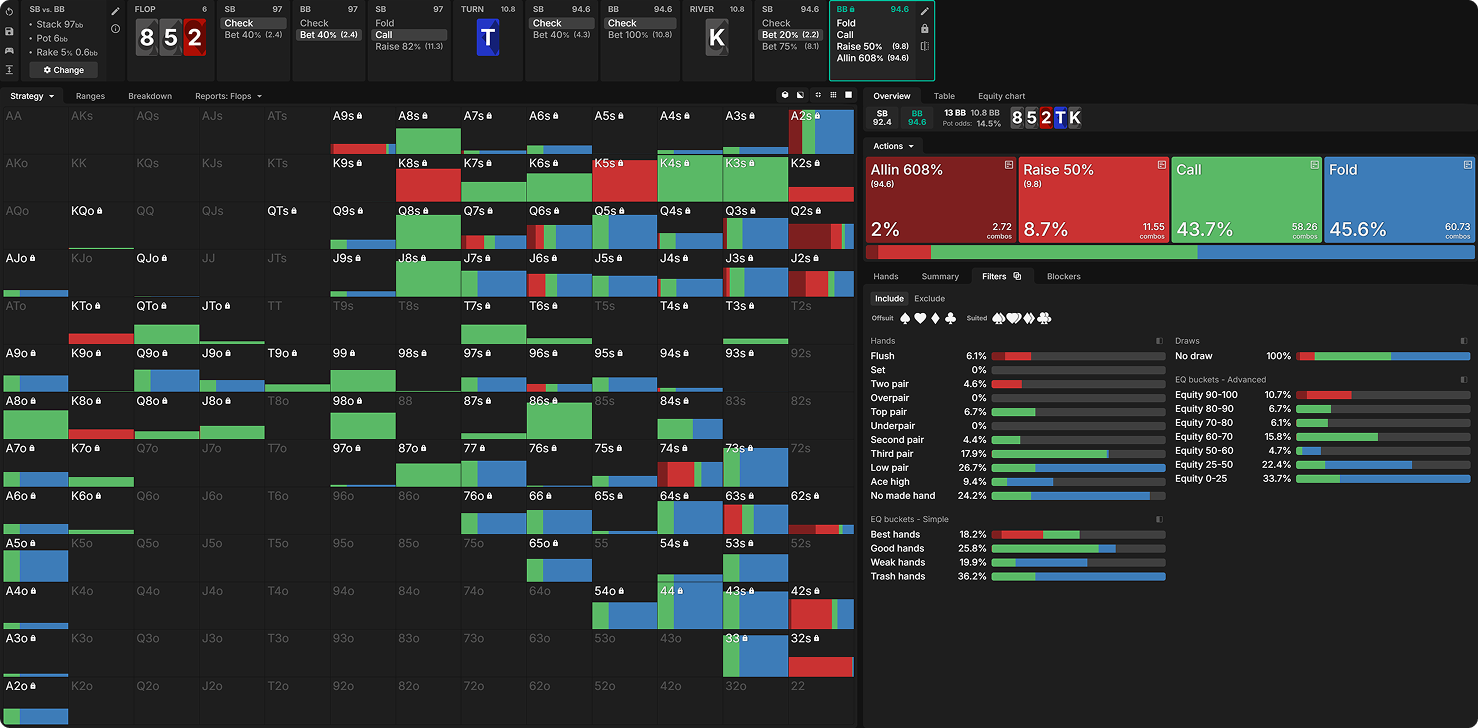
Let’s assume the Villain is purely calling all second and top pairs, has no bluff-raises, and is over-folding their bluff catchers. These are all tendencies of the nitty, passive player type.
To make things more visual, here are both of BB’s ranges: the GTO raising range and the adjusted, passive one.
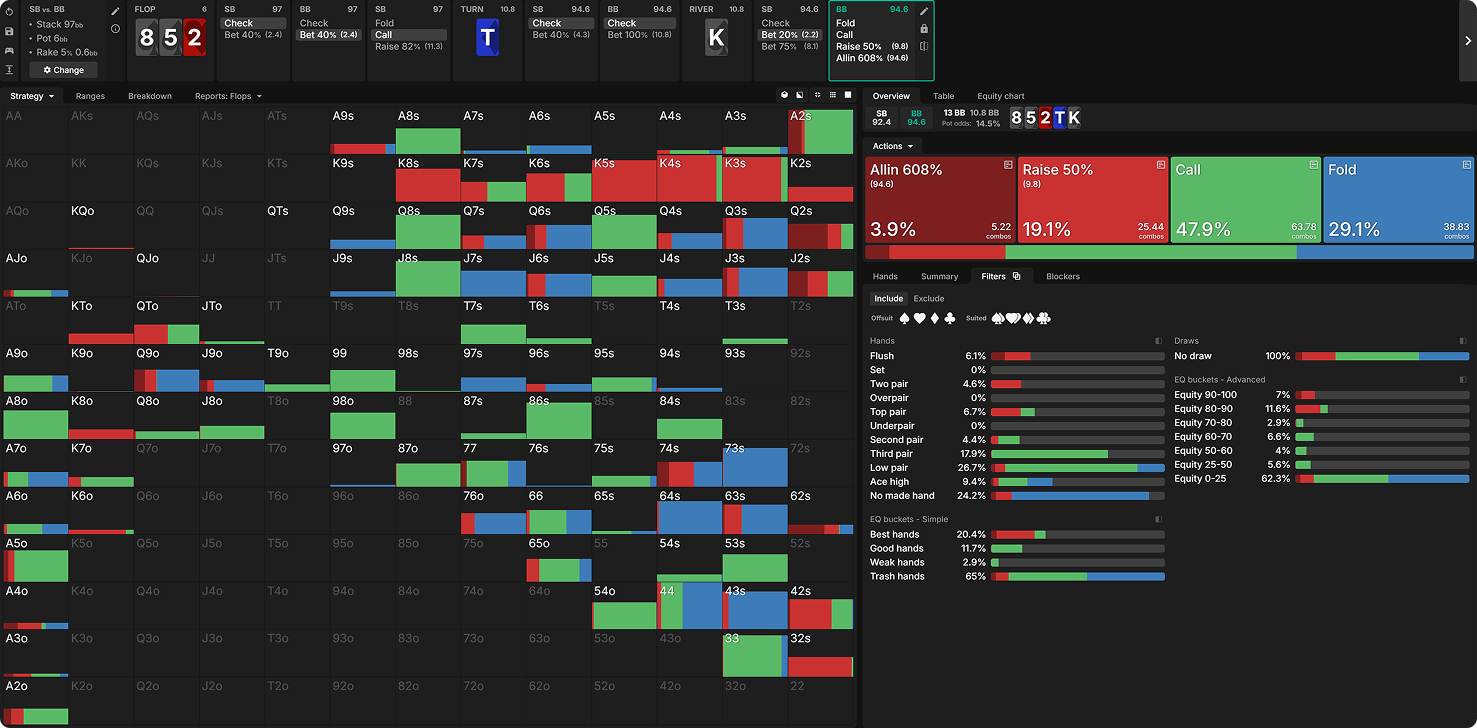
↑ BB response vs SB’s 20% pot river probe: GTO
↓ BB nodelocked (too tight and passive) response vs SB’s 20% pot river probe: Exploitable
The SB’s response is fascinating. Let’s isolate our bluff-catcher region (by filtering for 50% EQ and lower) to see how we are meant to react:
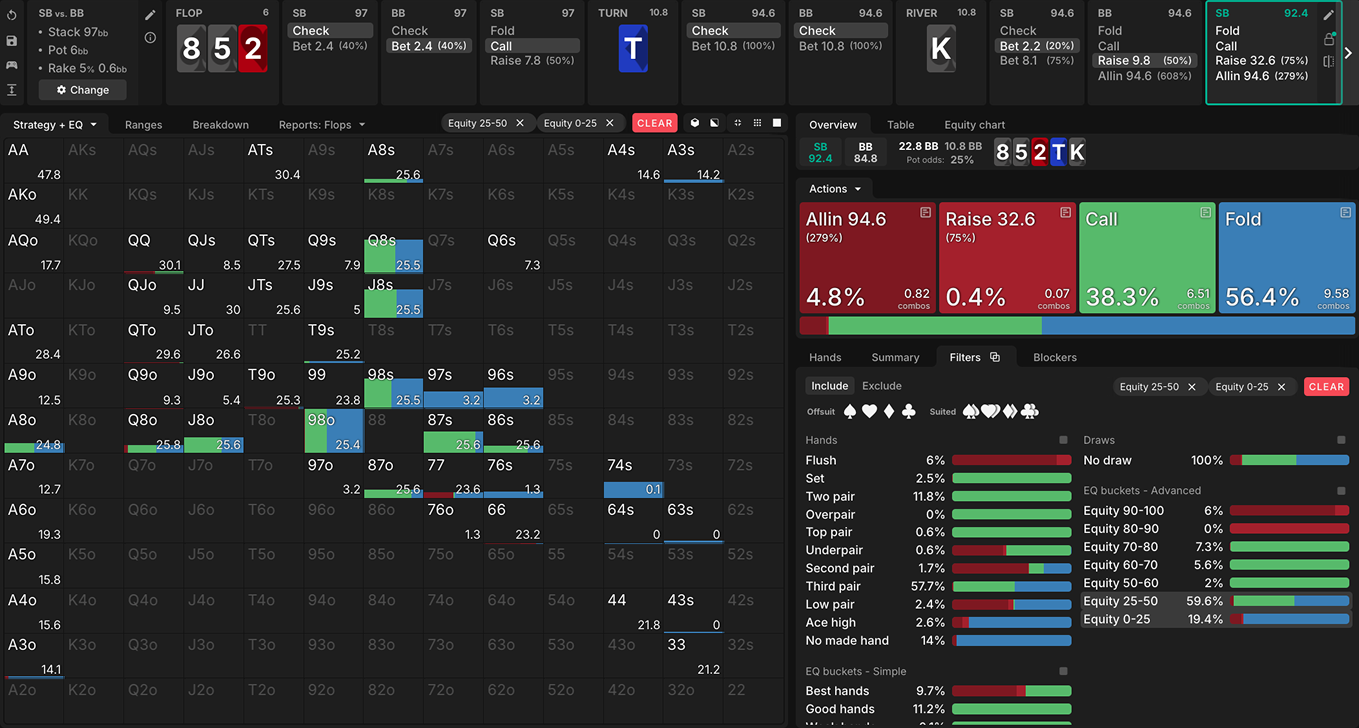
↑ SB response vs BB’s 50% pot river raise: GTO
↓ SB adjusted response vs BB’s nodelocked (too tight and passive) 50% pot river raise: Exploitative
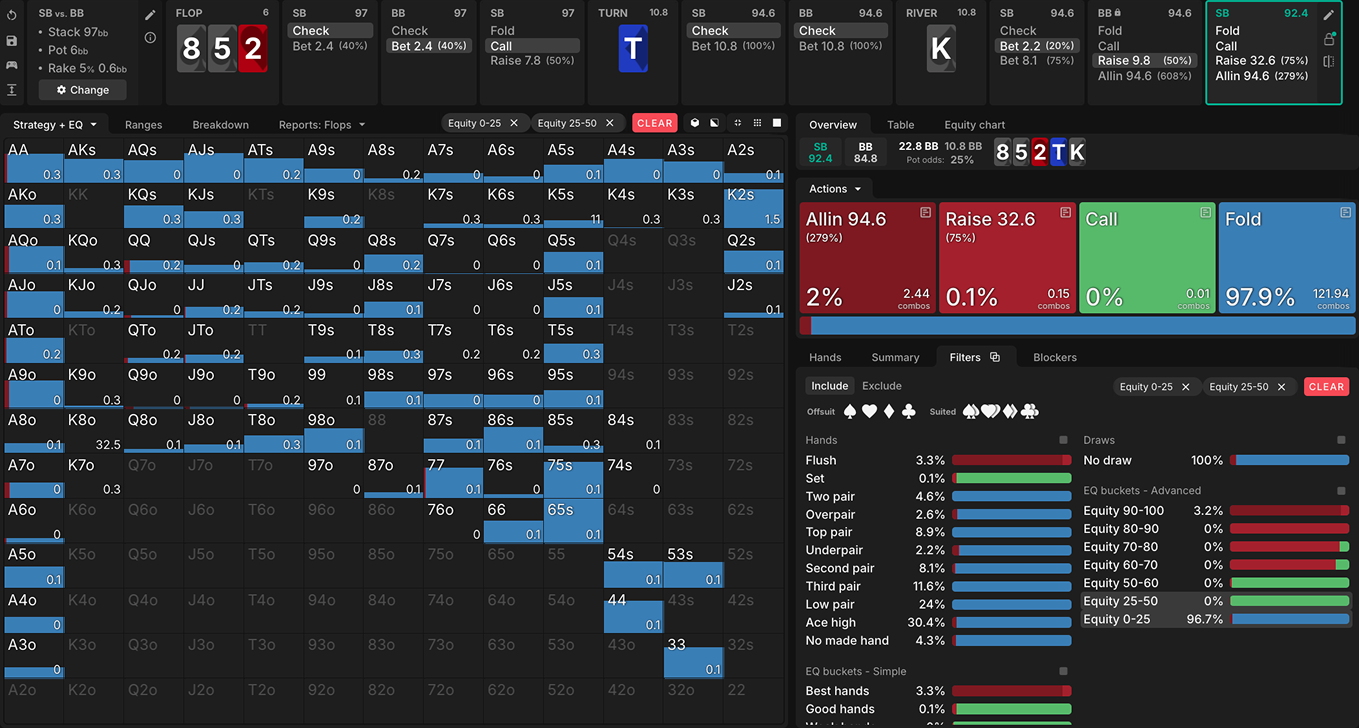
Our response at equilibrium with our bluff catchers versus a perfect opponent is to turn ~5% of hands into bluffs, call ~38%, and fold the rest. The difference when we compare this to the response versus our nitty profile is night and day. We are pure folding with all of our bluff catchers. While these hands need ~25.5% equity to justify a profitable call, they only ever reach that mark in GTO play. Against a nitty opponent, their actual equity is closer to 0%. As a result, there are essentially no calls, and since our value-raising range shrinks, our bluff-raises vanish as well. This experiment teaches us one crucial lesson: The only exploit versus a raise from a nitty, passive player is to over-fold heavily.
We have all been here: we’re holding a very weak hand that has little chance of winning at showdown, our hyperfixation on blockers leads us to believe that this is a good bluffing combo. The problem with this is that we’re completely ignoring the simple fact that our opponent’s range is full of nuts. When a player is not raising thinly enough for value or as a bluff, our continuation range drastically narrows. The hands that make sense to attack by raising again are not in the opponent’s range. We are bluffing into an extremely strong set of hands.
The idea of needing to know where the money comes from is easy enough to understand, but applying it in all the different spots, against all the different player types, is much more challenging. Here are a few additional pointers regarding our current spot to give you a sense of the possibilities:
- Against passive opponents who call too wide, you can value bet thinner (and over-fold to raises).
- Against passive opponents who fold too often, you can bluff more/all of your air (and over-fold to raises).
- But against spewy opponents who raise too much, to the point where they overplay their value and overshoot their bluffs, you can put stronger hands into your small betting range and call off more/all bluff catchers.
If you want to be able to identify mistakes, you first need to know what it means to play flawlessly, i.e., without mistakes. This knowledge comes from studying GTO strategies and the underlying theoretical principles. With this strong foundation to build upon, you can then reach for even higher win rates. That’s where work with our nodelocking feature enters the picture. It can help you understand how to take advantage of the mistakes you identified.
2) Relying on Your Opponent To Grow the Pot for You
Let’s imagine we’re in the following spot: We face a BTN open in the SB while holding AA, so we 3-bet. The BTN calls, and the flop is dealt 752 rainbow.
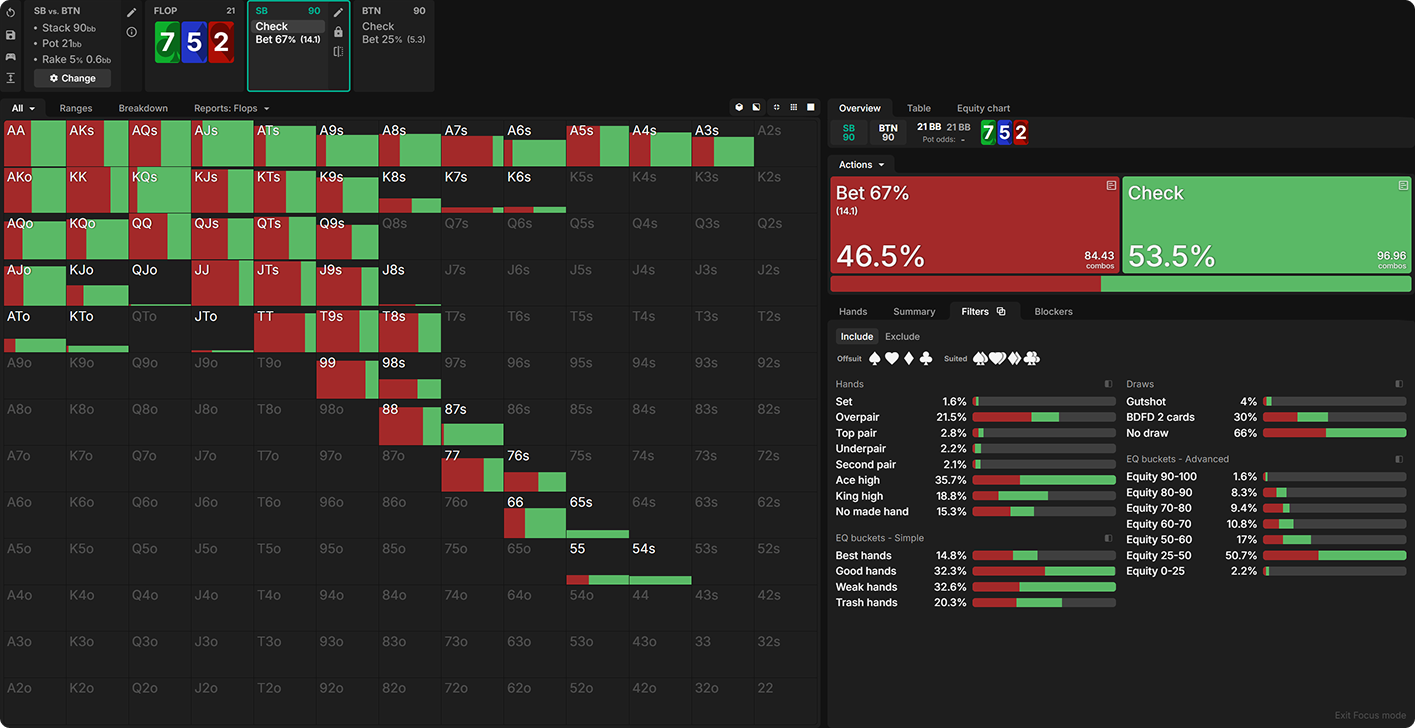
A couple of things catch my eye when looking at the SB’s flop strategy:
- We are checking a large portion of our range.
- We are not just checking no-made hands, we also include overpairs in the passive node.
- The preferred bet size we want to use is a larger one, around ⅔ pot.
Our 3-betting range is mainly built around high cards and pairs. Our entire high card region whiffs, so we can’t bet often. To prevent our checking range from becoming too weak, we include some of our overpairs, especially the least vulnerable ones. If you want to explore 3-bet pots as OOP further, check out these articles for flop, turn, and river!
The flop connects better with the IP preflop defender. Let’s examine how the BTN is supposed to react versus a check from the SB.
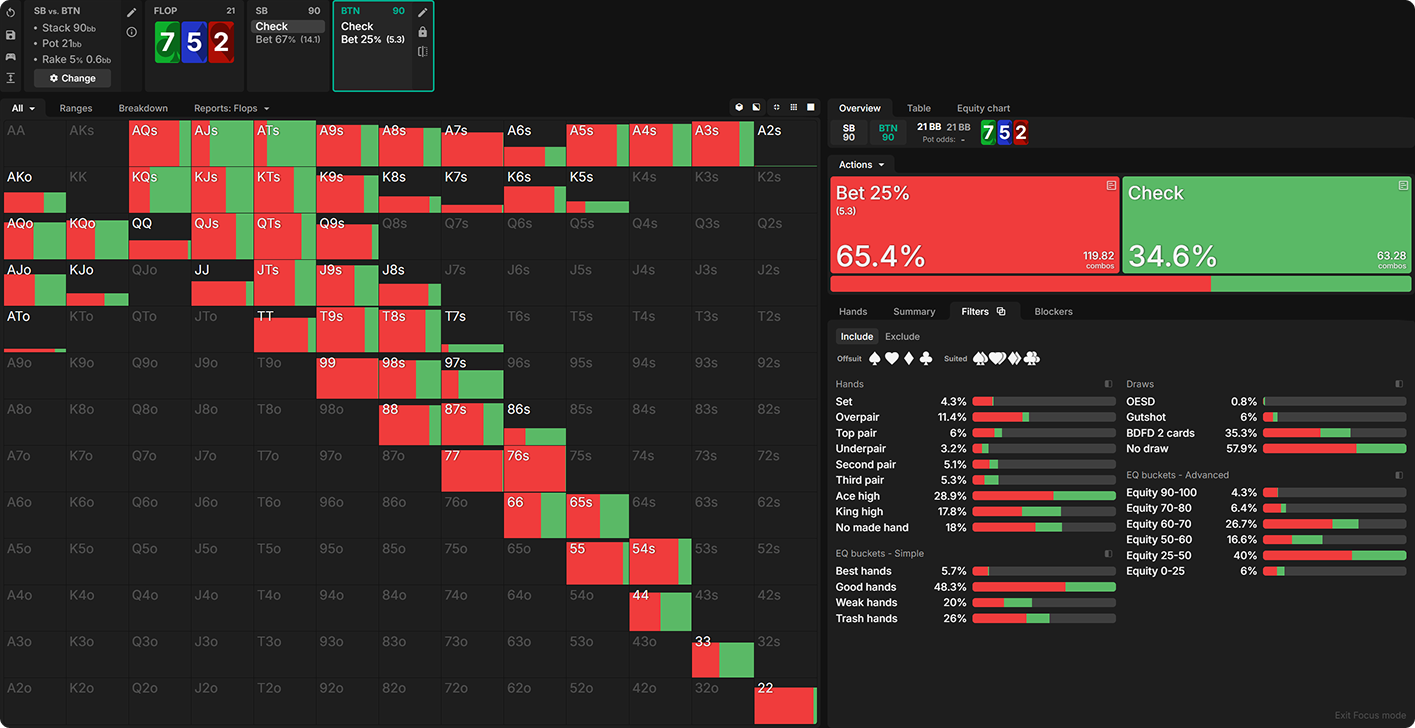
When we give IP the option to use a 25% sizing, the BTN is supposed to bet ⅔ of their entire range. Pairs benefit greatly from denying equity, and 9/T/J/Q-highs are all folding out a decent amount of better hands. The BTN naturally wants to use a small size because their value range is weighted toward lower pairs, which can extract value from some unpaired hands that call or benefit significantly from protection against unpaired hands that fold, but still have to contend with the stronger overpairs that the SB holds more frequently.
Everything seems logical so far. There is only one problem. Failing to adapt to a more passive opponent will blunt our edge. To illustrate the issue, let’s compare how often we want to check our overpairs in the equilibrium solution with a nodelocked solution where IP’s stabbing frequency decreased by just 5%.
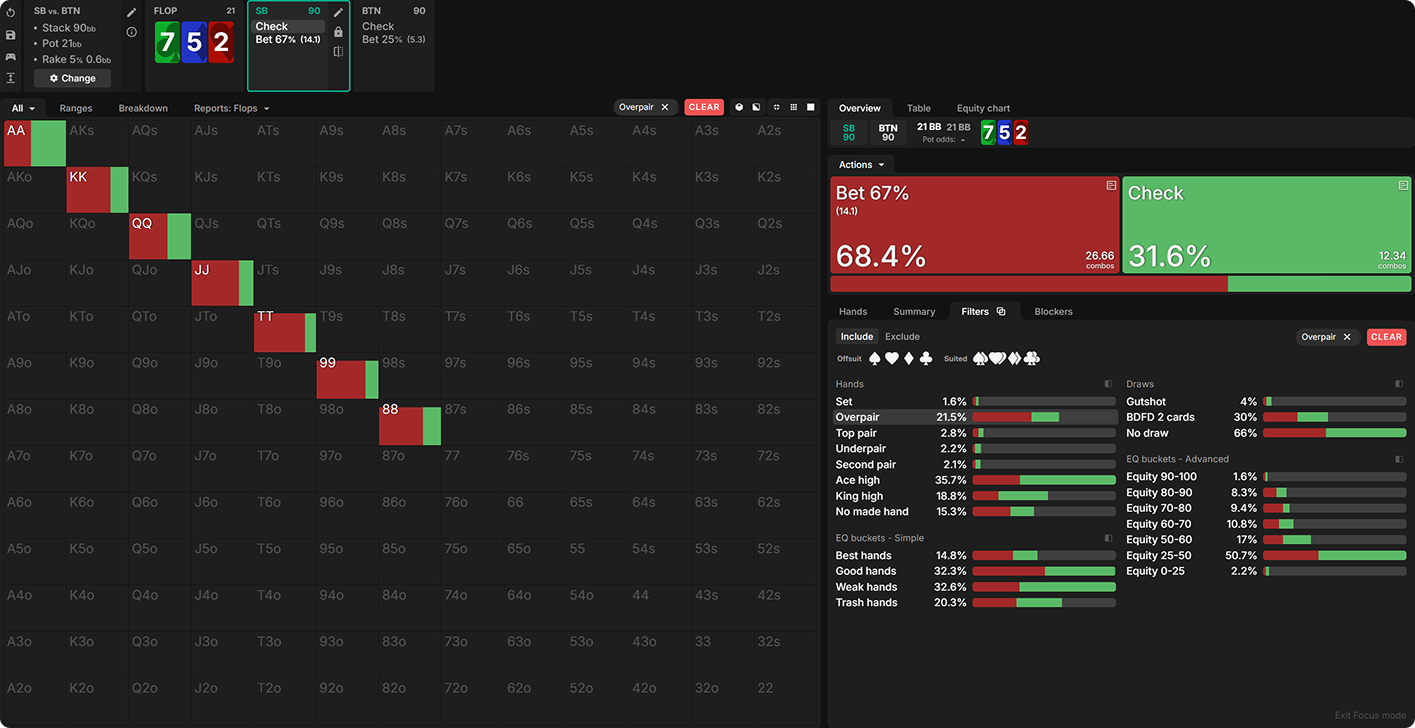
↑ SB c-bet flop strategy filtered for overpairs: GTO
↓ SB adjusted c-bet flop strategy with overpairs vs nodelocked BB (too passive): Exploitative
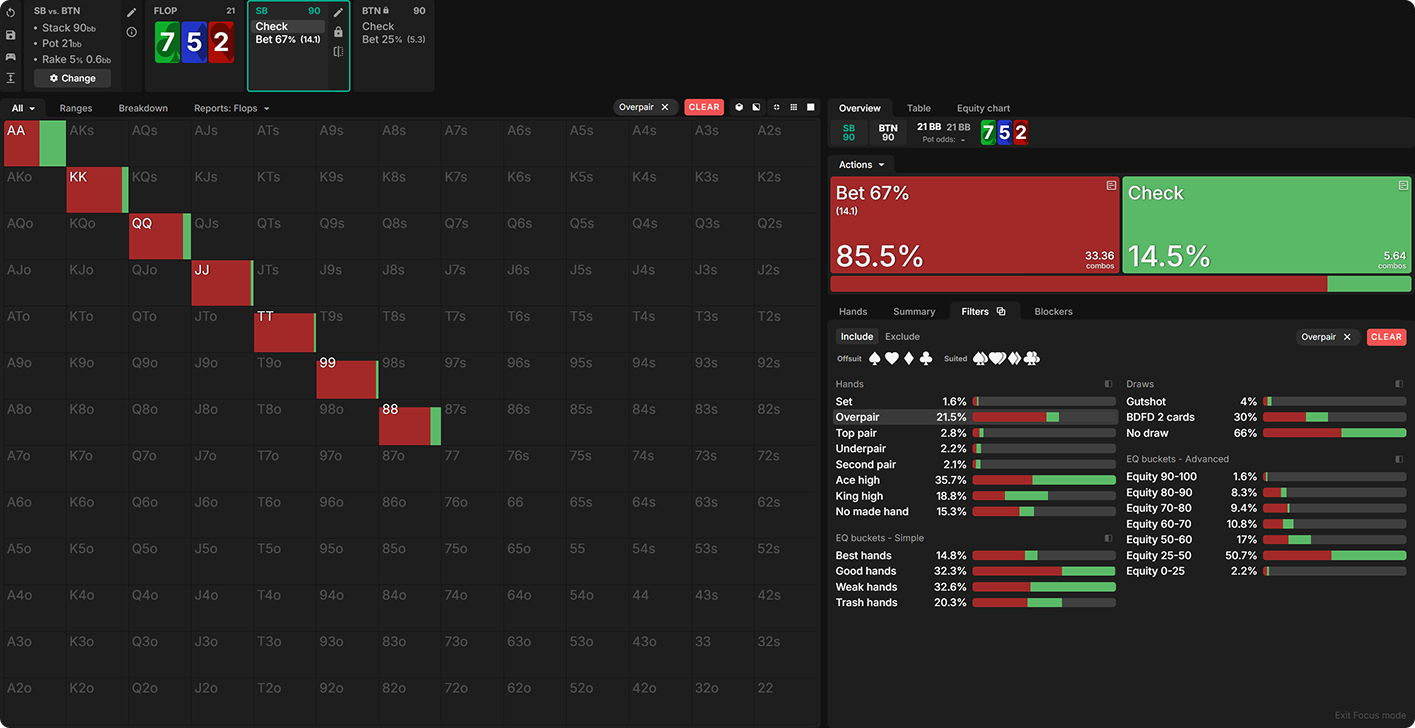
The result is eye-opening. Decreasing IP’s stabbing frequency by a mere 5% causes the betting frequency of our overpairs to increase by almost 20%. The experiment shows us that we should always consider adjusting and never rely on passive opponents to put the money in for us.
There are countless situations where players fail to adjust, leaving large quantities of value on the table, especially when our opponents are too tight and passive. The cost increases as pots grow larger and opponents are more passive. When thinking about what size we want to choose for our nutted hands, players often think along the lines of: “I want to get called, so I size down,” or “I go for a small sizing to appear weak and bait the opponent into bluffing me.”
These arguments may sound reasonable, but they’re flawed from a GTO point of view because the case is built by only considering a specific part of a particular player’s range, not all the ranges in their entirety. Even from an exploitative point of view, there’s an issue since it will backfire against opponents who do not raise thinly enough for value or as a bluff. To get a more detailed insight into this matter, you can read the section titled “One Important River Exploit” from the 3-bet pots as OOP on the river article.
3) Not Thinking Deeply Enough About Exploits
Being able to hit the competition’s weak points is one of those skills that contributes most to achieving high win rates. What holds many players back is their inability to analyze their opponents’ actions deeply enough and adjust appropriately. The consequence is that they overlook details, get lost further down the game tree, and ultimately miss out on the extra value they could have captured.
To illustrate what I mean, I have found the following spot: We open as the CO, the BTN calls, and the Blinds fold. We check the flop and see the BTN putting in a small 25% pot bet.
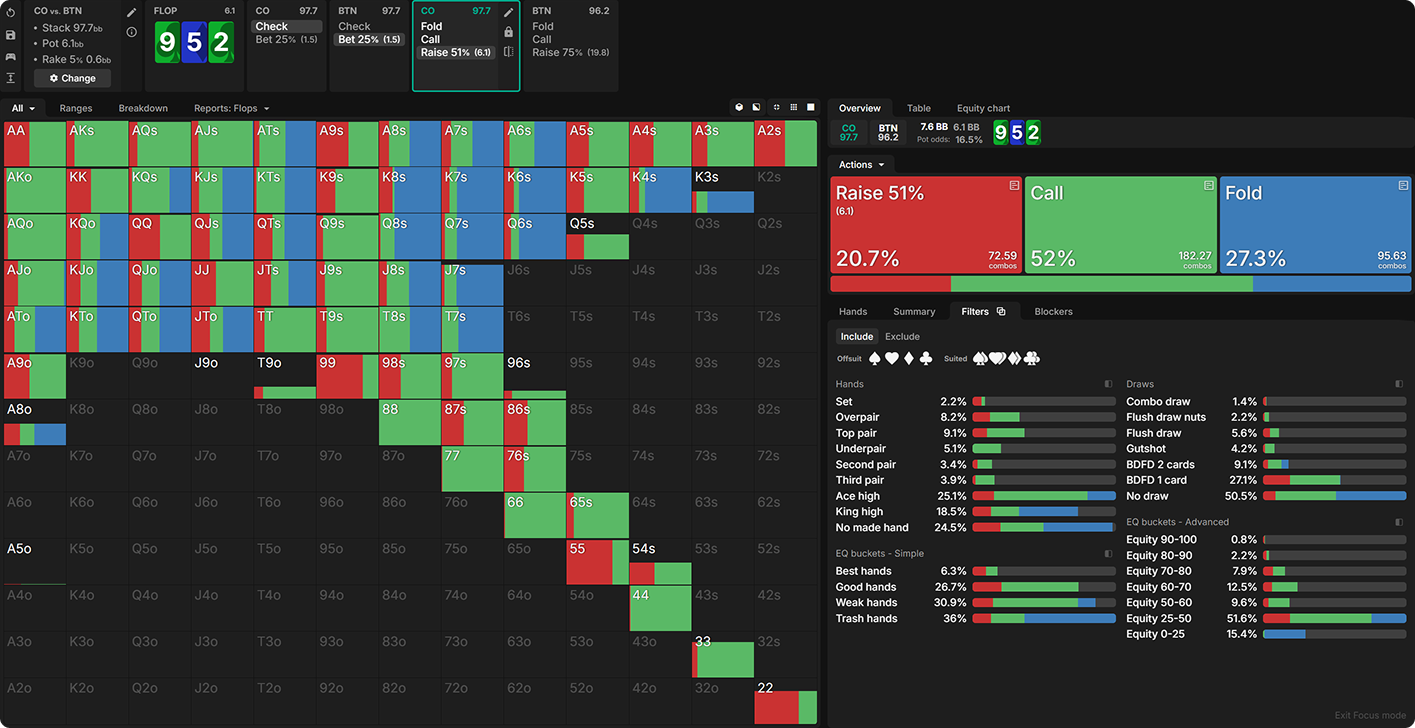
We assume that most players will make way more mistakes facing aggression compared to passivity, so we decide to check-raise very aggressively. While it’s true that the average player will have a much harder time playing versus a check-raise, we need to know exactly which mistakes the BTN is making.
We also need to consider how to proceed on the future streets. Our opponent’s mistakes on the flop not only impact our flop approach but also influence our turn and river strategy. Getting lost and misplaying nodes further down the line is the consequence. But don’t worry; by the end of this chapter, you will know exactly how to approach exploiting your opponent on a deep and advanced level.
To illustrate this point, let’s assume the Villain is making the mistake of calling too wide versus check-raises.
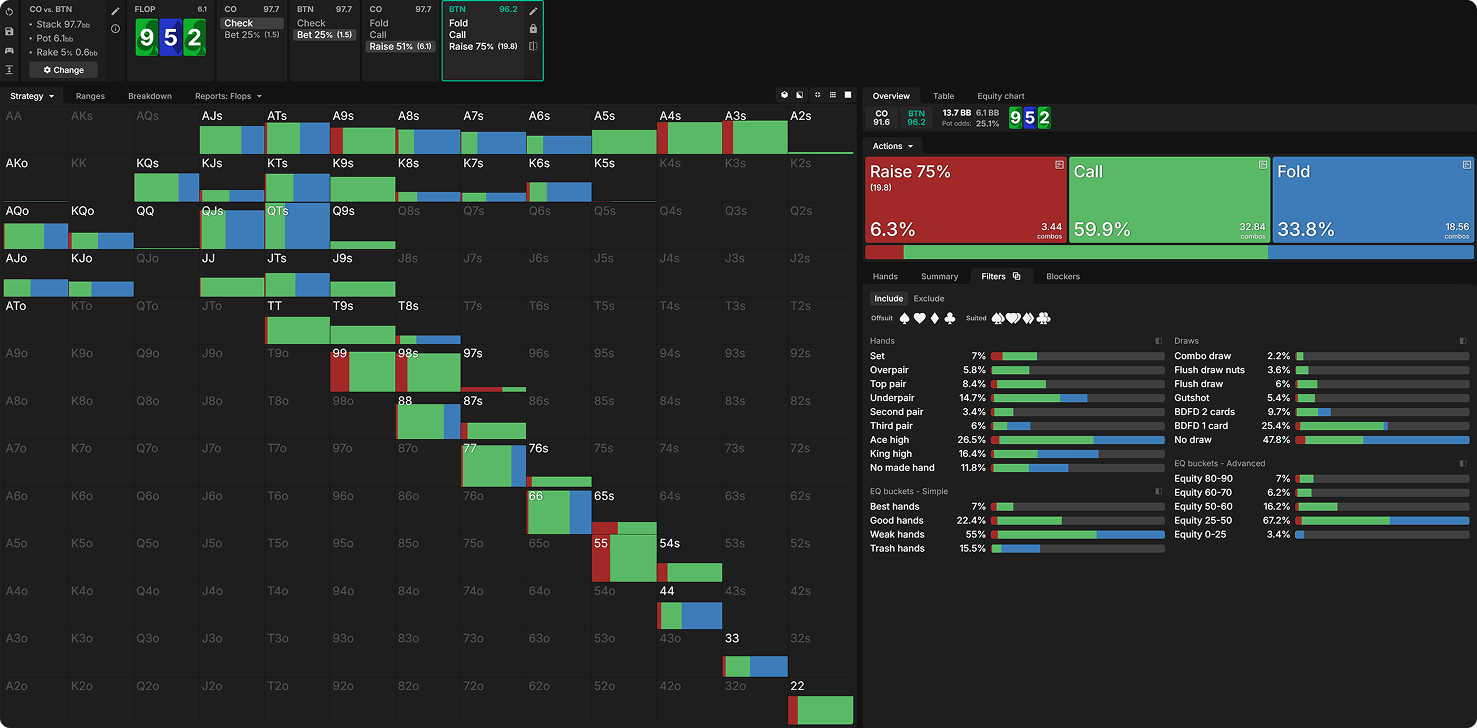
↑ BTN response vs CO’s 51% pot check-raise: GTO
↓ BTN nodelocked (too loose) response vs CO’s 51% pot check-raise: Exploitable
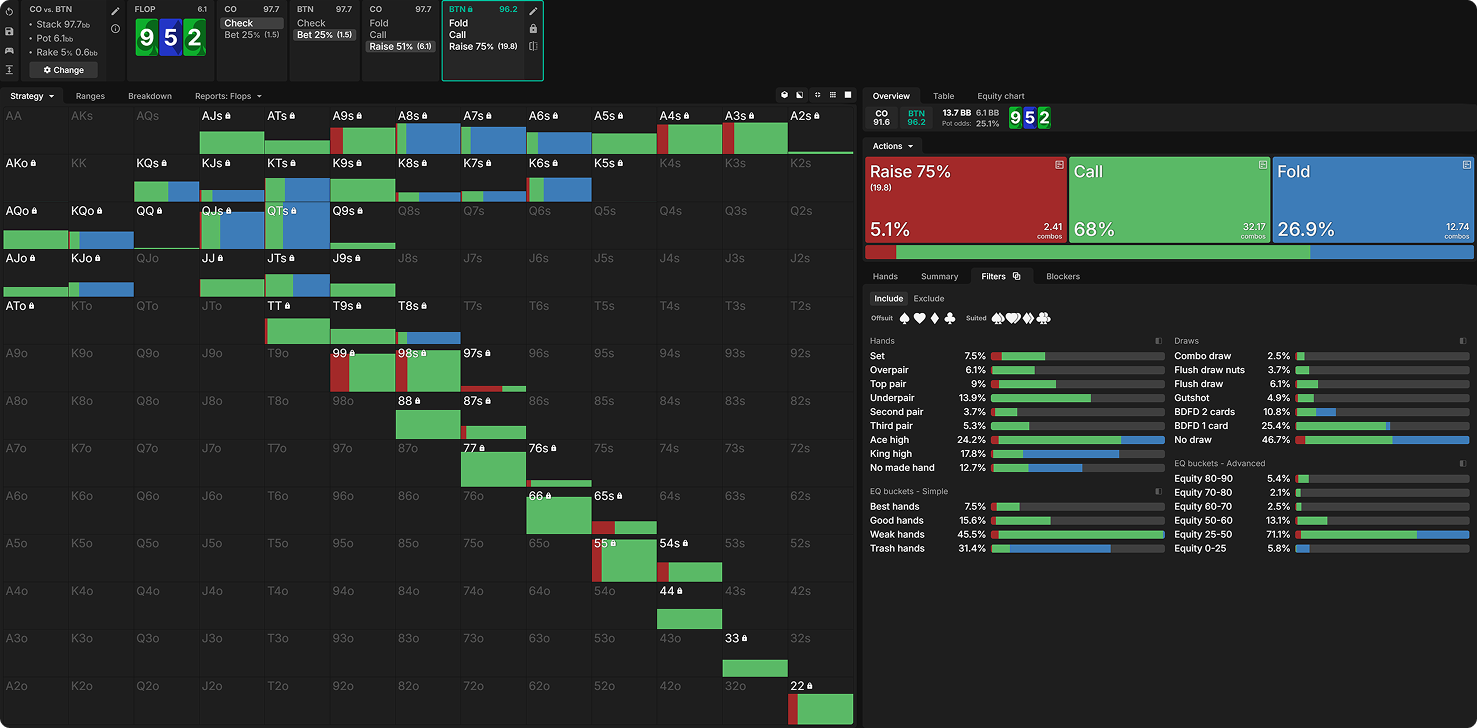
The image at the top shows the unexploitable solution and how the BTN should respond to a check-raise. To model a sticky opponent, we nodelocked BTN’s response (bottom image), which does not fold any pairs and calls pure with all AT, AJ, and AQ.
{{question-mark}}
Now, the challenge begins! How should we adjust our check-raising range against a sticky opponent? Take a moment to think about this yourself.
{{/question-mark}}
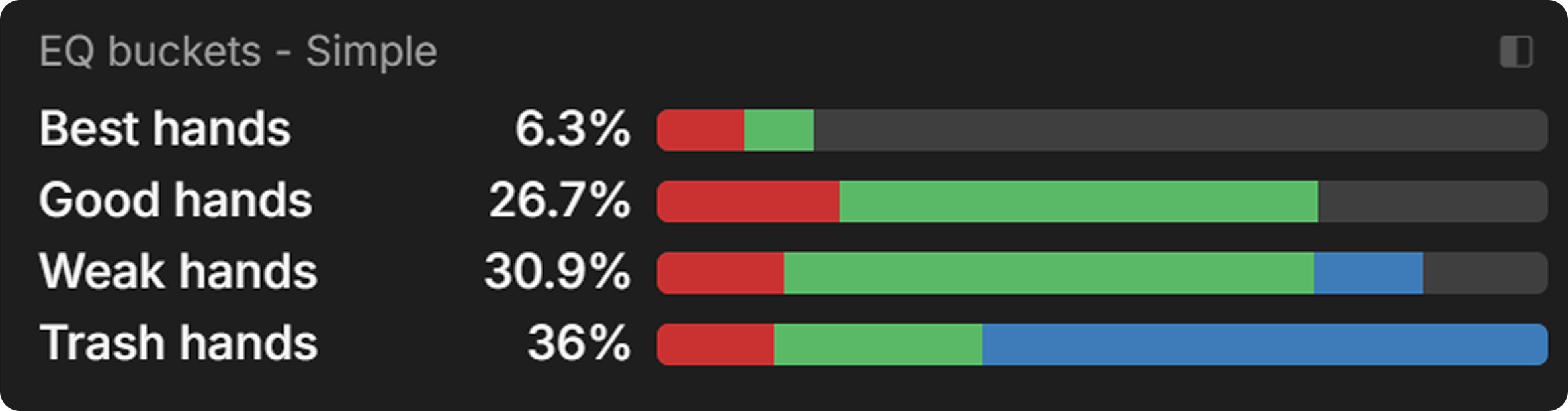
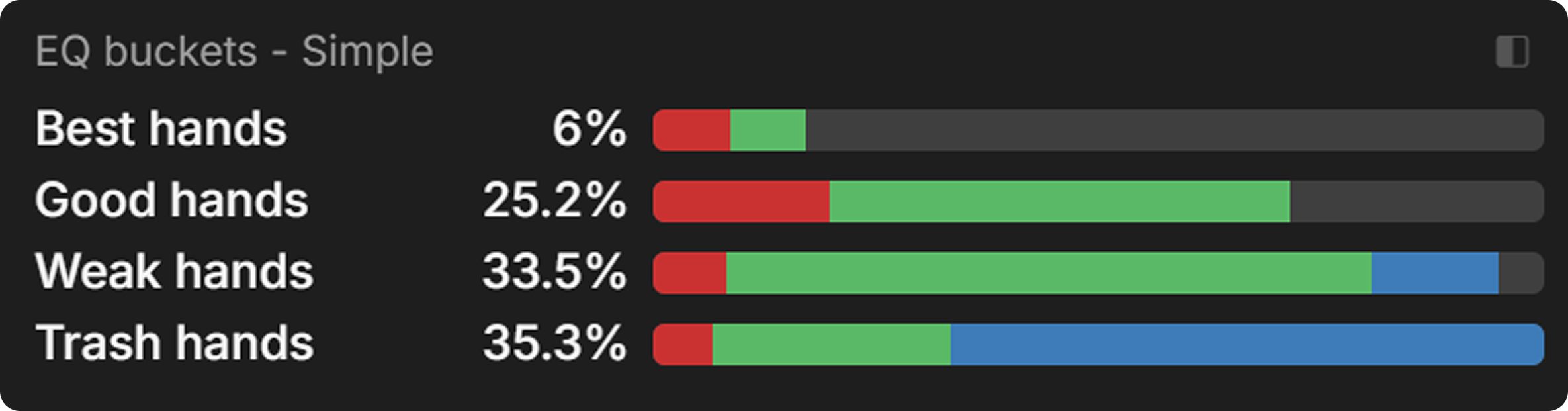
By comparing the EQ buckets of the equilibrium solution with the nodelocked one, we can identify two evident changes:
- We fast-play much more “Good” and “Best” hands against a loose, call-heavy opponent.
- But reduce the raising frequency with our “Weak” and “Trash” hands.
Fast-playing more versus sticky opponents (1) is the more obvious adjustment. However, adapting our bluffing range (2) can be tricky. To bring more clarity, let us examine our bluffing range in more detail and how we adapt it when playing with the flop calling station.
We start by comparing what our weakest bluffing hands want to do in both solutions.
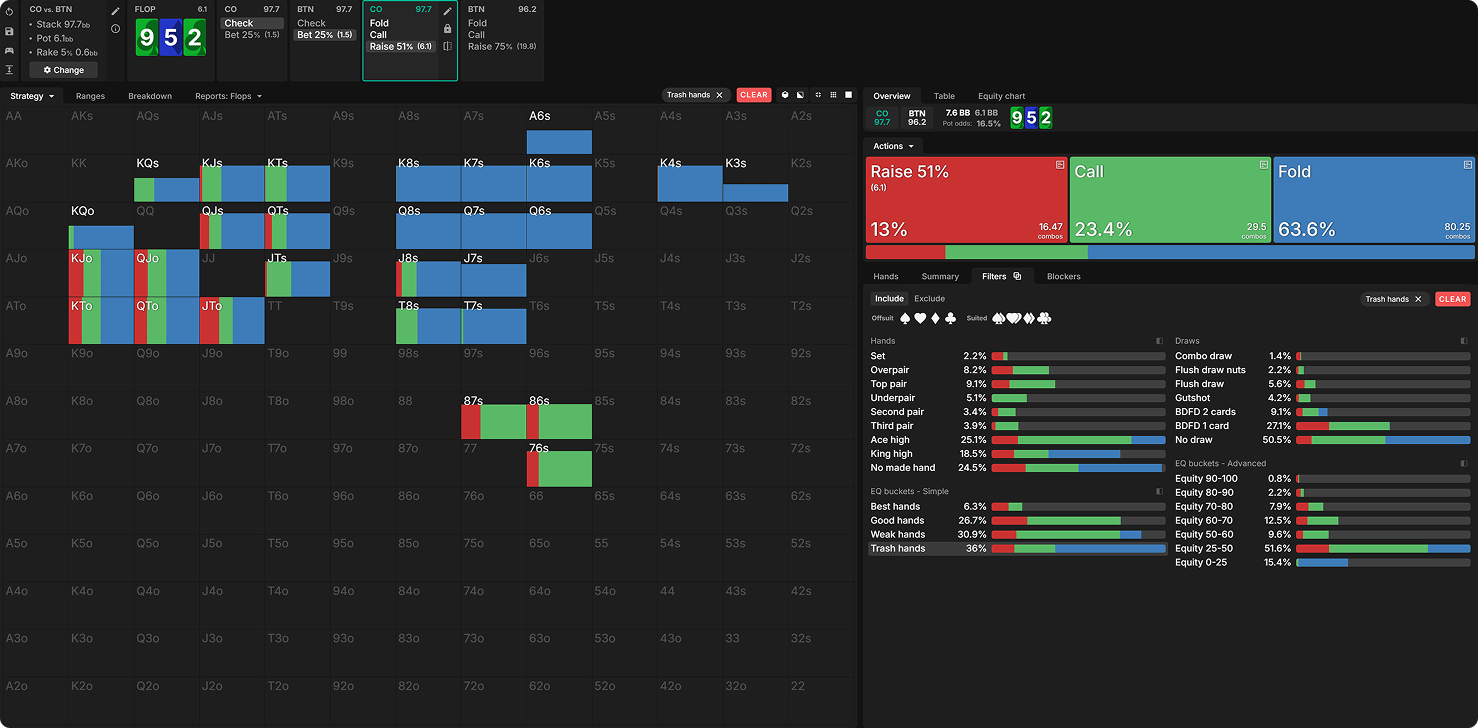
↑ CO flop strategy (filter = Trash hands) vs BTN’s 25% pot stab: GTO
↓ CO adjusted flop strategy with trash vs nodelocked BTN (too sticky) after having stabbed 25% pot: Exploitative
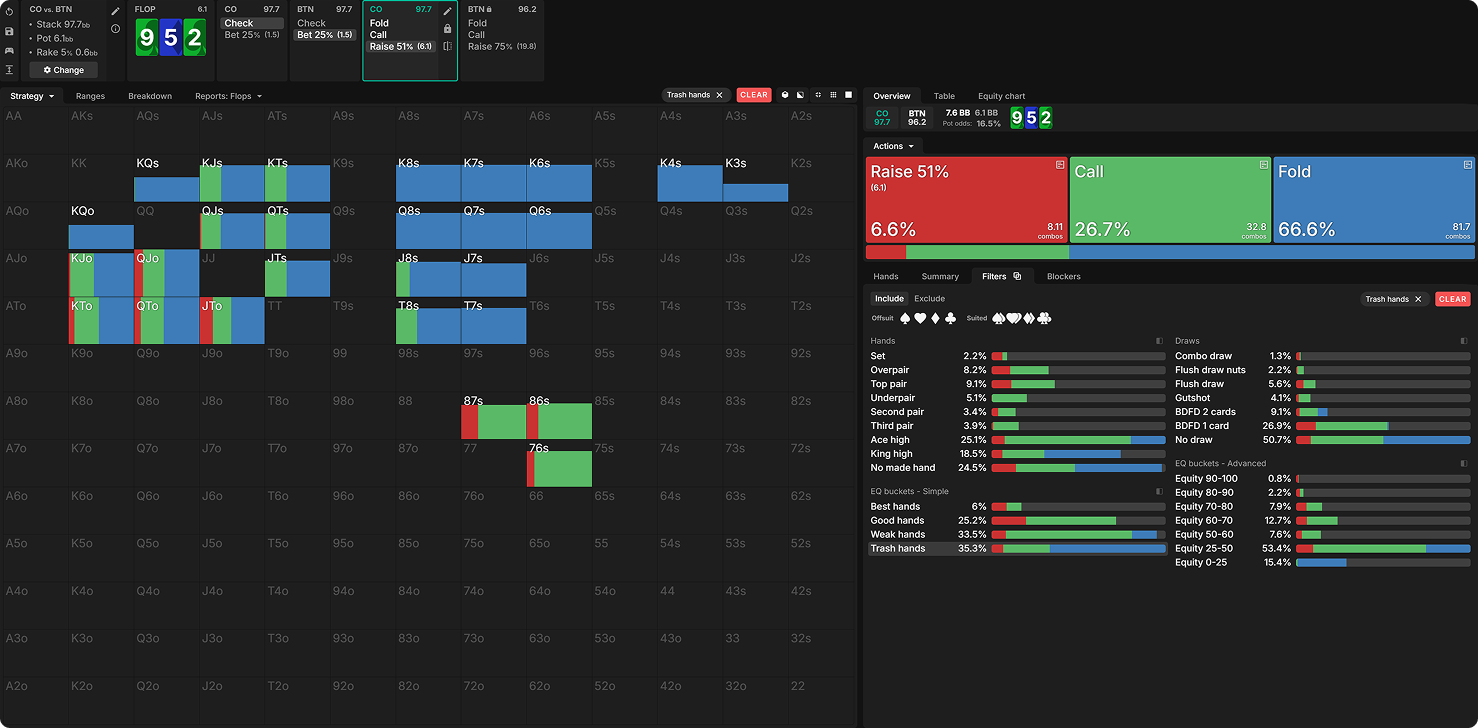
When examining both solutions, we notice a clear difference: Facing an opponent who is too sticky (bottom image) on the flop with pairs and Ace-high incentivizes us to continue with a more equity-driven range. Hands such as backdoor flush draws (BDFD) or overcards don’t want to continue as much. Check-raising hands like QTo with a BDFD usually benefit from folding out some pairs and certain Ace-high combos. Our low-EQ bluffs perform poorly as soon as the Villain is under-folding those hands.
What can we learn when comparing the higher-EQ bluffs (flush draws and combo draws)? Let’s find out!
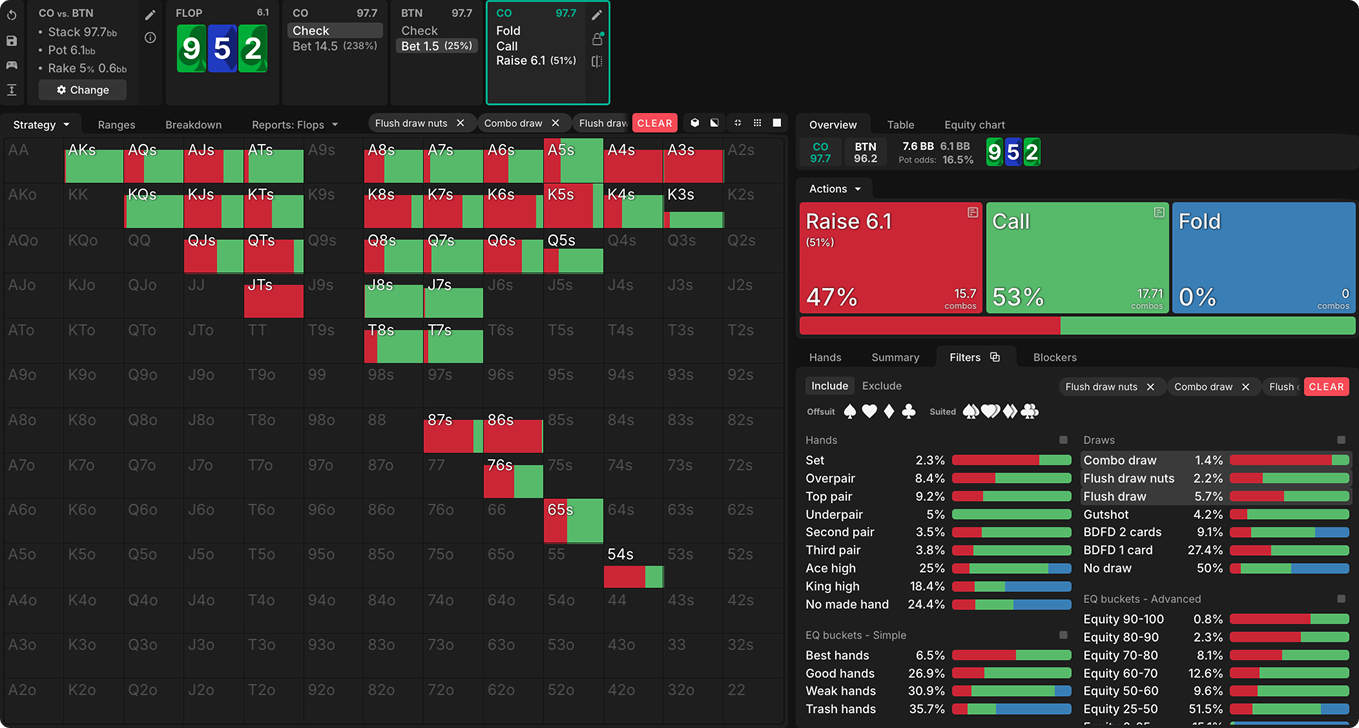
↑ CO flop strategy (filter = flush and combo draws) vs BTN’s 25% pot stab: GTO
↓ CO adjusted flop strategy with FD+ vs nodelocked BTN (too sticky) after having stabbed 25% pot: Exploitative
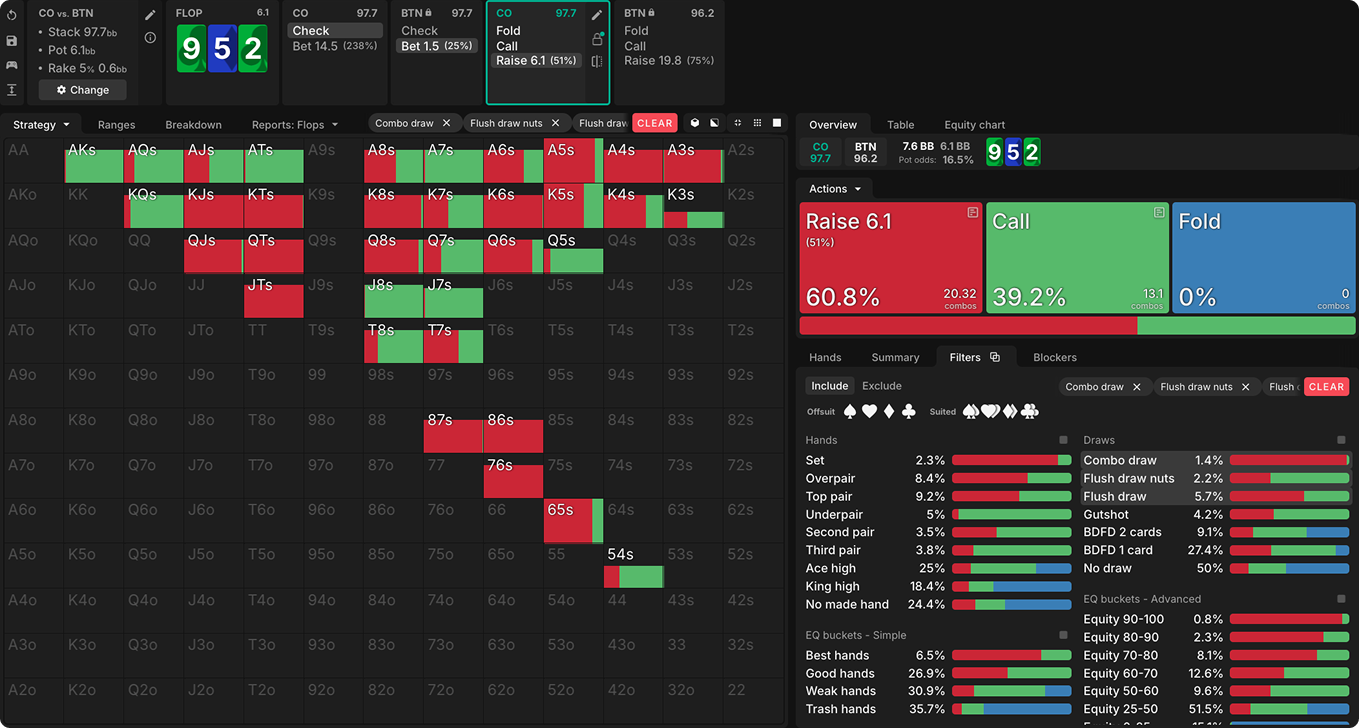
Similar to the images before, we can spot a distinct difference: Our higher-EQ bluffs start to raise significantly more when facing a flop calling station. They perform notably better versus BTN’s wide calling range.
The key takeaways on the flop, facing a sticky opponent, are:
- Check-raise more EQ-driven
- Avoid bluffing weak draws
- Fast-play value much more
Exploiting our opponent on the flop is one thing. But knowing how to optimally play future streets in unfamiliar game trees is another; it’s the next level. To give you a better picture, let us investigate how the turn strategy changes in both scenarios when a 2♠ is turned.
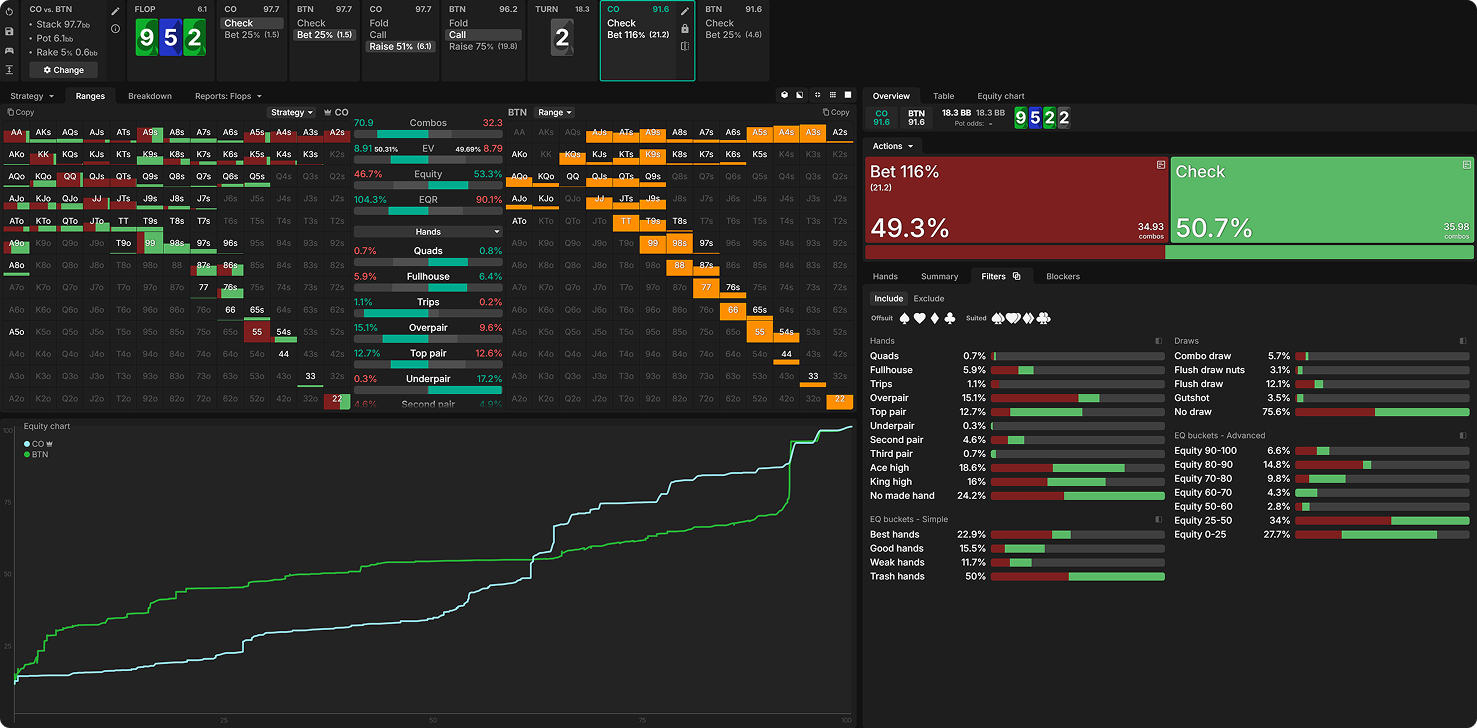
↑ CO first-in turn strategy vs BTN on 9♣5♦2♣ 2♠ (when flop = X-B25-R51-C): GTO
↓ CO adjusted first-in turn strategy vs nodelocked BTN (too sticky flop): Exploitative
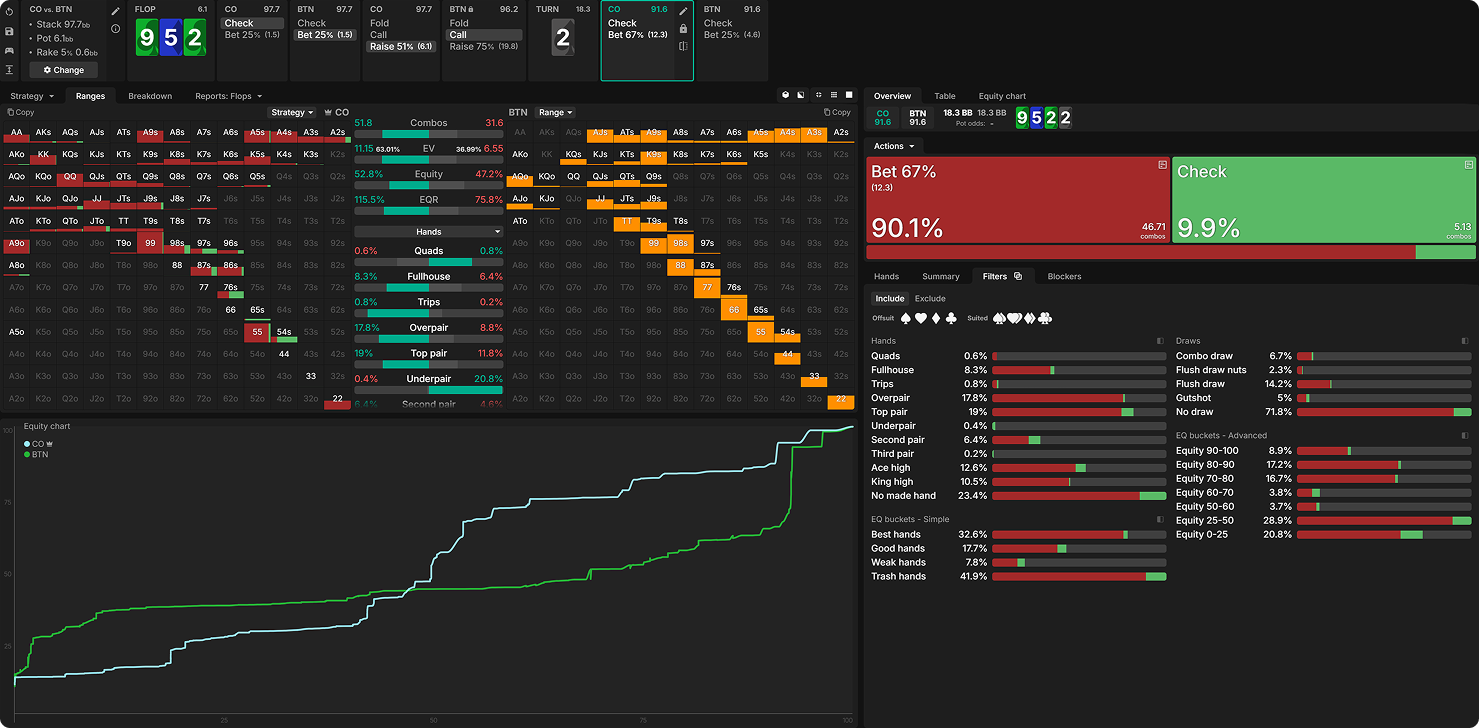
To understand our strategy, we need to understand what we’re working with. A clear view of what the ranges look like is crucial, so let’s start forming those images in our minds:
- Facing a balanced (GTO) strategy (see top image):Usually, we want to take a polarized approach on the turn. 9-x is not good enough to bet anymore, but we still hold the advantage in strong hands (large overpairs). After checking-raising the flop, we filtered Villain’s range while we still had a notable amount of low-EQ bluffs.
- Facing an imbalanced flop calling station (see bottom image):The sticky opponent has a particularly wide range after calling the flop (raise) too loose. We exploited that by check-raising a more EQ-driven range, resulting in a strong range advantage on many turns. We can bet more frequently for value and target more of the Villain’s relatively weak range, incentivizing us to bet nearly our entire range for a medium size.
If we notice that our opponent remains very sticky on the turn, we must adjust right away. This example highlights the importance of being able to pinpoint vulnerabilities. By studying theory, you’ll be more clued in on what you and your opponent should be doing (to be unexploitable). And it’s this knowledge that allows you to identify deviations, which are opportunities to exploit for extra EV.
Certain range dynamics typically lead to certain types of strategies. To help you on your way, here’s a list of some basic rules of thumb for strategy design based on ranges:
- When you have the stronger range and the EQ advantage, bet very frequently.
- Without an EQ advantage but with more nutted hands, build a (balanced) betting range around those nutted hands for larger sizes; the remaining hands will be checked. Note that the checking range will be substantial since only the strongest hands and some bluffs are bet.
- If you’re at a significant disadvantage in strong hands, you should have many checks, and the relatively few betting hands will prefer sizing smaller.
Don’t Give Your Opponents (Undue) Credit
We have all fallen into this trap: Overestimating our opponents at the next level because we assume that they must be excellent players (having played higher than we have so far). The truth is that giving your opponents credit when they have not earned it (yet), especially in the low- and even mid-stakes, will cost you a lot of value. There are many ways to leak, like missing out on thin value bets, calling too much in under-bluffed spots, or forcing yourself to be balanced. All this happened, to realize later that most players you face do not drastically differ from your former foes. Don’t get me wrong, there are solid players in mid- and maybe even low-stakes games, but blindly assuming everyone is a top-tier player will hurt your chance of reaching high win rates.
How to get better at side-stepping this trap, you ask? In my opinion, the following two qualities are critical. Firstly, you need an enquiring mind to gain insight into theory. Secondly, you must also have a searching eye, one that’s looking for what your opponents are doing wrong (or right) relative to theory. Together, they will help you better adapt to the competition. Get you from surviving to thriving.
Summary
Phew, that was a lot of information to process! Let’s quickly recap the key points.
- Avoid bluffing when the opponent has a tight, strong range. The main exploit is to over-fold, rather than trying to run fancy bluffs.
- Use HUD data or live observations to figure out the opponent’s vulnerabilities.
- Against passive opponents, you should always bet yourself to extract value with strong hands. Relying on them to do the betting for you will result in leaving a lot of money on the table.
- Taking advantage of an opponent’s vulnerabilities is essential to achieving the highest win rates. Many players fail to thoroughly analyze their opponent’s strategy, which leads them to overlook important details and miss opportunities, ultimately blunting their edge.
- Be aware that your opponent’s mistakes on earlier streets affect optimal play further down the game tree.
- One of the most unrecognized reasons many players don’t make it to high stakes is that they overestimate their opponents. Assuming everyone is a top player can hurt your win rate, so try to form an idea of what your opponents are up to, and give it your best shot to formulate the optimal response. This can be trying to approximate a GTO strategy or deviating from it if you think an exploitative strategy can win more.

Exploiting Profiles: Episode V – The LAG
LAG players are uncomfortable to play against. They barrel, they lead, they never seem to fold, and somehow they keep winning pots they have no business being in. In this article you'll learn how to perfectly exploit them so you start taking their money instead.
Exploiting Profiles: Episode IV – The TAG
They're not a fish. They're not a maniac. The TAG reg is the opponent you'll face most often, yet most players have no idea how to exploit them.

Exploiting Profiles: Episode III – The Maniac
There's a maniac at your table. They bet every street, call everything, and somehow keep winning pots they have no business being in. So what's the adjustment? Do you start blasting back?