How to Crush Ante Cash Games

Overview
Cash games with an {{tooltip-title: ante}} are becoming increasingly common, particularly online. Fortunately, GTO Wizard has recently released preflop simulations for ante games, making it easy to study how strategies change with these extra chips in the pot.
{{tooltip-content: ante}}
A predetermined amount of chips that all players are required to put in the pot preflop, commonly used in tournament play, but occasionally also in cash games. Unlike blinds, one doesn’t need to meet the antes to see a flop.
{{/tooltip-content}}
Since my current game of choice includes an ante, having these solutions available has been invaluable in developing strategies to best crush in my pools. In this article, I’d like to share some of what I’ve discovered.
Open Raises
One of the most intuitive preflop adjustments that occurs when there’s an ante in play is that every position at the table enters the pot more often. Comparing an ante chart with a classic chart, equivalent positions open raise around 4–6% more often in the ante simulation.
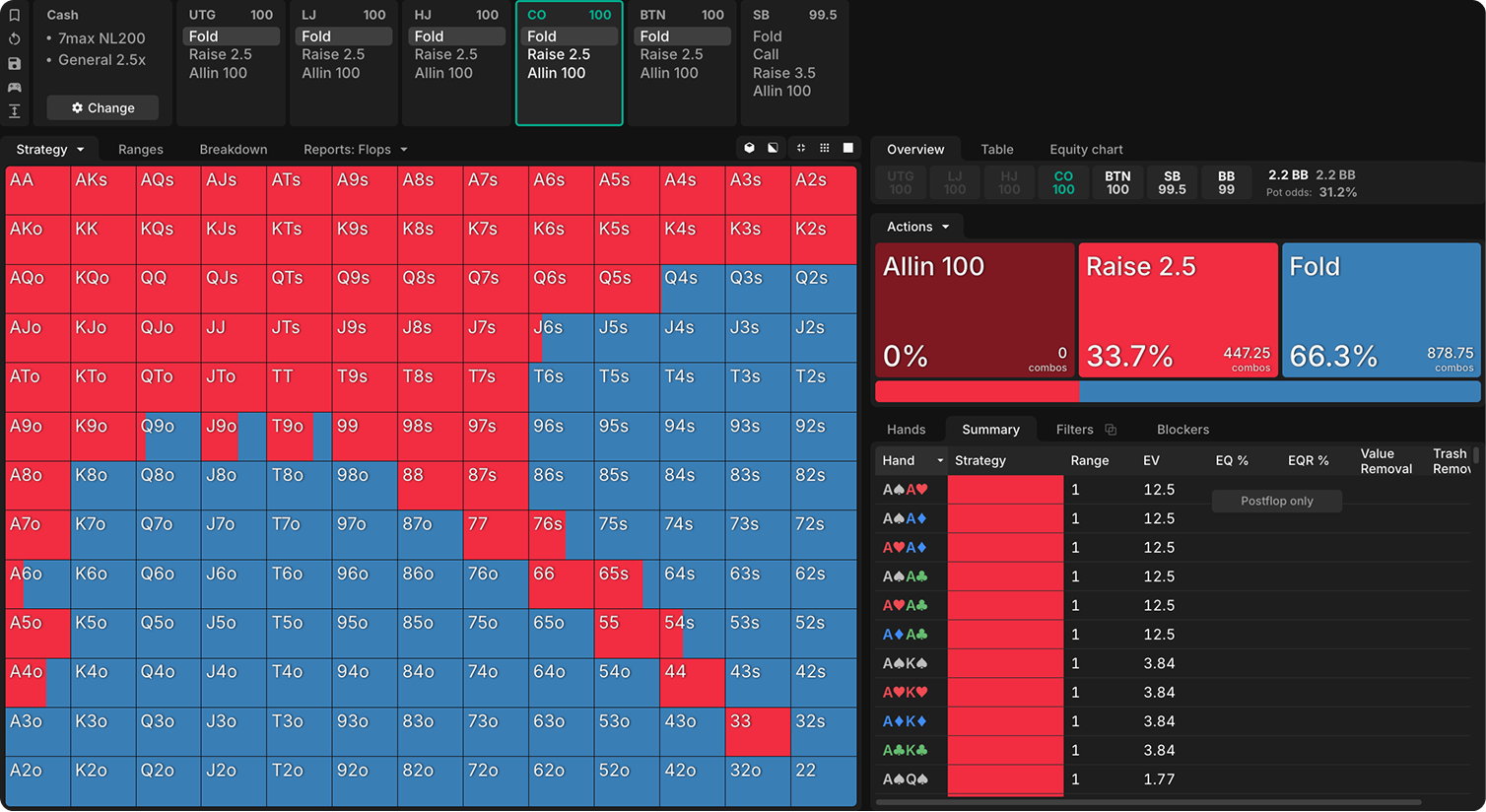
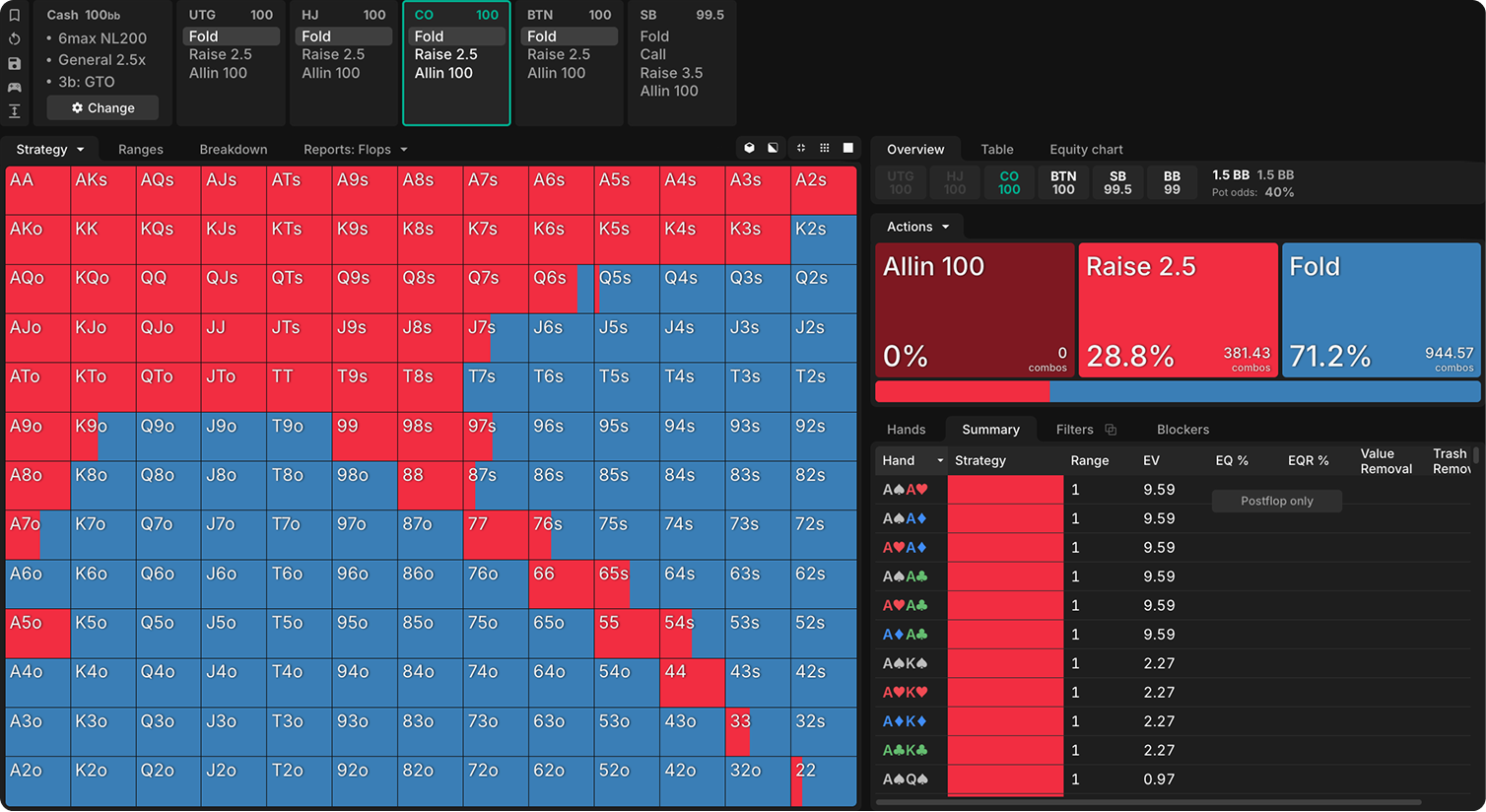
This is, of course, because there is more money to start off in the pot. With more to be gained upon winning the hand, weaker holdings that might be a fold otherwise can make up for the increased frequency of losing their investment.
It is interesting, however, that these mediocre hands do not gain much EV. In ante games, the extra EV is heavily concentrated in the strongest hands. Being dealt AA {{tooltip-title: three positions before the Button}} is worth 3.18bb more in a game with an ante than a game without one. Not only is the starting pot size bigger, but the pot grows faster both pre- and postflop, and the strongest hands naturally benefit from this.
{{tooltip-content: three positions before the Button}}
UTG in 6-max
LJ in 7-max
{{/tooltip-content}}
The biggest shifts when being first-in happen to SB’s strategies. When folded to, SB in an ante game folds only 33% of the time, a massive decrease from the 54% of hands that SB will fold without an ante. Additionally, the primary continuing strategy for SB is to limp, an option that is rarely taken without an ante. This is done with a wide variety of hands, including the strongest hands in SB’s range, to take advantage of BB isolations.
Facing an Open Raise
Some aspects of ante strategy start to become a theme when we begin to look at how we should react to raises before us. Continue more often, and call more often when you do. Every position has extra incentive to enter the pot against an open raise. This is, in part, simply due to the extra chips in play (mini challenge: count how many times I say that in this article), but additionally, every open raise is a few percentage points wider than in Classic games, and more hands can generate enough EV to continue against wider ranges.
The tendency to call more often, rather than 3-betting, is emphasized the closer you get to the Button. These seats have an increased incentive to see flops in position and keep exercising that positional advantage postflop. Against a HJ raise, BTN calls more than half of the time when it continues!
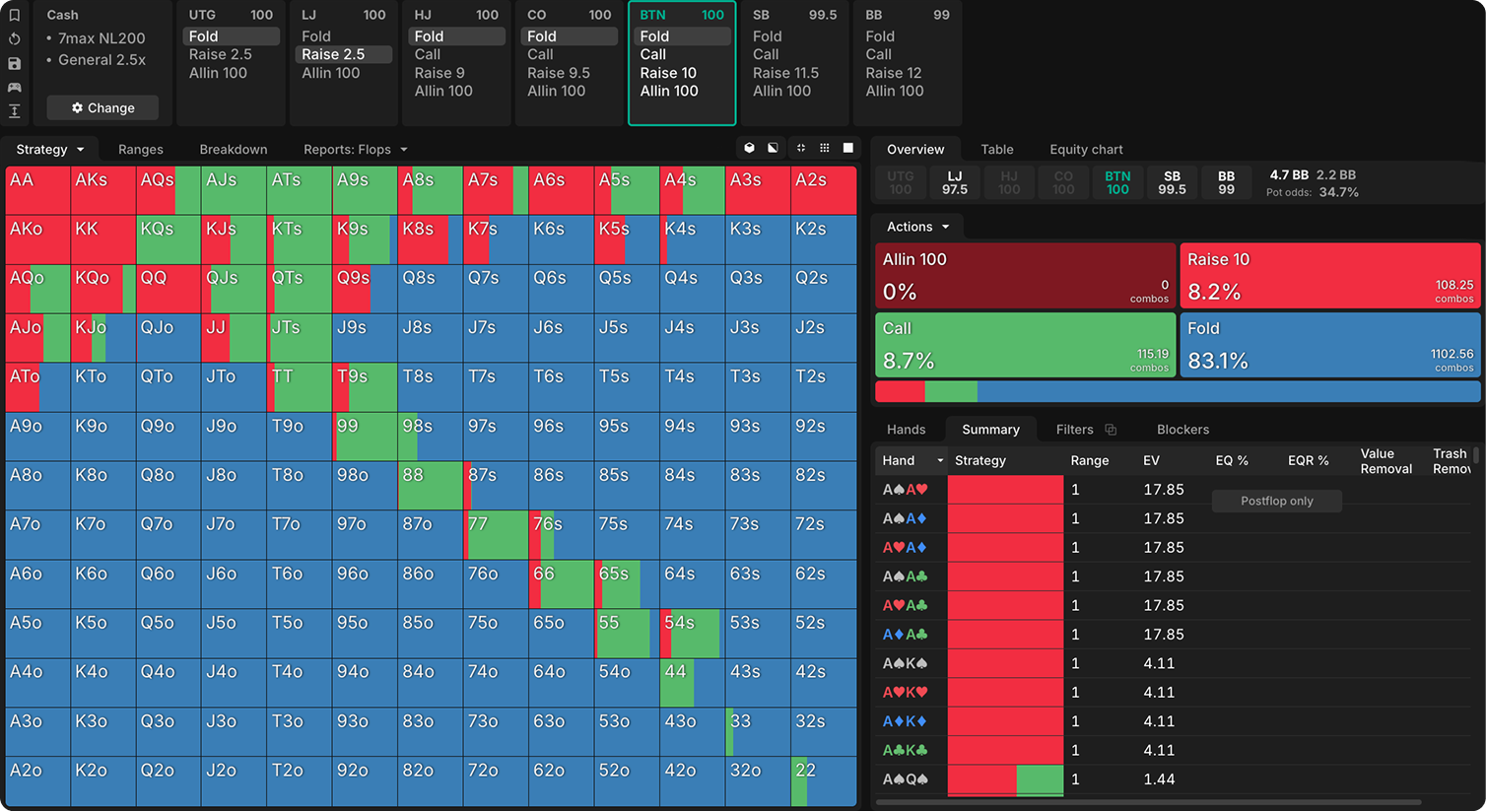
The hands that perform best in the calling line are overwhelmingly suited, or pocket pairs looking to set mine. As these hands will 3-bet less often, non-premium 3-bet (“3-bet bluff”) candidates shift towards combinations that contain offsuit high cards. For example, AJo and ATo begin to 3-bet, while they would be pure folds in a non-ante game. Additionally, 3-bets are sized slightly larger to compensate for the better price that the initial raiser would otherwise get to continue.
The biggest strategic differences when facing an open will appear in the BB. Against a UTG/HJ raise, BB continues 10% more often globally, mostly by adding calls with hands that would have previously folded.
Simplifying the Adjustments
So far, it’s become clear that antes widen the preflop ranges and reduce the postflop SPR; both of which affect postflop strategy. Additionally, the prevalence of calls preflop in Ante games means that many more hands will go multiway; multiway spots are notoriously difficult to study and require specialized solvers that can handle more than two players.
There is a way to study an Ante strategy that deviates less from Classic strategies, though: using a larger preflop sizing, which the solver actually prefers. The larger opening sizes tend to have higher EV. So far, we’ve been comparing simulations that are as close to each other as possible, where the primary distinction is the inclusion of the ante.
In both of these simulations, the open raise size was 2.5x the big blind for all positions except SB, which opens to 3.5x (when not limping). However, if we compare a Classic simulation that opens 2.5x to an Ante simulation that opens to 3x, we see strategies that come a lot closer to what we already know. The percentage of hands that open raise is much closer in equivalent seats, and other players’ reactions to our opens involve calling at a much lower frequency. Both of these are derived from the higher price to enter the pot, helping to counterbalance the effect of the ante on our strategy.
To be clear, the ranges are not the same; opening larger causes all ranges to shift towards hands with higher raw equity, largely due to the lower SPR postflop. Small pocket pairs and suited connectors are reduced in value, while having high cards, particularly an Ace, goes up in value. This can be seen when comparing LJ 3x opens in an Ante (7-max) game to UTG 2.5x opens in a Classic (6-max) game. Low pocket pairs and suited connectors are opened ever so slightly less often in the Ante sim, despite opening 2.1% more often in total with the ante in play.
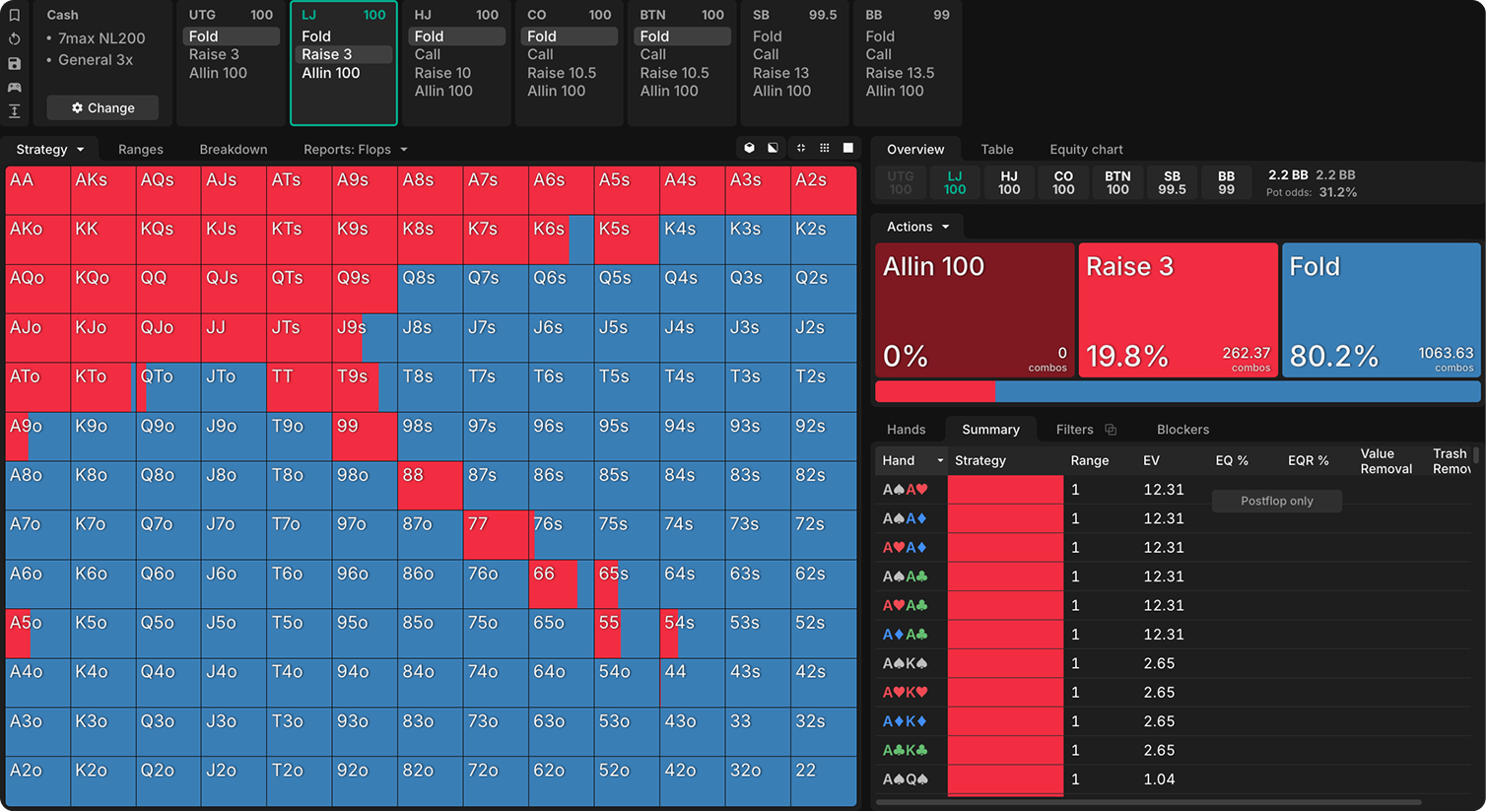
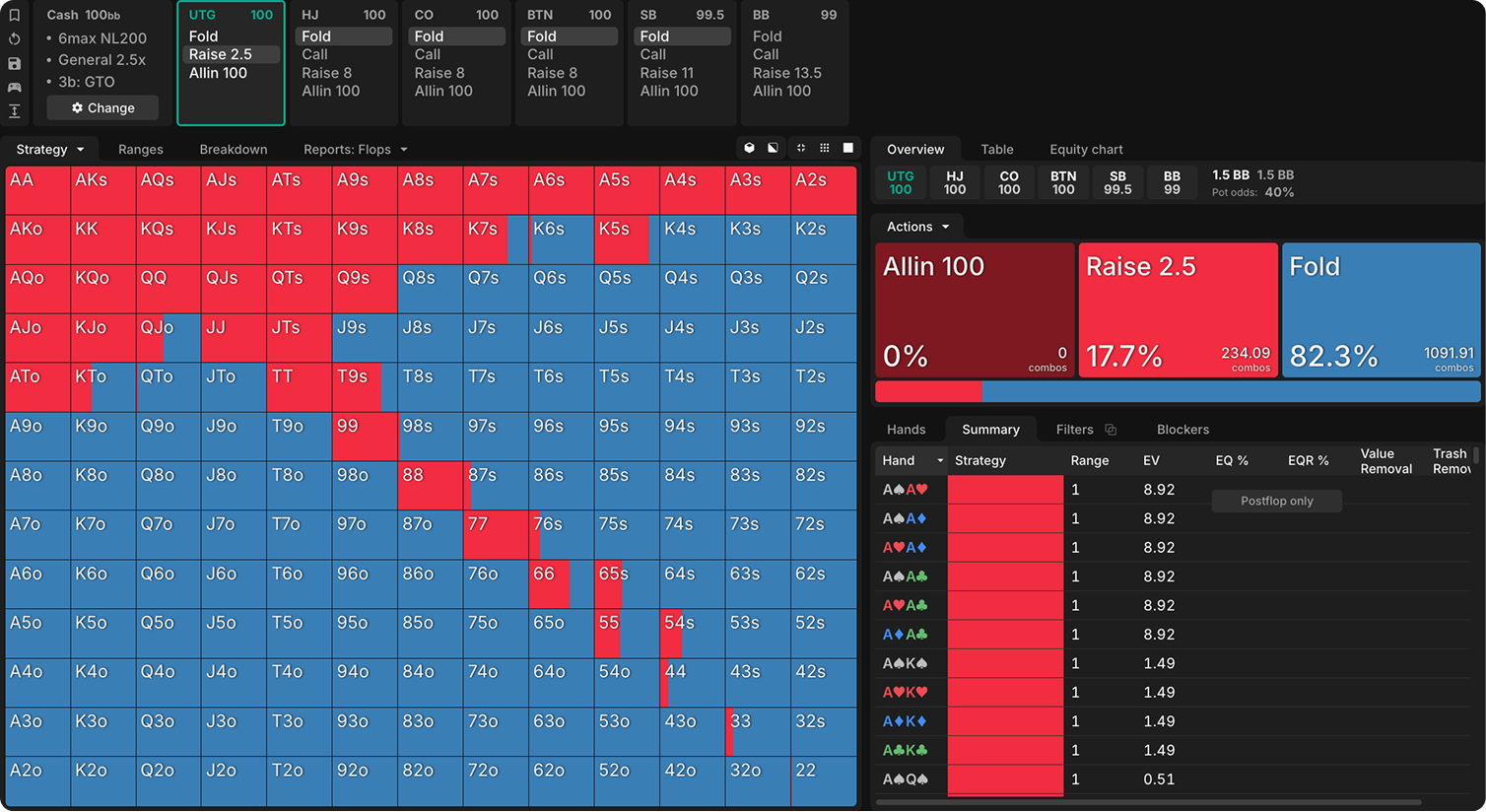
The differences to Classic when playing with the larger open raise size, however, are much more manageable in my opinion. The ranges are not identical, but they do end up structured similarly. Additionally, there are fewer complicated calling ranges to contend with, and you’ll play many more hands heads up, allowing you to use heuristics developed while studying Classic games far more often.
Conclusion
Despite what, on its face, appears to be a very similar game structure, having an ante in play impacts theory in many ways. These changes can be somewhat offset by using a larger open size than in an equivalent Classic game format, but being knowledgeable about how strategy shifts as early as preflop is critical to succeeding in these games.
- Play more hands, and expand calling ranges, particularly when in position or getting a discount to enter the pot.
- Focus less on hands that rely on implied odds, as SPR will be lower across all streets.
- Prioritize offsuit high-card hands when 3-bet bluffing, as suited combos will frequently prefer to call.
Ready to begin studying Ante cash games in earnest? Try these drills out!
{{grid: 3}}
{{/grid}}
We Are Hiring
We are looking for remarkable individuals to join us in our quest to build the next-generation poker training ecosystem. If you are passionate, dedicated, and driven to excel, we want to hear from you. Join us in redefining how poker is being studied.
Check out the available positions here.
Is Limping Preflop Viable in Mississippi Straddle Games?
In this article, we’ll delve into both the theory and the practice of open limping. Why does it make so much more sense in Mississippi Straddle games than in traditional, two-blind Hold‘em? How should you respond to limpers when you have position on them?
Navigating BvB OOP After Check-Calling the Flop
Today, we’ll be discussing a scenario that presents itself incredibly often for online cash grinders, one that incorporates all three of these complications: playing the XC-X-? line as the OOP preflop raiser from the SB vs BB in SRPs.
Why You’re Bluffing the River Wrong With Bricked Flush Draws in Cash Games
It’s exciting to flop a flush draw; when you do, you have a fairly high chance of having a strong hand by the river. It’s a lot less exciting, however, when the river arrives without your flush and you’re left with air or a weak pair, especially when you’ve invested a lot of chips on previous street