Punish the Unstudied: Capped Ranges & Bluffing Imbalances

Overview
This is part two in our series on exploiting players who don’t study GTO. In the first part, we explored how being unstudied in the ways of theory can cause preflop mistakes and sizing tells. In this follow-up piece, we will learn what the punishments are for some of the other common tendencies: capped ranges and unbalanced bluffing strategies.
By the end of it, you will be another step closer to becoming a player who has a deep arsenal of powerful exploits and is able to recognize which one will be most effective given the specifics of a situation.
1) Capped Ranges
Not having a handle on how ranges interact with board textures can cause your range to be overly skewed in one direction. We can extract extra value by applying pressure to these vulnerable, face-up ranges. I have selected two spots for us that will illustrate what I mean. By the end of this chapter, you will know precisely when and how to exploit capped ranges.
Example: SB vs BTN, 3-Bet Pot
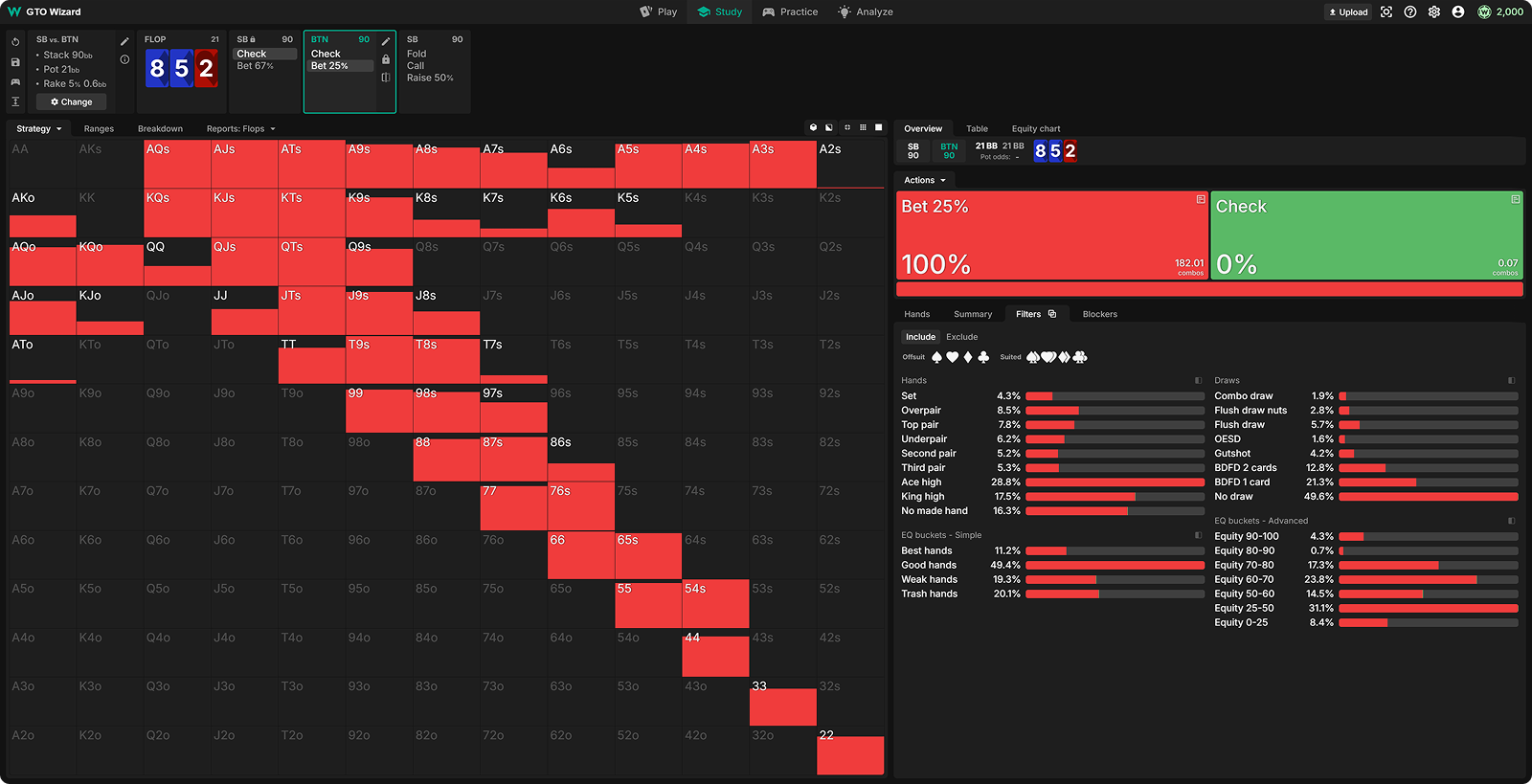
We start with the following spot: The BTN opens, SB 3-bets, and the BTN calls. The flop comes down 8♦5♦2♥. Below you can see the SB’s c-betting strategy:
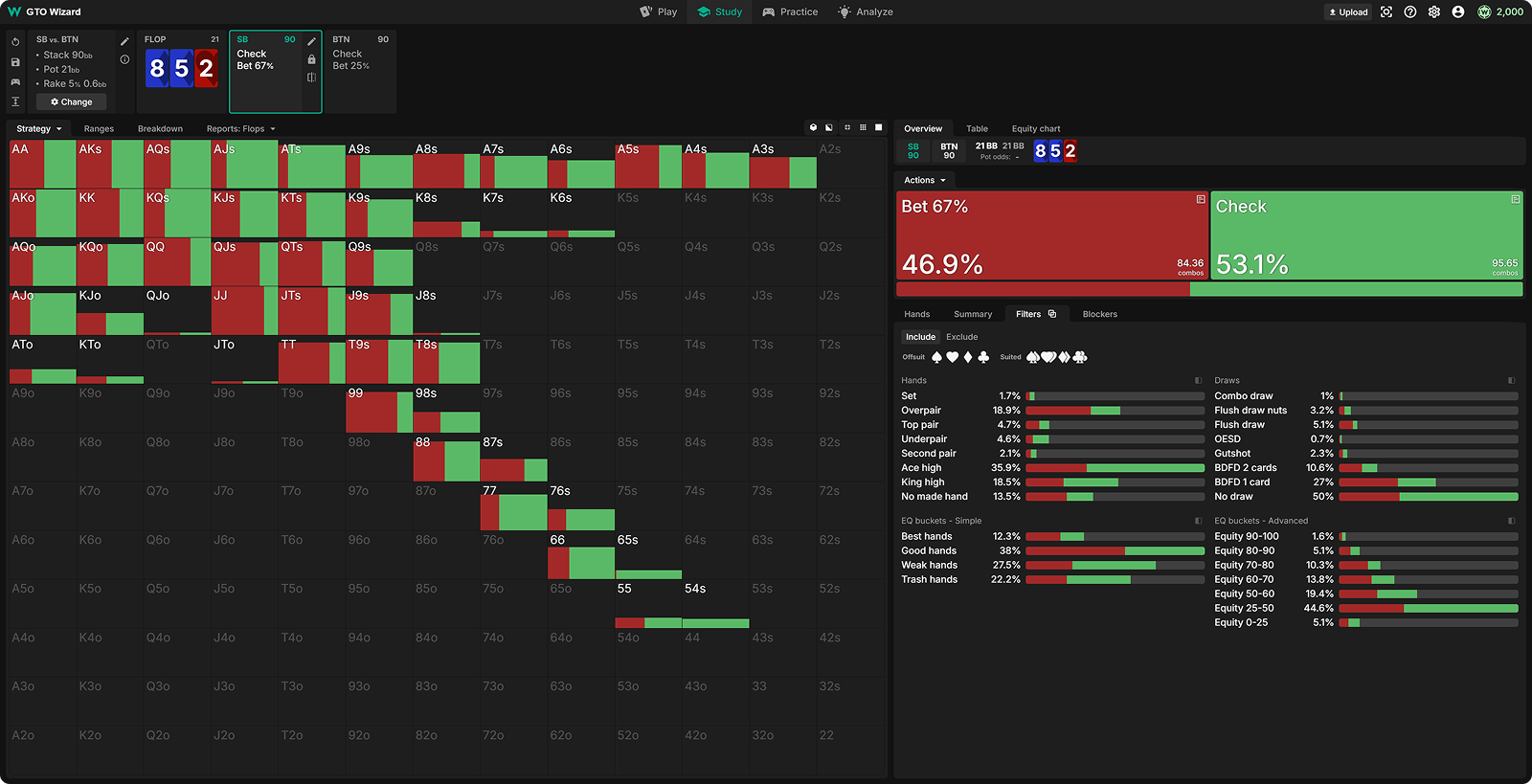
From the Small Blind, we’re supposed to check around half of the time, while mixing in a larger ⅔ pot bet size for the other half. Several key drivers steered the AI solver to arrive at this betting strategy, which is heavy on checks and large bets:
- The SB‘s range is heavily weighted toward high cards, most of which entirely miss this kind of texture.
- The SB’s top pairs and overpairs (99–QQ) are quite vulnerable, so there’s a strong incentive to deny equity.
- The BTN connects well with middling board textures and can continue a lot of hands if they face a smaller sizing.
- The SB has a significant overpair advantage, and being 100bb deep, we want to start building the pot as early as possible with that hand class, especially before the runout kills our action.
So there’s a lack of board interaction for a large portion of SB’s range. Combine that with the need to protect their strong but vulnerable hands, plus the desire to hinder the BTN from accessing an easy path to realize equity, and we end up in a place with a lot of checking and larger bets as the SB.
To prevent the checking range from becoming too weak, OOP will take a more passive line by checking around 30% of their overpairs, especially the less vulnerable ones like AA and KK.
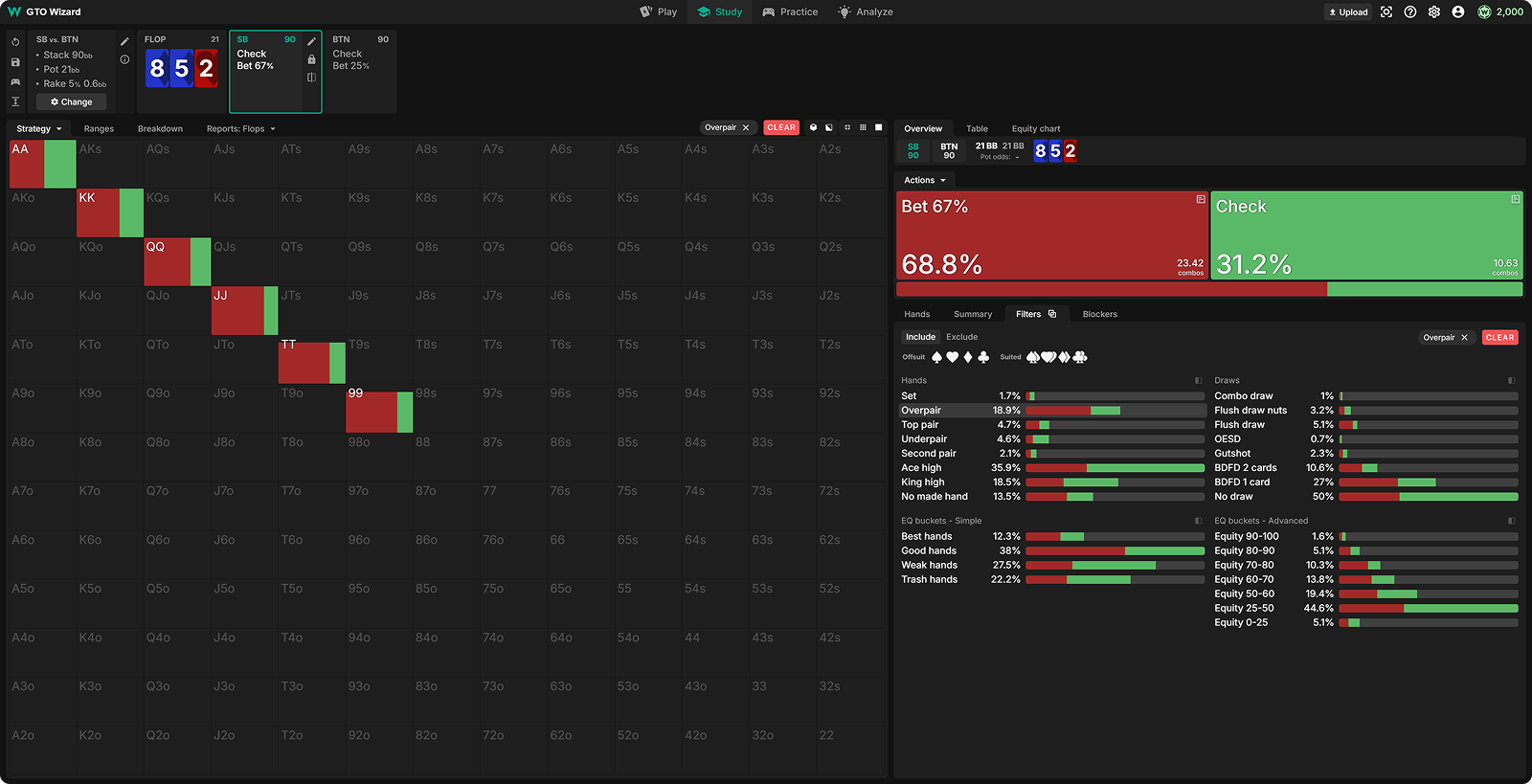
In practice, though, most players at the low- and mid-stakes levels won’t check nearly enough of their overpair region on the flop. We need to adjust aggressively as the BTN when we identify this imbalance. To highlight how drastically we’re allowed to deviate from GTO as an exploit, let’s look at a nodelocked scenario where the SB always bets their overpairs.
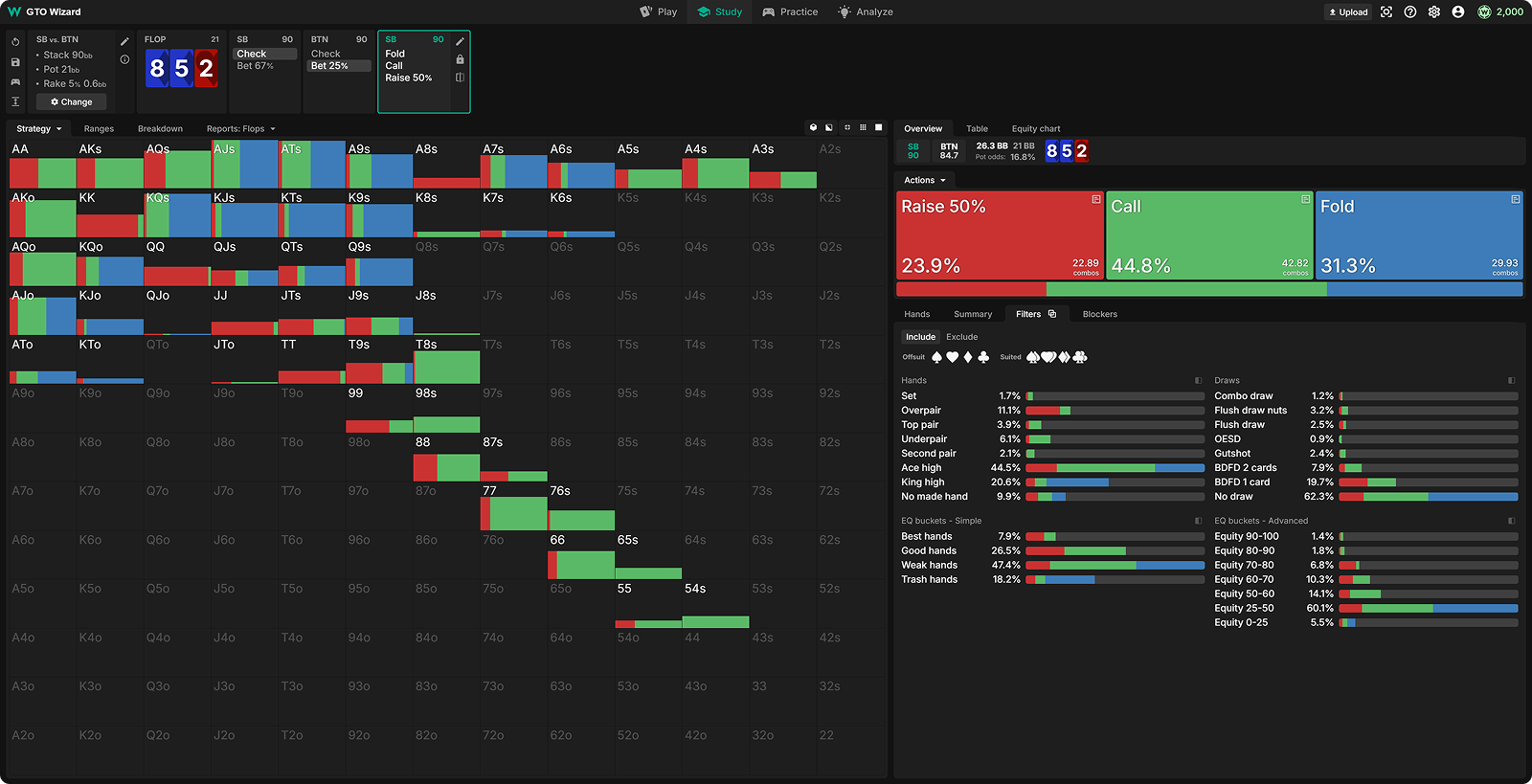
BTN vs SB Check
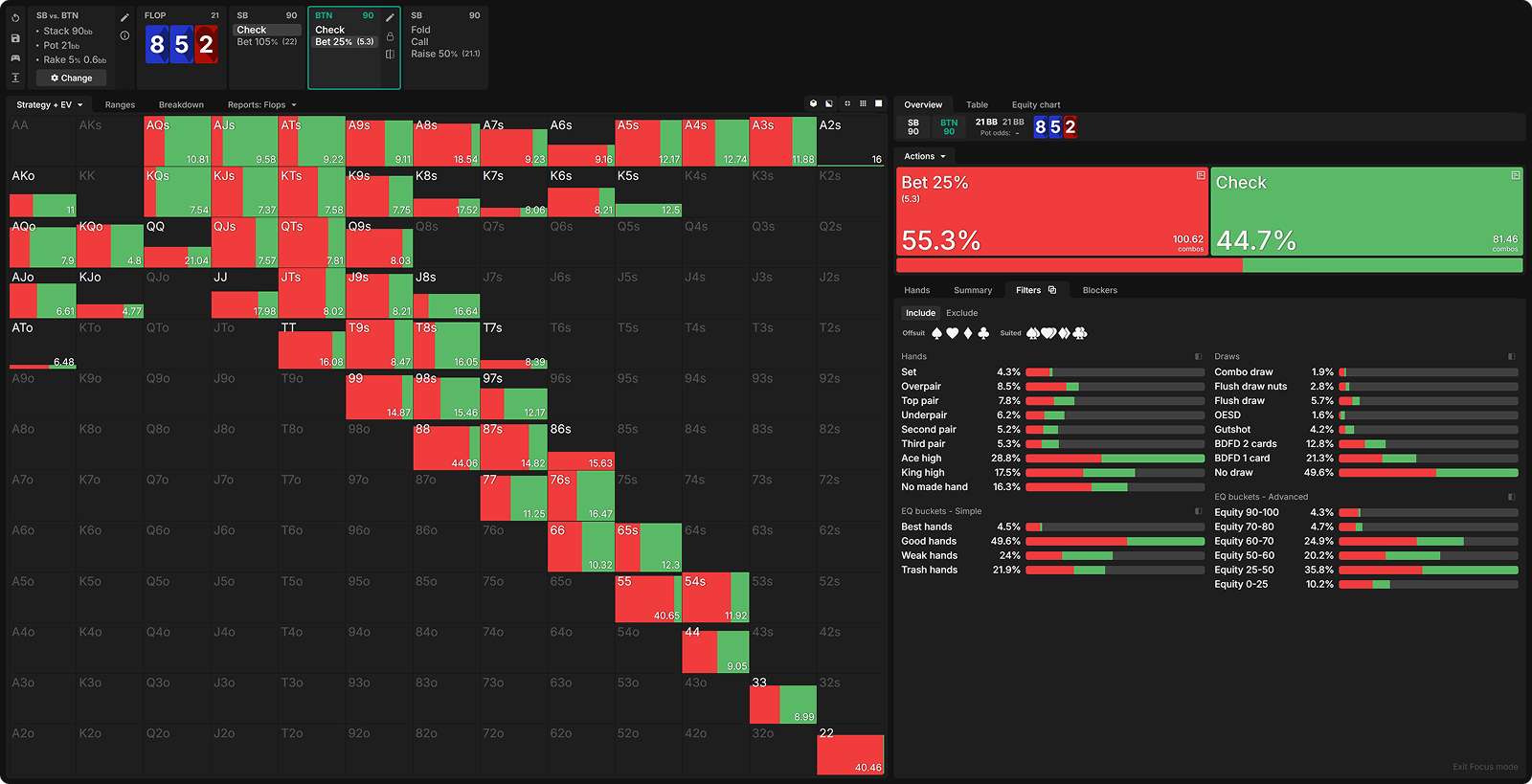
↑ BTN flop strategy vs SB check: GTO
↓ BTN flop strategy vs SB nodelocked check (no overpairs): Exploitative
SB vs BTN Stab
↑ SB response vs BTN’s 25% pot stab: GTO
↓ SB response vs BTN’s 25% pot nodelocked stab: Exploitative
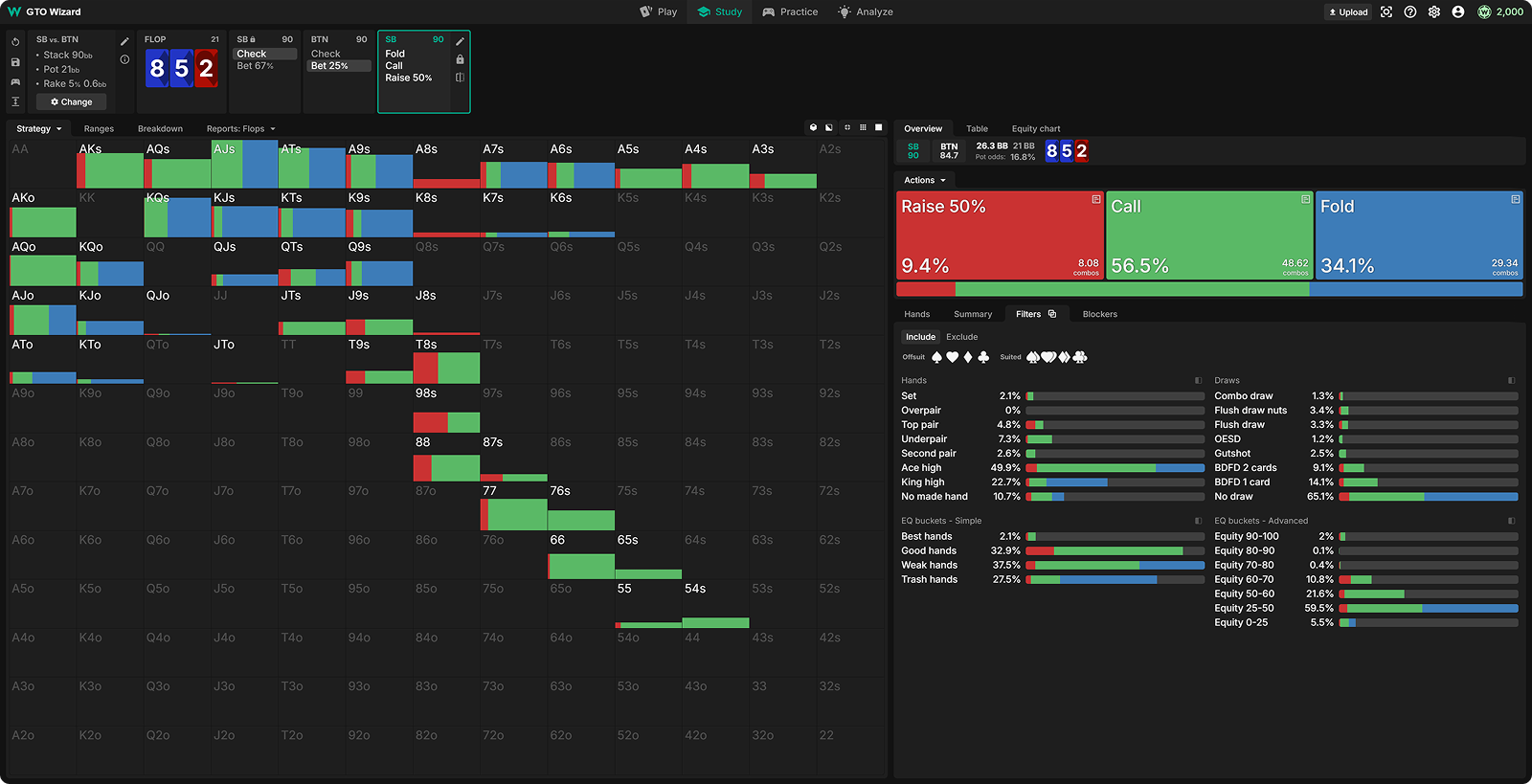
In the baseline GTO solution, BTN stabs ~55% of the time using a small 25% pot sizing. But once we nodelock the SB to bet 100% of their overpairs, the BTN’s strategy shifts dramatically; stabbing with 100% of their range. IP can now furiously charge the SB’s capped checking line, betting thinner for value, and denying more equity.
Since SB’s checking range now lacks strong hands, BTN’s entire range increases in equity. As a result, SB is forced to over-fold and check-raise far less often, allowing BTN to realize way more equity than they should.
This example shows how we can adjust our strategy when a player’s range is capped in a specific line.
To further level up your understanding of when/how/why we attack capped ranges and how capped ranges on the flop influence future decisions, I’ll jump to a second spot: UTG opens this time, and the BB calls. A flop of 6♣4♦2♣ hits the felt.
Example: BB vs UTG, Single-Raised Pot
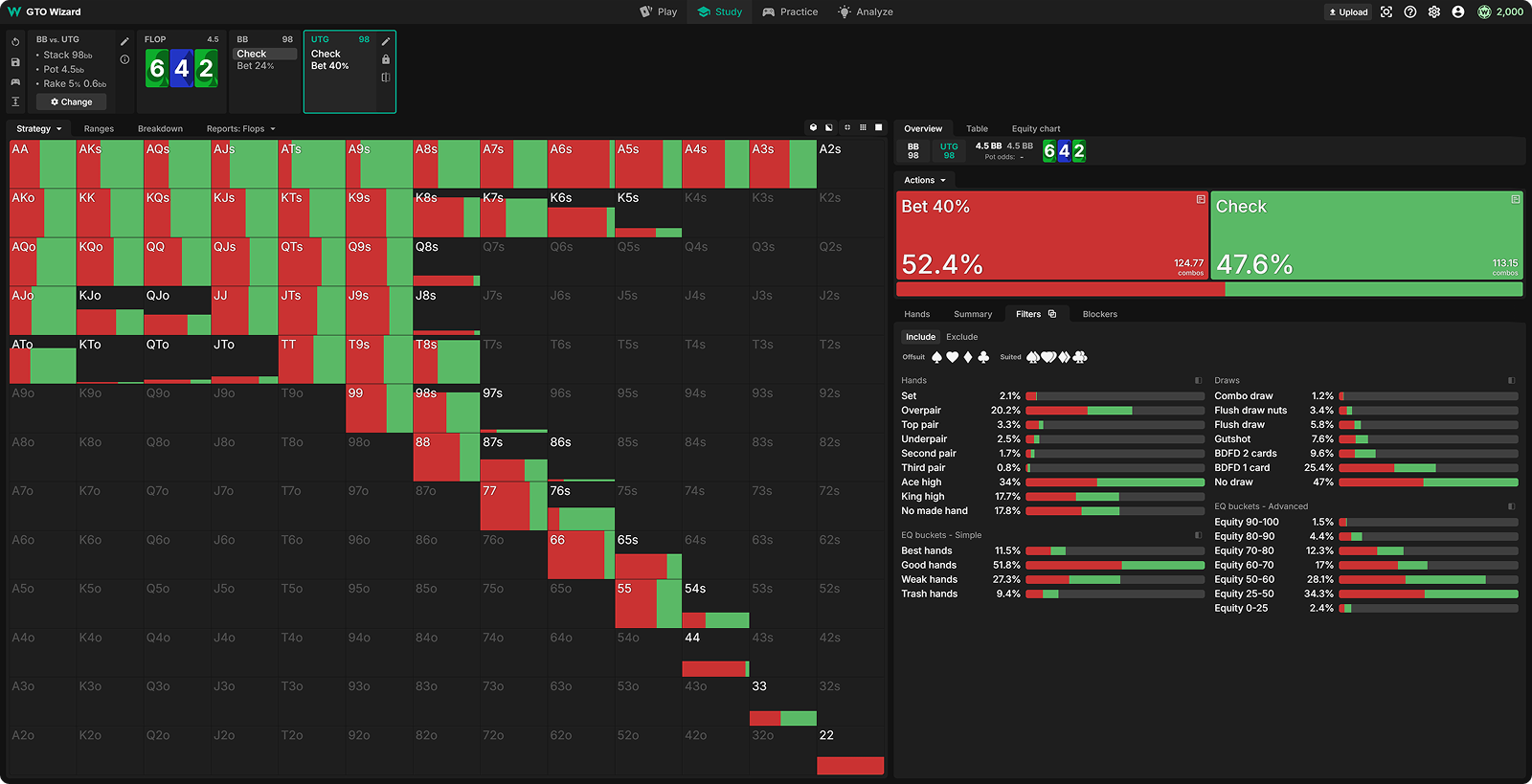
↑ UTG c-bet flop strategy vs BB on 6♣4♦2♣ in an SRP: 100bb starting, NL500
↓ UTG’s strategy with overpairs
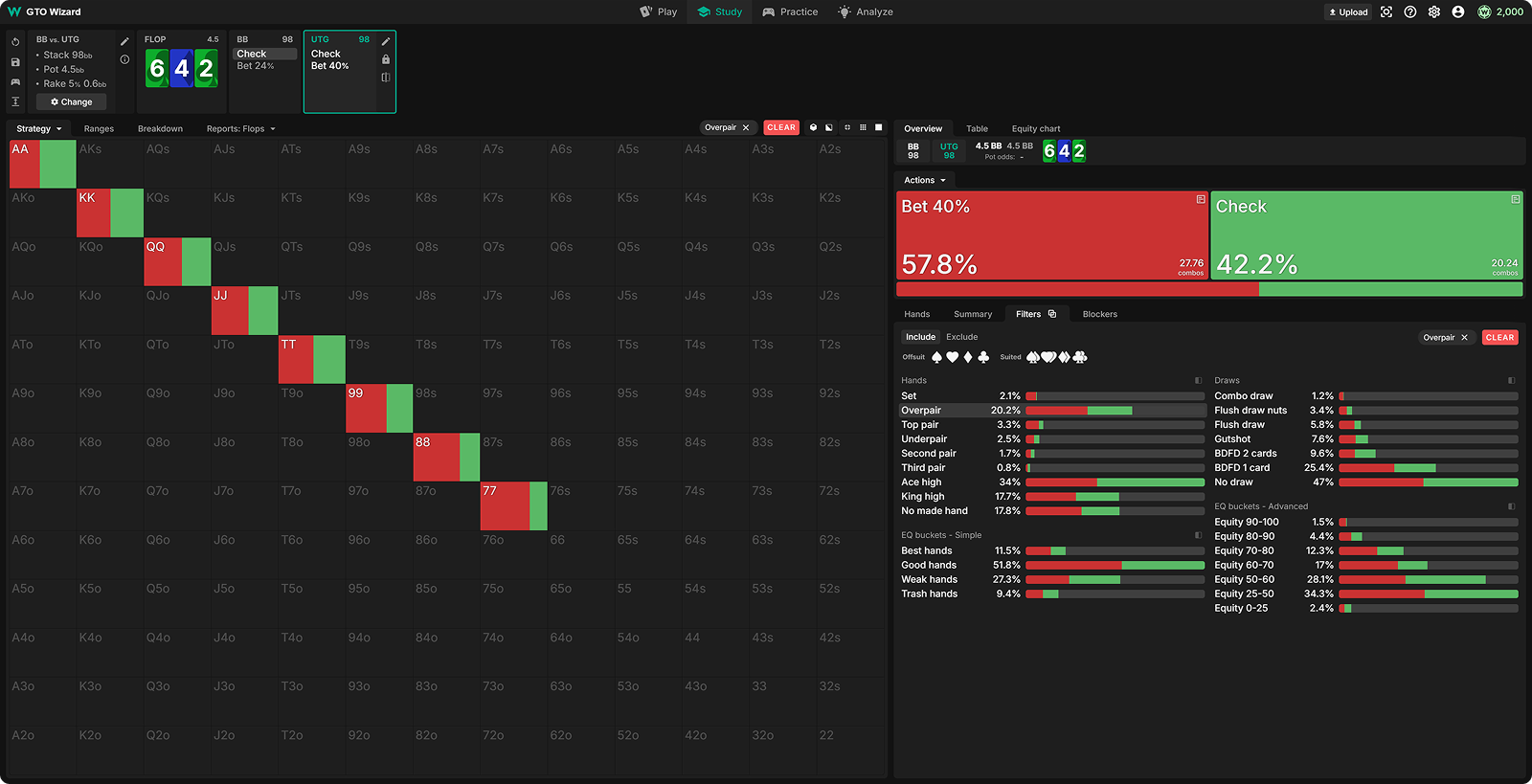
The UTG player is supposed to check roughly 50% of their range on this board. The texture connects very well with the BB’s preflop calling range. Most of UTG’s range, especially the Broadway region, completely misses here, and the BB has the nut advantage. As a result, UTG is forced to use smaller c-bet sizes and include many checks. This applies even to their overpair region. To not weaken their checking range too much, UTG should also check approximately 40% of their overpairs.
However, most players, especially those who don’t study GTO, are unaware of how often they’re supposed to check overpairs in spots like this. To demonstrate how our turn-probe strategy should be altered when the Villain doesn’t check overpairs, let’s compare two scenarios:
- GTO solution: UTG checks with ~50% of their overpairs.
- Exploitative solution: UTG nodelocked to check 0% of overpairs; betting 100% of them.
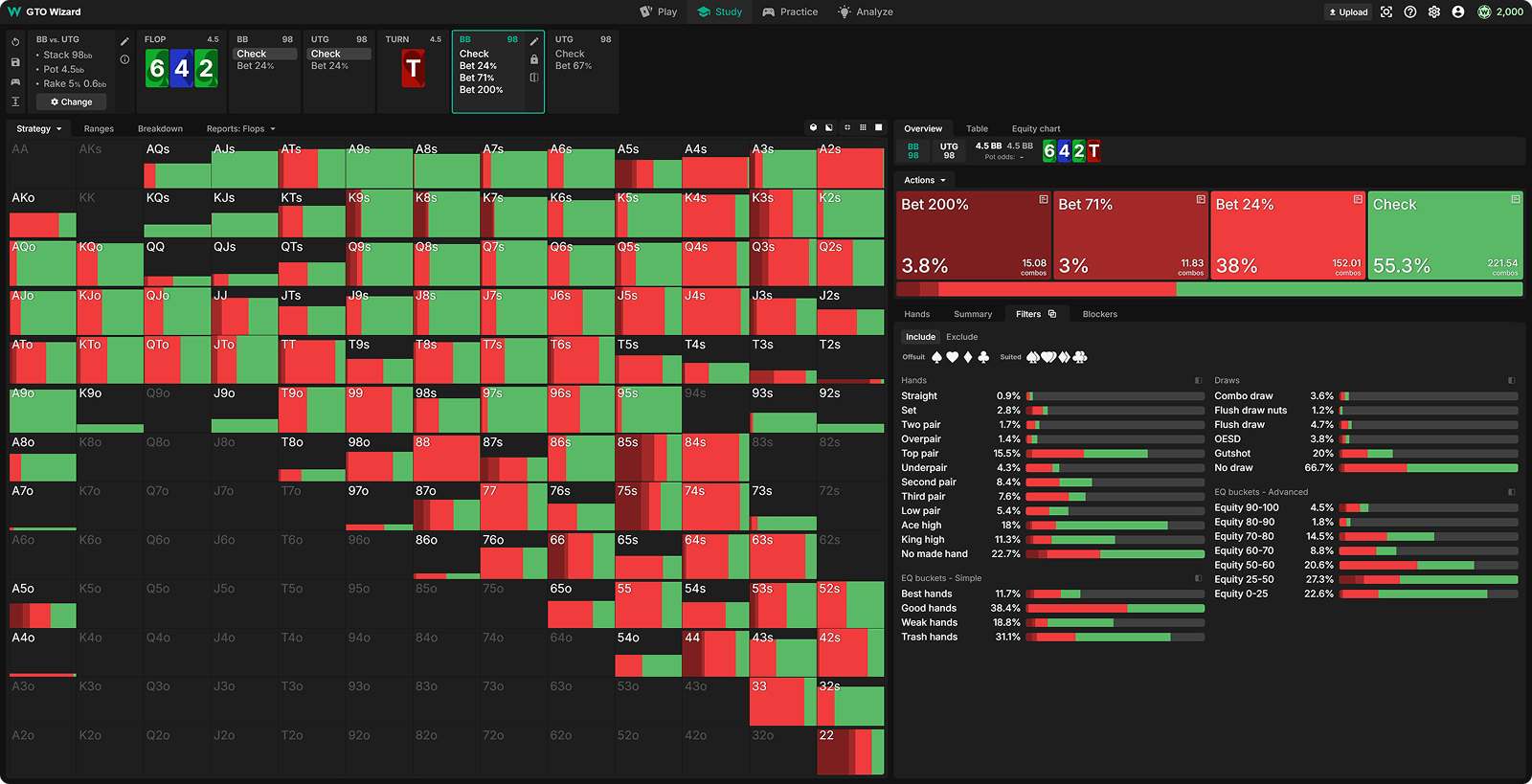
↑ BB probe turn strategy vs UTG on 6♣4♦2♣ T♥: GTO
↓ BB probe turn strategy vs nodelocked UTG (no flop checks with overpairs): Exploitative
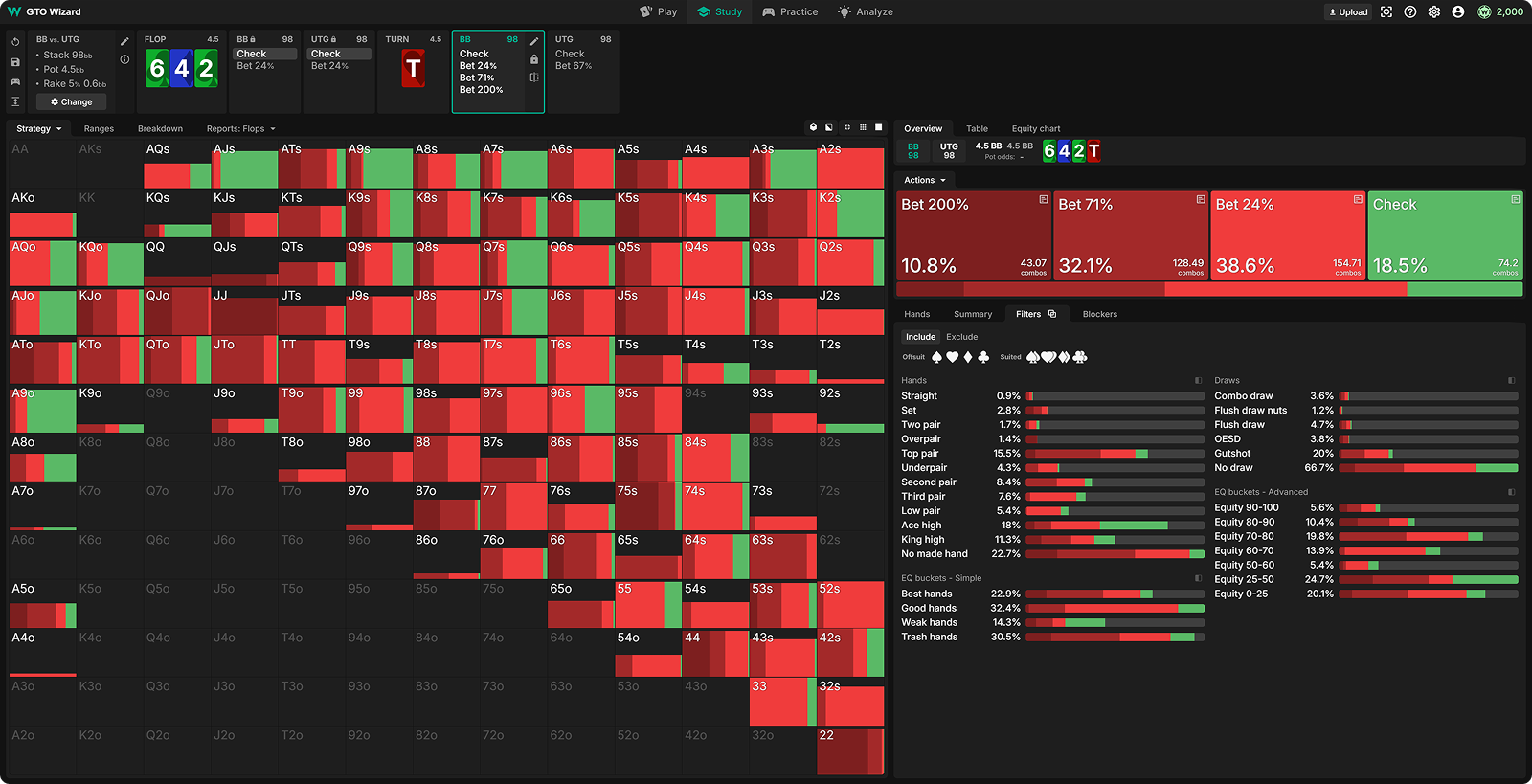
Wow! We can see some massive differences, right?
- There’s an increase in the overall betting frequency of nearly 40%.
- The large overbets occur more than twice as often.
- We size up 7-x to medium-sized bets.
- The value betting threshold for all hand classes is lowered: hands like 6-x and Ten-x are now strong enough for a medium sizing, and hands such as AT, JJ, and QQ can comfortably overbet.
Every hand gets an equity boost:
- 1–10% for made hands
- 1–5% for draws and air
→ Our overall range equity rises by almost 6%!
That equity has to come from somewhere. Indeed, it’s Villain’s range equity that drops significantly since they no longer have overpairs in their checking range. This forces them to fold more and raise less often compared to the GTO solution. As a result, we get to realize and deny more equity at the same time.
But the exploitation doesn’t stop on the turn. IP’s range remains overly weak going into the river. Let’s now look at how the strategy changes on the river after betting 71% pot on the turn, using four different river bet sizes to show how drastically each hand class is affected.
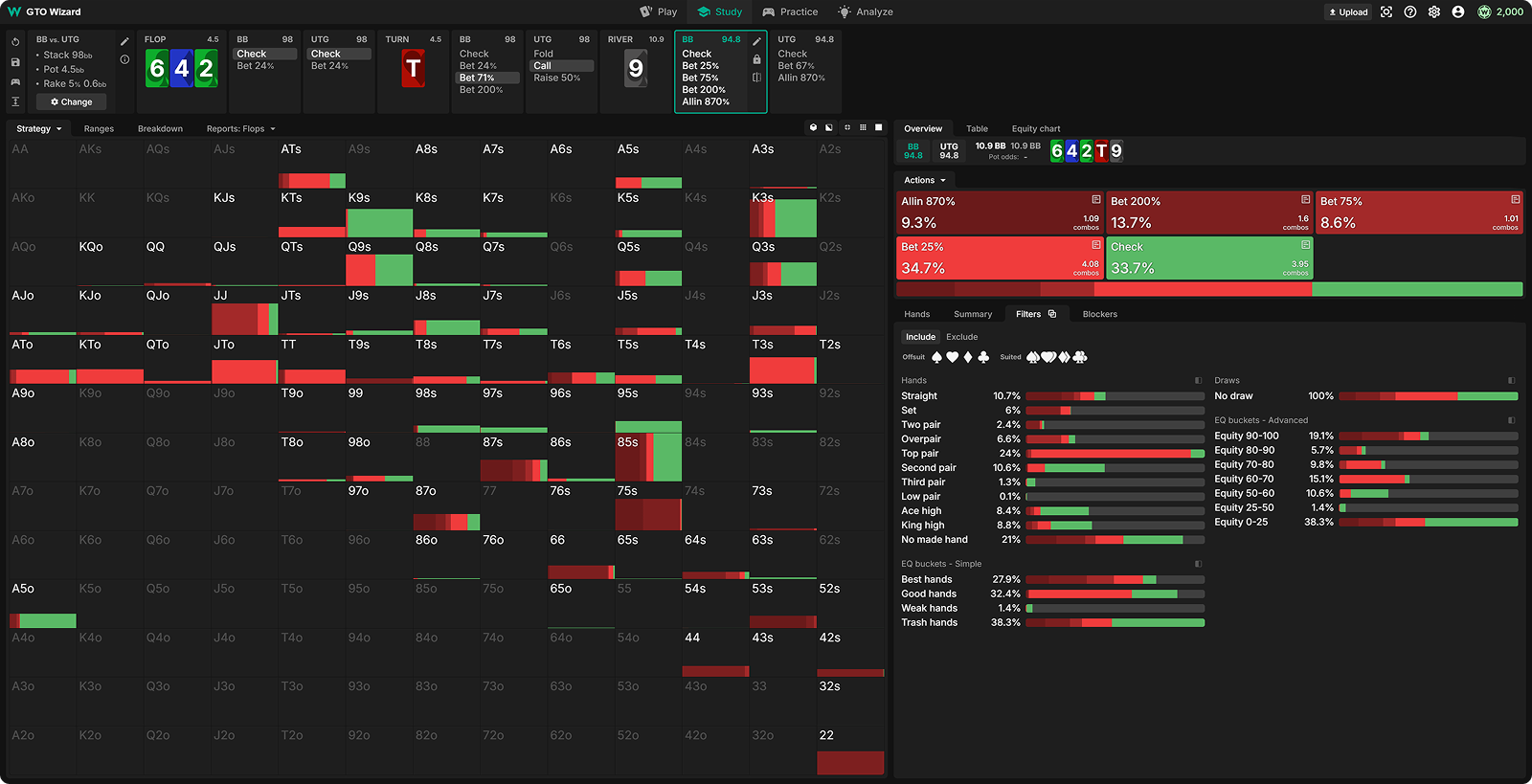
↑ BB river strategy vs UTG on 6♣4♦2♣ T♥ 9♠ after probing the turn for 71% pot: GTO
↓ BB’s river strategy vs nodelocked UTG (to never check flop with any overpairs): Exploitative
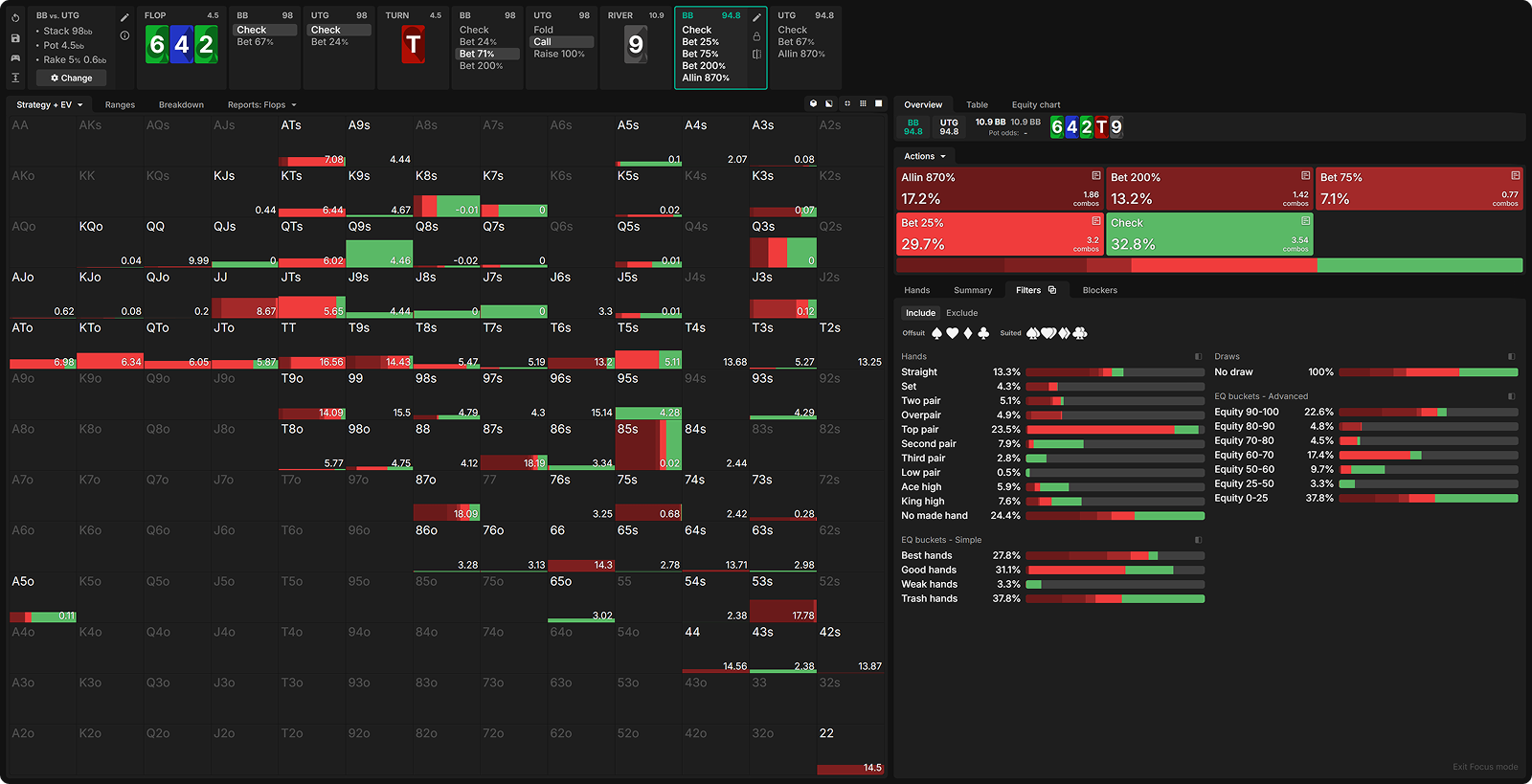
The pattern on the turn repeats on the river. We’re betting much more frequently with both thin value and bluffs, once again, indicating a lowered value threshold.
Comparison: GTO → Exploitative
- 6-x and 9-x mostly check → can also block bet exploitatively.
- Weak Ten-x is checking → block betting
- Strong Ten-x can block → can now bet 75% pot.
Note that our very best hands (like two pair or better) don’t change much, since they were already beating JJ–AA in the GTO solution.
What’s important to know is that when the defending player lacks strong hands, they have to take a stand with weaker hands. However, curiously, if they don’t and over-fold instead, we shift even further—bluff more often and value bet less thinly, since those thin value bets don’t get called enough.
Mistakes early on in the game tree will influence our strategy further down. Not balancing all of the different lines enough is one of the most common mistakes low- and mid-stakes players are making, especially the ones who don’t study GTO.
2) Bluffing Imbalances
{{grid: 3fr 1fr}}
In theory, a betting range tends to be perfectly balanced, meaning that it contains a ratio of bluffs to value hands that makes bluff catchers indifferent between calling and folding. The effect on our pure bluff catchers is that they neither make nor lose money over time (0EV).

{{/grid}}
But in reality, perfect balance is hard to achieve, especially if you haven’t studied GTO. Naturally, there are two directions to fall into when balance is lost: not bluffing enough or bluffing too often. And the effect this time on our pure bluff catchers will be that they either start burning (-EV) or printing (+EV) money.
Let’s examine two common spots where players tend to be significantly off-balance, scenarios that offer excellent opportunities to exploit our opponents.
2.1) Over-Bluffed Spots
Let’s start off by exploring a potentially over-bluffed spot: The BTN raise-calls a SB 3-bet. The flop comes down T♣9♦2♣, which the SB c-bets to the tune of 50% pot. The 3♠ turns, prompting the SB to keep up the pressure with another half-pot bet. The river brings in the 2♥, a total brick.
The SB reached this point with a lot of candidates to bluff the river with: all of the natural bluffs (busted draws). But with limited value hands in their range, they simply can’t afford to fire all of them if they want to maintain balance. In the theoretical realm, OOP must give up on a large chunk of these hands.
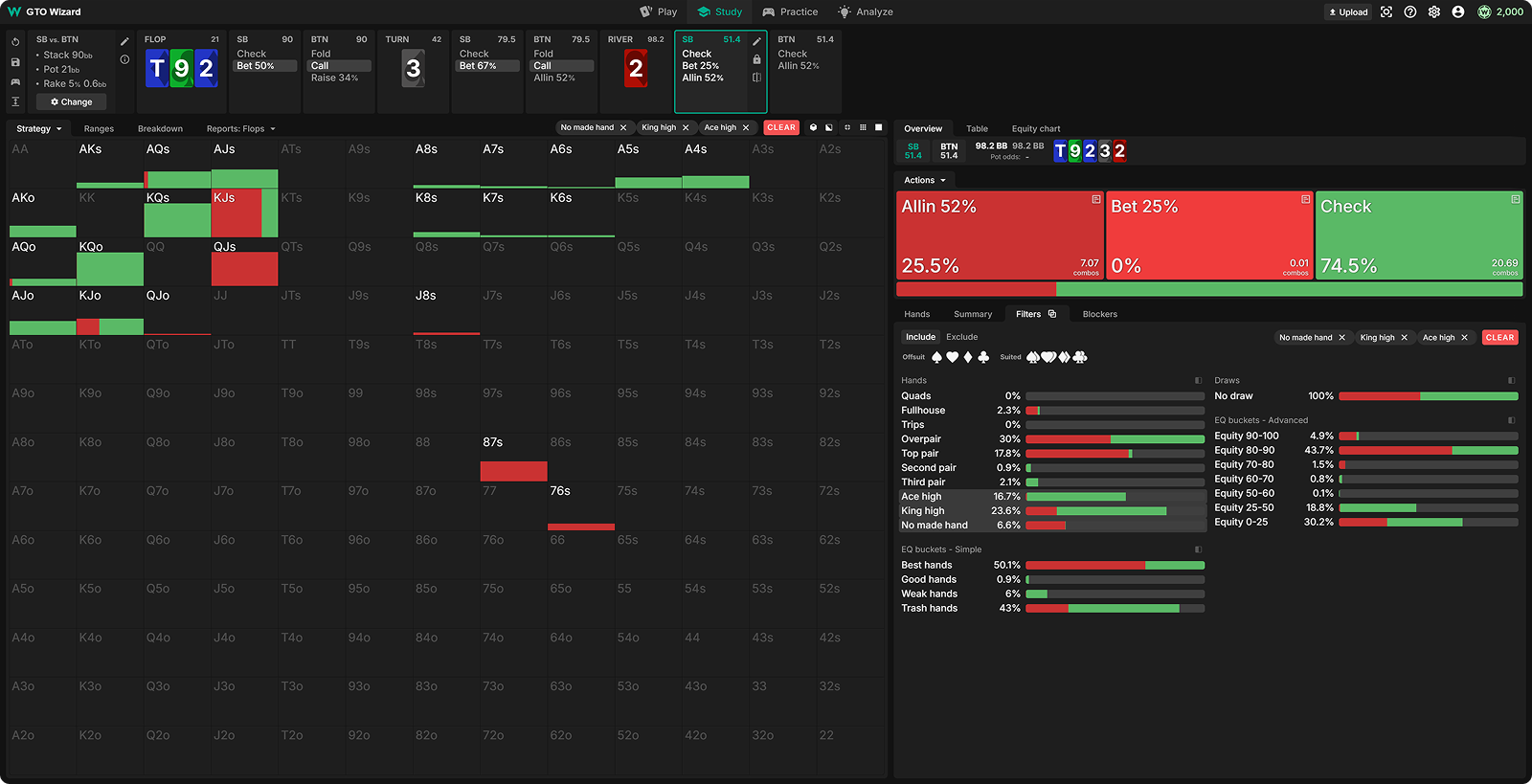
As we can see, the SB is supposed to give up almost ¾ of all their air. Players who don’t understand how much more air they have compared to value will have a hard time holding fire enough of the time, causing them to lose control over their bluffing frequencies.
Tip: How to Identify Over-Bluffed Spots
One of the easiest ways to find over-bluffed spots is to look for situations where:
- It’s easy to arrive at the river with a lot of bluffing candidates (because bluffing earlier streets came naturally with plenty of draws to choose from, and most of them did not complete).
- There aren’t many value candidates that the opponent would play this way.
- A bet is sized in a way that it requires way more value than bluffs in order to be balanced.
For example, with a 50% pot river bet, your opponent lays you 3:1 odds on a call, meaning they need a 3:1 ratio of value to bluffs—that’s 75% value, 25% bluffs.
When they fail to give up enough of their bluffing candidates, your bluff catchers gain EV and transition from 0EV to +EV.
Of course, this doesn’t mean that every opponent will over-bluff in these spots. To figure out who does and who doesn’t, pay close attention to showdowns. If you consistently see a player showing up with bluffs in spots where they’re supposed to give up a lot, that’s a strong indicator that they’re bluffing too often. Once you’ve identified this tendency, you can start adjusting by bluff-catching more frequently against that player.
Studying GTO theory will sharpen your ability to recognize and exploit these over-bluffing imbalances quickly.
Can’t get enough of catching people with their hands too often in the cookie jar? 🍪🫙
Then you will love this limited edition piece from Sotirios “Sotos” Liakos: “Calling Down Over-Bluffed Lines in Lower Limits.”
2.2) Under-Bluffed Spots
Bluff-catching can generate value, but it can also leak it. As an example, I found this typically under-bluffed spot: The BTN 3-bets a CO open and follows up with a small range-bet on an A♦K♦4♠ flop and a ⅔ pot bet on a flush-completing Q♦.
Here’s how the BTN should treat their weak pairs on a rivered 2 that doesn’t change anything anymore.
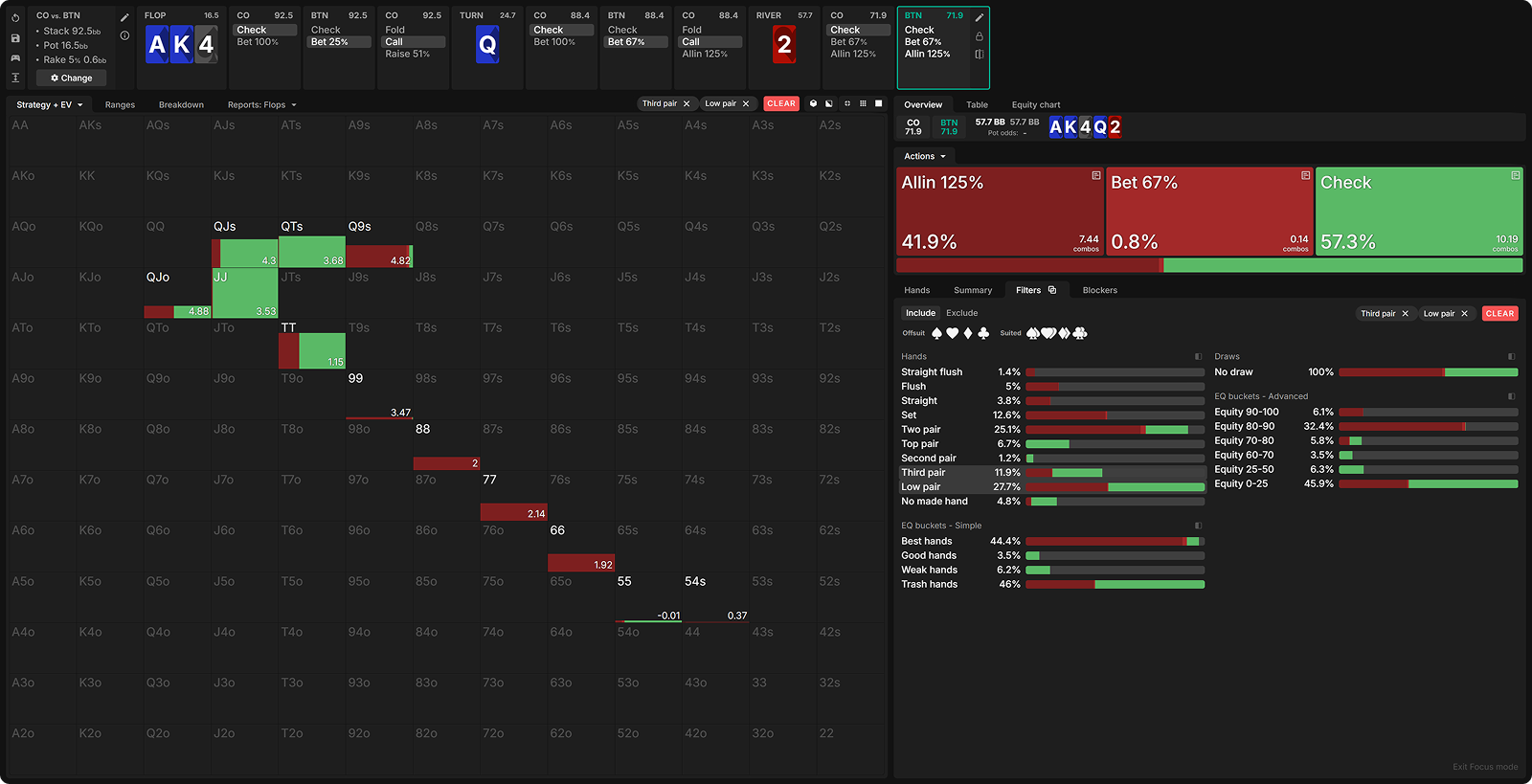
In this scenario, the BTN has few natural bluffs, there are very few missed straight or flush draws by the river. So they need to get creative, starting already on the turn. The solver begins mixing in bluffs with low pairs that have good blocker properties.
Looking at BTN’s river strategy, we can see they’re supposed to bluff third and bottom pairs over 40% of the time, with a preference for the combos that include a diamond to block flushes.
In practice, however, many weaker players can’t get out of showdown mode with these weaker pairs. Not finding these bluffs causes an under-bluffing imbalance. The essence of this problem is shaped as a hole, a hole in knowledge:
A General Rule for River Defense
When you’re facing a river bet, don’t focus solely on your hand strength or your blockers. Instead, before getting to those factors, ask yourself this question:
“Which hands have to be bluffed for my bluff catcher to be at least breakeven, and will my opponent find and fire enough of them?“
Against weaker opponents, the answer is often: not enough. Many players simply aren’t aware that they should be turning pairs into bluffs when they run out of natural bluffs.
Being cautious in these spots pays off. And again, be mindful of showdowns: If your opponent regularly checks down potential bluff combos, it’s a strong sign they’re under-bluffing, and you can start folding more frequently with confidence.
The Essence of Punishing Those Who Didn’t Do Their GTO Homework
Adjusting to take advantage of your opponents’ mistakes against theory. Sounds obvious, right?
Even though many strategies seem straightforward at first glance, executing them effectively is a whole other story. Players who don’t study GTO often deviate drastically from a theoretically sound approach, which opens the door for extreme exploitation. The catch? There are different ways to deviate. This nuance allows us to be more precise and say that the essence of it is to become proficient in identifying imbalances and designing the exploits that maximize EV. This is not limited to preflop, but extends all the way down the game tree.
Here’s the recipe to exploit players who deviate from GTO, consisting of three steps:
- Start with the question, “What would the GTO solution be here?”
- Next, ask yourself, “In what way(s) is my opponent’s strategy different from the GTO solution?”
- If you found the mistake(s), you can now think about how to take advantage (i.e., exploit).
However, to do the recipe justice, we have to carefully select the ingredients. Two in particular are essential:
- A solid understanding of theory – You need to be able to recognize when opponents are making mistakes in the first place. Without knowing what’s right, you can not know what’s wrong. That’s why studying with solvers is so important; they show you what’s theoretically right, which heightens your sense to spot and even predict deviations from GTO.
- A creative ability to come up with a strong exploitative response – Understanding that your opponent is making a mistake and, better yet, knowing which type of mistake, is an essential first step, but isn’t enough to generate additional EV. That also requires being able to create the right exploit, which does the actual capturing of the extra value on the table. Getting handy with GTO Wizard AI’s nodelocking feature will build this skill. Show the solver your opponent’s imbalanced strategy, and through simulation, it will show you the max EV counter-strategy. This won’t just spike your short-term profits; by gaining more insight into exploitative dynamics, you will become more adaptable, allowing you to thrive in an ecosystem that evolves over time.
Summary
That was a lot to take in! Let’s wrap things up with a quick summary of the key takeaways to help you get a clear overview.
- Many low- and mid-stakes players don’t bother with studying GTO, which causes them to make consistent strategic errors. But if you take the time to do your homework, you will not only be less likely to make these errors yourself, it will also enhance your ability to quickly spot these leaks and design targeted counterstrategies.
- Capped ranges occur when opponents never include their strongest hands in certain lines. Once identified, you can attack them by betting and raising more frequently with thinner value bets and additional bluffs. Another lever to pull is bet sizing; each hand class can typically also size up.
- In practice, calling with pure bluff catchers is either profitable or will cost you money. After all, no human is perfectly balanced. When opponents over-bluff (e.g., by failing to give up missed draws), your bluff catchers become profitable calls. But when your Villain is under-bluffing (e.g., failing to find unnatural bluffs), all of your bluff catchers lose EV. Adjust accordingly based on player tendencies.
- Exploitative play is kickstarted with this sequence: What is the GTO baseline? How does my opponent deviate from it? What is the most +EV way to respond? Simple questions lead to powerful exploits!
- Studying GTO gives you the means to identify mistakes and punish them. Solver features like nodelocking allow you to simulate common leaks and view the max EV adjustment.
Is Limping Preflop Viable in Mississippi Straddle Games?
In this article, we’ll delve into both the theory and the practice of open limping. Why does it make so much more sense in Mississippi Straddle games than in traditional, two-blind Hold‘em? How should you respond to limpers when you have position on them?
Navigating BvB OOP After Check-Calling the Flop
Today, we’ll be discussing a scenario that presents itself incredibly often for online cash grinders, one that incorporates all three of these complications: playing the XC-X-? line as the OOP preflop raiser from the SB vs BB in SRPs.
Why You’re Bluffing the River Wrong With Bricked Flush Draws in Cash Games
It’s exciting to flop a flush draw; when you do, you have a fairly high chance of having a strong hand by the river. It’s a lot less exciting, however, when the river arrives without your flush and you’re left with air or a weak pair, especially when you’ve invested a lot of chips on previous street