Common Poker Sayings That Ruin Your Winrate

Overview
If you’ve been around poker for a decent amount of time, you’ve probably heard the following two phrases. You may have even uttered (or thought) them yourself!
These are expressions that are most commonly made by studied players; often, they’ll understand that, in theory, the hand they’re holding is simply required to take a certain action, even though it’s an undesirable spot to be in. Bluffing on the river, or inversely, bluff catching against an all-in, are nodes in the game tree where our actions will never be all that profitable, even the best option.
These sayings often remind us that even though something feels bad, we know it’s the right thing to do, and they help us to follow through on that. However, these useful reminders can also hurt your win rate by shortcutting actually thinking about the real-life game environment you’ve found yourself in practice.
I’m at the Top of My Range; I Have To Call.
This adage is often used to justify bluff-catching in difficult spots, especially when it feels very uncomfortable, such as facing large river bets. In theory, this makes sense; a solver will balance these large bets with the appropriate amount of value and bluffs, meaning that our best bluff catchers will usually be profitable calls.
However, this saying frequently falls apart in a real game. Everyone who’s played much poker knows about the OMC player type, who almost exclusively has strong value when betting large.
But even stronger players who are generally willing to bluff can fall victim to under-bluffing in specific scenarios. These are also spots where this saying can bypass your thought process, resulting in a hit to your win rate.
The example we’ll use here is on the river with a board that has run out four to a flush. Specifically, we’re looking at a CO vs BB SRP with 100bb deep starting stacks. On the flop of K♦T♦5♠, CO c-bet 33% pot, and BB called. After the turn 2♦ checks through, the river is the 8♦.
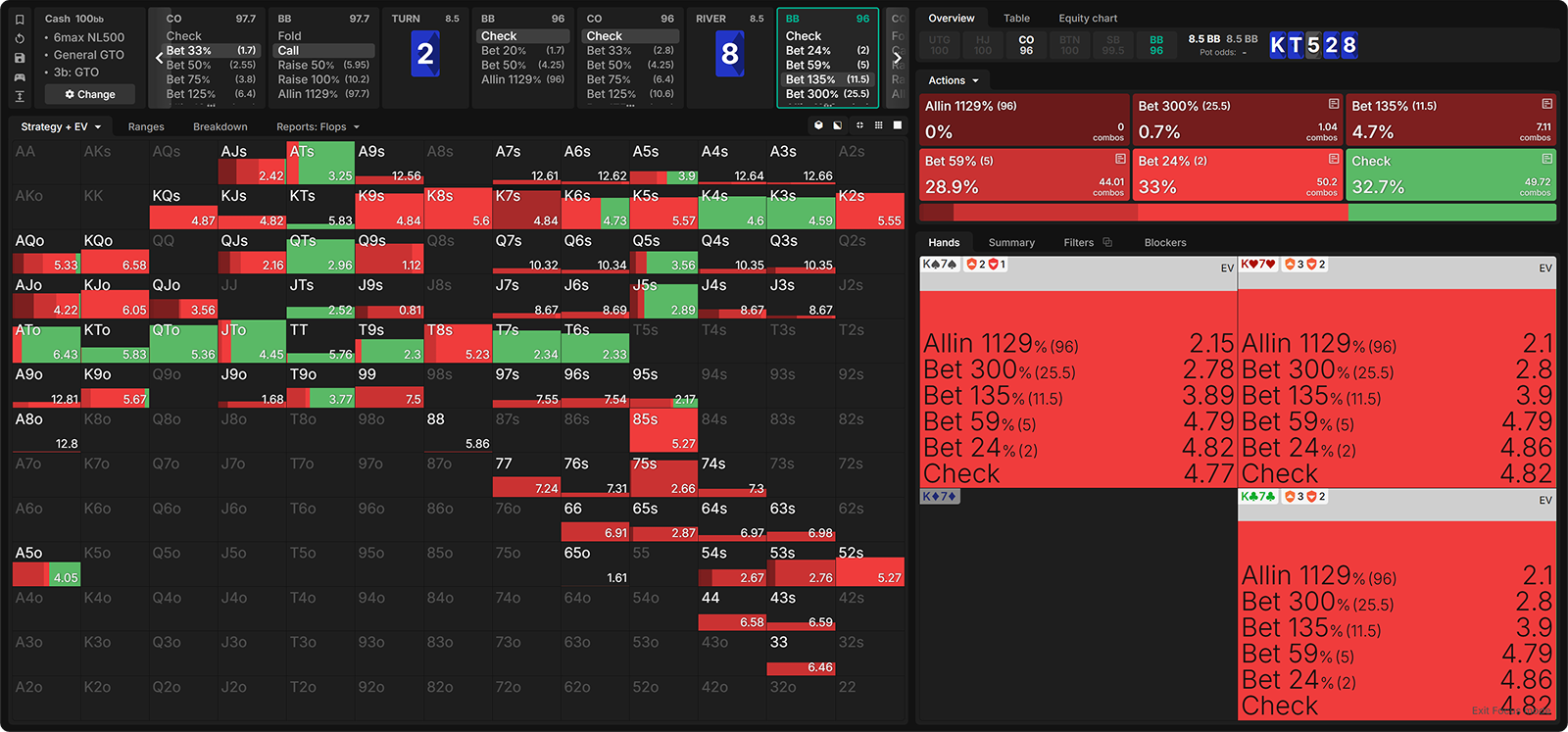
On the river, BB has a larger proportion of nut flushes than CO does, by a fairly significant margin. Looking at both players, we can find the two biggest factors:
- BB’s preflop calling range has more offsuit Ace-x combinations.
- Additionally, the majority of CO’s combos that contain the A♦ barrel the turn.
This creates a scenario in which BB can lead overbet the river at some frequency, punishing the relatively capped range CO has arrived with. For value, BB will overbet as low as the J♦, while bluffs come from double Broadway combos without a ♦.
When facing this lead, assuming it’s balanced, CO must defend hands as weak as a simple top pair to avoid making indiscriminate bluffing profitable for the BB.
Let us step back from the solver, however, and inspect the human element of this scenario. While the BB will have more nuts than the CO, both players will still have the A♦ at some frequency. From an emotional perspective, it is easy to imagine a tight-aggressive player being unwilling to bluff into a range that is perceived to contain the nuts easily, or at least be reluctant to do so.
Additionally, unless a player has studied this sort of river spot thoroughly, it would be difficult to find an overbet with the third nut flush like the solver would. What this adds up to is a spot where most players are not going thinly enough for value, and are almost certainly not bluffing with the proper frequency.
So, what to do when holding something with the Q♦, for the second nuts? Well… It depends. Folding it against the lead overbet loses a lot of chips in theory, so you’d have to be quite confident about your read if you want to execute the over-folding exploit. However, I would argue that there are many players, even studied ones, who are emotionally unwilling to bluff in spots like these.
I’m at the Bottom of My Range; This Is a Mandatory Bluff.
This particular phrase is self-explanatory; you’ll hear it often right before putting all of the chips in on the river with 7-high. While it is not always wrong, if you find this phrase echoing in your mind instead of actually considering the bluff you’re about to make, you’re losing EV!
In our previous example, we looked at a spot where many real players would have a difficult time being balanced, and how accounting for this could shift our strategy from baseline. In this example, however, we’re looking at an entirely GTO scenario.
The spot looks as follows:
- UTG opens, BB calls.
- On the flop of A♥K♠2♦, UTG c-bets using an overbet sizing, and the BB calls.
- When the 2♣ turns up, UTG overbets once again, and the BB once more calls.
- The river comes the A♣, and UTG goes all-in.
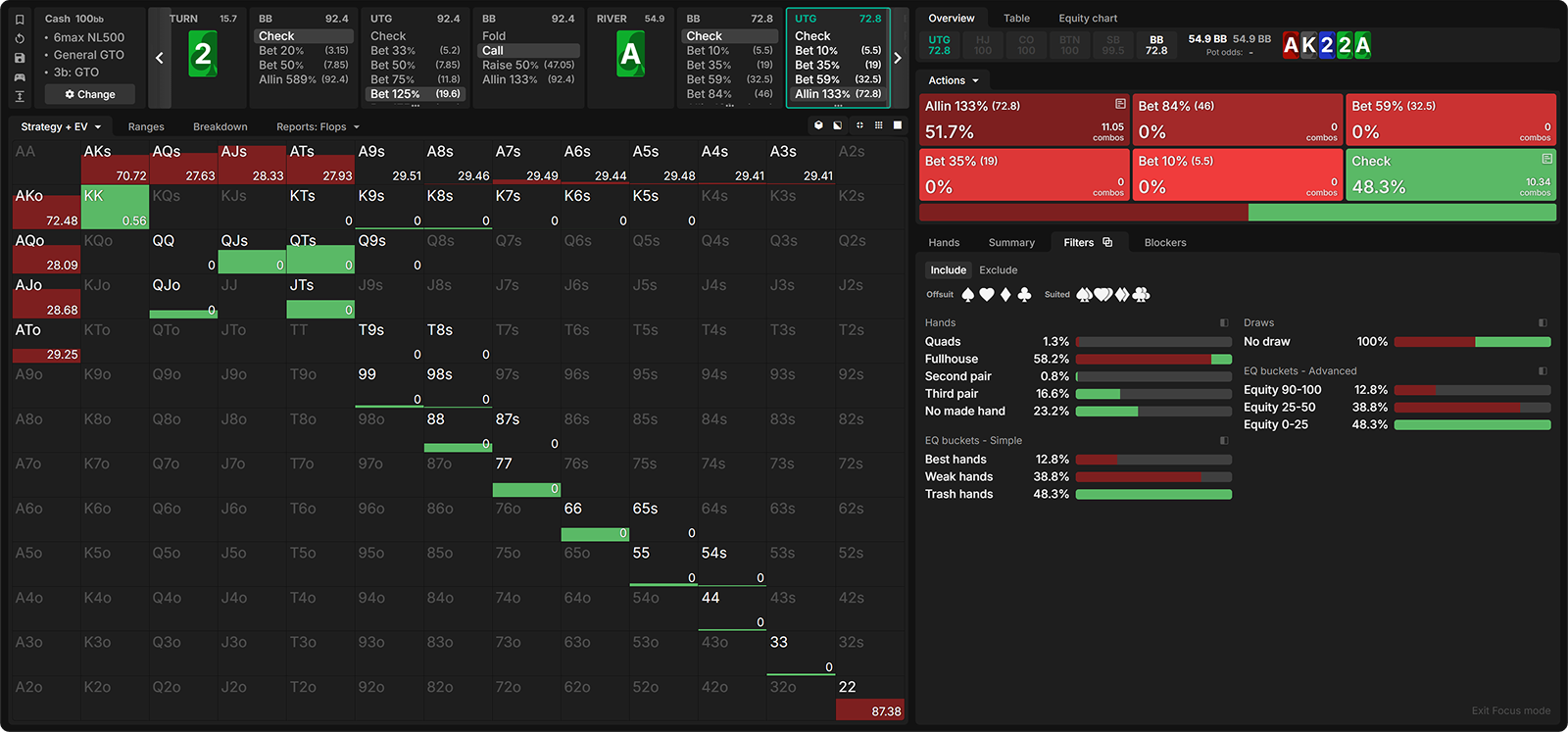
UTG’s value range is obvious; Any Ace-x makes a full house, and AK for top boat will make lots of chips off of BB’s own Ace-x hands, only losing to the rare combination of pocket 22. UTG’s bluffs, on the other hand… don’t exist?
{{width: 67%}}
{{/width}}
{{question-mark}}
But wait, isn’t the solver supposed to be balanced? Isn’t it supposed to have bluffs to offset its value combinations?
{{/question-mark}}
Typically, yes, but the solver has no concept of “balance” like a human does. The reason it arrives at strategies that include bluffing hands at the bottom is that they maximize EV against a perfect opponent. In this example, bluffing with air is simply never profitable!
The reason why isn’t hard to see when we explore what BB’s range looks like on this river. After facing an overbet on the prior two streets, BB’s worst hand with more than 50% frequency on the river is a counterfeited full house (K2s)! Almost every other combination BB holds features an Ace (for Aces full of Deuces). It’s not that UTG arrives at this river lacking bluff candidates; UTG’s range contains underpairs and suited Broadway combinations that were used to bluff previous streets. So you’re probably wondering: why is the solver not bluffing with them?
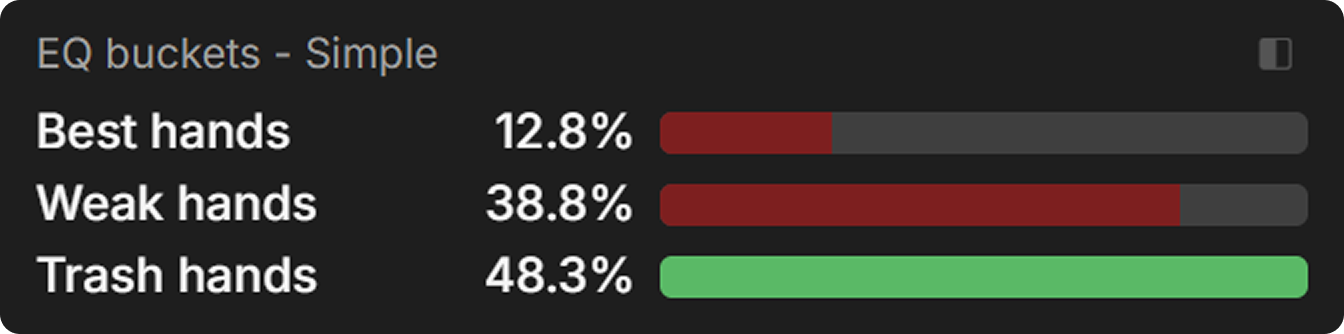
Now, there’s a nuance here I haven’t mentioned yet; if you managed to catch it, well done! Earlier, I said that Ace-x combinations are part of UTG’s value range, but they’re actually what the solver uses to balance strong value like AK and 22. The graphic above indicates that these hands are actually in the 25–50% equity bucket; they are largely chopping and occasionally losing. When UTG shoves Ace-x, it never gets called by a worse hand. This is, of course, for the same reason that we don’t see UTG’s air combinations being bluffed; BB has exclusively full houses or better. Given that non-AK Ace-x combinations are never called by worse, they’re not actually part of the value range; they are bluffs. BB is actually meant to fold AQ through AT combinations, as they block the most give-ups in UTG’s range.
So I’ve misled you somewhat. The solver actually does manage to find bluffs in this node; they just happen to be bluffs that mostly result in a chop when called, which overperforms the usual “air bluffs.” This is another situation where understanding human opponents is important. Almost no human is going to find a fold with AQ as the BB in this line, and if you’re in a game with someone who might, I’d recommend finding an easier game!
The next time you’ve made it to the river, particularly after bluffing for large sizes on previous streets, take a moment and consider: “Does my opponent actually have any hands remaining that are likely to fold?” If not, perhaps it’s time to wave the white flag and save your stack for another day.
Conclusion
Building heuristics by studying poker is an important aspect of understanding spots in real-time. It is an infinitely complex game, and one could spend many hours analyzing a single hand to understand every nuance. But this is not viable for us mere mortals, so we need to find ways to transform that knowledge into something that’s useful in practice.
However, these heuristics can also be dangerous and lead us down wrong paths without even realizing it. No heuristic will ever substitute for turning off autopilot and turning on your brain. So always think through the real-life hand/spot that you find yourself in.
We Are Hiring
We are looking for remarkable individuals to join us in our quest to build the next-generation poker training ecosystem. If you are passionate, dedicated, and driven to excel, we want to hear from you. Join us in redefining how poker is being studied.
Check out the available positions here.
Monkey in the Middle: 3-Way Pot Heuristics
In this article, we will discuss the key strategic differences between this scenario and one where you face a continuation bet in a heads-up pot, how those differences factor into the GTO responses to these bets in 3-way pots, and when those differences are more or less salient.
The Trouble With Implied Odds
When we were brand new to poker strategy, many of us learned about concepts like equity, outs, and pot odds. When drawing, we were taught to count our outs, use those to estimate our equity, and then call or fold based on whether we were getting the right pot odds for the equity we had.
Poker Concepts You’re Using Wrong (and How They’re Hurting Your Winrate)
Language and poker are two of my great passions in life, so I’ve always been interested in poker’s unique and colorful vocabulary. As a poker coach, podcaster, and writer, I have particularly strong opinions about the language we use to explain poker strategy.