How to Exploit Human Mistakes After a Flop Overbet

Overview
If you’ve read my article on overbetting flops, then the last thing holding you back from taking advantage of this powerful play is a lack of familiarity with how to follow through on turns and rivers. I’ve got two pieces of good news for you:
- It’s not really all that tricky.
- I’m about to tell you everything you need to know!
The most important thing to understand, when it comes to playing the later streets, is the range dynamics created by your flop overbet. What did your overbet tell your opponent about your range? And what did their call tell you about theirs?
Overbetting polarizes your range. That means you should have mostly very strong or very weak hands after overbetting.
Calling the overbet strengthens your opponent’s range dramatically. Calling a big bet from out of position is not the sort of thing they can justify with a weak hand.
Calling does not necessarily cap your opponent because when you bet so large, they have good reason to think you may keep shoveling money in and consequently feel little urgency to reveal the strength of their hand by raising. However, the flops you overbet should be ones where your opponent is already capped. This means they will usually hold few very strong hands after calling your overbet, not because slow-playing would be unreasonable, but because they simply didn’t have many strong hands in their flop range to slow-play with. The result is they will generally have a condensed range, consisting of mostly medium-to-good holdings, with few weak hands but also few nutty ones.
Your approach to later streets will depend on how much the new cards change this polarized-versus-condensed dynamic. The default should be that you will continue barreling a polarized range, using geometric bet sizing to get the rest of the money in when you wish to do so.
{{question-mark}}
But just how strong does a hand need to be to make it into the value region of your polarized range? And how should you choose your bluffs? To answer these questions, we’ll investigate a few examples.
{{/question-mark}}
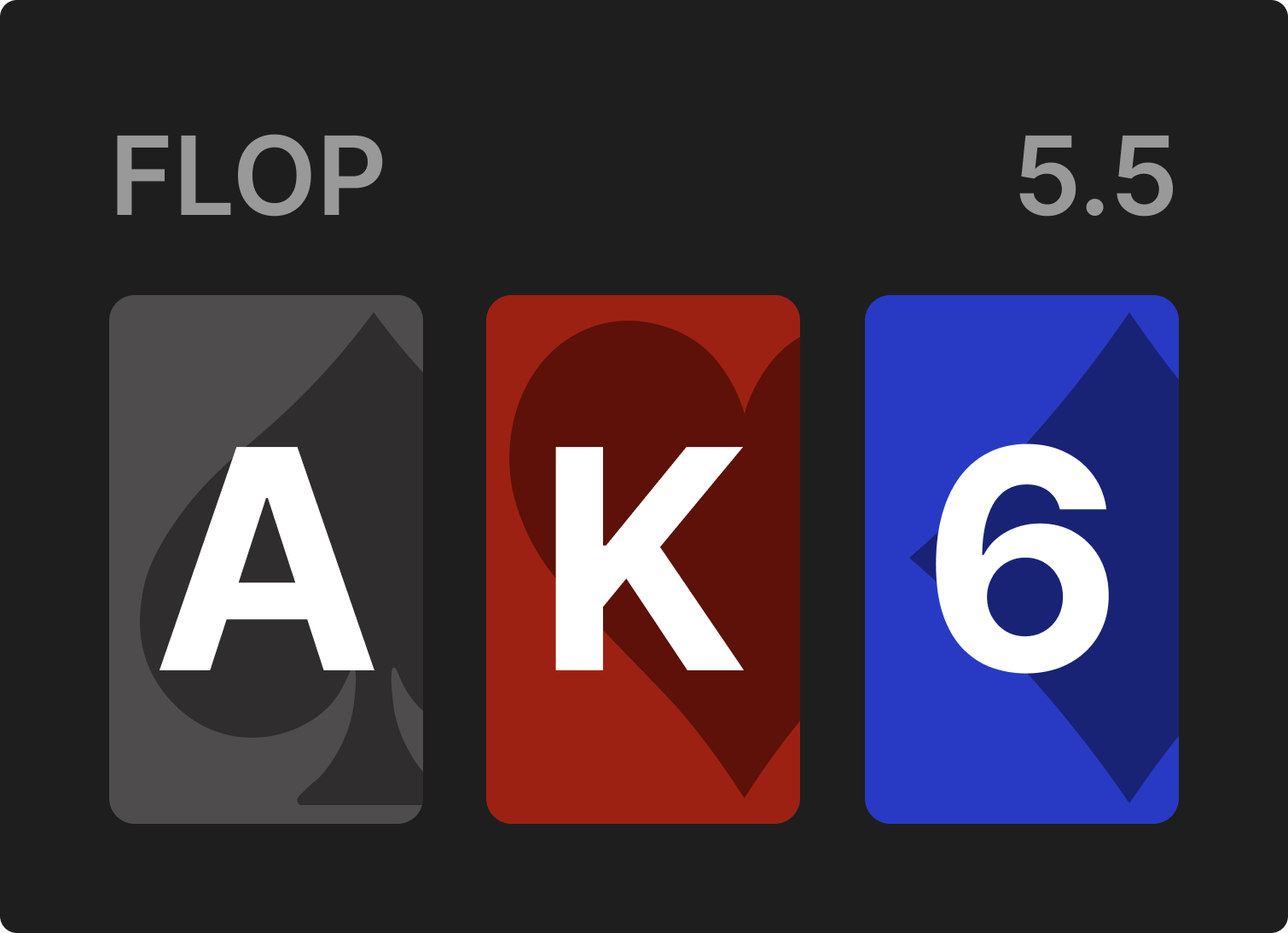
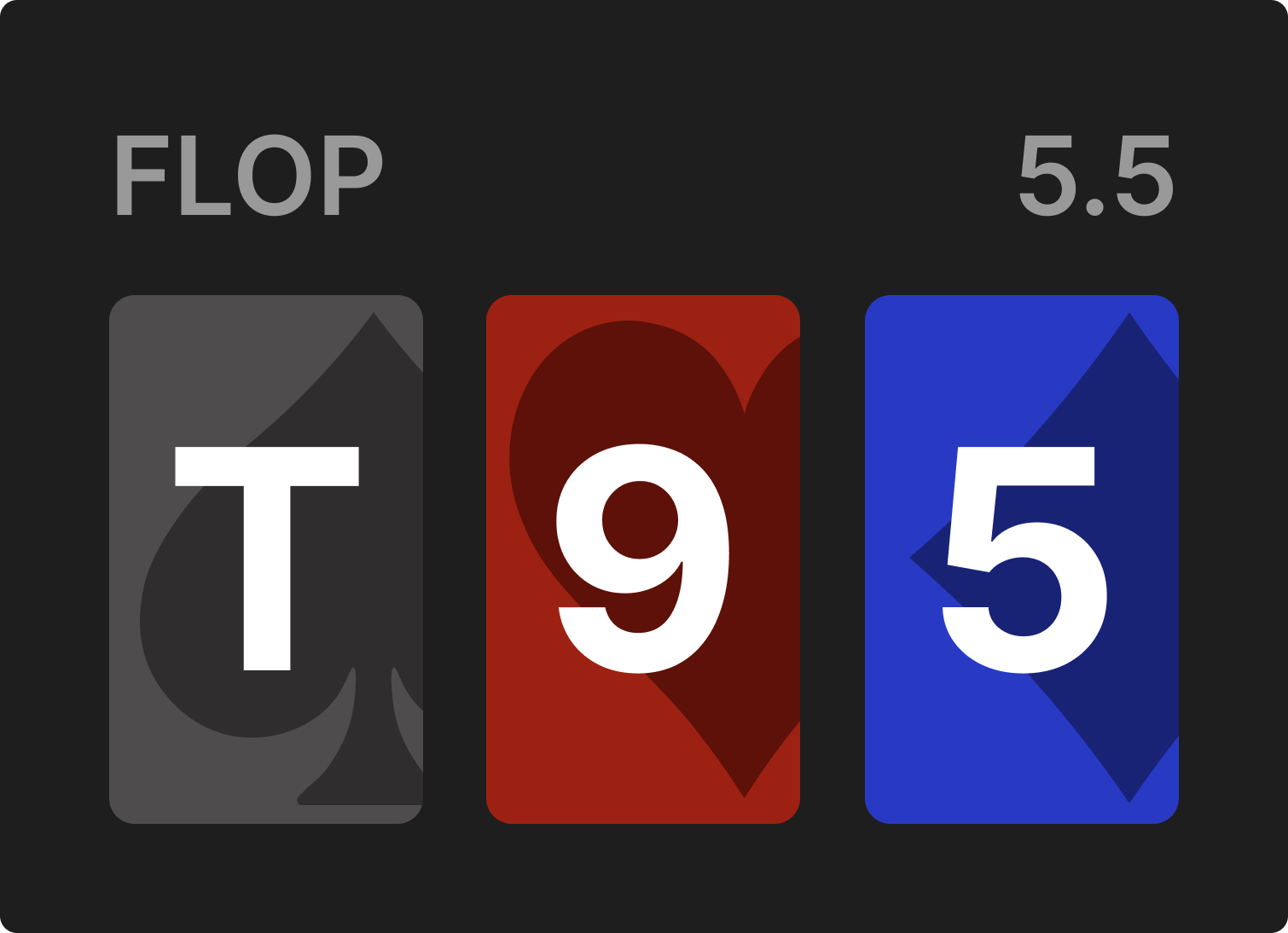
As in the previous article, these examples are all drawn from BTN vs BB SRP 100bb deep cash game scenarios. On AK6r, BTN bet 253% pot. On T95r, they bet 125% pot.
Now, we will look at how to follow through on those flop overbets after the BB called.
{{width: 25%}}
{{/width}}
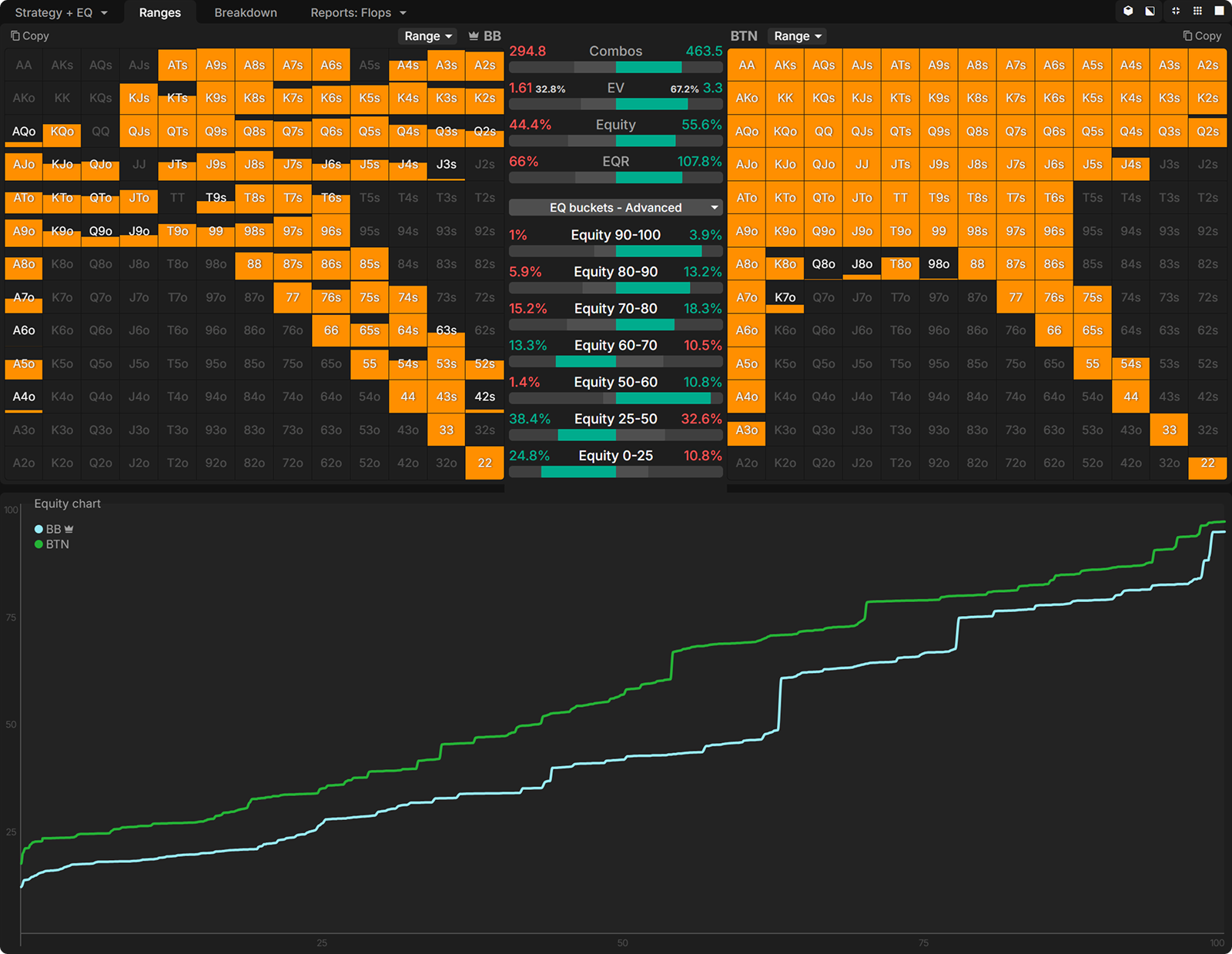
At the moment they saw the flop, before any action took place, BTN enjoyed a nice ~56% equity advantage (vs. BB’s 44% EQ) and also had more of the best hands in their range. This is what made overbetting an appealing play in the first place:
This dynamic changes drastically after BB calls the overbet. Here’s what it looks like on one of the blankest of turns, the 2♣:
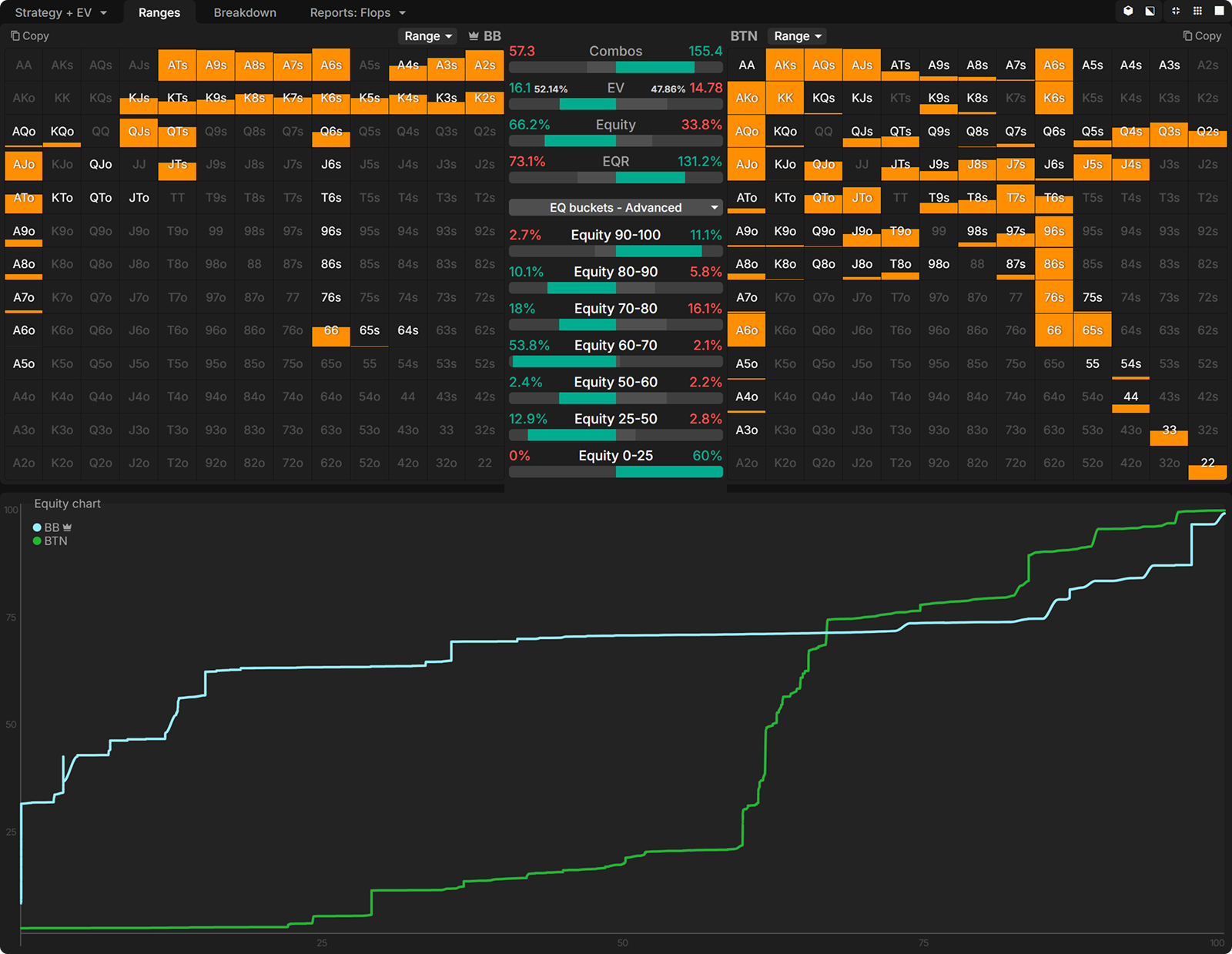
BTN’s nuts advantage is slightly more pronounced, but their equity has plummeted from 56% to 34%!
The players have entered a classic polarized-versus-condensed range dynamic. Because the board is so static, this is a rare real-world, pre-river spot that can be modeled reasonably well by a toy game.
BTN, with a high degree of confidence, can look at their hand and conclude either “I will hold the best hand on the river” or “I will not hold the best hand on the river.” BB can likewise conclude that, with most of their range, they will win against BTN’s bluffs but not against their value bets.
The GTO strategy for BTN in this case is to value bet all their strongest hands and to balance those bets with an appropriate number of bluffs. They can optimize this by betting geometrically, sizing their bets so that they bet the same fraction of the pot on the turn and river. This is exactly what the solver does; betting the turn for 73% pot to set up a 73% pot-sized shove on the river.
The tricky parts are identifying just how strong a hand must be to value bet and which hands to bluff with.

At the top end, notice that there is no slow-playing. With any AQ or better hand, BTN purely bets.
The main reason to slow-play would be to keep very weak hands in BB’s range and give them an opportunity to improve or bluff later. But it’s too late for that: BTN has already caused those hands to fold by overbetting the flop. Checking now would incur the downside of slow-playing (i.e., failing to grow the pot) without the upside of keeping those weak hands around.
The strongest hands BTN checks are AJ and AT, which, if they further strengthen BB’s range by betting the turn, would not be strong enough to jam a blank river for value. Because BTN is not looking to play for stacks with these hands, they can choose whether to get their second (and final) value bet on the turn or the river. There are slight advantages and disadvantages to each, but it doesn’t matter terribly much which they choose. The important thing is to recognize that these hands are not strong enough to play for stacks, which is why checking the turn is an option worth considering.
Among BTN’s weak hands, there are hands that always bluff, hands that never bluff, and hands that sometimes bluff. It is important to recognize that this distinction is not based on equity.
After overbetting this flop, they have no middle. A hand like 86s has 19% equity, but it rarely realizes that equity unless it improves. BTN should not expect to check it down and win unimproved, because BB should bluff the river with anything that cannot beat 86s, and a pair of sixes will be too weak to call even a small river bet.
As on the flop, a pair of sixes is a pure bluff, not because of its equity but despite it. BTN does not bet these hands as thin value bets or semi-bluffs. They are pure bluffs that show a profit because they block sets and two pairs. The same is true of the few hands in BTN’s range that pair the 2 on the turn.
Conversely, the worst hands to bluff are those that block BB’s folding range. That means BTN is checking QJ not because they expect to realize their 15% equity at showdown but because when they bluff, they want BB to be holding QJ or QT, and that is less likely when those cards are in BTN’s hand.
The hands that are indifferent to bluffing are those with only minor blocking effects. A hand like 33, which blocks neither calls nor folds, sometimes bluffs and sometimes checks.
Again, the critical thing to recognize is that these decisions are based on blockers, not on equity or how high (or low) a hand is in BTN’s range. Whether they have 1% equity or 19% equity, these hands are all effectively worthless at showdown. The only question is whether they contain the right properties for bluffing.
Straight-Completing Turns
Things play out a bit differently on straight-completing turns, but only a bit. Here’s what the range dynamics look like after a flop overbet and a J♣ turn:
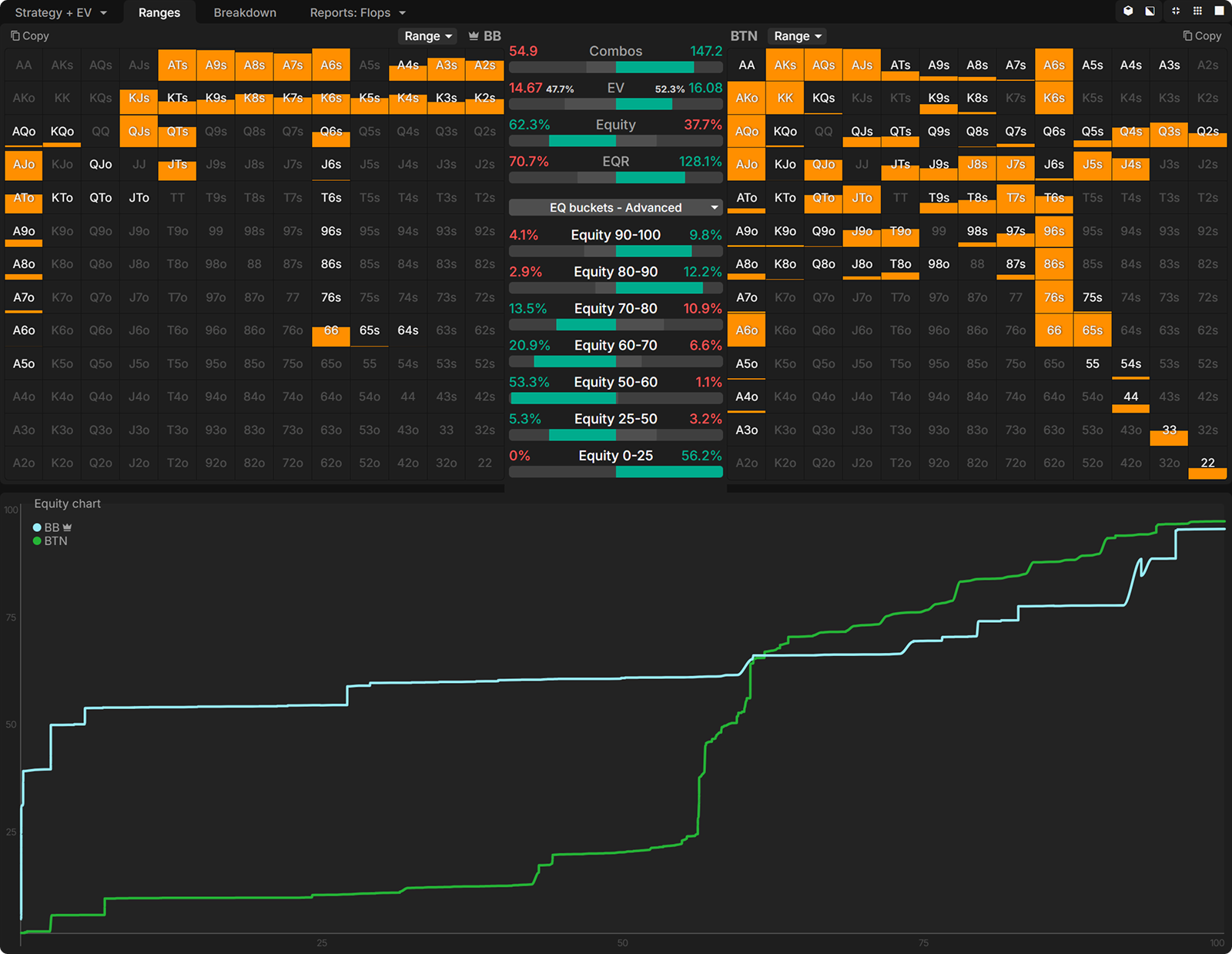
BTN has 38% rather than 34% equity, and their nuts advantage is a bit more pronounced. But it’s still a polarized-versus-condensed dynamic, and BTN still does best by betting a polar range for a geometric size.
Because both players turn straights and two pairs on this card, BTN can’t purely value bet their two pairs. In fact, on the J♣ turn, blockers play a role even in selecting value bets: BTN purely bets AQ, which blocks straights and the stronger two pairs in BB’s range, but mostly checks K6, which does not block straights or many combos of Aces Up.
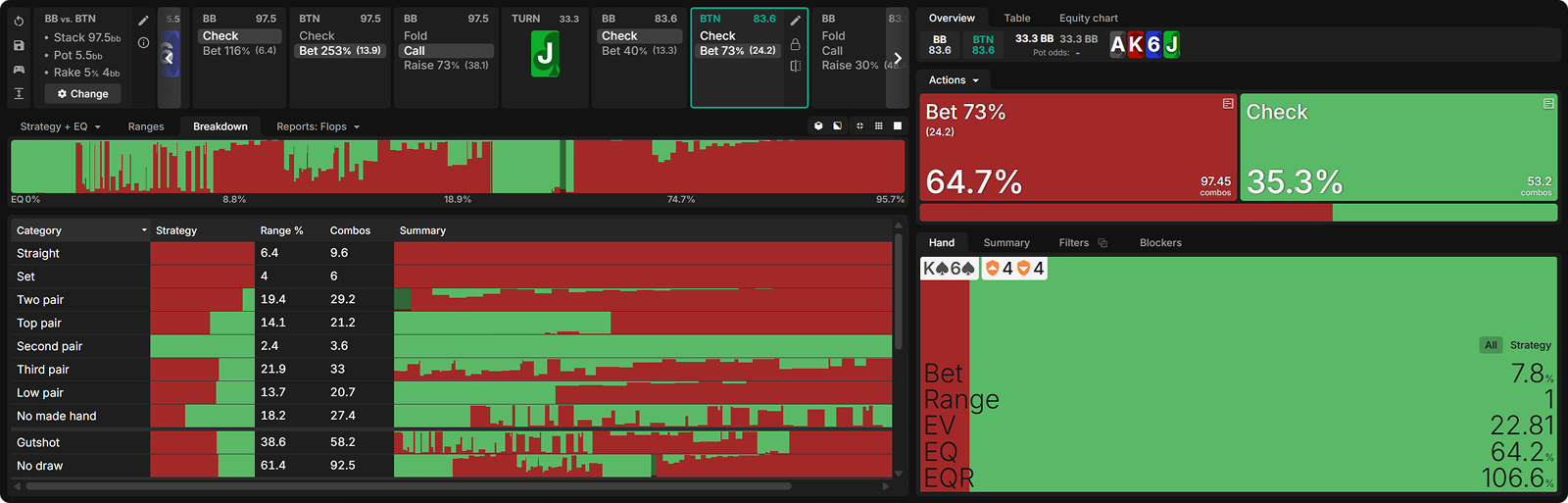
A pair of Sixes is still a good bluffing hand, but on the J♣, it gets demoted from a pure bluff to a mix. This is because BTN turns a pair much more often when the turn is a Jack than when it is a 2, and those turned Jacks also make appealing bluffs, especially when they block the straight (which means they also have a chance to river a straight if called).
Small pocket pairs never bluff because, although they are relatively neutral as far as blockers are concerned, BTN simply has better candidates. They are already choosing not to bluff with all their 6-x, which has good blocking effects, so there is no reason to bluff with a hand that has no blockers at all.
Barreling Rivers
These same principles apply to the river:
- On blanks, BTN’s threshold for value betting will be lower and their best bluffs will block sets and two pairs (incl. rivered two pairs).
- On straight-completing rivers, the threshold for value betting will be higher, and BTN will have more blocker-based bluffs to choose from.
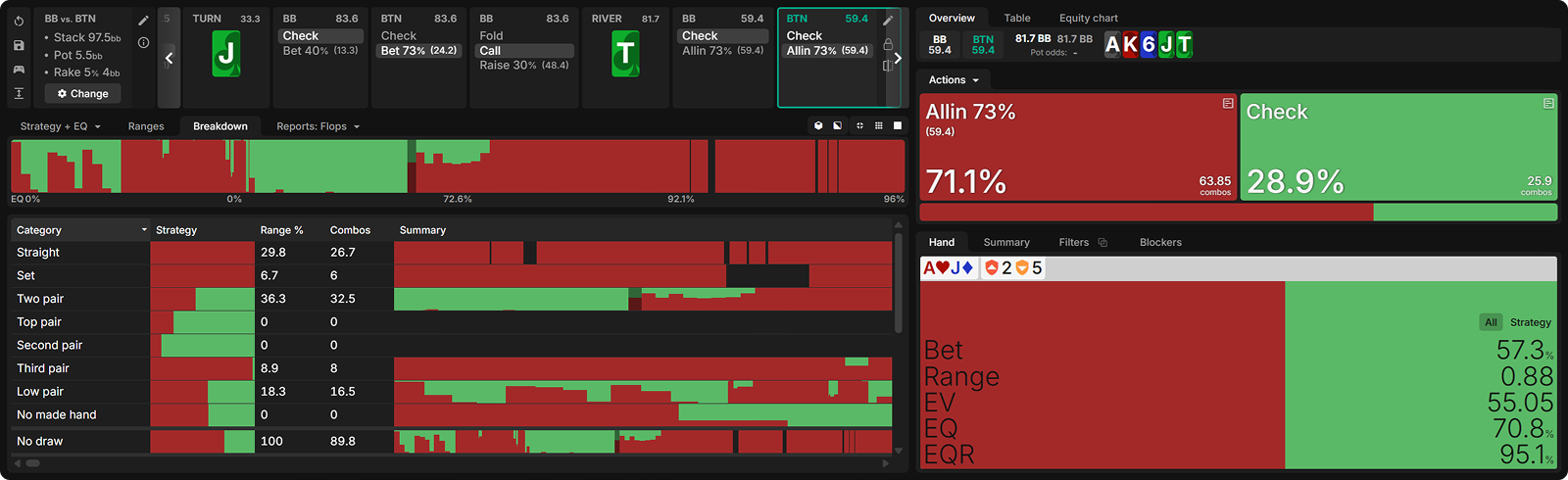
The only really tricky case is when the board runs out a four-liner to a straight. In this case, BTN still value bets their best two pairs (AJ and above), but 6-x is no longer a good bluff, because A6 and K6 are important parts of BB’s folding range. Blocking AJ and AT is more important, so BTN is more inclined to turn those higher pairs into bluffs.
Once again, this isn’t about checking hands with showdown value. BTN never wins by checking either pairs of Jacks or Sixes, so the only factor determining which to bluff is its blockers.
{{width: 25%}}
{{/width}}
After overbetting T95r, the dynamic on a blank turn is not fundamentally different from the AK6r turn scenarios we investigated above, though it is less dramatic. This is partly owing to the nature of the board but also partly to the size of BTN’s flop overbet. Betting 125% pot does not polarize BTN’s range or condense BB’s as dramatically as betting 253% pot does. As a result, BTN retains ~42% on a 2♣ turn. Not great, but not nearly as bad as the 34% they had on AK62r.
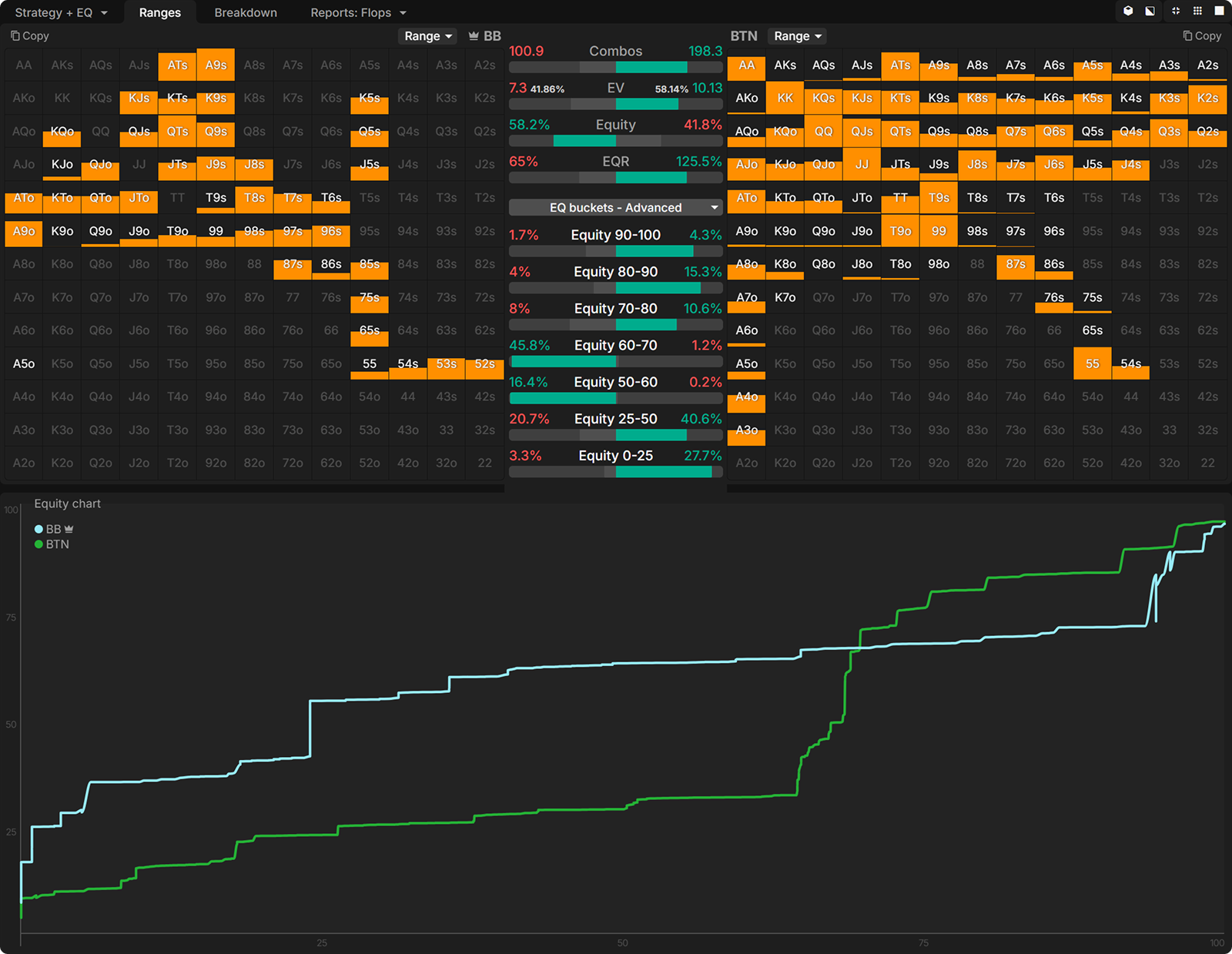
BTN’s turn sizing remains geometric even on this more dynamic board, but because the flop bet was only 125% pot, the geometric size on the turn is also an overbet for 111% pot.
Despite the overbet, BTN’s range is not terribly polar. They pure check their worst hands, and most of their high-frequency bluffs are semi-bluffs from strong draws like KQ and QJ:
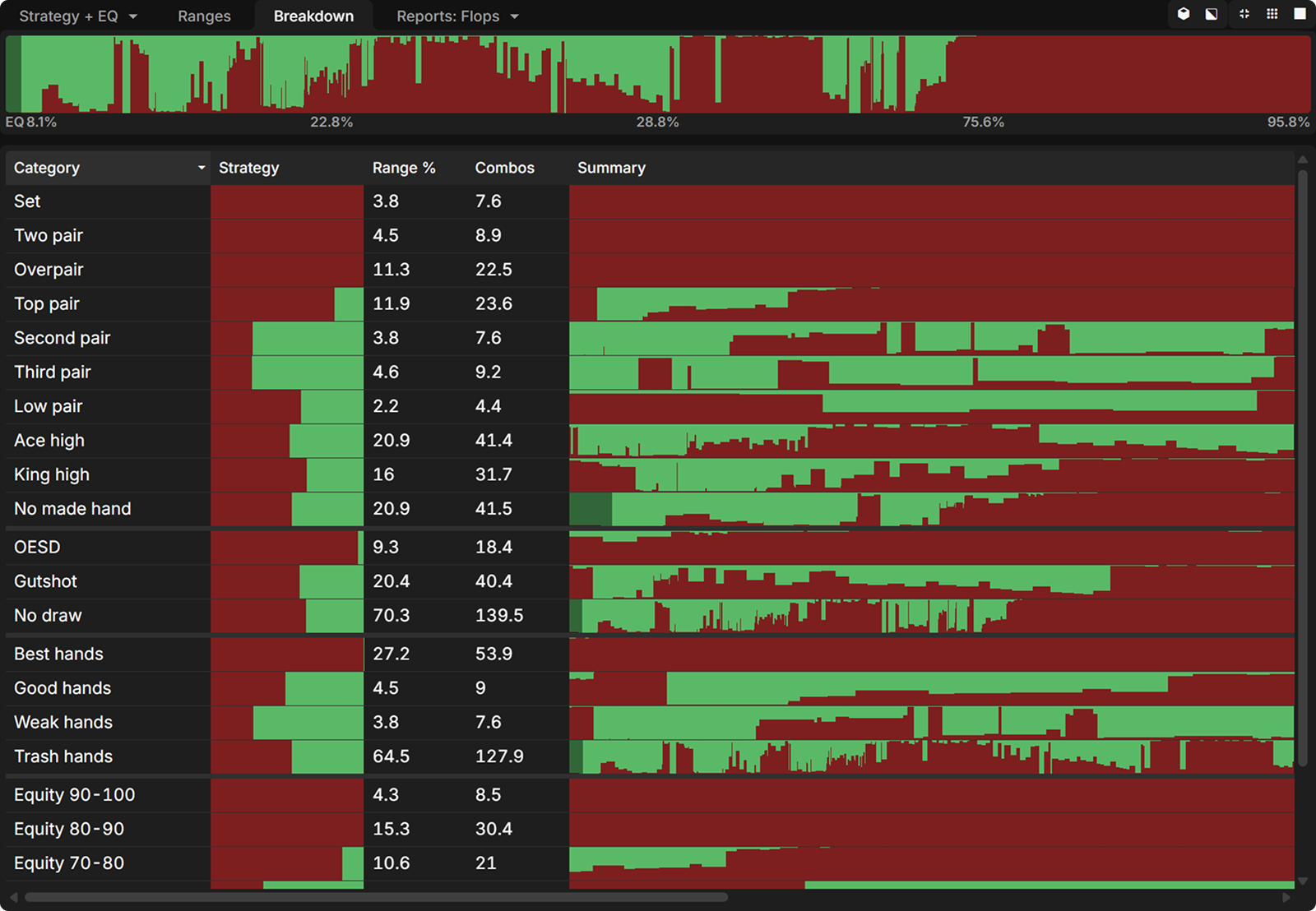
BB is condensed enough that they rarely raise despite the prevalence of draws in BTN’s range, so BTN prefers to bluff hands that retain equity when called, even for an overbet.
Much of their bluffing strategy revolves around the busted draws in BB’s range, specifically QJ. While the BB folds many of their weaker draws to the turn overbet, they often call with two overcards and an open-ender, making QJ an important part of their river folding range.
For this reason, BTN does not bluff their own QJ and rarely bluffs KQ or KJ. These hands block BB’s folding range and have a shred of showdown value, as they can chop with or beat QJ.
We know these checks are not entirely about showdown value, however, because BTN bluffs with many Ace-high hands, including AJ. While blocking QJ is unfortunate, blocking AT is great, better even than blocking KT, with which BB does not pure call the river shove.
Straight-Completing Rivers
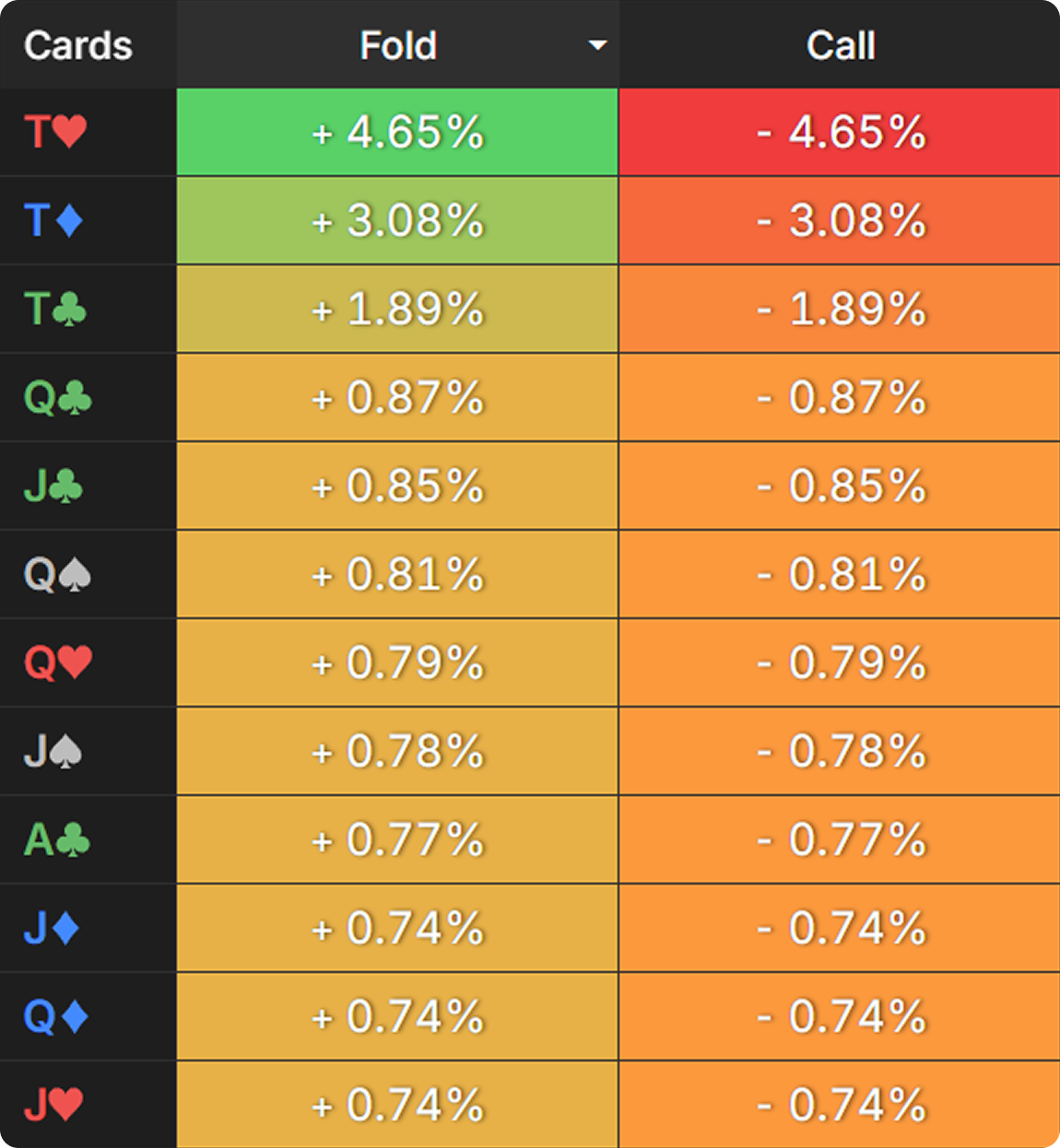
When the draw does come in, BTN’s bluffing strategy is similarly built around blockers: almost all their bluffs on an 8♠ river contain either a Queen or a Jack (or an Ace). These are the very best blockers, other than a Ten which, of course, is too strong to bluff.
{{width: 40%}}
{{/width}}
The more interesting thing about this river is how wide BTN jams for value. Despite the obvious draw coming in, they purely jam all overpairs and mix jams and checks with AT.
Value shoves, on the other hand, are profitable enough that, although they lose value when the draws come in, many remain profitable. BB is very capped after check-calling twice from out of position, so even though the river slightly uncaps them, they still must defend with many marginal hands to keep BTN indifferent to bluffing. This is what incentivizes BTN to jam as wide as AT for value.
Straight-Completing Turns
When the draw completes on the turn, things play out a bit differently than when it comes in on the river. BTN loses their nuts advantage and wants to get in some thin value/protection bets, so they bet 67% pot rather than the geometric 111% pot size. They still draw almost all their bluffs from the Queen-x and Jack-x holdings, but they are more conservative with their value bets. QQ and JJ mostly bet because they benefit from protection, block turned straights, and can river straights, but KK mostly checks, and AA is a pure check. Despite the smaller bet size, BTN overall bets less frequently when the draw completes on the turn than when it completes on the river.
There are two reasons why these hands bet less often when the straight completes on the turn than when it completes on the river:
- Risk of a raise. Strong made hands without straight potential, such as AT and KK, are in danger of getting semi-bluffed off their equity by a turn raise. Folding to QJ is no big deal, as these hands are drawing dead anyway, but folding to KJ or Q5 is a disaster!
- Leverage. If KK barrels an 8♣ turn, it will not be strong enough to value bet even a blank river. Checking in hopes of inducing bluffs or making a cleaner value bet on a blank river is therefore an appealing proposition. Of course, QQ and JJ do not keep barreling blank rivers either, but the potential to river a straight they will want to value bet increases their incentive to bet the turn.
Conclusion
Overbetting the flop usually results in a pronounced polarized-versus-condensed dynamic on the turn and (if you keep barreling) the river. This dynamic is relatively simple to optimize: bet a polar range for a geometric size, purely betting your strongest hands, and choosing bluffs based on blockers. The two tricky bits are:
- Recognizing how thinly to value bet. It can be scary to see your opponent call a large bet out of position, but don’t lose your nerve. The whole reason you are overbetting in the first place is that they have very few nutty hands in their range. If you can beat top pair, even if only because of your kicker, you often can and should keep barreling. Not only can you get called by worse, but you’ll also benefit from denying equity when your opponent folds (on the turn, anyway).
- Misjudging your showdown value. Because calling a large bet from out of position is so risky, your opponent is unlikely to hold very weak hands after doing so. That means the difference in showdown value between 8-high, Ace-high, and even bottom or second pair is often negligible. The pairs may well be the better hands to bluff with, as they block the sets and two pairs that would be among your opponent’s few pure calls.
Dynamic boards are often less good for overbetting, but in the event that you do overbet them, pay careful attention to the draws in your opponent’s range. When those draws miss, you want to bluff when you unblock them and consider checking when you can beat them, even if your hand seems quite weak.
When they come in, your best bluffs will usually block those draws. But don’t get skittish about value! These draws usually represent just a few combos, and you should still jam for value with many hands that beat the rest of your opponent’s range despite the risk of running into a monster.
Is Limping Preflop Viable in Mississippi Straddle Games?
In this article, we’ll delve into both the theory and the practice of open limping. Why does it make so much more sense in Mississippi Straddle games than in traditional, two-blind Hold‘em? How should you respond to limpers when you have position on them?
Navigating BvB OOP After Check-Calling the Flop
Today, we’ll be discussing a scenario that presents itself incredibly often for online cash grinders, one that incorporates all three of these complications: playing the XC-X-? line as the OOP preflop raiser from the SB vs BB in SRPs.
Why You’re Bluffing the River Wrong With Bricked Flush Draws in Cash Games
It’s exciting to flop a flush draw; when you do, you have a fairly high chance of having a strong hand by the river. It’s a lot less exciting, however, when the river arrives without your flush and you’re left with air or a weak pair, especially when you’ve invested a lot of chips on previous street