Round Out Your Defense: The Power of Raising


Overview
‘Defending’ in poker is a more complicated concept than it may seem at first. It raises the question: “Defending against what?”
The term is most commonly applied to playing in a way that would prevent your opponent from bluffing profitably, but again, this raises a question: “What is a bluff?”
On the river, that’s easy to answer. A river bluff is a bet from one of your opponent’s worst hands, usually a hand with little or no showdown value, hoping to push you off a better hand.
Before the river, however, few hands have little or no equity. Many of your opponents’ “bluff” candidates will essentially be semi-bluffs, ranging from strong draws to live overcards to gutshots. The ideal defense against each of these is different, so putting together a practical response requires negotiating a compromise between how you’d ideally respond to bets from each of these hand classes.
Then there is the problem of thin value bets, which must also be defended against.
In this article, we will examine the role of raising in the defense against bets of various sorts. We will start on the river, where things are a bit less complex since hand values are static. Then, look at a more complicated flop scenario involving dynamic hand values.
Defending on the River
This example comes from an 8-handed 100bb cash game, but this concept is not at all specific to cash game poker, nor even to Hold‘em.
UTG opens for a min-raise, BTN calls, and they go heads up to a K♥9♦6♦ flop. UTG bets 65% pot and BTN calls. Both players check the 2♣ turn, and the river brings the J♠. UTG bets 66% pot.
Before you read ahead, attempt to answer the following questions about BTN’s response to this (river) bet for yourself:
- What is BTN’s minimum defense frequency (MDF)?
- How could UTG exploit BTN if BTN defends less than this frequency?
- Do you expect BTN to defend mostly by calling or by raising?
{{toggle: Reveal Answer}}
- Applying the formula [1-Bet / (Bet+Pot)] to a 66% pot bet gives us [1-66 / (66+100)] = 60%. According to MDF, BTN must defend roughly 60% of their range to this bet, meaning that if they fold more than 40% of their hands, UTG’s worst hands can profitably bluff.
- If BTN does not defend enough, UTG’s main exploit is to bluff more often. Depending on what exactly BTN’s response looks like, UTG could perhaps also exploit by checking a few of what would otherwise be their most marginal value bets.
- At equilibrium, BTN defends mostly by calling, but they also have a narrow raising range consisting of QT for value and QQ/TT as bluffs because they heavily block UTG’s QT:
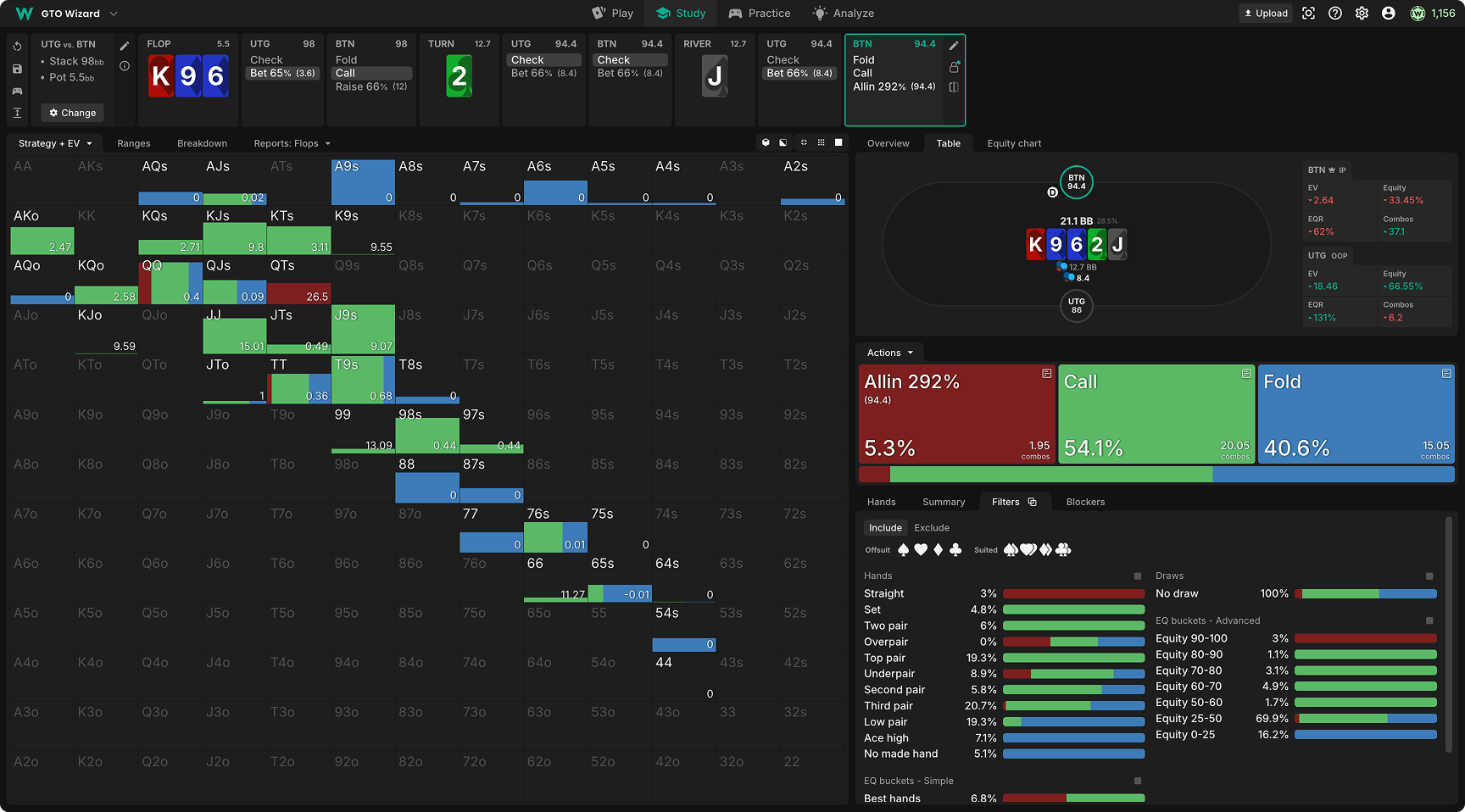
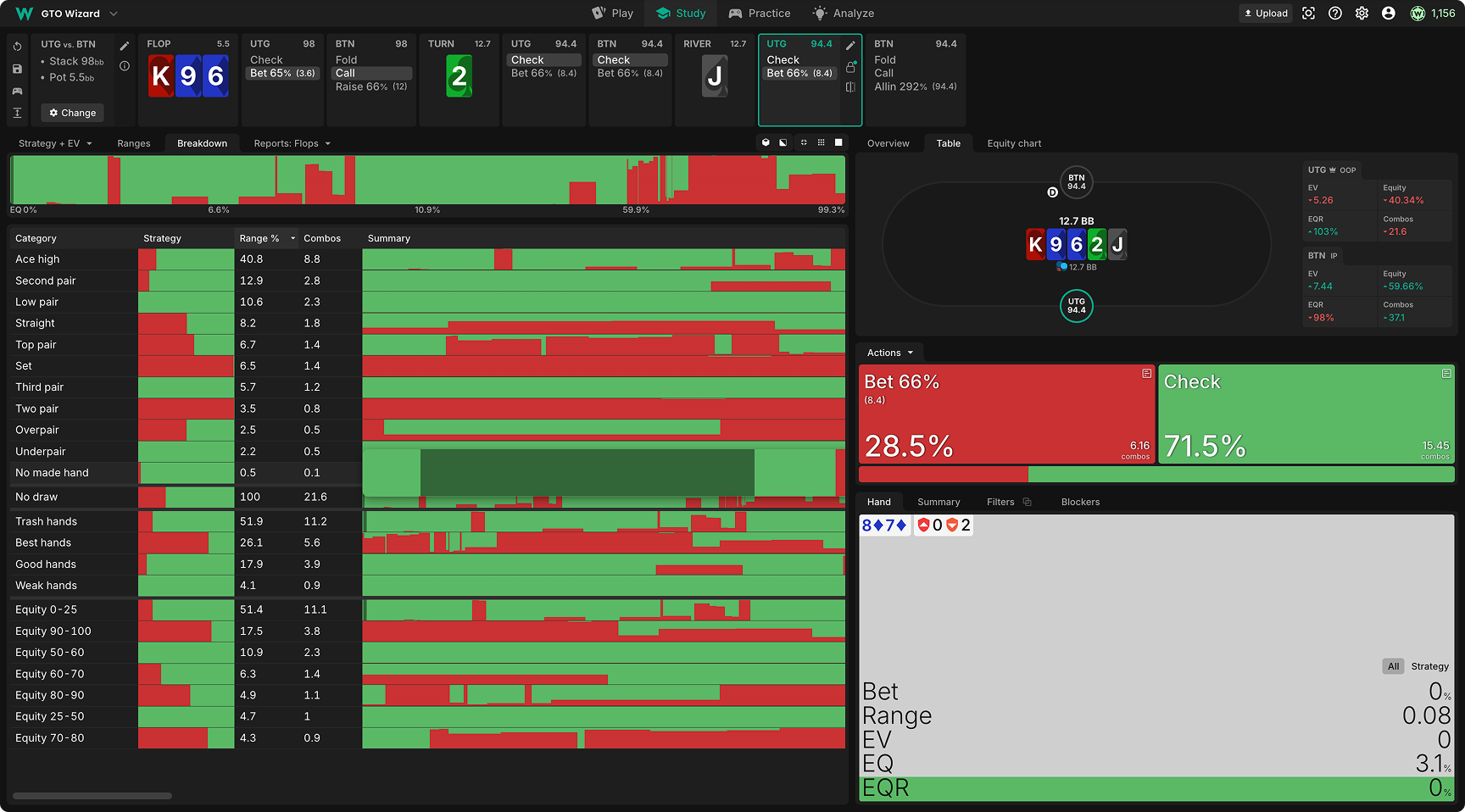
BTN’s folding frequency of ~41% is actually slightly higher than the 40% that MDF would dictate. This, too, is because of blockers. Despite BTN’s apparently elevated folding frequency, UTG never bluffs their very worst hands because they are all whiffed flush draws that block a lot of BTN’s folding range.
{{/toggle}}
What Do Raises Defend Against?
If we’re curious about what function raising serves in BTN’s defending strategy, a great way to test for that is to take the option away and see what changes. Try to make your own predictions before you read on:
- If we nodelock UTG to play the same betting strategy above (i.e., we do not allow them to exploit BTN’s failure to raise), do you expect BTN’s folding frequency to increase, decrease, or remain the same when they are not allowed to raise compared to the equilibrium we examined above?
- How could UTG adjust their strategy to exploit BTN’s failure to raise?
{{toggle: Reveal Answers}}
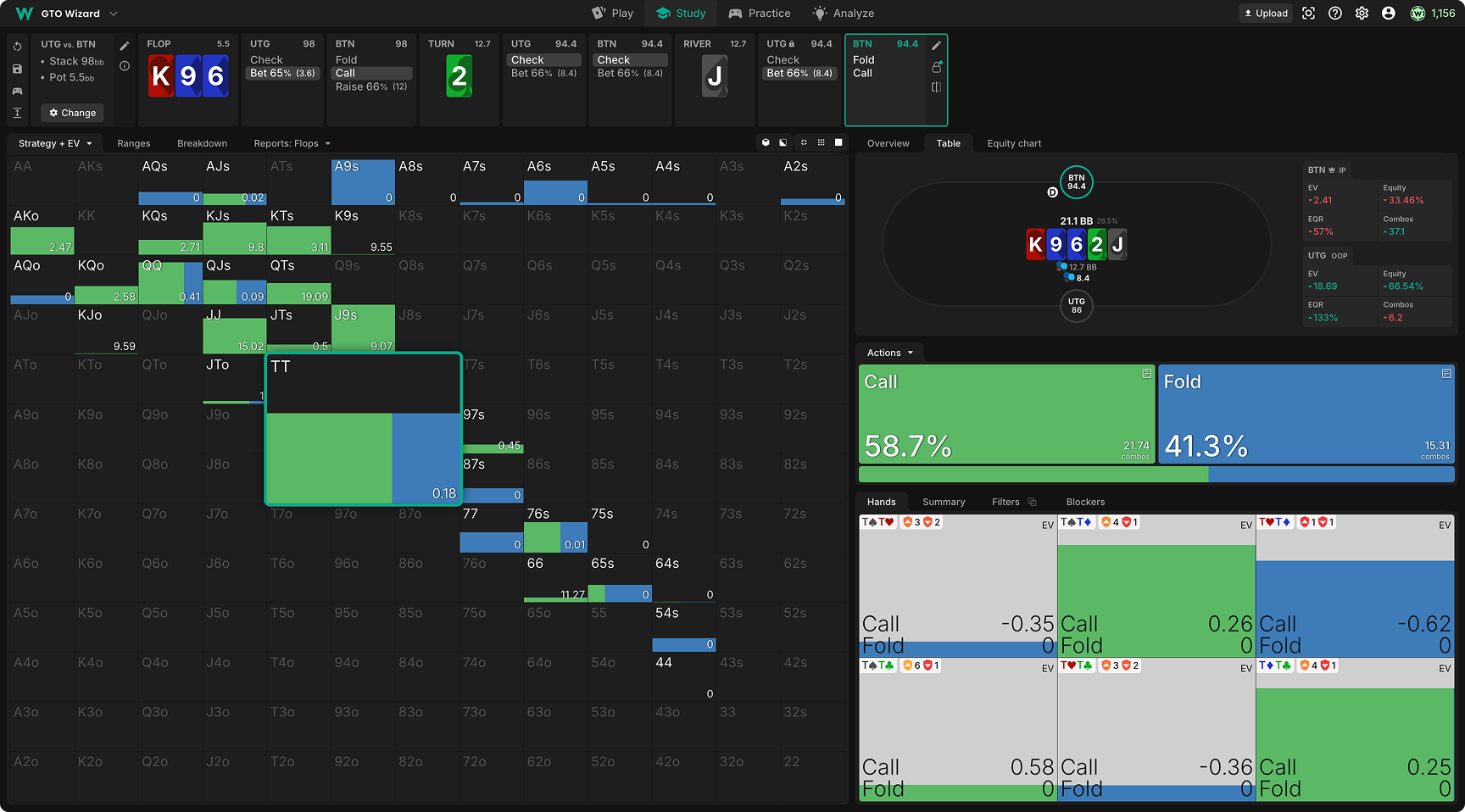
(1) BTN’s folding frequency increases slightly! The reason is that once UTG’s betting range is fixed (nodelocked), BTN no longer has to defend at MDF, because there’s no threat of being exploited. As a result, hands like QQ and TT, which could have raised profitably in the raise-allowed tree, become less profitable and shift some of those raises into folds. In short, failing to bluff-raise often enough actually increases the EV of UTG’s bluffs and decreases the EV of our range.
(2) UTG is more inclined to bet for thin value, and balances proportionally with bluffs.
UTG River strategy vs BTN


Bluffs lose whether they get called or raised, so as long as BTN’s folding frequency remains (roughly) the same, UTG’s bluffing frequency will not change regardless of how often BTN calls vs. raises.
UTG’s thin value bets hate getting raised. Depending on their blockers, a raise from a balanced, polarized range turns thin value bets into either folds, 0 EV bluff catchers that mix call and fold, or very slightly profitable calls—much less profitable than they would have been vs. BTN’s calling range.
At equilibrium, marginal hands often mix between betting for value and checking to induce bluffs. When the risk of a raise is reduced, the balance tilts toward betting.
{{/toggle}}
Before the River
Things get more complicated before the river, as they usually do. Let’s think about BTN’s response to UTG’s 65% pot continuation bet on the K96tt flop. As before, try to answer the questions below for yourself before reading on.

(1) BTN’s folding frequency is slightly higher than the 40% that MDF would dictate, making it profitable for UTG to bet any two cards. Yet UTG often checks weak hands, and their very weakest, 5♠4♠, is a pure check. Why is BTN not taking advantage of this profitable bluffing opportunity?

(2) If we nodelock UTG’s betting range so they cannot adjust to exploit, what effect do you think removing the option to raise will have on BTN’s response to this bet? Do you expect BTN to fold more often, less often, or equally as often when they are not allowed to raise?
(3) How could UTG adjust their c-betting strategy to exploit a BTN who never raised the flop in this spot?
{{toggle: Reveal Answers}}
(1) The MDF formula returns the frequency at which a player must defend in order to make their opponent indifferent to bluffing with a 0 EV hand. But hands rarely have 0 EV before the river! Even 5♠4♠ has 13.6% equity and .49bb EV. That BTN is not defending at MDF tells us that bluffing is profitable, but it does not tell us whether bluffing is the most profitable option.
Some of the value of checking weak hands comes from improving them on later streets. Some of it comes from bluffing on later streets. You have a lot of flexibility even with seemingly worthless hands, and it’s important to consider all your options rather than jumping at the first profitable one you notice.
(2) BTN’s folding frequency decreases to ~39% if they are not allowed to raise. We saw that on the river, BTN folded more frequently when they couldn’t raise, but the dynamics on the flop are much more complex and produce the opposite effect. Since there are still additional streets to be played, BTN’s strategy of never raising the flop influences the turn and river decisions of both players across all subsequent nodes.
Without a raising range, BTN’s calling range becomes comparatively stronger. This, in turn, compels UTG to play more cautiously and passively on later streets, which benefits the weaker hands in BTN’s range that would normally fold, giving them now a +EV call.
In summary, BTN’s absence of a raising range compels them to continue with more mediocre hands, almost as if attempting to regain part of the EV lost by not raising on the flop.
(3) UTG should bet more often, with semi-bluffs and thin value bets being the biggest beneficiaries, as these are the hands that lose the most when raised. UTG’s strongest hands actually suffer a bit because, of course, they are hoping for a raise when they flop a strong hand!
When we remove BTN’s option to raise but allow them to increase their calling frequency, UTG’s betting frequency increases from 33% to 47%. If we keep BTN’s calling frequency locked at 58.3% but deny them the option to raise, then UTG’s betting frequency further increases to 64%.
{{/toggle}}
Conclusion
Minimum Defense Frequency is a crude measure. It tells us how to make an opponent indifferent to bluffing with a 0 EV hand, but most hands are not 0 EV, especially not before the river.
Additionally, MDF does not tell us anything about how to defend. The central goal of GTO poker is to make opponents indifferent—to deny them good options—with many hands in their range, not just the 0 EV bluffs.
Before the river, it’s also important for defending against semi-bluffs.
And the bluffs are an important component of your raising range! As we saw with QQ and TT in our river example, raising can make it profitable to defend with hands that could not profitably call. If you only raised the nuts, this would not deter your opponents from betting their thin value bets, as this would not deny them of a good option facing the raise; they could simply fold with no risk of folding the best hand. At the same time, your strategy would make their bluffs slightly more profitable, since many hands that can bluff-raise profitably aren’t strong enough to call a bet.
If you’d like to learn more about choosing good bluff-raising candidates, GTO Wizard subscribers have access to this excellent coaching session from Donk Orleone.
We Are Hiring
We are looking for remarkable individuals to join us in our quest to build the next-generation poker training ecosystem. If you are passionate, dedicated, and driven to excel, we want to hear from you. Join us in redefining how poker is being studied.
Check out the available positions here.
Monkey in the Middle: 3-Way Pot Heuristics
In this article, we will discuss the key strategic differences between this scenario and one where you face a continuation bet in a heads-up pot, how those differences factor into the GTO responses to these bets in 3-way pots, and when those differences are more or less salient.
The Trouble With Implied Odds
When we were brand new to poker strategy, many of us learned about concepts like equity, outs, and pot odds. When drawing, we were taught to count our outs, use those to estimate our equity, and then call or fold based on whether we were getting the right pot odds for the equity we had.
Poker Concepts You’re Using Wrong (and How They’re Hurting Your Winrate)
Language and poker are two of my great passions in life, so I’ve always been interested in poker’s unique and colorful vocabulary. As a poker coach, podcaster, and writer, I have particularly strong opinions about the language we use to explain poker strategy.