
Navigating BvB OOP
After Check-Calling the Flop
There are typically 3 themes that tend to increase the difficulty of poker spots:
- Playing out of position (OOP)
- Deep stacks (100bb+)
- Broken aggression lines (B-X-B, X-B-B, etc.)
Today, we’ll be discussing a scenario that presents itself incredibly often for online cash grinders, one that incorporates all three of these complications: playing the XC-X-? line as the OOP preflop raiser from the SB vs BB in SRPs. Specifically, we’ll be discussing wet/draw-completing runouts and how to navigate them. This is a line nearly every player is misplaying to some degree. Even many good players are making significant blunders on certain runouts (relative to theory, of course).
B-X-B Refresher (Equity Advantages)
A key point to consider when playing rivers is how the equities stack up. Very broadly speaking, the player with the equity advantage will have more made hands relative to their opponent, so they can bet thinner/more often to extract value. When a player calls a bet on a given street, typically the equity shifts in their favor (barring the scenarios where the turn/river are extremely good for the bettor).
In the B-X-B line, the flop caller will almost always have an equity advantage across most runouts. This enables them to bet more often, especially in wide-range scenarios where certain runouts won’t be drastically better for one player over the other.
What Makes This Spot Unique?
This spot is going to play a bit differently than some adjacent lines, such as the B-X-? or X-XC-? scenarios. The main reason is that on many board textures, the OOP (SB) player will be more capped and/or heavier on high cards/showdown value hands than if it were BTN vs BB, where the flop caller (BB) was also the preflop caller. (Think: OOP will usually be seeing a turn after having defended against a flop stab when they hold AK/AQ, even on wet/scary boards).
Consider the SB vs BB in an SRP scenario where the OOP preflop raiser (PFR) check-calls a 50% pot flop stab. The PFR will be much heavier in high-card hands when they check-called flop, since their high cards have significantly more equity vs. the stabbing range as opposed to the BTN vs BB scenario, where the high-card region has less equity vs. the c-betting range (of the IP PFR) that contains stronger high cards, causing them to usually over-fold.
Check-Calling (XC) on Low Boards
Let’s take a look at the XC strategy on a low board, such as 963r first (SRP between the Blinds):
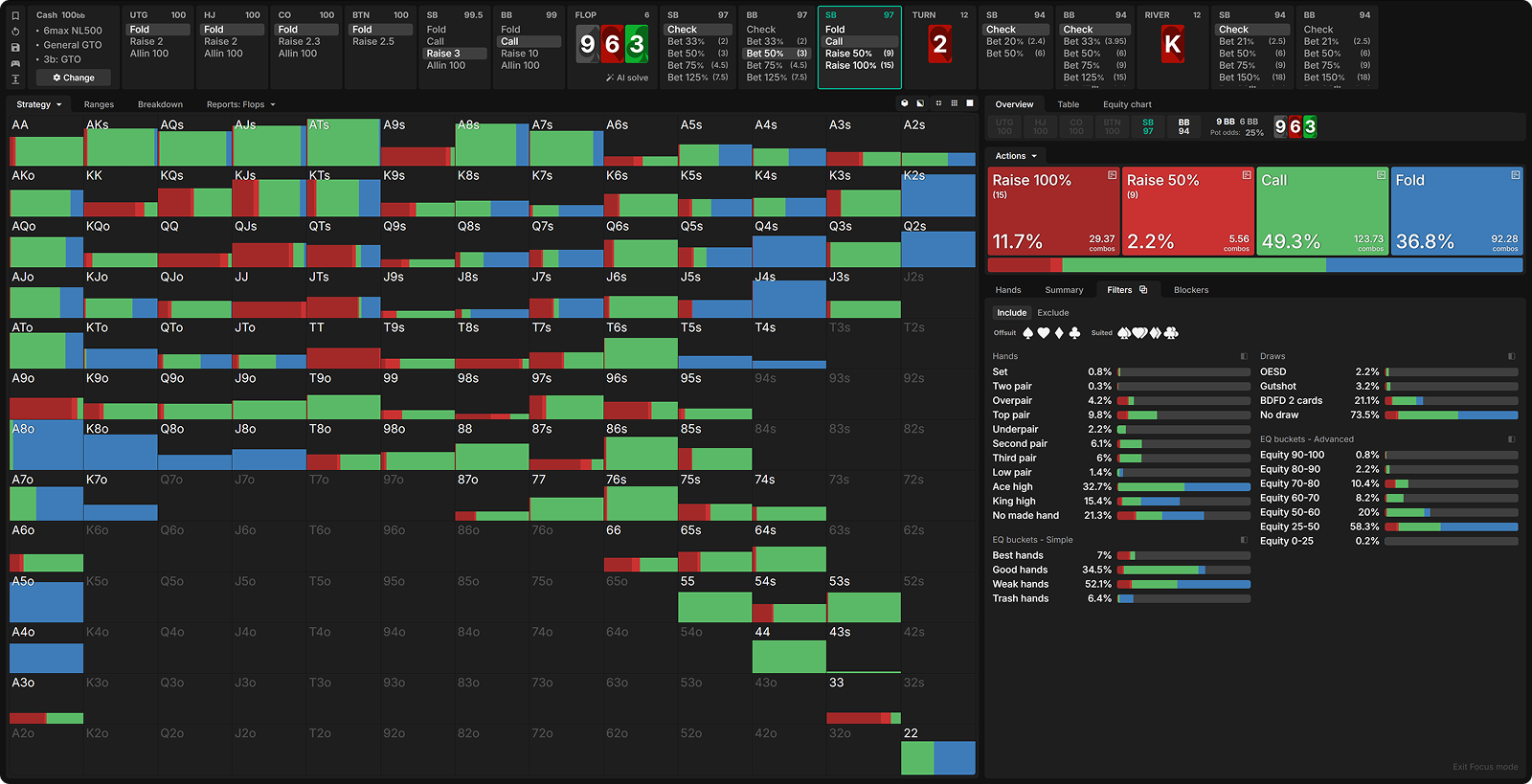
This is the response from OOP vs. the stab. On a raggy rainbow board such as this one, OOP will be continuing tons of naked high-card hands due to their greater ability to showdown or value bet across later streets if they hit a made hand (in addition to OOP c-betting more middling/low pairs on rainbow boards).
To demonstrate the point, here’s OOP’s response vs. the stab on 963tt:
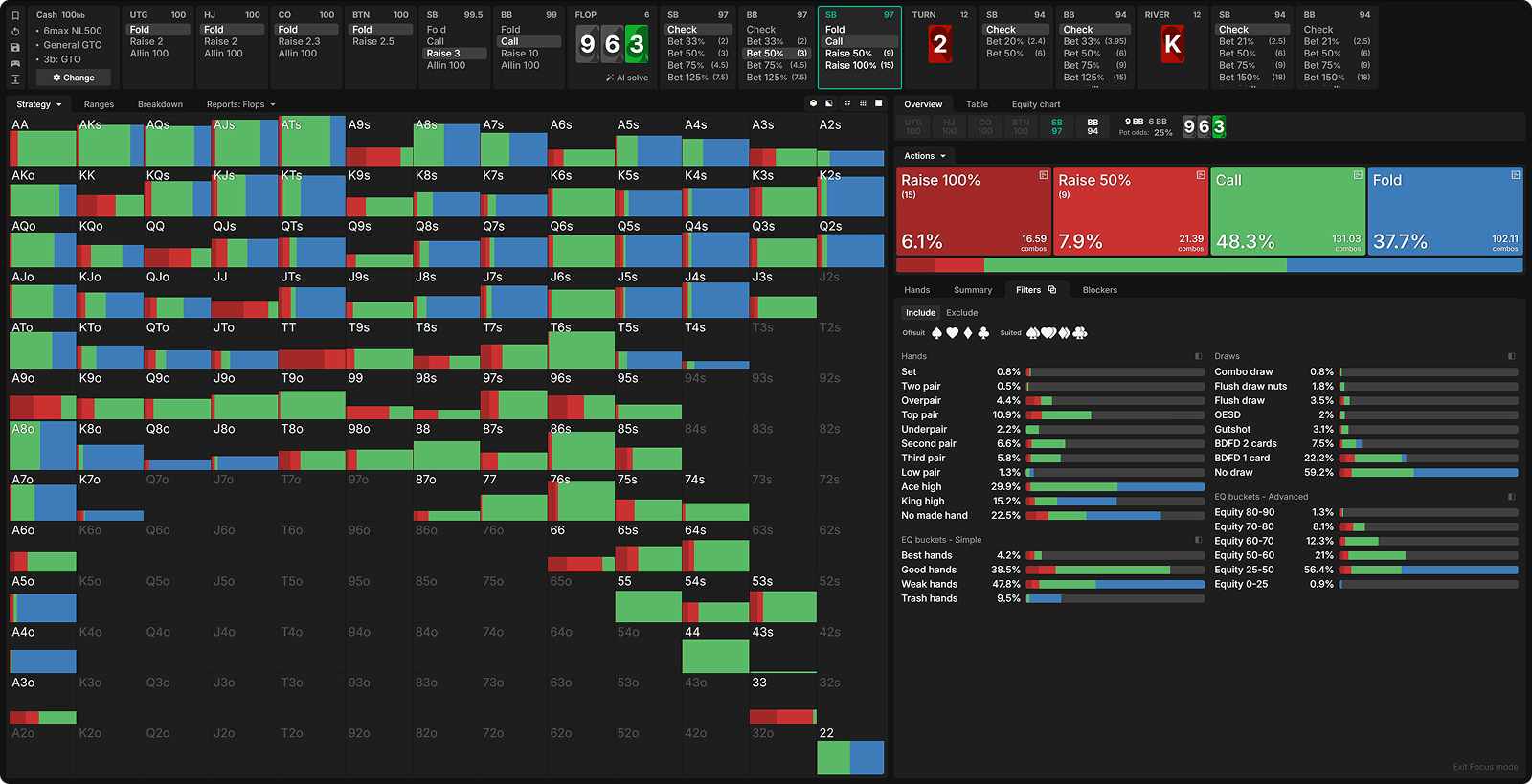
Notice that OOP is folding slightly more and calling slightly less. If you look closely, you’ll see high-card hands like K8s, K4s, A7s, etc. mostly folding due to the decrease in their ability to value bet later streets if they make pairs (since more draws will complete on two-toned boards).
The result is that on two-toned boards, OOP will XC flop with more showdown-oriented hands (good Ace-highs, low/middling pairs). Whereas on rainbow boards, OOP will be floating more weak high-card air with backdoors. The effect on how the B-X-B line plays is difficult to summarize in short bullet points without demonstration first, so let’s get our hands dirty.
This is the range breakdown of 2 scenarios for the boards given above. On the left, we have the range matchups for the 9♠6♠3♣ 2♥5♦ runout. And on the right, 9♠6♥3♣ 2♣5♦. Essentially, the same board with a non-flush runout, with the difference being that one flop is two-toned. SB range is on the left, BB on the right side of each graphic.
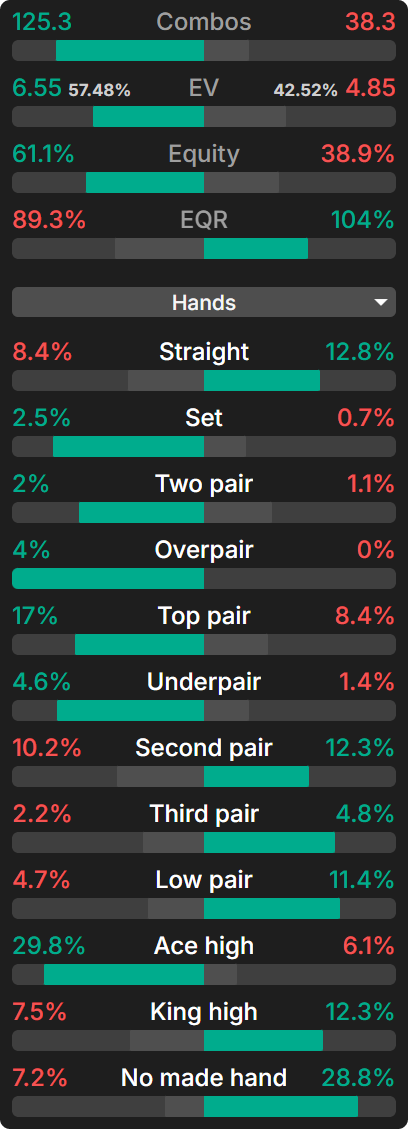
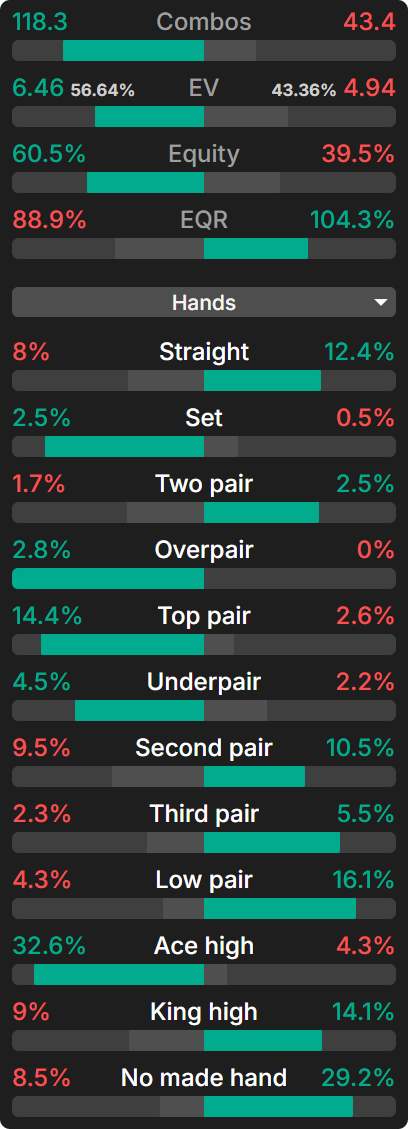
On the two-toned board (left), what sticks out to you about the range matchups relative to the rainbow board (right)?
Here’s what sticks out to me about boards that started out with a two-tone flop (compared to the rainbow equivalent):
- OOP has more overpairs and top pair (TP), the in-position player has significantly less top pair.
- On a ragged rainbow board, IP will continue betting top pair for value on the turn, but not as often on two-toned boards because OOP’s XC range on a two-toned flop will contain more good top pair/overpairs, making IP less incentivized to bet middling TP.
- OOP has significantly less air (Ace-high or worse) on the two-toned board.
- This is related to what we discussed above about high cards dropping in value on wet boards.
The big idea is simply that on wet boards, OOP will XC less air on the flop. However, don’t get ahead of yourself. It would be easy to leap to the conclusion that they should be betting quite often, but this is not necessarily the case. Remember, the hands worth betting are the ones that gain value by betting; you don’t magically profit from thin value bets just because your range is more protected. The thin value hands make money by betting small enough to squeak out value from worse.
Constructing OOP’s River Checking Range
Consider the XC-X-? line on 963♠♠ 2oT♠:
While it is true we arrive at the river with less air when check-calling on a two-toned flop, the middling hands (77, 6-x, 3-x, etc.) are no longer worth value betting when flushes come in. Take a look at the high-card region:
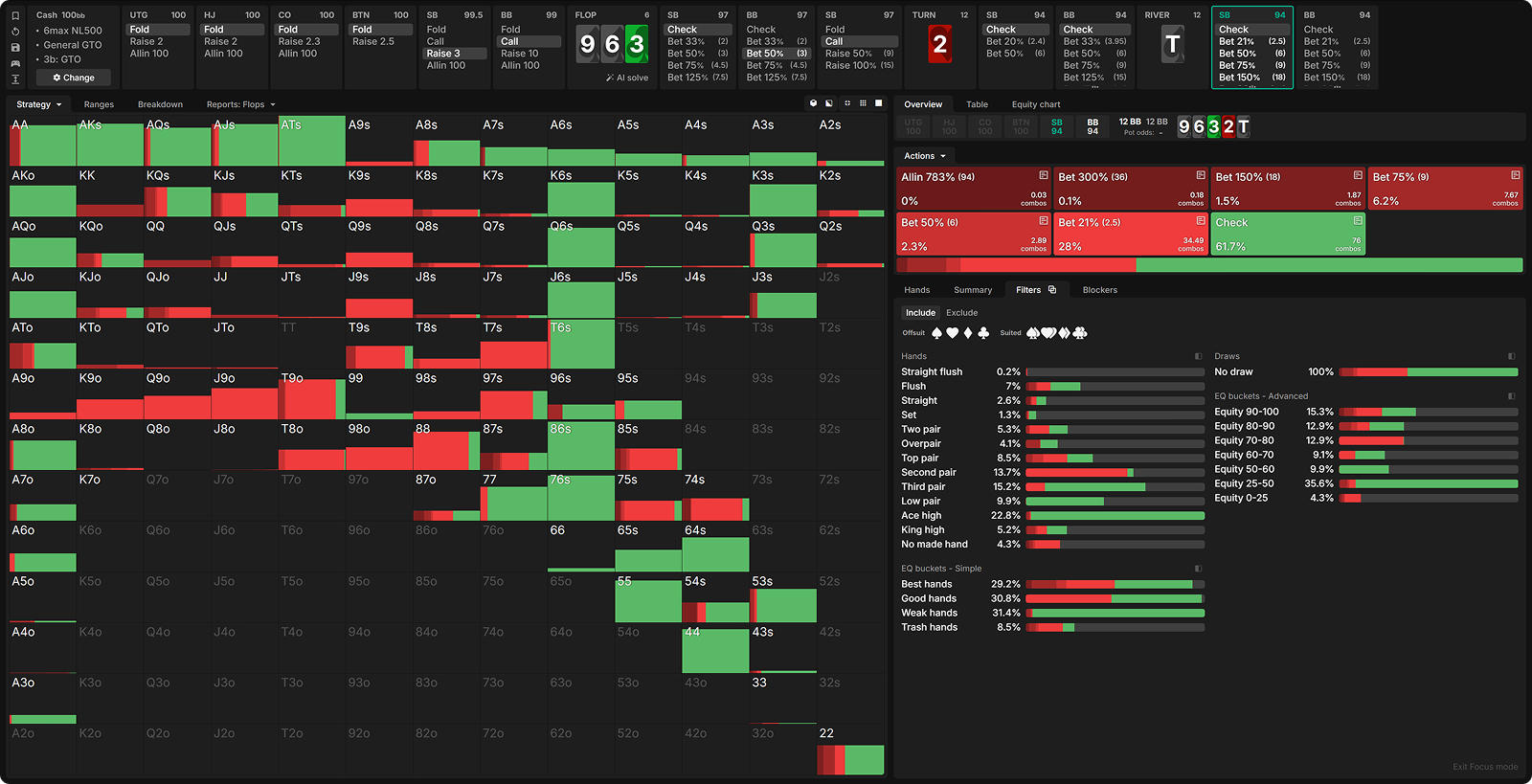
There are two things for me that should be noted about the high-card region:
- IP has a massive advantage in top pair since OOP doesn’t XC flop with much JTo/QTo; those hands will often XR or XF vs. a flop stab.
- OOP is very dense in low pairs and Ace-highs, significantly more so than IP.
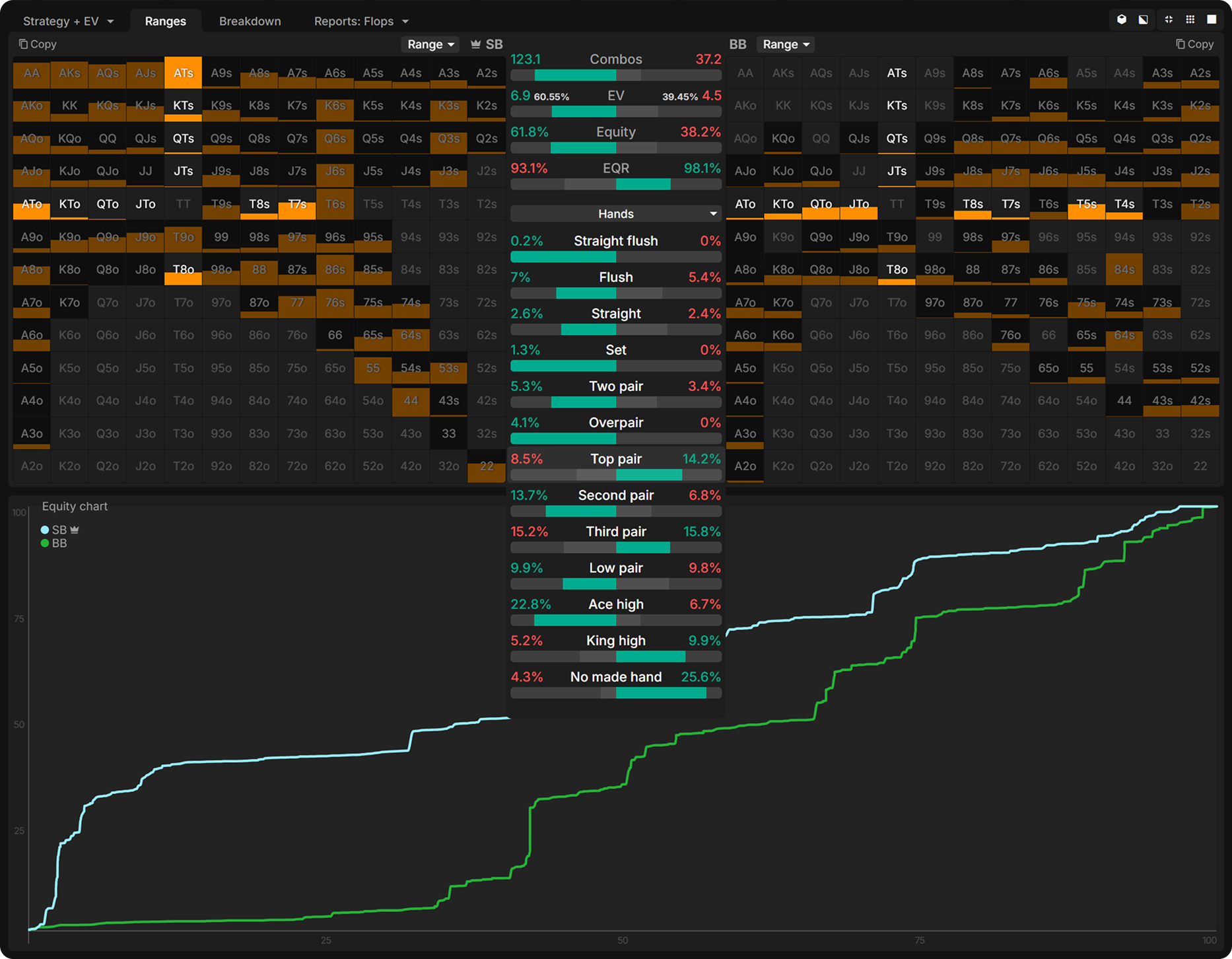
So while OOP has a huge equity advantage, IP will reopen this river Ten more often than if it was a King or Ace, giving us more incentive to check. On cards IP is less likely to reopen, we need to do more betting ourselves.
The interesting part of the OOP strategy is how the solver plays flushes:
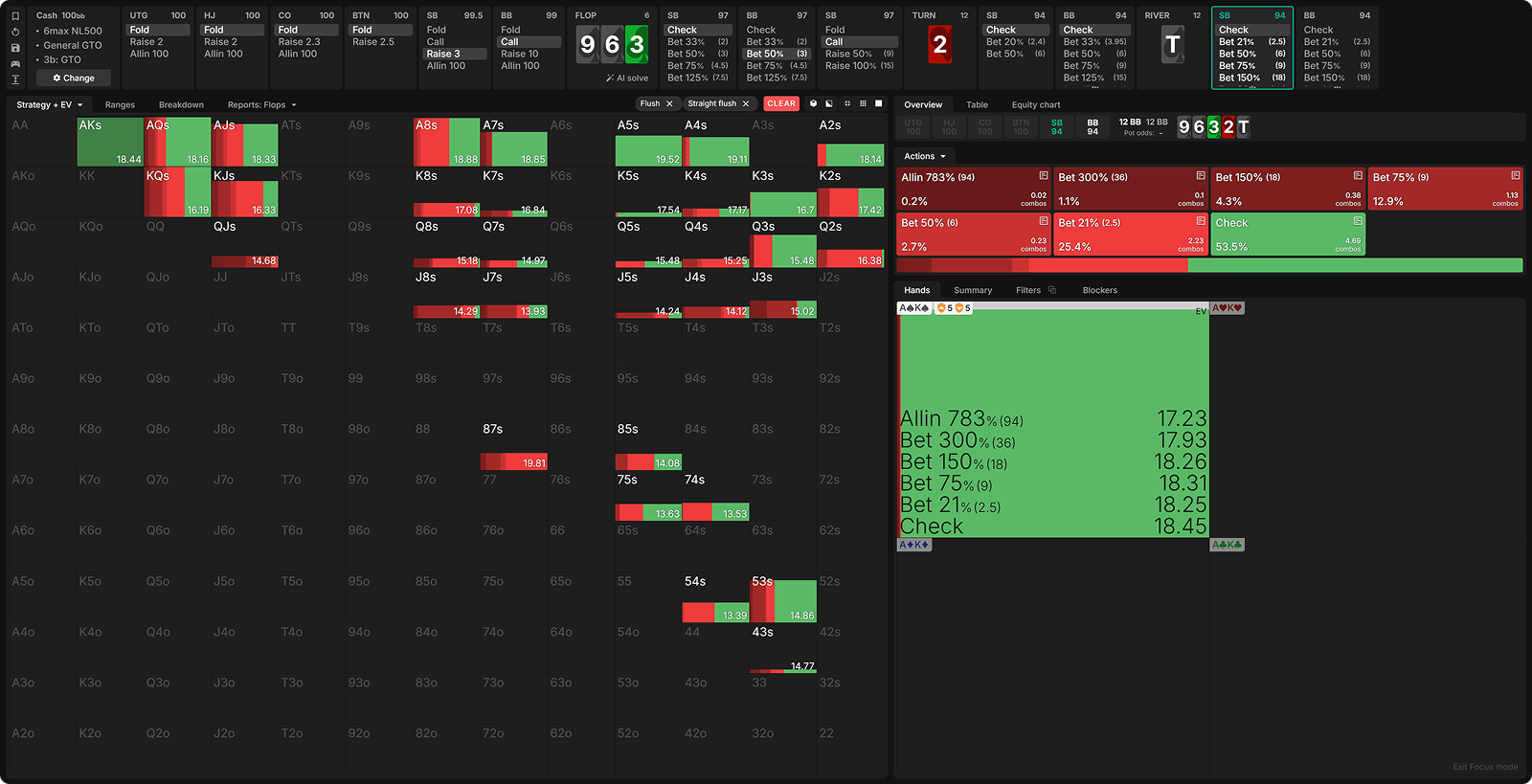
OOP is checking their flush combos over 50% of the time. Notice the flushes that strongly prefer checking are AX♠♠, namely A♠K♠, and the lower sidecard combos. The flush combos with a Queen or Jack in them bet much more often (notice Q♠J♠ is a pure bet). To understand why, think about the range IP will reopen. Combos like QTo/JTo that bet flop get here much more often than their counterparts without the suit of the flush draw, so when we have a flush with a Queen or Jack of ♠ in hand we get bet into much less often. Also, when we have a hand like A♠7♠, A♠4♠, etc., we unblock combinations of Ten-x since the Ten is a spade.
Speaking of unblockers, there’s one more related concept: unblocking air. Think about it like this: if IP has a potential turn bluff candidate without a ♠, this type of air will get put into the turn check line to possibly bluff rivers much more often than similar hands with a ♠, since flush draws (and offsuit hands that block flush draws) tend to take preference in the bluff selection on the turn. After it goes X-X on the turn, it’s much more beneficial to check a made hand OOP with a ♠ as a trap regardless of whether the flush completes on the river. For example, if we XC the flop with K♦Q♦ and the turn checks through, it’s more likely IP has a hand that’s trying to get to showdown because we block the hands that are going to slow down on the turn and possibly bluff river, hands like Q♦7♦ or K♦8♦.
Exercise for the Reader
In this custom AI solution for the same spot discussed above in the BXB line on 9♠6♣3♦ 2♥T♠. Given what we learned about OOP trapping some flushes and two pairs (T6, 96 mainly), try altering IP’s betting strategy when OOP checks river using the nodelocking feature. Force IP to play a bit more aggressively (value betting thinner, allowing overbets, etc.) and take notes on how that changes OOP’s response. Then do the same for a Villain that’s too passive (not value betting thin enough, only using up to pot-sized bets, etc.).
Building on what we’ve covered here, let’s take a look at how to construct betting ranges on runouts that are better for OOP (and so will feature higher betting frequencies from OOP).
Constructing OOP’s River Betting Range
The XC-X-B line will, for the most part, feature small bets, mainly for 3 reasons:
- OOP’s best hands on the flop will often be check-raising, condensing their check-calling range to low pairs/high cards with showdown value
- The IP bet-check range will be quite heavy with air that decided to give up turn. A small bet size is often appropriate to get value from Ace/King-high and low pairs IP hit on turn or river.
- As the OOP player, we can check to raise instead of betting big ourselves with nut hands.
The main exception would be when we have a massive advantage in a nutted hand class, making IP less likely to reopen. A prime example would be a non-flush board like 963 6J, where IP bets flop for a larger size (like 75% pot). IP isn’t betting 6-x for this size on the flop, so we have significantly more trip Sixes than IP.
On high-card rivers, OOP will certainly make significantly more new hands, but how does that affect our betting strategy?
Recall that in this line, the vast majority of hands in our range are either high cards, low/middling pairs, or draws. To give an idea, let’s refer back to the 963tt board. Assume we get a 9♠6♠3♣ 2♥Q♦ runout. Here, only 18.6% of OOP’s range is top pair or better, compared to 40.6% second through fifth pair (with many of the second and third pairs value betting). This is a classic example of a spot that is easy to mess up by:
- Betting too often/not trapping enough.
- Betting too big too often (not accounting for how much of the range are thin value hands)
- Funneling all the good hands into the big bet range
It is very reasonable to have overbets in this line, but it’s important to keep your entire range in view here, and not immediately go for the overbet button just because your current hand rivered a good pair. Tons of your range will want to check or block, always consider “trapping” your good made hands on the river by assigning them to those two ranges. You can do this by using your side card and an RNG. For instance, if you river an offsuit Queen in the hand outlined just above. In the case of AQ, laying the occasional trap with a check and then springing it with a click on the raise button is an option worthy of consideration. A nice property of this hand is the sidecard Ace, which blocks your opponents check backs. When holding Q6s, you could put it in the blocking line to go along with other, weaker hands that can bet for thin value (like 6-x).
Study Question
We talked about unblockers and their relevance to playing flushes. How might unblockers play a role in the line that thin value hands decide to take?
Summary
Some general strategy notes:
- When OOP, it takes more mental energy to properly construct a betting/checking range. So take your time.
- When OOP, you have the option to check-raise!
a) In this new era of solvers and poker theory, everyone loves to bet big everywhere—exploitatively, this can often be good against weaker players—but why develop a 200% pot betting range on the river when you could just check-raise all-in, especially when the vast majority of your range is made up of hands attempting to showdown?
b) Consider your entire range before deciding on a sizing scheme, simply playing B25 or X is often appropriate when OOP on the river if a huge chunk of your range is very middling value except for the sliver of flushes you have (like what we’ve covered in this article). In these spots, it’s very easy to gut your checking range because you’re developing overbet sizes OOP in spots where a large portion of your range is relatively weak, so your checking range never contains strong hands. - Our river-betting frequency is strongly correlated with the bet size we faced on the flop.
a) The bigger the bet we check-called → the stronger our range → the more we bet.
b) If we check-called a small flop bet, we should be doing tons of trapping to accommodate the many high-card hands we have in range. - Unblockers are extremely important when navigating broken aggression lines. This is due to Villain’s give-up range being heavy in cards with no suit interaction.

Author
Josh Lessner
Josh is a professional poker player living in Las Vegas, NV. He’s been a full-time professional for 5 years, mostly playing online NLHE cash games. He specializes in poker theory with a passion for teaching others how to utilize technical tools to improve their game. Josh is the co-founder and head coach of Radar Poker.
We Are Hiring
We are looking for remarkable individuals to join us in our quest to build the next-generation poker training ecosystem. If you are passionate, dedicated, and driven to excel, we want to hear from you. Join us in redefining how poker is being studied.
Latest article

Exploiting Profiles: Episode I – The Calling Station
In this article, we will derive some heuristics for exploiting calling stations specifically. Before we…
Small Blind, Big Problems: When to Size Up From OOP BvB
Being OOP in a Spin and Go is tricky even for the most experienced of…
Is Limping Preflop Viable in Mississippi Straddle Games?
In this article, we’ll delve into both the theory and the practice of open limping.…
Navigating BvB OOP After Check-Calling the Flop
Today, we’ll be discussing a scenario that presents itself incredibly often for online cash grinders,…
When to Open Shove vs. Different Player Profiles
There are hands that fare best as shoves and hands that outperform as regular (non-all-in)…

Monkey in the Middle: 3-Way Pot Heuristics
In my experimentation with 3-way postflop sims, many of the most counterintuitive results I’ve come…
The Trouble With Implied Odds
When we were brand new to poker strategy, many of us learned about concepts like…

The Art of Value Bluffing From the Button
Playing “OK” from the Button in Spins often comes relatively naturally. Our relatively tight preflop…

Mississippi Straddles: Building a C-Betting Strategy vs. BTN
A Button straddle, also known as a Mississippi straddle, changes the preflop incentives of all…
Mississippi Straddles: How to Defend vs Raises
This is the second in a series of articles about playing in games with a…

Opening Strategy When the Button Straddles
A Mississippi straddle is when you straddle the button (put out a third blind). Action…

Mastering PKOs With Custom Aggregated Reports
In this article, I will introduce one of our most unique innovations in what poker…

Poker Concepts You’re Using Wrong (And How They’re Hurting Your Winrate)
Language and poker are two of my great passions in life, so I’ve always been…

How To Improve Your Heads-Up Game
Knowing what and how to study in poker can be overwhelming. Learning heads-up (HU) poker,…

How Payout Structures Reshape Postflop Strategy
Is all ICM pressure the same, or should we tailor our postflop strategy to different…

How ICM Quietly Shapes Postflop Strategy From the Start
How significant is ICM at the start—as in the very first hand—of a tournament? Have…
ICM vs. ChipEV: The Hidden Logic Behind BB 3-Bets
BB 3-betting is fundamentally different from 3-betting from any other seat, even the SB. Calling…
How ICM Reshapes 3-Bet Pots (And Why You Can’t Trust ChipEV)
Analyzing postflop ICM sims is tricky. Because ICM dramatically changes preflop strategies, starting ranges for…

Betting Draws in Position: The Real Rules
A “calling station,” someone who is seemingly willing to consider calling down with any pair,…

When Checking the Nuts Beats Betting Them
Poker is a complex game that requires a diverse skillset from someone who wants to…
How To Use Range Builder in GTO Wizard To Improve Your Game
In this article, we will look at another key feature: “Range Builder.” The Range Builder…
Why You’re Bluffing the River Wrong With Bricked Flush Draws in Cash Games
It’s exciting to flop a flush draw; when you do, you have a fairly high…
How to Exploit Human Mistakes After a Flop Overbet
The most important thing to understand, when it comes to playing the later streets, is…
The Art of the Flop Overbet (And Why You’re Probably Doing It Wrong)
I’ll begin this article with a confession: I’m bad at overbetting flops. I’ve known for…

Crush Calling Stations With These 3 Solver-Approved Strategies
A “calling station,” someone who is seemingly willing to consider calling down with any pair,…
How Pros Use Solvers To Crush Pool Leaks
When studying with a solver, it’s easy to fall into the trap of getting tunnel…
Understanding Domination: The Hidden Logic Behind Every Bet
In poker jargon, domination refers to one hand being heavily favored against another, not just…
Common Poker Sayings That Ruin Your Winrate
If you’ve been around poker for a decent amount of time, you’ve probably heard the…
Punish the Unstudied: Capped Ranges & Bluffing Imbalances
This is part two in our series on exploiting players who don’t study GTO. In…

Why Your Poker Range Is a Team
“Think ahead” and “Always have a plan” are phrases we hear all the time in…

Isolating Limpers in Short Stack HU
Heads-up (HU) poker at shallow stack depths is unforgiving. Did you know that small differences…
Are You Leaving Value on the River?
In the early days of online poker, players were too loose. In the modern era,…
The 3 Biggest Leaks Killing Your Winrate
You are studying and working hard, but your results still aren’t where you want them…

Round Out Your Defense: The Power of Raising
‘Defending’ in poker is a more complicated concept than it may seem at first. It…

The Hidden Cost of Late Reg in PKOs
In poker, we often face a wide variety of opponents. One common type we encounter,…

How to Crush Ante Cash Games
Cash games with an ante are becoming increasingly common, particularly online. Fortunately, GTO Wizard has…
Register Late, Win More: The Math Behind Smarter Tournament Entry
Regular tournament players know that, no matter what their skill level, they will sometimes bust…

Punish the Unstudied: Preflop Mistakes & Sizing Tells
In poker, we often face a wide variety of opponents. One common type we encounter,…

Building Better River Strategies (And When to Ignore Equity Advantage)
Understanding solver technology is very challenging. You not only have to grapple with the technology…
The Case for the Hero Check: Why Great Players Know When Not to Bet
In this era of game theory and solvers and poker games running at a huge…

What’s Your Hand Worth? From Thin Value to Playing for Stacks
Poker theory offers many conceptual tools for answering the question, “What is your hand worth?”…
Tournament Poker’s Hidden Stakes
In this era of game theory and solvers and poker games running at a huge…

Top GTO Wizard Features the Pros Prioritize (and What They Leave Out)
In this roundtable series, I have been asking GTO Wizard content creators about some of…
How To Prep Like a Pro for WSOP
The World Series of Poker (WSOP) is one of the most recognized tournament series in…

Cold-Calling in Straddle + Ante Games
In traditional no-limit Hold‘em cash games, calling an open-raise is rarely appealing unless you are…

Roundtable: Aha! Moments in GTO Wizard
Understanding solver technology is very challenging. You not only have to grapple with the technology…

Poker: The Battle for Information
Poker is sometimes described as a battle for information, and there is much truth in…

How To Construct a Squeezing Range
As is often the case with my articles for this blog, what I am writing…
Opening From the Blinds in Straddle + Ante Games
Opening From the Blinds in Straddle + Ante Games No-limit Hold‘em has not traditionally been…
When To Just Shove Post Flop in ICM Spots
When To Just Shove Post Flop in ICM Spots The general trend for bet sizing,…
The Theory of Bounty Tournaments – Part 3: Key Calculations
Parts 1 and 2 in this bounty theory series describe how total risk premiums are…

The Learning System That Separates the Best From the Rest
As an avid strategy game enthusiast, I’ve spent a large portion of my life trying…

The Fish Were Right All Along
In a recent conversation with Andrew Brokos, he made the comment, “The fish were onto…

How to Use Practice Mode in GTO Wizard to Improve Your Game
GTO Wizard provides a wide variety of tools to help you become a better player,…

Should You Ever Bluff with a Pair?
Turning a made hand into a bluff might initially sound counterintuitive. In the pre-solver days,…

ICM Strategy: Playing IP Against the Chip Leader on the Final Table
The good news is you’ve made the final table (FT). Better yet, you’ve made it…

ICM Survival Guide: How To Play OOP vs. a Covering Stack at the Final Table
Contesting a pot against a player who covers you at a final table (FT) is…

We’re At The River. Our Hand Can’t Win. Now What?
You’re in a heads-up pot and you’ve made it to the river. Your opponent has…

When Is Bluffing Profitable? The Key Factors You Need to Know
When is bluffing profitable? When you expect your opponent to fold! That’s not a joke,…

Blockers & Unblockers: The Secret to Picking Great Bluffs
Blocker/unblocker was a concept my coach, Dara O’Kearney, showed me in relation to bluffs. It…

The Art of Game Selection for MTTs: Finding Soft Fields & Extra Value
Game selection is not something immediately associated with tournaments because the seat draw is random.…

How To Get the Most out of Your Hand Reviews
I don’t spend much of my study time checking whether specific hands I played are…

The Art of Turn Probing: Exploiting Checked Flops
After calling a 3-bet as the out of position (OOP) player, you should expect to…

How To Respond to Large Preflop Raises in Poker
Solver-derived preflop charts for both cash games and tournaments have historically assumed small raises on…

Mastering Postflop ICM: Avoid These Common Mistakes
The new postflop ICM feature from GTO Wizard is a game changer. Previous incarnations of…

What Happens When Playing Chip EV and ICM Is Significant
Just how costly is it to play a Chip EV style when ICM is significant?…

How To Become a Winning Poker Player in 2025 – Part 2
Welcome back to part 2 of our series on how to become a winning poker…

How To Become a Winning Poker Player in 2025 – Part 1
I fell in love with the game of poker when I saw the best players…

IP 4-Betting in Deep-Stacked Cash Games
4-betting in position (IP) is a totally different phenomenon from 4-betting out of position (OOP).…

OOP 4-Betting in Deep-Stacked Cash Games
4-bet pots (4BP) can be scary because the stakes are high, but with 100bb stacks,…

Fixing a Poker Leak Part 2: The Mental Game
In the first part of my series on fixing leaks, I looked at the many…

Fixing a Poker Leak Part 1: Spotting and Correcting Errors
In this two-part series, I am going to look at how we can identify and…

How Significant Is ICM During Late Registration?
One of the many valuable aspects of GTO Wizard’s new postflop ICM feature is that…

The Many Faces of Balance in Poker
When you think of balance in poker, what comes to mind? Most likely, you were…

Unwrapping GTO Wizard’s Hidden Gems for 2025
A new year is upon us, which is classically the time that most people start…

The Theory of Bounty Tournaments – Part 2: ICM and Equity Drops
In part 1 of “Introduction to Bounty Theory,” we analyzed how the structures of bounty…

The Theory of Bounty Tournaments – Part 1: Prize Pool Fundamentals
Bounties are a significant new variable to take into account when studying tournament theory and…

Responding to Donk Bets at Final Tables
It’s scary to contest a pot against a covering stack when you have a high…

Donk Betting As the Covering Stack in MTTs
Tournament poker generally incentivizes stack preservation and more conservative play than cash game poker, and…

Dominate the River in 3-Bet Pots OOP
Playing the river may seem scary. Pots, on average, have been swelling up big time…
Exploiting BBs Who Never Donk Bet
In a single-raised pot (SRP), a BB caller should almost always check when out of…

Picking the Right Semi-Bluffs
As I often like to remind readers, I am not a professional poker player; I…

Playing Calls From the Button in Cash Games
When first beginning to study cash game poker strategy, there is a common refrain that…

Bringing It All Together: PKO Review
Throughout the past year, our writers have presented nine unique articles and videos outlining how…

What Factors Impact Ranges the Most in PKOs?
In our article “How Does ICM Impact PKO Strategy?“, we contrasted how PKO and Classic…

PKO vs Classic: Postflop Play
In our previous articles comparing PKO and Classic tournaments, we reviewed how to adapt our…
How Do Bounties Impact Our Flop Ranges When Covering?
The previous articles in our PKO series showed how preflop ranges that are adjusted for…

Short Stack Stealing on the Bubble
Open-raising on the bubble into players who cover you is scary. Savvy opponents will recognize…

Maximizing Monsters in Deep-Stacked Scenarios
Why did Dracula quit the game when Wolfman insisted on a mandatory straddle? — Why?…
Confronting Monsters Under the Bed in Poker
Do you hide from things that go bump in the night? Does the sight of…

Bullying the Blinds With Continuation Bets
A big stack in No Limit Hold‘em does not always carry a license to steal.…

A Comprehensive Guide to Playing Satellites
One of the most important inventions in poker that contributed to the growth of the…

A Comprehensive Guide to Playing Mystery Bounties
The Mystery Bounty format looked like a novelty event at first, but swiftly became a…

Leading Hands That Should Check-Call
The most consistent leak I have encountered live and online, and at a variety of…

Mastering Turn Play in 3-Bet Pots OOP
Playing the flop OOP in a 3-bet pot can be challenging. Turn play, however, is…

PKO Versus Classic: Responding to 3-Bets
One of the keys to adapting to new game formats, such as Progressive Knockout (PKO)…
PKO Versus Classic: Responding to a Preflop Open
One of the keys to adapting to new game formats, such as Progressive Knockout (PKO)…

Preflop Range Morphology
Morphology in poker is the study of shapes/forms of ranges. This domain of poker study…
The Five Imbalances of Exploitative Poker
One of the great modern debates in poker is GTO vs Exploitative strategy. It can…
PKO Versus Classic: Preflop RFI Range Comparisons
One of the keys to adapting to new game formats, such as Progressive Knockout (PKO)…

Why So Much? An Exploration of Larger-Than-Geometric Bet Sizing
Via toy games, it is easy to demonstrate that a player betting a perfectly polarized…

Slow-Playing
Slow-playing, like running a big bluff or making a heroic call, feels great when it…

MDF vs ICM: Rethinking Bluffing & Defense Strategies in MTTs
Minimum Defense Frequency (MDF) is, strictly speaking, the calling (and/or raising) frequency that makes your…

The Magic of Equity Buckets
One of the most daunting aspects of learning the modern game of poker, especially with…

Preflop Strategy in Straddled Pots
Many games allow “straddles,” where a player who is not in the blinds voluntarily posts…
The 5 Levels of Trainer Mastery for MTTs
Studying poker can be a challenge to both new and seasoned players. Tournament poker, in…

4-Bet Pots OOP as the Preflop Caller
4-bet pots are often uncomfortable to play. Some of the reasons include: — A lot…
Bounty Models Explained: Solving Knockout Tournaments
We’ve just rolled out a revolutionary update! You can now find optimal postflop ICM strategies…
Theoretical Breakthroughs in ICM
Today, we’ll share one of the most significant theoretical breakthroughs in tournament poker since the…
The Limitations of Nash Equilibrium in ICM Spots
In the complex world of poker tournaments, the Independent Chip Model (ICM) plays a pivotal…
Rake & Rakeback Explained: Optimize Your Poker Earnings
Rake is one of the main things that allows poker to distinguish itself as a…

From Gutshots to Airballs: Choosing Your Bluffs
Whenever you’re running a bluff, it’s reassuring to have a backup plan like some draw…
Crush 3-Bet Pots OOP in Cash Games
Did you know that 3-bet pots out of position (OOP) as the preflop aggressor make…
The Math of Multi-Street Bluffs
Bluffing is a fundamental skill in poker, blending deception with strategic calculation to sway the…

The Mechanics of C-Bet Sizing
What factors influence c-bet sizing on the flop? Is it fold equity, SPR, draw equity,…

Poker Insurance: Reducing Variance or Wasting Money?
Variance is what makes poker great. Without it, recreational players would not keep playing. Most…

Money Bubble vs Final Table Bubble
Is one bubble the same as another? Should we play more conservatively on the money…
Facing 3-Bets From Covering Stacks at the Final Table
The last thing you want when you have a nice stack at the final table…
Poker Staking Essentials
One of the great ‘through the looking glass’ moments for any poker player is when…
A Poker Player’s Guide to Conquering Cognitive Biases – Part 2
In the past, I’ve written about gambling biases that can affect how you play and…

The 5 Levels of Trainer Mastery for Cash Games
We’ve created over 40 custom drills for this article! Though all drills are accessible through…
How To Review ICM Preflop Ranges
In a sense, tournaments could be considered the more complex format compared to cash games.…
Calling Down Over-Bluffed Lines in Lower Limits
If you are playing low stakes, chances are you have a plummeting red line in…
A Poker Player’s Guide to Conquering Cognitive Biases – Part 1
In my article on confirmation bias, I mentioned that there are many cognitive biases and…
Exploiting Cold Callers Who Stab Too Much
In single-raised pots (SRPs) between an in position (IP) raiser and an out of position…
Using the 80/20 Rule in Poker
The Pareto principle, or the ‘80/20 Rule’, is an economic theory that, when you learn…
Attacking Aggressive Opponents When They Check Back Flop
Playing out of position (OOP) is hard. Playing out of position against an aggressive opponent…
Buying the Showdown
This article was inspired by Mark, who submitted a question to my podcast about a…
Barreling as IP Cold-Caller
You cold-called a preflop raise. That’s scary. You bet into a check from the preflop…

How Confirmation Bias Impacts Poker Study
There are a great number of cognitive biases, mental models, and heuristics that I plan…

A Champion’s Guide to Knockout Poker Formats
If you’ve opened any online poker client recently you will have seen an explosion of…
Pushing Equity With Small Bets
One of the most memorable pieces of poker wisdom I ever received came from my…

Turn Check-Raise Heuristics
Dealing with turn aggression is an area many players find difficult, which is an excellent…
Aggregate Flop Strategy: SB C-Betting in SRP
Continuation betting from the SB does not follow the usual patterns for out of position…

The Power of the Hypergeometric Bet
What size should we bet with our value and bluffs? When our range is perfectly…
The Limits of Nodelocking
GTO Wizard’s nodelocking feature is where the theory meets the practical; you can study how…
Limp-Called Pot as BB
My favorite way to study with GTO Wizard is to approach it experimentally, using the…
Why Not Shove?
You’re in the money in an MTT but still a long way from the final…

What We Can Learn From Outlier Hands
The worst way to use a tool like GTO Wizard is to simply ‘line-check’ how…
Building Exploits From Showdown
Understanding how and when to exploit opponents at a live poker table is a delicate…

Navigating Nasty Rivers Out of Position
Playing out of position (OOP) is hard. It’s fundamentally disadvantageous to act on each street…
Crack the Shell of Nut Draw Strategy
Nut draws hold obvious appeal as betting and raising candidates. They benefit from fold equity,…

Preflop Raise Sizing: Examining 2 Key Factors
It amazes me that, after nearly twenty years of playing no-limit hold ‘em professionally, I…
How to Handle Loose-Passive Limpers
Solver charts and presolved solutions do not offer much in the way of explicit guidance…
Top 5 Mistakes in Spin & Gos
As a Spin and Go poker coach, I regularly encounter common mistakes that players make,…
An Introduction to Spin & Gos
I was playing Tournaments for the first decade of my career. But after my first…

Relationships and Poker
In my more than 15 years of poker coaching, I’ve helped hundreds of clients improve…

Do Multiple Sizes Matter?
Should I work out the other tools or just stick to the crowbar? Solver results…

The Science of Learning Applied to GTO Wizard
The way we were taught to study in schools was flawed and has negatively impacted…
Check-Raising a Single Pair
In this article, I will address a question raised by Twitter/X user ’Matt Riley’, who…

The Turn Probe Bet
Imagine yourself defending as the BB caller vs BTN preflop raiser in a 100bb cash…
When To Encourage Multiway Pots in PKOs
I was recently shown this fascinating PKO hand from the GTO Wizard PKO library. Somebody…
Protect Equity and Prosper
When we think about the best hands to bet in a given situation, we tend…
Do Solvers Have Targets?
Targeting has long been a staple of exploitative poker thinking. When you’re value betting against…
Disciplining Big Blind in Limped Pots
When the BTN open-limps off a short stack, the postflop play against the BB should…
I’d Rather Be Drawing
Which is the better hand on a K♥8♦5♦ flop: K♠T♣ or 7♥6♥? OK, I’ll admit…
The Curious Case of Open-Limping Buttons
Before the advent of solvers, open-limping was considered the province of passive, gambley recreational players…

Cleaning Out Sticky IP Callers
A “sticky” player on your left, one who calls your preflop raises too often and…
Defending Against Tiny 3-Bets
Tournament poker is about precision. Cash games, where stacks typically run into the hundreds of…
Heads up! Exploiting SB’s Preflop Mistakes
Heads up (HU) tournament play presents unique challenges to the average player. Many tournament players,…

C-Betting As the OOP Preflop Raiser
Position is an extremely valuable advantage in poker. Most players would describe the comfort zone…

Overchoice: Making Sense of Multiple Sizings
Solver solutions with multiple bet sizes often involve a lot of mixing between those sizes,…
River Refinements: When Your Opponent Won’t Check-Raise
One of the biggest strategic differences between playing in versus out of position involves betting…

Turn Barreling in 3-Bet Pots
There are two articles on the GTO Wizard blog that make good prerequisites to this…

The Right Way To Think About Protection
Suppose Paul the Protector is in a 200bb cash game and opens A♠A♣ in the…
The Importance of Board Coverage
The first public version of the GTO Wizard announced AI upgrade already has some useful…
How To Adjust When Villain Has No Bluffs
“They always have it!” is a common, semi-joking expression in poker to describe the tendency…
Adjusting on Later Streets After Exploiting Flop
The key to exploiting opponents profitably is knowing when to stop. I’m not referring to…
C-Betting IP vs Passive Poker Players
A preflop raiser enjoys a significant range advantage over a BB caller, enabling them to…
C-Betting Against ICM Preflop Ranges
You raise from early position (EP) in a multi-table tournament and the BB calls. Both…
The Art of Bluff Catching
Bluff catching—calling a bet with a modest hand which you expect to win only if…
Exploiting Excessive C-Betting by IP
On some flops, it is simply not possible for the preflop raiser to continuation bet…
Is Limping Pimping?
In a past Discord post, one of our members noted that an upside of implementing…
Exploiting Excessive C-Betting by OOP
A preflop raiser who continuation bets too often is always a potential target for exploitation,…
Preflop Button Mastery in PKOs
Playing from the Button presents many unique opportunities in any tournament format, especially in PKOs.…
The Worst Turn Card
Greetings from GTO land. In today’s article, we will use the Turn Reports feature to…
Navigating Range Disadvantage as the 3-Bettor
Picture this: We’re playing a NL500 6-max cash game, and we’ve won a few pots,…
Mastering Three-Bet Pots In Position in MTTs
Playing in position against a three-better is a lesson in playing to your advantages. As…
Mastering Three-Bet Pots Out of Position in MTTs
Three-bet pots are scary. Playing out of position is scary. Put them together, and you’ve…

The Greatest Final Table in Triton History
Today, we’ll examine one of the most epic final table battles I’ve ever witnessed! Our…
Mastering Thin Value Bets in Checked-Down Pots
Valuing your hand appropriately—determining whether it’s strong enough to value bet or so weak you…
Maximizing Value on Monotone Flops
Monotone flops tend to provoke great anxiety among poker players. It’s easy to imagine that…
How to Defend Against Turn Donk Bets
Responding effectively to donk bets on the turn is tricky;, there’s no getting around that.…
How and Why You Should Use Turn Donk Bets
Donk betting–taking the betting lead away from the previous street’s aggressor–on the flop is rarely…

How Stack Sizes Change Your Range
In this series, we have looked at factors that can influence ranges in otherwise identical…
How to Leverage GTO Wizard’s EV Comparison Tool
With the advent of solvers, some troubling new turns of phrase have entered the poker…
Should You Ever Cold Call a 3-Bet?
When there’s been a raise and re-raise before the action is on you, you will…
When ICM Breaks Down
If you have read my previous GTO Wizard articles and my books, you’ll know I…
When Is It Correct To Fold AA Preflop?
One of the criticisms of ICM is that it is boring and robotic. In my…
OOP C-betting vs Loose Cold-callers
In a previous GTO Wizard article, I asserted that “Playing against an in-position cold-caller is…
Short-Stacked Play in MTTs
Playing a short stack well is an essential tournament skill. It is extremely rare to…
When To Ladder in Tournaments
In my last two articles, I wrote about the effect field size and payout structure…
How Payout Structures Impact ICM
Last time we discussed the ICM considerations in game selection, we looked at field size,…
C-Betting IP in 3-Bet Pots
When you three-bet before the flop and the original raiser calls from out of position,…
C-Betting OOP in 3-Bet Pots
Continuation betting from out of position can be a dicey proposition in single-raised pots. Cold…

Dynamic Sizing: A GTO Breakthrough
Dynamic Sizing is a revolutionary new poker algorithm that automatically simplifies your strategy with the…
Dynamic Sizing Benchmarks
Dynamic Sizing is a revolutionary new poker algorithm that automatically simplifies your strategy with the…
Understanding The Impact Of Field Size On ICM In Poker
When people talk about game selection in multi-table tournaments (MTTs), they invariably talk about the…
Defending vs BB Check-Raise on Paired Flops
This is a companion piece to Attacking Paired Flops from the BB; you will get…
Mastering PKO Final Tables
Final tables can be the most exciting and rewarding phase of a tournament, and being…
Attacking Paired Flops From the BB
Paired flops present unique challenges to both a preflop raiser and a BB caller. The…
KK vs QQ vs JJ at WSOP Main Event
With only fourteen players remaining in the 2023 WSOP Main Event and blinds of 400K/800K/800K,…
Responding to BB Squeezes
You open raise, someone calls, and the BB squeezes. How should you construct your strategy?…

Crushing a Top HUNL Poker Bot
In 2022, Philippe Beardsell and Marc-Antoine Provost, a team of Canadian programmers from Quebec, developed…
GTO Wizard AI Explained
We are excited to introduce GTO Wizard AI, formerly known as Ruse, the world’s best…
GTO Wizard AI Benchmarks
GTO Wizard has combined the power of artificial intelligence with traditional solving methods to bring…
Table Management in PKOs
Perhaps the most important strategic consideration in Progressive Knockout Tournaments (PKOs) is making sure you…
Overcalling From the BB
In poker, overcalling refers to calling a bet or raise after another player has also…
Understanding Which Mistakes Cost You the Most Money
I am fortunate enough to have worked for many years with the mental game coach…
Overbetting The Flop in Cash Games
Although most commonly analyzed on turns and rivers, flop overbetting can be a devastating weapon…
Using New Skills at the Poker Table
How many times has it happened to you that you make a mistake only to…
Flatting Ace-X Hands Shortstacked
Playing out of position is tricky, but it’s an essential part of tournament play. With…
Playing Limped Pots as the BB in MTTs
Success as the BB in limped pots begins before the flop. The BB’s equilibrium strategy…
The Absurd Game Theory of Chopped Boards
A “chopped board” in poker is one where the community cards make up the best…
Playing Limped Pots as the SB in MTTs
MTT confrontations between the small blind and big blind force no-limit players into uncomfortable situations,…
The Art of Learning Poker
In his book The Art of Learning, chess and Push Hands champion Josh Waitzkin describes…
Is Donk Betting for Donkeys?
“Donk betting”, or betting from out of position into the player who was the aggressor…
Delayed C-Betting
This is a companion piece to Probe Betting. It stands on its own, but understanding…
Probe Betting
As far as rules of thumb go in poker, “check to the raiser” is a…
ICM and Blind Battles: The Big Blind
This is a companion piece to this article on the SB’s strategy for blind vs…
ICM and Blind Battles: The Small Blind
ICM incentivizes more conservative play, which means that at stages of the tournament where risk…
The Initial Bettor’s Advantage
The mathematics of poker holds a little-known secret: the first bettor enjoys better bluffing odds…
Mastering the Chiplead: The Scalpel and the Sledgehammer
When you have a lot of chips at a final table or in another situation…
Flop Heuristics: IP C-Betting in Cash Games
Our never-ending quest for money and fame leads us to the flop. We open the…
How ICM Impacts Restealing From The Blinds
When I first started working with preflop solves, one of the features I found most…

The ICM Benefits of Late Registration in Poker Tournaments
Why do so many professional poker players register late for tournaments when they clearly would…
Flop Heuristics: OOP C-Betting in MTTs
Playing against an in-position cold-caller is dramatically different–and dramatically more difficult–than playing against a caller…
Counterintuitive Calls
Solver outputs such as those provided by GTO Wizard are models of no-limit hold ‘em,…
How To Negotiate Final Table Deals
Most people’s first introduction to the Independent Chip Model (ICM) is not from studying bubble…
How Does ICM Impact PKO Strategy?
If you have read The Theory of Progressive Knockout Tournaments you already know why we…
Understanding Blockers in Poker
Often when looking through a solver’s meticulously crafted grid of deception, one of the following…

Flop Heuristics: IP Cold-Caller in MTTs
A Cold-call refers to the act of calling a preflop raise when you don’t close…
Flop Heuristics: IP C-Betting in MTTs
In the world of poker, the flop is a crucial stage of the game that…
Flop Heuristics for Defending the Blinds in MTTs
The field of Game Theoretically Optimal poker is extensive, and thus, to simplify our strategy,…
Multiway strategy in Progressive Knockout Tournaments
Progressive Knockout (PKO) tournaments are much more complex than traditional MTTs. The fact that players…
How To Calculate Raises In Poker
One of the most frequently asked questions in poker is how to calculate the size…
Principles of River Play
The river offers the least complicated strategy of any betting street. With no further cards…
Exploitative Dynamics
GTO solutions are designed to be unexploitable, performing reasonably well no matter how your opponents…
How ICM Impacts Postflop Strategy
Most players understand how the Independent Chip Model (ICM) in poker impacts their strategy preflop,…
10 Tips for Multiway Pots in Poker
While lots of work has been placed into research and explanation of heads-up pot strategy,…
What is the Bubble Factor in poker tournaments?
The Independent Chip Model (ICM) shows us the real money implications of tournament chip decisions.…
The Theory of Progressive Knockout Tournaments
In poker, a PKO (Progressive Knockout) tournament is a type of tournament where a portion…
How To Analyze Turn Textures In Poker
Master the art of turn analysis in poker. Understand how the turn card changes the…
Principles of Turn Strategy
Learn the principles of turn strategy in poker and discover what makes the turn unique.…

Poker Strategies: Tournaments vs. Cash Games
Tournament poker is not as different from cash game poker as people sometimes assume. Most…
How Solvers Work
A Game Theory Optimal solver is an algorithm that calculates the best possible poker strategy.…

The Most Powerful Play in Poker
The central strategic implication of stack depth is the question of how much equity a…
When does ICM become significant in MTTs?
The Independent Chip Model (ICM) was invented in 1987 by M. Malmuth and is one…

How To Study GTO Solutions
Tools like GTO Wizard and other solvers should not be used to memorize specific strategies.…
Principles of GTO
Game theory, or GTO (for Game Theoretically Optimal), is best understood not as a rigid…
Interpreting Equity Distributions
GTO Wizard’s range vs range equity distribution graphs are an excellent tool for visualizing which…
What is Leverage in poker?
Leverage refers to the risk of future betting. When you call a bet on the…
Reasons for value betting in poker
You’re probably accustomed to thinking of bets as either value or bluff. In this taxonomy,…
The Science of Poker Performance
Poker is a game of small edges and big swings. Every hand is an investment…
What is Valor in poker?
Can a poker hand be courageous? How does your ability to value bet future streets…
Pot Geometry
“Pot Geometry” refers to betting an equal fraction of the pot on each street, such…
A Beginner’s Guide to Poker Combinatorics
Combinatorics is a fancy term for evaluating the number of possible “combinations” (combos) of any…
Stack-to-pot ratio
Stack-to-pot ratio, or SPR, is a way of measuring how deep the effective stack is…
Equity Realization
In poker jargon, equity expresses how much of the pot a hand will win, on…
Variance and Bankroll Management
Variance and Bankroll Management. Vital Soft Skills for Every Poker Player.
How to Become a GTO Wizard
Welcome to the wonderful world of game theory optimal poker! This article will serve as…
The Three Laws of Indifference
Indifference in poker is one of the most misunderstood concepts. The word “indifference” means that…
Poker subsets and abstractions
An “abstraction” is a way to simplify the game of poker. This game is so…
Mathematical Misconceptions in Poker
Pot Odds and MDF are foundational mathematical formulas in poker.
How to solve toy games
Poker is a complicated game. It’s impossible to calculate GTO strategies on the fly. By…
The Value of Fold Equity – Experiment
The term “fold equity” is ambiguous in the poker community. Firstly, it’s an EV equation,…
MDF & Alpha
MDF & Alpha. Minimum Defense Frequency and Alpha are metrics on poker that determine how…
What are Pot Odds in poker?
Pot odds are a fundamental calculation in poker. In the simplest terms, pot odds tell…
Does your range affect your strategy?
Advanced players will often tell you that your range affects your strategy.
Visualizing implied odds
Implied odds are the value you expect to gain over and above your raw equity.…
ICM Basics
As a tournament player, you may have heard about the concept of “ICM”, but what…
What is Equity in Poker?
The term “Equity” is ubiquitous throughout poker theory. Equity refers to your chances of winning…
Range Morphology
“Morphology” is the study of form or structure. You’ve probably heard terms thrown around such…
What is Expected Value in Poker?
Expected value (EV) is the most fundamental metric in poker. Every decision you make is…
Why doesn’t my solution match GTO Wizard?
So, you’ve got your own solutions to some spot, compared it to GTO Wizard, and…
Understanding Nash Distance
Understanding Nash Distance. One of the most common questions when studying with solvers is “Why…
Combinatorics Poker Puzzle
Today we have a special puzzle for you that will test your intuition as a…
The 10 Most Important Concepts for New Poker Players
The 10 Most Important Concepts for New Poker Players. Fundamentals are one of the most…
What is GTO in Poker?
The meaning of GTO in poker is Game Theory Optimal. Game theory is a study…
What does GTO aim to achieve?
So what exactly is a GTO strategy? What makes it “unexploitable”? What does it try…